Posts Tagged ‘Teaching’

Inspiring Words For All Teachers

April 24, 2011

I came across this brilliant article by Priscilla Wilson, a retired school teacher and educator.  In her wonderful piece, she calls on new teachers to put children first, and to look past bureaucratic stumbling blocks and instead, fight for the child.  It is so refreshing to come across a teacher that puts this critical message in such eloquent terms.

Teachers from all around the globe would be well advised to read this:

This week is somewhat of a milestone for me.

Forty years ago this week I started my first teaching job. In reflecting on what a great time that was for me, I am saddened as to how much things have changed. It was an exciting time when people who felt that they wanted to teach could easily do so.

It was actually a very care-free and nurturing time which I must say we simply took for granted. It only made sense that if you had studied to be a teacher, you would have the opportunity to do so. The big discussion was not if you could get a job but simply where you thought you wanted to live and work! People were excited to do both and there was a great buzz about the profession and about getting to it!

April may seem like a strange time to begin teaching but I simply finished my university year one week and went to work the following week. I was in Fredericton and there was a separate Special Education school. I had the pleasure of volunteering there during my time at Teachers College and St. Thomas University and knew that this was exactly what I wanted to do. Following this opportunity, I was fortunate to be able to work in a segregated Special Education school for 10 years prior to Integration in the early 1980s. It was indeed an exceptional time that was especially meaningful, productive and memorable, a time of my life filled with fond memories that I will have forever.

With the introduction of Integration, many of us who had taught in the separate Special Education system became resource teachers. In addition to working as a resource teacher I was fortunate to teach most grades from 1 to 9.

I know now that I was always drawn to the child who was struggling, for whatever reason. I was very drawn to this particular student and was always intrigued as to what I could do that would be different; teach it again or another way. What was it going to take in order for the student/students to be successful?

I consider myself so fortunate because teaching has been such a positive career choice for me. What about those who are ready now to dedicate their time and energies to teaching? Why does employment have to be such a struggle for them? Why, too, are so many who are teaching so dissatisfied with their career? What changes could be made to the system to make things better for everyone?

What is more important than our young people; both our students and our young teachers? At a time when so many so-called topics of importance are being discussed, why aren’t we hearing more about the importance of an education? Why aren’t we talking more about how to make it better?

Many children are unhappy with their school experience which is extremely sad and quite unbelievable! Parents are dissatisfied and teachers can only dream of better teaching experiences, and thousands of enthusiastic young teachers feel they may never teach. How can things be so desperate in what should be such a progressive time?

In addition, the needs of so many children are not being met because the system is not set up to handle them. Amazing young people are losing out every day and we get to help them and, in fact, turn their lives around because at Wilson Reading Centre we’ve created a learning environment that is working for them.

Getting back to my 40-year anniversary, I think that it’s interesting that I have the energy and stamina that I’ve always have. Well, it seems that way to me. No doubt, I have slowed down somewhat but I’m having too much fun to notice. There’s nothing extra special about me, except that I truly love what I am doing. That in itself is a gift and one that I wish for the many young people trying to fulfill their dream of being a teacher. Just think of what they could accomplish!

I feel strongly that as a society we should be fighting back. Our students need so much more and our young people need work.

I personally know very capable young people who have left the area in order to teach. Can you imagine the time, effort and expenses that they have endured in order to achieve the necessary qualifications, only to be unemployed? If this isn’t enough, they are then forced to move away in order to find work.

I know that this isn’t just happening within education but my soap-box is education. A good education can have the most meaningful effect on the lives of our young people and we are letting them down.

We always say how important our children are to us as parents and as a society. Parents do their best to provide for their children but they aren’t the ones assigned the task of teaching their children to read.

Being a successful reader carries over into every aspect of life. Without it, the child feels helpless, defenceless, frustrated, discouraged but most importantly defeated and unsuccessful.

So my challenge to the education system is to look at each individual and ask what we as a society could be doing differently.

Perhaps the key to my happiness as a teacher was the fact that I was drawn to the child who was struggling and set about to make a difference. It seems like a reasonable solution to a successful career because it would mean the difference between doing the best job possible and one that produced mediocrity.

Teachers feel overwhelmed because too many children are coming to them with too many struggles. One solution would be to address some of these struggles before they become insurmountable.

I am not talking about a hypothetical situation. I am, in fact, talking about one that I decided to tackle as an individual. I did so by creating a learn-to-read program that I felt would make a difference. Then I set about to prove that it would work.

Having accomplished this has allowed me the opportunity to prove my philosophy on many levels. One is that by simply taking a different approach to learning to read, people who have struggled, sometimes for years, can be successful. Another is the proof of the overwhelming power that learning to read plays in each individual’s life.

Finally, the clincher, which I think is the fact that being able to give back is the key to a successful career whatever you do. So, as this week represents forty years of tons of fun and loads of opportunities to give back, my plea is that we try harder as a society and look for ways to help more children be more successful, for certain more successful and more confident as readers and therefore, as individuals!



Schools Must Share the Blame With Parents

April 18, 2011

Teachers are great at blaming poor parenting for the bad habits of their students. Often it is completely justified. However, sometimes parents are not the only one that deserves the criticism. Sometimes when students present poorly at school, it is just as much the failure of the school to engage and enforce standards as it is the parents.

Take this case for example:

Teachers are warning that pupils are failing to pack their schoolbags with basic classroom equipment and instead are bringing mobile phones, iPods, hand-held computer game devices and even the latest iPads to school.

Some schools have even begun to introduce new agreements which require parents to ensure their children are equipped with textbooks and pens at the beginning of each day.

“They often don’t come to school with their books, or without their homework and sometimes they are lacking something so basic as a pencil to write with,” said Chris Keates, the general secretary of the NASUWT union.

“They come with all this electronic equipment, it would be nice if they just brought a pen.

“My message to parents is that you can send a very powerful message to your child about the importance of their schooling by making sure that they are ready to work when they get to class each morning.”

The problem will be discussed at the union’s annual conference later this week, which will also hear from schools which have drawn up “learning contracts” with parents to encourage them to take a keener interest in their child’s day-to-day progress.

Frustrated by pupils forgetting the basics but arriving with hundreds of pounds worth of electronics in their blazer pocket or schoolbag, one Sheffield teacher was instrumental in introducing a learning contract at his school.

The English and drama teacher, who declined to be named, said: “I teach children from some of the wealthiest backgrounds in the city but it was getting to be an absolute pain in terms of the day-to-day basics.

“It’s amazing how many devices kids carry around with them these days. Young people aspire to have these Macbooks and other expensive equipment but it seems to me that the priorities are skewed.

“They automatically reach for their MP3 players and so on, but not for the writing equipment.

“I believe they should be able to pick up a pen and construct a sentence, which is correct in terms of grammar and spelling, without resorting to an electronic spellchecking device which will probably give them an incorrect, American version.”

He added: “Our policy sees any forgotten equipment being marked in children’s daily log books for parents to see and I urge all parents in the country to check their child has the basic equipment for the school day.”

The Education Bill published in January proposed new powers for teachers to confiscate prohibited items, including electronic gadgets, and to also enable staff to examine data such as video clips for evidence of bullying or other bad behaviour.

A survey in 2006 found that 91 per cent of children owned a mobile telephone by the age of 12.

This article is a great example of teachers blaming parents for a problem they have a share in. The following points need to be made:

  1. If you have a child at your school for 5-15 years and they still haven’t grasped the concept of bringing pens and text books to class, you are not running a very good school. Where are your rules? Where are your expectations? Don’t blame parents for not overseeing their kids’ schoolbag – surely you can do more to enforce standards of organisation.
  2. What has mobile phones and i-Pods got to do with not bringing books and pens to school? If you have a problem with electronic gadgets, ban them or at least set some guidelines. Kids will always be drawn to modern gadgets. Don’t blame mobile phones for the lack of student organisation. There is no reason why kids can’t be taught the importance of balancing educational and extra-curricular activities.
  3. If you’ve got something to say to parents don’t do it through the media. Teachers and parents must work together. Articles that have teachers preaching to parents often create a divide which helps no one.
  4. Finally, and perhaps most importantly, a likely reason for our students being so disinterested in their studies as to come to class unprepared, is due to the lack of engagement on the part of teacher. One of the most important skills a teacher must have is the ability to stimulate and interest their class. If their class seems bored, it is probably because they have a boring teacher. It’s so easy to blame parents and i-Pods, when the real issue is there are too many teachers who offer little and expect a lot in return.

You might accuse me of being disloyal to my profession. The truth is, I am a parent as well as a teacher, and I empathise and relate to both sides of this debate. Sure there is far too many parents out there that don’t get involved with their child’s educational needs. I hear horror stories all the time. But let’s not forget that teachers choose to enter this profession because they want to make a difference to their students. To do this, they must be prepared to work through all obstacles and challenges.

Apportioning blame is fine – just as long as all parties accept some responsibility.

Should Teachers Have Students as Facebook Friends?

April 12, 2011

My answer to this question is a categorical no.  Whilst my own teachers were generous with their time, even giving out their phone numbers (when I was in 12th grade) to offer help after hours, this sort of generosity is now just plain unprofessional.  Teachers should not accept invitations to be Facebook friends with their students, nor should they be giving out their phone numbers.

It seems that this issue is a concern around the world.  A study was recently conducted in Ontario, which featured the following recommendations:

A report, to be released Monday, recommends teachers neither accept — nor send out — Facebook friend requests involving students. They should avoid texting, and never communicate by email using a personal account, says the advisory from the Ontario College of Teachers, the body that oversees the profession.

Online communications should be via “established education platforms” such as web pages set up for a school project or class, says the report, obtained by the Toronto Star.

Teachers should also only contact students electronically during the same times they’d feel comfortable calling home.

“When we are communicating with students, face-to-face or in more traditional ways, we are trying to replicate that in other media,” said Michael Salvatori, the college’s registrar.

“The informal language of texting is not the kind of interaction a teacher and student would have … there are lots of ways teachers can be available for students without texting.”

The report comes as school boards try to figure out how to create rules around the use of social media, without hampering efforts by educators to engage students by using it.

And, increasingly, just as in their real life, teachers’ conduct online is also coming under scrutiny. Recently, in the U.S., teachers have been suspended for posting inappropriate comments on their personal Facebook pages, on their own time; one said he hated his job and students, another compared herself to a “warden” supervising “future criminals.”

This is only the third advisory the college has ever issued, and it will follow up with information sessions around the province this month and next.

Few school boards have a social media policy as yet, trusting to general guidelines around teacher and online conduct to cover it for now.

That’s because social media has exploded in the past few years, said Paul Elliott, vice-president of the Ontario Secondary School Teachers’ Federation, which put out a pamphlet for teachers on the issue a while ago.

It’s the newly graduated teachers who tend to have a tough time at the start, he added.

They’ve been active on Facebook, and they are moving into a profession where behaviour that wasn’t considered objectionable before is now inappropriate — such as posting a picture enjoying a beer with friends, he said.

As for texting, it can sometimes prove “a useful tool of communication in the classroom, with the curriculum — but that’s the only time it should be in use,” he said.

The college has also warned teachers that anything they post online can be altered, and that “innocent actions” can be “easily misconstrued or manipulated.” The report cites several disciplinary cases, albeit extreme ones, where emails or other online communications were involved.

There is no good reason for a teacher to be communicating with students through Facebook or any other forms of social media.  While I respect and appreciate my teachers for giving me the opportunity to call on them after hours with queries or concerns, I don’t think the current day teacher should be allowed to do the same today.  Teachers must be responsible and careful in their dealing with their students.  There is nothing responsible about being a Facebook friend with your student.

Why Teachers Want Out of the Profession

April 6, 2011

It’s such a tragedy to read that nearly two-thirds of teachers want to quit. I love the profession, and recommend it to anyone that has an interest in teaching, but it is clear that no matter how wonderful this vocation is, the support and welfare of teachers is, more often than not, missing from the equation.

Unlike what some may think, teachers aren’t leaving because of the money (even though we clearly don’t make very much).  A recent survey spell it out:

Centre for Marketing Schools director Dr Linda Vining said the survey confirmed the “deeper issues” of concern to teachers.

They included a lack of communication between staff and principals, and feeling undervalued and not being consulted.

“Teachers are feeling steamrollered . . . they are feeling that things are happening too quickly,” Dr Vining said.

“Through my research comes a sense they feel they are not valued members of the team – they are simply there to work and for many of them that’s not fulfilling.”

The findings are a sad indication of why so many teachers are unhappy:

  • SIXTY per cent of teachers said the school’s direction was not clearly communicated.
  • FIFTY-ONE per cent did not feel part of a close-knit school community.
  • FIFTY-FOUR per cent said communication between staff and management was poor.
  • TWENTY-SEVEN per cent said the school principal was not approachable.

The tragedy of this situation is that teachers are leaving for reasons which should be easily rectifiable. They are not leaving because they don’t enjoy teaching, aren’t happy in a classroom or find that they are not up to the day-to-day demands of the profession. They are leaving because they are feeling unappreciated, ignored, not properly consulted and have difficulties with colleagues.

These issues should be able to be addressed and corrected, so that teachers can enjoy the same kinds of working conditions as I do. The fact that they aren’t is a strong condemnation on the way schools and administrators operate. They are often inflexible, unaccommodating and cold.

And this is supposed to be the warm, friendly and caring environment for our children?

Asperger’s Teacher Must Be Penalised for His Comments

April 1, 2011

I don’t know enough about Asperger’s Syndrome to be considered an expert on the condition.  Regardless, I am sure of this – a teacher who has a reputation for saying demeaning and insulting things to his/her students with some level of frequency needs to find another profession whether they have Asperger’s Syndrome or not.

I am a deep critic of the general lack of understanding and support given to students with autism and other related conditions, so I want to make it clear that I am not insensitive to the difficulties that such a condition poses on a person’s social skills.

Having said that, it is my belief that Robert Wollkind, if indeed it is proven that he did do what is alleged, needs to be fired for his behaviour:

A Connecticut high school teacher faces the loss of his job after asking a student, who is overweight, if he had eaten his homework. According to the Hartford Courant, officials in the Brookfield school district want to fire Robert Wollkind who, they say, has made a ‘string of inappropriate remarks over his 32-year career.’ Wollkind, a math teacher at Brookfield High School, was diagnosed in 2002 with Asperger’s Syndrome, an autism spectrum disorder in which individuals have normal or above intelligence but struggle with social, communicative and sensory skills. Wollkind has been on administrative leave since the November 2010 incident.

Lawyers representing the school district says that Wollkind has ‘used abusive language to others, including telling one student that he hated him.’ According to the News-Times:

The student, identified as “Student 21,” had been previously teased by peers about his weight, said the school district’s attorney Patrick McHale.

Wollkind’s personnel file also contains reported incidents of him screaming at a student, grabbing a student, and using “abusive and foul language” with students.

Wollkind counters that ‘many of those incidents have been described inaccurately.’

The fact that more than 1,000 Brookfield parents and students have signed a petition supporting him suggests he has some fine qualities as a teacher and that the parents of Brookfield are very understanding.

My issue is with his behaviour.  Teachers have an important role to fulfill that goes beyond the teaching of skills and knowledge.  They are there to build up the confidence of their students, empower them to take responsible risks and help them to realise their full potential.

Comments that hurt and strike at a child’s self-esteem do not belong in a teacher’s repertoire.  It hurts enough in the schoolyard by peers, but to get teased by your teacher is simply not acceptable and potentially destructive to the child.

Whilst I can understand that Mr. Wollkind’s jibe’s were a product of Asperger’s Syndrome, and I am deeply sympathetic to it’s likely influence over his actions, I am not sure I would want him teaching my child.


Skype in the Classroom

April 1, 2011

I haven’t really used Skype in the classroom before.  It’s something I’ve wanted to do for ages.  I stumbled along this article today that has made me want to introduce Skype to my class even more!

The Skype video chat service has long been used by teachers to connect students with the world outside their reach, from guest speakers to partner classrooms located around the globe. And with today’s launch of “Skype in the classroom,” providing that service has become an official goal of the company, and teachers can now more easily get help and advice from other educators to expand their students’ worldview.

According the the company’s press release, “in the classroom” is “a place for teachers to connect with each other, find partner classes and share inspiration.” It allows teachers to create their own profiles, through which they can describe their classes and their teaching goals. This feature also enables teachers to discuss practices with other educators, and to learn techniques they might not otherwise have access to.

Another feature of “in the classroom” is projects. Teachers can create projects, which are posted on the Skype website. These projects are viewable to any of the other teacher who use the “in the classroom” service. Teachers from anywhere in the world can collaborate on these projects with other teachers, and learn from those who have tried similar projects.

The last primary aspect of “Skype in the classroom” is its resources section. According to Skype, its resources list is stacked with “videos, links and tips” for teachers. Teachers can add additional resources in order to “create a huge, sharable library of teaching ideas.”

Have you used Skype in your classrooms?  What was the experience like?  How can it be best used for maximum educational effect?

The Use of Video in Education

March 31, 2011

Attached is a wonderful clip of presentation given by Salman Khan.  Salman started making YouTube tutorial clips for his cousins interstate.  Not only did his cousins benefit from the online video tutorials but so did thousands of others across the globe.  He talks about how he quit his high paying job to develop online lessons that were easy to follow, interactive and humorous.  Soon his Khan Academy programs became a hit with teachers, changing the way maths is taught in class and helping to make homework more enjoyable.

Whilst I am not a convert to the style of teaching he is advocating, I find his approach quite fascinating.

What do you think?

Teaching to The Blasted Test!

March 29, 2011


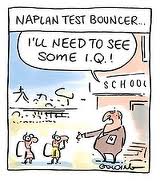
It sickens me to see the Government so smug about the upcoming round of National Testing.  In Australia it’s called the NAPLAN (I refer to it as “NAPALM”), and like other National tests around the world it compares student data against the average.  The Government uses the National tests as an easy way out of doing something constructive about Education.

Before I slam these pathetic tests, in the spirit of goodwill, I will acknowledge some advantages of National Testing:

  • It uses these tests as a vehicle for pressurising schools and teachers to lift their game and secure good results for their students.
  • It forces teachers not strictly following the curriculum to adhere to the syllabus
  • It gives parents some real data to consider, rather than the deliberately vague school reporting, which essentially tells parents nothing.
  • It gives parents an opportunity to become more involved in their child’s education.

Now for the disadvantages:

  • It forces teachers to stop what they are doing, and spend weeks if not months practicing for the test.  Everything gets put on hold while the sample test papers get wheeled out.
  • It fills students as young as 8 years-old with anxiety, pressure and insecurity.
  • It causes schools to “encourage” the parents of special needs students to keep their kids at home during the testing week.  This is to ensure that their child doesn’t affect the school’s results.  It also achieves in further marginalising these children who, in many cases, already feel disconnected from their peers.
  • It puts enormous stress on teachers.  This stress has an effect on their quality of teaching.
  • It turns education into an extreme negative at a time when kids still show an interest in learning.

I am currently teaching Grade 5 for the first time.  I am preparing my students for the rigours of NAPLAN (they sat for them 2 year ago).  It means that my emphasis has had to change.  Instead of teaching in an engaging and creative way, I’ve been forced to teach to the tests.  The result has been a succession of comparatively boring and turgid lessons on strategies for answering multiple choice questions, “debugging” sample tests and revising basic skills.  My students are not enjoying these lessons at all!  I fear that when they sit these tests they will sabotage the process by rushing through it as revenge for what its done to their enjoyment of school.

What makes these tests even worse is that they are testing the children at Grade 5 level even though they have just started Grade 5.  Because of that, my students haven’t covered some of the concepts being tested.  Surely, if they wanted to test a Grade 5 class against the Grade 5 benchmarks they should have done it at the end of the school year, not at the beginning!

When are Governments going to stop being so lazy and start taking on a fresh and innovative approach to learning?  Why must my students be subjected to sample tests and other turgid preparatorylessons, instead of conventional, authentic lessons?

Parents have the right to know how  their child is progressing.  At the same time though, their children deserve the right to have a pressure reduced primary education, where the teachers are able to harness their natural curiosities, instead of burden them with weeks of test prepa
ration!

Newsflash: Teachers Are Bullied Too!

March 28, 2011

I found this letter to the editor which captures the sentiment of many against teachers.  At the moment there is a clear backlash against teachers which is both irrational and highly unfair. Whilst certainly not perfect, most of us do our very best to help our students to thrive emotionally as well as academically, with little financial reward.  This letter is a good example of how a profession that was once respected and appreciated, is by many, no longer admired or highly thought of.

Now, teachers can empathize with bullied kids

The Bakersfield Californian | Saturday, Mar 26 2011 11:04 PM

Last Updated Saturday, Mar 26 2011 11:04 PM

Wow, how funny that the tables have turned and some Bakersfield City School District teachers are now afraid to go to work. Just think how some students were also afraid to go to school.

In the March 23 article “BCSD vows action on student discipline issues,” teachers said that students have “shoved, slapped and cursed” at them.

Isn’t it ironic that students have been feeling this for quite some time and nothing has been done about it? Teachers have left it up to school administrators to handle any unruly students, and all that the administrators have done, in some cases, is suspend both students, which results in the situation never being fixed and the punishment of the victim along with the bully.

So, to those teachers that have found themselves in this situation, I say welcome to the life of those students who are bullied every day while administrators do nothing or very little to correct the situation and also put blame on the victims for defending themselves. Teachers, welcome to the club!

DAVID A. FLORES

Bakersfield

To Mr. Flores, all I can say that he obviously knows nothing about our profession.   Teachers are the most bullied of all professionals.  They are subjected to bullying from a variety of sources; their superiors, parents, colleagues, students and as we see from New York, the Government regulators.

Whilst that does not excuse a lack of awareness of schoolyard bullying on the part of the teacher, it is offensive to get satisfaction when a person or group of people are victim to bullying.

This letter emphasises how important it is for us to restore our great profession to what it once was.  Many of us love our job.  We love contributing to the lives of our students.  We love helping them develop a sense of sense of self and watching them grow both literally and metaphorically.

Mr. Flores, I may be on the other side of the world, but you are welcome in my classroom any time.  You might gain an appreciation for how hard the job is and how important the welfare of our students is to us.

Valuable Advice for Bystanders of School Bullying

March 27, 2011

One of the underreported aspects of the Casey Heynes/Ritchard Gale bullying incident, was the role of the onlookers in inflaming the situation (or at least failing to intervene).  Not enough of the ensuing conversation focussed on the importance of intervening and diffusing a bullying situation.  Many media outlets omitted the fact that the child filming the incident was suspended, and few columnists even bothered to see it as an issue.

Whilst it is easy to blame bystanders of a bullying incident for their inaction, intervening in such a heated situation is quite a difficult assignment.  That’s why I was so thrilled to stumble on a wonderful article by Rosalind Wiseman, which detailes strategies that bystanders can employ:

Recently I’ve taken a hard look at the advice we give to kids who are being bullied and challenged all of us who work on this issue to do better. Now I want to question the common advice we give bystanders. This is critical for two reasons; we rarely admit the complex role bystanders play in bullying and I’ve never seen us publicly acknowledge that often the reason bystanders don’t come forward is because they don’t have confidence in the adults to do what’s right.

Being a bystander:

It’s not like any of us look forward to the opportunity of confronting a bully, as we saw in the recent Dateline special. Ironically, it can often be harder to confront a bully we’re close to than someone we don’t know or don’t like. And no matter how you feel about the bully or the target, it can be easy to stay silent because you don’t want the abuse directed at you.

But here are three inescapable facts:

  • Almost all of us will be in a situation at some point of our lives where we see someone bully someone else.
  • Bystanders often decide to get involved based on their feelings toward the bully and/or the target. If you like the bully then you are more likely to excuse the behavior. If you think the target is annoying, then you’ll more easily believe the target was asking for it. But a bystander’s decision to get involved should be based on the merits of the problem, not on their relationship to the people.
  • In that moment, we will have three choices. 1. Reinforce the abuse of power by supporting the bully; 2. Stay neutral — which looks like you’re either intimidated by the bully yourself or you support their actions; 3. Act in some way that confronts the bully’s abuse of power.

In the face of seeing someone bullied, here are some common reactions:

  • Deny it’s going on.
  • Distract yourself so it looks like you don’t know what’s going on. And if you don’t know then you have no obligation to do stop it.
  • Remove yourself from the situation.
  • Laugh to try to convince yourself that what’s going on isn’t serious.
  • Join in the bullying, because it’s safer to be on the side of the person with the most power.
  • Ignore it in the hope that it will go away.

What do you do if you are a bystander?

Even if you aren’t proud of how you handled the bullying when it occurred, it’s important to recognize how hard it is to know what to do in the moment. But that fact doesn’t mean it’s too late now to speak out. Especially if you are friends with the bully, reaching out to them is actually the ultimate sign of your friendship.

Supporting someone who’s been bullied.

Say, “I’m sorry that happened to you, do you want to tell me about it?”

Don’t tell them what they should have done or what you would have done. Listen and help them think through how to address the problem effectively. And if they ask you to back them up the next time it happens, ask them what that looks like to them. If it means upholding their right to be treated with dignity and not getting revenge on the bully, then do it.

Supporting someone who is being the bully.

In your own words say something like, “This is uncomfortable to talk about but yesterday when you sent that picture of Dave you know that really embarrassed him. And I know I laughed and I know he can be annoying but it’s still wrong. If you do it again I’m not going to back you up.”

Yes the bully is going to push back, make you uncomfortable, try to get you on their side but remember what happened and why you feel like the bully’s actions were wrong.

Why are bystanders so reluctant to come forward?

Let’s move away from the bystanders and focus on the adults. The prevailing explanation of why kids won’t come forward is because there’s a code of silence that forbids them. No one wants to be a snitch. While there’s some truth in that — I think just as powerful a reason for kids’ silence is because the adults haven’t created an environment where kids think reporting will make the problem better instead of worse. Yet, the most common advice we give to bystanders is to is tell an adult. Like it or not, the truth is it’s not good enough to tell kids to tell an adult.

Telling an adult won’t magically solve the problem. What far too many kids know and experience on a daily basis but we deny is that far too many adults are ill-equipped to respond effectively and often only cause the child to give up on adults entirely. Furthermore, the very way a lot of adults treat young people — in a condescending or dominant (i.e. “bullying”) manner — makes it impossible for children to have any confidence in our ability to be effective advocates.

While there are many effective counselors, even the suggestion to “talk to your counselor” may not be realistic. The child may have no idea who the counselor is — let alone a strong enough relationship with them to take this leap of faith. Recent budget cuts have led many school districts to cut back on their counselors or eliminate them completely. And it has always been the case that kids tend to form strong relationships with their teachers and coaches. It’s these people who bystanders will more likely tell what’s going on. Especially for a bystander that could easily think that since the bullying isn’t technically happening to them, reporting to a counselor is too extreme.

That’s why teachers need to know what to do. Instead of, “That person just needs to get a tougher skin”, “It can’t be that bad, can it?” they need to respond with “I’m really sorry this is happening. Thanks for telling me. I know it can be hard to come forward about things like this and I really respect the fact that you did. Let’s think about what we can do about it.”

Let’s be clear: beyond the peer pressure not to snitch and adolescent cynicism, adults matter. If our kids see us treat people with dignity, if we are outspoken about our respect for people who come forward, if we are honest with how scary reporting can be but assure them that we will be with them throughout the process, I guarantee our kids will find the courage to speak out.

Ms. Wiseman can be contacted through her Twitter account on: www.twitter.com/rosalindwiseman