Posts Tagged ‘Teachers’

Why Be Flexible When You Can Be Politically Correct?

April 5, 2011

There used to be a time when educators were self-directed.  They could decide how to teach, when to discipline and were given the opportunity to do their job according to their own unique style.

Not any more.

Everything is dictated and imposed, so little is left up to the educators.  There is such a lack of trust in the gut instincts and methodology of teachers and school communities, that Governments feel they must intervene.  What we are left with is political correctness gone mad!

Take this story for example:

CHILDCARE workers who send tantrum-throwing toddlers to “time out” risk hefty fines under national childcare laws to come into force next year.

New regulations will expose childcare centres to penalties if children are required to take part in religious or cultural activities, such as Christmas tree decoration or Easter egg hunts.

Childcare supervisors risk personal fines for the first time, under the national legislation being adopted by state and territory governments.

Centres could be fined as much as $50,000, and supervisors $10,000, for failing to ensure children are adequately supervised, or for using “inappropriate discipline” to keep order.

Centres will be banned from using …  “any discipline that is unreasonable in the circumstances”.

The Education and Care Services National Act, which has been passed by Victoria as the “host jurisdiction” and will be replicated by other states and territories, does not define “unreasonable” discipline.

But draft regulations with the legislation show childcare supervisors risk $2000 fines for “separating” children.

Supervisors must “ensure that a child being educated and cared for by the service is not separated from other children for any reason other than illness or an accident”, the regulations state.

Herein lies the problem.  Governments know precious little about education.  Here is just a few examples of how they’ve got it wrong:

  1. “Separating children” is often an essential method of conflict resolution and discipline.  If a child is threatening another child/children, they must be separated.  You can’t allow a child (regardless of age) who is in an irrational or heated frame of mind to be among other children. It is simply a safety imperative.
  2. Similarly, separation can be quite effective for teaching students that every action has a consequence.  When a child misbehaves and is forced to sit out of a game or activity for a period of time, it teaches the child that privileges come with responsible behaviour.
  3. To not define “unreasonable” discipline is just ridiculous.  How can you pass a law about something that isn’t even defined?  How can you have already thought up the fine before you have properly defined the offence?
  4. What is wrong with giving childcare centres the opportunity to decide for themselves whether or not to conduct Easter egg hunts?  They are not stupid.  If they have a large non-Christian demographic, there is no way they would ever consider such an activity.  But what if they were entirely Christian in make-up?  What if the parents were uniformly comfortable with their children taking part in Easter Egg Hunts?  No,  the Government says they will fine you  regardless.

Political correctness stifles those in the know from doing their job properly.  It stops teachers from injecting their own personal style and prevents innovators from providing our educational system with much-needed positive change.  It says that all childcare centres and schools must be run in the same way, with the same harsh and uncompromising rules without any thought given to the makeup or cultural uniqueness of the institution.

Political correctness is useless and counter productive.  Instead of these harsh and illogical rules, teachers and childcare workers need to be encouraged to be flexible, sensible and sensitive to the welfare of their students and their families.

Asperger’s Teacher Must Be Penalised for His Comments

April 1, 2011

I don’t know enough about Asperger’s Syndrome to be considered an expert on the condition.  Regardless, I am sure of this – a teacher who has a reputation for saying demeaning and insulting things to his/her students with some level of frequency needs to find another profession whether they have Asperger’s Syndrome or not.

I am a deep critic of the general lack of understanding and support given to students with autism and other related conditions, so I want to make it clear that I am not insensitive to the difficulties that such a condition poses on a person’s social skills.

Having said that, it is my belief that Robert Wollkind, if indeed it is proven that he did do what is alleged, needs to be fired for his behaviour:

A Connecticut high school teacher faces the loss of his job after asking a student, who is overweight, if he had eaten his homework. According to the Hartford Courant, officials in the Brookfield school district want to fire Robert Wollkind who, they say, has made a ‘string of inappropriate remarks over his 32-year career.’ Wollkind, a math teacher at Brookfield High School, was diagnosed in 2002 with Asperger’s Syndrome, an autism spectrum disorder in which individuals have normal or above intelligence but struggle with social, communicative and sensory skills. Wollkind has been on administrative leave since the November 2010 incident.

Lawyers representing the school district says that Wollkind has ‘used abusive language to others, including telling one student that he hated him.’ According to the News-Times:

The student, identified as “Student 21,” had been previously teased by peers about his weight, said the school district’s attorney Patrick McHale.

Wollkind’s personnel file also contains reported incidents of him screaming at a student, grabbing a student, and using “abusive and foul language” with students.

Wollkind counters that ‘many of those incidents have been described inaccurately.’

The fact that more than 1,000 Brookfield parents and students have signed a petition supporting him suggests he has some fine qualities as a teacher and that the parents of Brookfield are very understanding.

My issue is with his behaviour.  Teachers have an important role to fulfill that goes beyond the teaching of skills and knowledge.  They are there to build up the confidence of their students, empower them to take responsible risks and help them to realise their full potential.

Comments that hurt and strike at a child’s self-esteem do not belong in a teacher’s repertoire.  It hurts enough in the schoolyard by peers, but to get teased by your teacher is simply not acceptable and potentially destructive to the child.

Whilst I can understand that Mr. Wollkind’s jibe’s were a product of Asperger’s Syndrome, and I am deeply sympathetic to it’s likely influence over his actions, I am not sure I would want him teaching my child.


Skype in the Classroom

April 1, 2011

I haven’t really used Skype in the classroom before.  It’s something I’ve wanted to do for ages.  I stumbled along this article today that has made me want to introduce Skype to my class even more!

The Skype video chat service has long been used by teachers to connect students with the world outside their reach, from guest speakers to partner classrooms located around the globe. And with today’s launch of “Skype in the classroom,” providing that service has become an official goal of the company, and teachers can now more easily get help and advice from other educators to expand their students’ worldview.

According the the company’s press release, “in the classroom” is “a place for teachers to connect with each other, find partner classes and share inspiration.” It allows teachers to create their own profiles, through which they can describe their classes and their teaching goals. This feature also enables teachers to discuss practices with other educators, and to learn techniques they might not otherwise have access to.

Another feature of “in the classroom” is projects. Teachers can create projects, which are posted on the Skype website. These projects are viewable to any of the other teacher who use the “in the classroom” service. Teachers from anywhere in the world can collaborate on these projects with other teachers, and learn from those who have tried similar projects.

The last primary aspect of “Skype in the classroom” is its resources section. According to Skype, its resources list is stacked with “videos, links and tips” for teachers. Teachers can add additional resources in order to “create a huge, sharable library of teaching ideas.”

Have you used Skype in your classrooms?  What was the experience like?  How can it be best used for maximum educational effect?

Teaching to The Blasted Test!

March 29, 2011


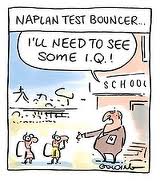
It sickens me to see the Government so smug about the upcoming round of National Testing.  In Australia it’s called the NAPLAN (I refer to it as “NAPALM”), and like other National tests around the world it compares student data against the average.  The Government uses the National tests as an easy way out of doing something constructive about Education.

Before I slam these pathetic tests, in the spirit of goodwill, I will acknowledge some advantages of National Testing:

  • It uses these tests as a vehicle for pressurising schools and teachers to lift their game and secure good results for their students.
  • It forces teachers not strictly following the curriculum to adhere to the syllabus
  • It gives parents some real data to consider, rather than the deliberately vague school reporting, which essentially tells parents nothing.
  • It gives parents an opportunity to become more involved in their child’s education.

Now for the disadvantages:

  • It forces teachers to stop what they are doing, and spend weeks if not months practicing for the test.  Everything gets put on hold while the sample test papers get wheeled out.
  • It fills students as young as 8 years-old with anxiety, pressure and insecurity.
  • It causes schools to “encourage” the parents of special needs students to keep their kids at home during the testing week.  This is to ensure that their child doesn’t affect the school’s results.  It also achieves in further marginalising these children who, in many cases, already feel disconnected from their peers.
  • It puts enormous stress on teachers.  This stress has an effect on their quality of teaching.
  • It turns education into an extreme negative at a time when kids still show an interest in learning.

I am currently teaching Grade 5 for the first time.  I am preparing my students for the rigours of NAPLAN (they sat for them 2 year ago).  It means that my emphasis has had to change.  Instead of teaching in an engaging and creative way, I’ve been forced to teach to the tests.  The result has been a succession of comparatively boring and turgid lessons on strategies for answering multiple choice questions, “debugging” sample tests and revising basic skills.  My students are not enjoying these lessons at all!  I fear that when they sit these tests they will sabotage the process by rushing through it as revenge for what its done to their enjoyment of school.

What makes these tests even worse is that they are testing the children at Grade 5 level even though they have just started Grade 5.  Because of that, my students haven’t covered some of the concepts being tested.  Surely, if they wanted to test a Grade 5 class against the Grade 5 benchmarks they should have done it at the end of the school year, not at the beginning!

When are Governments going to stop being so lazy and start taking on a fresh and innovative approach to learning?  Why must my students be subjected to sample tests and other turgid preparatorylessons, instead of conventional, authentic lessons?

Parents have the right to know how  their child is progressing.  At the same time though, their children deserve the right to have a pressure reduced primary education, where the teachers are able to harness their natural curiosities, instead of burden them with weeks of test prepa
ration!

Newsflash: Teachers Are Bullied Too!

March 28, 2011

I found this letter to the editor which captures the sentiment of many against teachers.  At the moment there is a clear backlash against teachers which is both irrational and highly unfair. Whilst certainly not perfect, most of us do our very best to help our students to thrive emotionally as well as academically, with little financial reward.  This letter is a good example of how a profession that was once respected and appreciated, is by many, no longer admired or highly thought of.

Now, teachers can empathize with bullied kids

The Bakersfield Californian | Saturday, Mar 26 2011 11:04 PM

Last Updated Saturday, Mar 26 2011 11:04 PM

Wow, how funny that the tables have turned and some Bakersfield City School District teachers are now afraid to go to work. Just think how some students were also afraid to go to school.

In the March 23 article “BCSD vows action on student discipline issues,” teachers said that students have “shoved, slapped and cursed” at them.

Isn’t it ironic that students have been feeling this for quite some time and nothing has been done about it? Teachers have left it up to school administrators to handle any unruly students, and all that the administrators have done, in some cases, is suspend both students, which results in the situation never being fixed and the punishment of the victim along with the bully.

So, to those teachers that have found themselves in this situation, I say welcome to the life of those students who are bullied every day while administrators do nothing or very little to correct the situation and also put blame on the victims for defending themselves. Teachers, welcome to the club!

DAVID A. FLORES

Bakersfield

To Mr. Flores, all I can say that he obviously knows nothing about our profession.   Teachers are the most bullied of all professionals.  They are subjected to bullying from a variety of sources; their superiors, parents, colleagues, students and as we see from New York, the Government regulators.

Whilst that does not excuse a lack of awareness of schoolyard bullying on the part of the teacher, it is offensive to get satisfaction when a person or group of people are victim to bullying.

This letter emphasises how important it is for us to restore our great profession to what it once was.  Many of us love our job.  We love contributing to the lives of our students.  We love helping them develop a sense of sense of self and watching them grow both literally and metaphorically.

Mr. Flores, I may be on the other side of the world, but you are welcome in my classroom any time.  You might gain an appreciation for how hard the job is and how important the welfare of our students is to us.

50 Books Every Child Should Read

March 24, 2011

I stumbled on a wonderful piece by the Independent entitled The 50 Books Every Child Should Read. It was written in response to Michael Gove’s recommendation that children read 50 books a year.  They asked three of Britain’s leading children’s authors and two of their in-house book experts to each pick 10 books, suitable for Year 7 students.”

Below is the list:

Philip Pullman

* Alice’s Adventures in Wonderland and Through the Looking Glass by Lewis Carroll. Indispensable. The great classic beginning of English children’s literature.

* Pinocchio by Carlo Collodi. What effortless invention looks like.

* Emil and the Detectives by Erich Kastner. A great political story: democracy in action.

* Swallows and Amazons by Arthur Ransome. As clear and pure as Mozart.

* Black Hearts in Battersea by Joan Aiken. If Ransome was Mozart, Aiken was Rossini. Unforced effervescence.

* The Owl Service by Alan Garner. Showed how children’s literature could sound dark and troubling chords.

* The Phantom Tollbooth by Norton Juster. Superb wit and vigorous invention.

* Moominsummer Madness by Tove Jansson. Any of the Moomin books would supply the same strange light Nordic magic.

* A Hundred Million Francs by Paul Berna. A particular favourite of mine, as much for Richard Kennedy’s delicate illustrations (in the English edition) as for the story.

* The Castafiore Emerald by Hergé. Three generations of this family have loved Tintin. Perfect timing, perfect narrative tact and command, blissfully funny.

Michael Morpurgo

* The Star of Kazan by Eva Ibbotson.

The heroine is blessed with such wonderful friends who help her through the twists and turns of this incredible journey.

* A Christmas Carol by Charles Dickens. The first few pages were so engaging, Marley’s ghostly face on the knocker of Scrooge’s door still gives me the shivers.

* Just William books by Richmal Crompton. These are a must for every child.

* The Happy Prince by Oscar Wilde. This was the first story, I think, that ever made me cry and it still has the power to make me cry.

* The Elephant’s Child From The Just So Stories by Rudyard Kipling. The story my mother used to read me most often, because I asked for it again and again. I loved the sheer fun of it, the music and the rhythm of the words. It was subversive too. Still my favourite story.

* Treasure Island by R.L. Stevenson This was the first real book I read for myself. I lived this book as I read it.

* The Old Man and the Sea by Ernest Hemingway. A classic tale of man versus nature. I wish I’d written this.

* The Man Who Planted Trees by Jean Giono. A book for children from 8 to 80. I love the humanity of this story and how one man’s efforts can change the future for so many.

* The Singing Tree by Kate Seredy The story of two children who go to find their father who has been listed missing in the trenches of the First World War.

* The Secret Garden by Frances Hodgson-Burnett. I love this story of a girl’s life being changed by nature.

Katy Guest, literary editor for The Independent on Sunday

* Refugee Boy by Benjamin Zephaniah. Story of a young Ethiopian boy, whose parents abandon him in London to save his life.

* Finn Family Moomintroll (and the other Moomin books) by Tove Jansson.

A fantasy series for small children that introduces bigger ones to ideas of adventure, dealing with fear, understanding character and tolerating difference.

* Diary of a Wimpy Kid by Jeff Kinney. It’s rude, it’s funny and it will chime with every 11-year-old who’s ever started a new school.

* I Capture the Castle by Dodie Smith. Written for a teenage audience but fun at any age.

* The Hobbit and The Lord of the Rings by JRR Tolkein. Be warned, these tales of hobbits, elves and Middle Earth are dangerously addictive.

* The Tygrine Cat (and The Tygrine Cat on the Run) by Inbali Iserles. If your parents keep going on at you to read Tarka the Otter, The Sheep-Pig and other animal fantasies, do – they’re great books – also try Iserles’ stories about a cat seeking his destiny.

* Carry On, Jeeves by PG Wodehouse. A grown-up book – but not that grown-up.

* When Hitler Stole Pink Rabbit by Judith Kerr. Judith Kerr’s semi-autobiographical story of a family fleeing the Nazis in 1933.

* Moving Pictures by Terry Pratchett. Elaborate mythological imagery and a background based in real science. If you like this, the Discworld series offers plenty more.

* The Story of Tracy Beaker by Jacqueline Wilson. The pinnacle of the wonderful Jacqueline Wilson’s brilliant and enormous output.

John Walsh, author and Independent columnist

* The Adventures of Sherlock Holmes by Sir Arthur Conan Doyle. Irresistible puzzle-solving tales of the chilly Victorian master-sleuth and his dim medical sidekick.

* The Curious Incident of the Dog in the Night-Time by Mark Haddon. Age-transcending tale, both funny and sad.

* Mistress Masham’s Repose by TH White. Magical story of 10-year-old Maria, living in a derelict stately home, shy, lonely and under threat from both her governess and her rascally guardian.

* Little Women by Louisa May Alcott. Inexplicably evergreen, trend and taste-defying 1868 classic.

* How to be Topp by Geoffrey Willams and Ronald Searle. Side-splitting satire on skool, oiks, teechers, fules, bulies, swots.

* Stormbreaker by Anthony Horowitz. First of the action-packed adventures with 14-year-old Alex Rider.

* Private Peaceful by Michael Morpurgo. “Dulce et Decorum Est” for pre-teens.

* Artemis Fowl by Eoin Colfer. Lively, amoral, wildly imaginative debut (six more followed) about the money-grabbing master-criminal Artemis, 12. The author called it “Die Hard with fairies”.

* The Silver Sword by Ian Serraillier. Inspiring wartime story of the Balicki family in Warsaw.

* Animal Farm by George Orwell. Smart 11-year-olds won’t need any pre-knowledge of Marx, Lenin, Trotsky and 1917 to appreciate this brilliantly-told fable.

Michael Rosen

* Skellig by David Almond. Brings magical realism to working-class North-east England.

* Red Cherry Red by Jackie Kay. A book of poems that reaches deep into our hidden thoughts but also talks in a joyous voice exploring the everyday.

* Talkin Turkeys by Benjamin Zephaniah. A book of poems that demands to be read aloud, performed and thought about.

* Greek myths by Geraldine McCaughrean. Superheroes battle with demons, gods intervene in our pleasures and fears – a bit like the spectres in our minds going through daily life, really – beautifully retold here.

* People Might Hear You by Robin Klein. A profound, suspenseful story about sects, freedom and the rights of all young people – especially girls.

* Noughts and Crosses by Malory Blackman. A book that dared to go where no one thought you could with young audiences because it raises tough stuff to do with race.

* Einstein’s Underpants and How They Saved the World by Anthony McGowan. A crazy adventure set amongst the kids you don’t want to know but who this book makes you really, really care about.

* After the First Death by Robert Cormier. Cormier is never afraid of handling how the personal meets the political all within the framework of a thriller.

* The London Eye Mystery by Siobhan Dowd. A book that allows difference to be part of the plot and not a point in itself.

* Beano Annual. A cornucopia of nutty, bad, silly ideas, tricks, situations and plots.

Top Ten Lists are fun.  What books would you recommend for a Year 7 child?

Helping Our Children Make Sense of Natural Disasters

March 16, 2011

Below is an article from Michael Grose’s Insight on how we can help our children cope with Natural disasters. After last week’s catastrophe in Japan, the earthquake in Christchurch and the floods in Australia, I thought it was timely to make educators aware of it.

Help your children make sense of natural disasters

By Michael Grose

The Queensland floods and the Victorian bushfires continue to wreak incredible havoc on so many people’s lives and will no doubt leave an indelible imprint on our collective psyches. These two natural disasters will be brought into our living rooms via the media over the coming days and weeks.

As adults we all want our children to live carefree lives and keep them from the pain and even horror of tragedies such as natural disasters. In reality we can’t do this.

So what is a parent, teacher, or other caring adult to do when the natural disasters fills the airwaves and the consciousness of society? Here are some ideas:

  1. Reassure children that they are safe. The consistency of the images can be frightening for young children who don’t understand the notion of distance and have difficulty distinguishing between reality and fiction. Let them know that while this event is indeed happening it will not affect them directly.
  2. Be available and ‘askable’. Let kids know that it is okay to talk about the unpleasant events. Listen to what they think and feel. By listening, you can find out if they have misunderstandings, and you can learn more about the support that they need. You do not need to explain more than they are ready to hear, but be willing to answer their questions.
  3. Help children process what they see and hear, particularly through television. Children are good observers but can be poor interpreters of events that are out of their level of understanding. Sit with them. Ask them questions to ascertain their understanding.
  4. Support children’s concerns for others. They may have genuine concerns for the suffering that will occur and they may need an outlet for those concerns. It is heart-warming to see this empathy in children for the concerns of others.
  5. Let them explore feelings beyond fear. Many children may feel sad or even angry with these events so let them express the full range of emotions. They may feel sadder for the loss of wildlife, than for loss of human life, which is impersonal for them.
  6. Help children and young people find a legitimate course of action if they wish. Action is a great antidote to stress and anxiety so finding simple ways to help, including donating some pocket money can assist kids to cope and teaches them to contribute.
  7. Avoid keeping the television on all the time. The visual nature of the media means that images are repeated over and over, which can be both distressing to some and desensitizing to others.
  8. Be aware of your own actions. Children will take their cues from you and if they see you focusing on it in an unhealthy way then they will focus on it too. Let them know that it is happening but it should not dominate their lives.
  9. Take action yourself. Children who know their parents, teachers, or other significant caregivers are working to make a difference feel hope. They feel safer and more positive about the future. So do something. It will make you feel more hopeful, too. And hope is one of the most valuable gifts we can give children and ourselves.

Children’s worlds can be affected in ways that we can’t even conceive of so adults need to be both sensitive to children’s needs and mindful of what they say and how they act in front of children.

In difficult times, it is worth remembering what adults and children need most are each other.

Teaching 150 Students in the One Classroom!

March 11, 2011

pupils

Pupils in an overcrowded classroom at Quarry Heights primary school interact with their teacher.


This story may well stop me from complaining ever again about class size.  I have always been of the opinion that the optimal class size is somewhere between 15 and 25.  Anything less than 15 provides the students with a lack of social opportunities, whilst anything more than 25 prevents the teacher from having sufficient 1-on-1 time with struggling and advanced students.

To think that classrooms exist with up to 150 students is just staggering!

One hundred and fifty Grade 1 pupils crammed into one classroom is the reality of Quarry Heights Primary School near Newlands East in Durban.

The 14 staff members battle to teach the pupils, virtually packed on top of each other, some of whom pass out because of heat exhaustion.

The school – which is made up of seven prefabricated buildings – caters for children mostly from disadvantaged backgrounds. It has only two taps for the 564 pupils, with no electricity, books or stationery.

The school’s governing body secretary and spokesman, Thami Nzama, said that the school lacked basic necessities and received little funding as it was a “no-fee school”, meaning that pupils did not pay school fees.

“The school was built for the poorer people of the community. We have a staff of 14. The Grade 2 class has 78 pupils; the Grade 3, 57; Grade 4, 70 pupils, and we have a joint class of grade six and sevens with 140 children.

“The other pupils are in Grade R. We have one building for a security guard who stays on the property and another that we use as a kitchen, but it does not have running water,” Nzama said.

He added that the staff did not have a staff room in which to meet and organise their work .

“Our staff room will be anywhere we find shade during the day, whether it be under a tree or prefab veranda.”

pupils 1

Teachers at Quarry Heights primary school marking exam scripts outside because they don’t have a staff room.


I can’t imagine teaching 150 six-year olds all day in the one classroom without even having a private staff room to retire to at lunch time.  I love teaching very much, but those conditions would push my level of job satisfaction to the limit. The amazing part of this story is that the teachers involved are loving the experience.

Credit goes out to the dedicated teachers who work in such an environment.  You are a credit to your profession, students and community.  May you continue to inspire us fellow teachers, to make every post a winner and overcome all challenges with a quiet resolve and an ever present smile.

Teacher’s Union Stuck on Viagra

March 10, 2011

I can see a sharp witted comedy writer pitching  a mockumentary to the studios about the inner workings of a teacher’s union.  While teachers are being layed off in their thousands, these unions defy logic with their soft approach and crazy fixations.  Never have they been so needed.  Never have they been so utterly useless.

Take what just happened in Milwaukee for example:

The Milwaukee teacher’s union has dropped its lawsuit to give male teachers access to free Viagra.

The union sued the Milwaukee district school board in 2010, with the aim of forcing them to include erectile dysfunction drugs on their free health insurance plan.

The union argued that, by excluding erectile dysfunction medications from this document, the board was discriminating against male employees.

However, union members were accused of having the wrong priorities, at a time when many teachers in the region were losing their jobs due to school cuts.

At the time the State Representative Jason Fields said: “You’ve got to be kidding me.”

The Milwaukee Democrat added: “The fact that is the point of contention is kind of frightening. What are our priorities? I’m all for love and peace. But almost 1 million dollars? [the estimate cost of adding Viagra to the bill] And you go to court over this issue?”

Lawyers for the school board also said that Viagra is mainly used for recreational sex and not to treat any long standing medical condition.

On the other hand, the counter argument went that erectile dysfunction is a genuine and widely recognised medical condition that affects millions of men, particularly older men. It was also argued by the union that male teachers suffering from the condition deserved access to Viagra, Levitra and Cialis. Impotence is associated with serious health problems such as atherosclerosis, high blood pressure and heart disease, and union members argued that ignoring the condition was therefore inappropriate.

This is an indictment on good, hard-working teachers on low saleries that pay big bucks every year to be part of what is arguably the most soft, useless union known to man.  To take a school board to court over Viagra when their members risk losing their jobs is insensitive, out of touch and just plain dumb.

Excuse the pun, but the teacher’s union has to harden up or refund their memberships!

Why Our Young Teachers Leave

March 7, 2011

This is a topic I feel very strongly about and it goes to the heart of the future of our educational system.  Our system is not being fair to our young teachers.  The way they are trained and geared towards teaching is horrendous.  The lack of support they receive upon commencing their first job is even worse.  If the Government really cared about teacher shortages and low retention rates they would do something about it.  But the truth is that they are too clueless to think up a decent policy and too inert to care.

As schools grapple with Australia’s teacher shortage, the race to lure more people into the profession has begun. Governments are scrambling to offer scholarships and other incentives to get more students, mature-age graduates and workers in other professions to consider a career in the classroom. The strategy seems to be working, with education authorities reporting a rise in teacher graduate numbers.

In Victoria, more than 4200 people graduated as teachers last year, an extra 400 compared with the previous year. But what if the focus on stimulating teacher supply is the policy version of pouring water into a bucket riddled with holes?

A team of education researchers who have spent the past nine years interviewing teachers think this is the case. They argue that chronic teacher shortages won’t be solved as long as governments keep failing to confront the reasons why large numbers of teachers desert their jobs early.

“Poor pay is not the reason they’re giving for leaving the profession: it’s the workplace issues of highly stressful, poor working conditions,” says Dr Paul Richardson, who has been working with Monash University colleague Dr Helen Watt since 2002 on Australia’s first longitudinal study tracking the experiences of 1650 teachers from the time they started a university education course through their years in the profession. Twenty-seven per cent of those surveyed planned to quit teaching within their first five years of teaching. Dr Richardson says the finding has big implications for governments trying to entice other professionals to switch to teaching. Many of the teacher recruits planning to quit were people who had experience in other professions.

“These were people who had been in business commenting on conditions in their schools by saying, ‘There’s no support, you can’t get any photocopying done, you’ve got to do it all yourself!’

“One guy said: ‘I’ve been a solicitor and now I’ve got a one-metre desk in a staffroom where you can’t think.’ They were totally shocked by the working conditions and the lack of administrative support.”

Between 25 and 40 per cent of teachers leave the profession within five years of starting, according to estimates in numerous surveys by teacher unions and education academics. An accurate national figure is not publicly available because exit statistics are kept and collated differently by individual education authorities in each state and territory.

Of course teachers aren’t leaving because of the pay.  Our future teachers know that the pay isn’t great, and still sign up to join the profession.  Why?  Because they have a devotion to education, to helping our next generations achieve, to making a difference.  But what they don’t bank on is the lack of sufficient training and support they will get along the way.

I went to one of the elite Australian universities, with a highly distinguished Education faculty.  Only problem is, my university, like so many around the world failed to give me the practical insights and methods necessary for doing my job properly.  They were brilliant at filling us up with the theoretical, terrible at preparing us for the day-today issues that face classroom teachers.  Accountants are prepared for their job straight out of Uni, as are doctors, lawyers and architects.  Why can’t teachers go into their profession with the same amount of confidence and practical nous?  And it’s not just the best universities in Australia.  This applies to abroad as well.

As a first year teacher I was on a one-year contract. I had to show competency straight away or risk losing my job and reputation even before my actual degree arrived in the mail.  I couldn’t ask my colleagues too many questions, for I didn’t want to lose confidence in the people who would help decide whether or not I should be retained at the end of the year.

Teaching is a wonderful profession.  And I’m glad that I had the determination and passion to stick through the uncertain times and develop the skills on my own.  But that isn’t going to cut it for all young teachers.  They deserve better practical training and a true support system that watches over them – not to judge them, but to honestly help them.  Teachers wont leave like they are if they feel adequately supported and nurtured.

Governments are dumb when they respond to the problem by making more places for teaching training at University.  The more places they make available, the more teachers scurry away before making any lasting impact in the profession.  Why should anyone be surprised?  How can you sell the profession to our youth, when in reality they face such an uphill battle for acceptance, confidence and job security?

Wouldn’t it be worth investing in support systems and greater practical experience for our young teachers?  Nurture them, assist them, give them the tools and then watch them thrive.