Posts Tagged ‘Teachers’
March 28, 2012

Whilst I can obviously see the value of teaching spelling skills, I don’t think it is anywhere near as important as schools make out.
The emphasis that spelling gets when it comes to teaching allotments, testing and reporting is astounding. Surely there are more vital skills such as maths, writing and reading that can profit from taking some of the ‘treasured’ spelling time.
Many skills now have specialised spelling programs complete with up to 5 weekly periods per class from the Second Grade upwards. Talk about overkill! My daughter recently brought home a form requesting our written consent to take her out of her classes in order to strengthen her spelling skills. What makes this request even more bizarre is that she is only in the first grade! I can understand taking her out for maths or English, but spelling?
What upsets me most about the obsession with children and spelling is what it does to our students. Our children know whether they are good spellers or not. They have been tested countless times and their work is often given a ‘dose of red’ where every misspelled word corrected. What then tends to happen, is that students become self-conscious about their spelling capabilities and try to avoid the dreaded red ink corrections. Instead of using the most appropriate word for their written work, they choose words they know how to spell. This has a severe negative impact on the quality of their writing.
I am a big fan of minimising the emphasis of spelling. I want my students to write freely, to choose words that best fits their work and have a fearless approach to spelling difficult words. To me, a free and unhampered piece of writing replete with spelling errors far outweighs a dreary, disjointed piece of work with correct spelling.
I’m not against the teaching of spelling and I certainly believe that spelling rules and the understanding of morphographs have a place in the classroom. I just don’t think these skills are anywhere near as important as many would have you believe.
Tags:Confidence, Education, First Grade, life, Programmes, Self-Esteem, Spelling, Teach, Teachers, Teaching, Writing
Posted in Education Matters | 10 Comments »
March 22, 2012

I’ve inherited a class that does not have a whiteboard. Well actually it does, but it is covered up by a Smart Board. It seems that my school was so excited to install brand new Smart Boards (interactive whiteboards) that they set it up directly on the existing board. They were so keen to set up the Smart Boards it didn’t even occur to them to take down the whiteboards first!
As much as I love my Smart Board, I find it much easier to write and present maths problems on a traditional whiteboard.
So I got my school to order one for me. Last December ….
And it only arrived today!
Meanwhile, my Smart Board died two weeks ago. The projector just decided it couldn’t facilitate any longer (I hope it didn’t have anything to do with my ghastly interactive whiteboard handwriting). A teacher without a whiteboard is like a carpenter without a drill. It is a huge challenge to teach without a board. A challenge that has proved frustrating and in a sense, quite revealing.
It has taught me that no matter how incredible modern technology has become. No matter how much education has been transformed because of touch screens, blogs, the internet, YouTube, Wikipedia etc. Nothing can replace the simple whiteboard!
Tags:Blogs, Education, interactive whiteboards, Internet, Smart Board, Teachers, Teaching, technology, Technology in the Classroom, touch screen, whiteboard, Wikipedia, YouTube
Posted in Technology, Technology in the Classroom | 4 Comments »
March 20, 2012

Another year, another impending strike. I know I am a lone voice on this one, but I find the notion of teachers striking very distasteful and selfish. The job of a teacher is to support and nurture their students. When a teacher decides not to front up to work, they are robbing children of a day of school.
I have never met a teacher that went into the caper for the money. It is a well-known fact that teachers don’t get paid vast sums of money. Partly, this is due to tradition and partly it is due to the fact that Governments simply cannot afford to offer large pay increases across the board.
Am I suggesting that teachers should not be paid more? Absolutely not. I think I work hard enough to justify an increase of salary (currently 3% less than a public school teacher). There is enough wasted money spent on education, I think it would be quite appropriate for some of that misspent money to be allocated to teachers.
What I don’t agree with is the argument that teachers should be given a marked increase. If that was to happen before I started my teacher training, I never would have become a teacher. A large wage increase would have led to a greater popularity in teacher enrolments. The flow on from this would have been that to get into a teaching course, the tertiary rank (based on Year 12 results) would have been much harder. I simply would not have had the grades to get a place.
Some would see that as a positive. Teachers should, according to many, posses outstanding academic credentials. After all, the smarter the teacher, the better the teacher, right?
Not necessarily. I was a late bloomer. I struggled throughout school. My teachers found me very frustrating. No matter how much I applied myself, simply passing was a huge challenge for me. And yet, it is this struggle that has made me become a decent teacher. It has provided me with patience and it allows me to understand the struggles of students with learning difficulties and confidence issues. I try to be the very teacher I felt I needed, but never had.
Whilst I believe that teachers do a wonderful job and they deserve to be paid accordingly, I would like to reach that point without strikes and without Education Unions (they shouldn’t be allowed to be called the Education Union – they aren’t representing what is best for education). I would like potential teachers to join this wonderful profession more for the passion and dedication they have for the job than the money.
I expect that I will be critcised roundly for my stance. I look forward to reading your take on this.
Tags:AEU State Counci, Education, Education Union, Government Funding, Industrial Relations, Mary Bluett, Parenting, Striking, Teacher Training, Teachers, Teachers Salary, Teaching
Posted in Education Union, Government Funding, Teacher Training, Teachers Salary | 4 Comments »
March 2, 2012
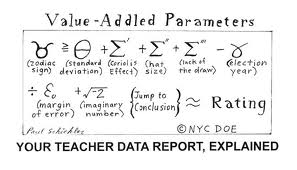 Parent Martha Foote has submitted a brilliant piece to the New York Times. In a resounding defense of teachers she called for the end of teacher data reporting:
“TDRs are a four-letter word!” That was my son’s favorite slogan when the parents and teachers at his school, Public School 321 in Park Slope, held a rally in the fall of 2010 to protest the imminent release of the teacher data reports. We were not alone. Sister rallies were held the same day at Brooklyn’s Public School 24, Public School 29, Middle School 51, Public School 154, and the John Jay Campus Community, and more than 5,000 letters of protest were signed across all five boroughs condemning the public humiliation of teachers as well as the release of what we believed were inaccurate scores. Sadly, though, after months of legal appeals, the teacher data reports were finally made public last week. And what have we learned?
So what do we do now? How do we move forward? To begin, I believe we must stop these attacks on our teachers. It is no way to treat one another (did we learn nothing in kindergarten?), and it is no way to improve education. We must turn away from this punitive blame game and instead work in a collaborative endeavor for the greater good. Look to the models. Look to Finland, where teachers are respected and trusted, and continual professional development is paramount. Look to Montgomery County, Md., where a successful system of teacher evaluation consists of mentoring struggling teachers combined with a panel of teachers and principals to decide if a teacher must be fired. (I only hope that New York State’s new system of teacher evaluation does not preclude the use of such successful strategies.) And stop relying on a score from a single high-stakes test to trump all the other 180 days in the classroom.
As for parents, of course we want our children to have excellent teachers. But as we have learned, these rankings tell us nothing. It is time to rely on our own observations, both direct and indirect, to gauge our children’s learning experiences in the classroom. Look at the types of assignments our children receive, the kinds of books they bring home to read, the quality of feedback they receive on their written work. It is this type of information that will tell us whether our child has a great teacher – and whether we need to be advocating for changes in the classroom.
If only the media and politicians thought the same way.
Tags:Education, FDR's, Finlans, life, Martha Foote, News, Parenting, Public School 321, Teachers, Teachers Stress, Teaching
Posted in Teachers Stress | Leave a Comment »
March 1, 2012

It is my belief that the job of a parent is to parent and the job of the teacher is to teach. Sure it’s wonderful when parents take it upon themselves to help reinforce skills taught in class. I am always appreciative of parents that spare some time to revise concepts covered during the school day. But essentially, I am paid to ensure that the parents can spend textbook-free quality time with their children. This is in my view essential to maximising the relationship of child and parent. Children often show a reluctance to work through school material with their parents and parents often get very anxious when trying to get their children to concentrate and listen to their explanations.
It is my job to see it that parents are free to spend time with their children without having to go through the ordeal of maths and science work. That’s what they pay me for.
But unfortunately, it seems that we are not doing a good enough job. It seems as if parents have often been given little choice but to try to fill in the gaps we have left behind. You hear too many stories of parents frantically trying to complete their own childs’ homework, sometimes struggling to work out the answers themselves:
A quarter of parents in Reading admit that helping their children with homework leads to family arguments, according to a survey.
Research by tuition provider Explore Learning also showed 9.2 per cent rarely helped their children with homework with more than two thirds struggling when they did.
Maths confuses parents the most with 41.2 per cent of parents finding the subject hard to grasp compared to the 11.1 per cent of parents who find English difficult.
Nationally, nearly a third of parents admitted homework had caused friction in the family with Reading not straying far from the average when it came to struggling in maths and English.
It’s time we let parents bond with their children instead of getting them to do our dirty work. Homework, if administered at all, should be revision of concepts covered in the class. If the children are not capable of doing it independently it shouldn’t have been given to them in the first place.

Tags:Children, Education, English, Explore Learning, Family, Homework, kids, Learning, maths, Parenting, Parents, Science, Survey, Teacher, Teachers
Posted in Homework, Parenting | 1 Comment »
February 26, 2012

As inconvenient as it is for a parent to pick their child up early from school, there are times when it is necessary to do so. Yes, there is a stigma with lice than can potentially embarrass both child and parent. There is no doubt about that. But schools that are sensitive to the needs of their students will make the necessary arrangements in a discreet and private fashion.
The political correct police obviously don’t trust schools to deal with internal issues themselves. Like in other instances, they like to overrule and impose themselves:
VICTORIAN schools have been accused of discriminating against students with head lice by sending them home from school when their nits are detected, the Herald Sun can reveal.
Federal and state guidelines say schools must not send children home if they have head lice, but merely send a notice home at the end of the day telling parents to treat their child’s hair that night.
Guidelines also say teachers should “exercise sensitivity” towards children with nits for fear of upsetting them.
But schools, preschools and childcare centres across the state are flouting these policies by immediately asking parents to collect their children. Children are often isolated from classmates until they are picked up.
One Melbourne primary school has been asked to change its approach after a complaint from a parent. In a letter to the principal, obtained by the Herald Sun, the parent said any child with head lice should not be “singled out, sent home and denied valuable education, only to return the following day to be reinfested”.
The parent, who did not want to be identified, said it was “discrimination to pick out one child and send them home when they might be in a whole class of kids with nits.”
Whenever Government regulation overrules schools you know it will end up bringing undesirable results. Lice spreads so quickly and the children suffering with lice are uncomfortable and unable to concentrate. I will continue pressing my school for the right to send children home with lice. That doesn’t mean that I am unaware that children with lice often feel humiliated and ostracised. What it does mean, is that I will handle the matter in such a way as the child receives my care and support and the rest of the class is never made aware of the child’s condition.
Tags:Australian Education Union, Education, Government Regulations, Hit Nitz For 6, lice, Mary Bluett, Michelle Olden, Nits, Nurses, Nursing, Parenting, Politics, Schools, Teachers
Posted in Lice | 3 Comments »
February 16, 2012

I stumbled upon an extremely useful guide for improving the teacher/student relationship. The following are 5 tips for assisting teachers in reaching out to their students more effectively:
1- Pay attention to your students’ interests
Now that I’ve been teaching 10 years and I’ve mastered my subject area and the pedagogy of how to teach and reach every child’s learning style, I’m able to focus on the interpersonal things that make a big difference.
Administrators, school boards, and districts may see numbers, but numbers are not children. No child is a number. Children have names and hobbies and interests and family lives. Children are individuals and it is my job as a teacher to help them find their unique talents. I want to be the one that helped them on their journey of self-discovery.
2- Tell your students what they need to hear not what they want to hear.
I’m not here to be popular, I am here to teach. I am here to love these kids and to do what is right by their future selves. I believe I have succeeded when my students come back in 10 years and thank me. Sometimes they think I’m tough now and they groan, but I know that I’m doing right by them.
3- Take time to think about individual students.
One of my heroes is the director of our learning lab here at Westwood, Grace Adkins. Every weekend she carries home a folder with the learning profiles, test results, and current work of 3 children who she works with in the lab, and she has been doing this for 60 years. She studies her students like a college student studies a textbook. She has doctors, lawyers, and bankers who credit her with helping them learn how to learn.
4- Learn to teach using many modalities.
Lecture may be ok some of the time, but it is never ok to do this all the time. Good teachers learn about pedagogy, the methods used to teach. Yesterday, I had a student dress up in a chef’s outfit with a mixing bowl and a recipe book with labels on everything to teach how microprocessors work. When I finished, my students said, “that is easy to understand.” A good teacher can demystify a complex topic and make it simple to understand.
5 – Let your passion come through.
If you love your topic, it will come through in your voice, your body language, and everything you do. There are times I’ve loved one subject more than another, but I can always get excited about teaching a child something for the first time that I know is valuable. I think it is important to let your own personality come through in your teaching.

The greatest challenge of teaching is reaching as many children as possible. Touching every student is an impossible task — but every moment in our lives as educators brings new opportunities.
I absolutely love this list. I think they have nailed some of the most essential methods for maintaining a strong connection between teacher and student.
Tags:Children, Education, Grace Adkins, kids, School, Schools, Students, Teacher, Teachers, Teaching, Teaching Methods
Posted in Teaching Methods | Leave a Comment »
February 13, 2012

I realise that what I am writing is a gross generalisation, but I believe that maths is generally taught in a very abstract and monotonous way. No wonder the students are not benefitting from maths instruction at the primary level. Traditional maths teaching involves worksheets, a mindless array of algorithms and plenty of other rote styled goodies.
The tragedy of it all is that maths can be taught in a completely different way. I find the basic skills of maths the most refreshing and creatively exciting subject to teach. The fact that maths is a composite of everyday skills means it translates wonderfully to problem solving activities.
The other day, whilst teaching ordering numbers up to 4 digits, I got my 8-year-old students into groups, each given a particular airline to reasearch. The groups had to find the 3 lowest airfares for a return domestic trip between certain dates and times, These prices were then compared and ordered from least expensive to most expensive. Isn’t that the whole point of ordering and comparing numbers?
Whilst engaging in the exercise, the students enjoyed working in groups, competing for a bargain against other groups, learning how to book airline tickets and simply use their imagination by pretending they were actually intending in going on the flight.
Isn’t that more interesting than a worksheet that has numbers on it to order?
This is why I am not at all surprised that British students leave Primary school ‘with the maths ability of 7-year-old’:
An analysis of last year’s SATs results has shown 27,500 11-year-olds are going on to secondary school with the numeracy skills of children four years their junior.
The figures equate to a staggering one in 20 of the total of those leaving primary school. Boys perform worse than girls, with 15,600 behind in their ability.
Separate statistics published two weeks ago also revealed that one in three GCSE pupils fail to get at least a grade C in maths.
The disclosure follows the launch of a Daily Telegraph campaign – Make Britain Count – to highlight the scale of the nation’s mathematical crisis and provide parents with tools to boost their children’s numeracy skills.
It comes amid concerns that schoolchildren are less likely to study maths to a high standard in England, Wales and Northern Ireland than in most other developed nations.
I appeal to Primary teachers to give the text-book a rest and don’t be afraid to try new and exciting ideas to engage your maths students.
Tags:Boys, Education, GCSE, Girls, life, Make Britain Count, math, maths, Numeracy, SATs, Teacher, Teachers, Teaching
Posted in Maths, Teaching boys, Teaching Girls | Leave a Comment »
February 12, 2012

We’ve all had the problem at stages of our career. We’ve been allocated a classroom that is far too small to comfortably teach in. There is insufficient room for mat time and the children, especially the very restless ones, need more space to work in.
I came across a piece that attempts to make this problem far more manageable:
Even if your classroom is much cozier than you imagined, there are ways to stretch the boundaries. These “big” ideas will help.
There’s no question that a small classroom is a real challenge to arrange. When I walked into my kindergarten classroom for the first time, there was wall-to-wall furniture! I had half of a room and 27 children; there simply was not enough space to set up a proper kindergarten room. With a little ingenuity, however, I was able to orchestrate a workable classroom layout that met all my — and my students’ — needs. Similar strategies just may work for your small classroom:
- Remove excess or over-sized furniture. Instead of a large piano, I brought in my small keyboard, which could be stored in a cabinet. Round and kidney-shaped tables were quickly adopted by other teachers who had more space. I kept only rectangular tables and a few desks in the room.
- Store rarely used equipment out of the way. I arranged for media equipment, which I don’t use on a daily basis, to be stored elsewhere. I did keep one student desk, which I made into a permanent listening center by removing the legs so that it sat only six inches above the ground. The cassette player sat on top of the desk and the headphones were stored in the desk.
- Consider carefully your furniture needs. Midway through the year, I decided my students did not need to have their own individual desks or table spots. Eliminating just one table from the classroom and placing the other tables around the perimeter of the room opened up a large center area for whole-group activities and provided space for centers, math manipulatives, reading, and writing.
- Explore creative management techniques. Without the traditional seat-for-every-student arrangement, I struggled with how to engage the entire class productively. I finally hit upon splitting the class; half would work at the tables and half would work in centers. I alternated the groups, so that everyone could participate in both activities on the same day.
If you’ve had this problem before and employed some strategies for maximising space I’d love to hear about it.
Tags:Classroom Presentation, Clutter, Design, Education, Furniture, Interior Design, Space, Teacher, Teachers, Teaching
Posted in Classroom Presentation | 2 Comments »
February 1, 2012

There is no other job in a democratic country that is legally cautioned against venting or giving political opinions. Unfortunately, teachers have become the focus of regulations that are sensible for the most part, but contain some over-the-top directives.
TEACHERS have been warned against contacting students online amid fears too many are befriending their charges on Facebook.
In a major crackdown on social media use in schools, the State Government has released new guidelines designed to protect teachers’ reputations.
Educators say online smear campaigns by students have put teachers’ careers at risk, with some being forced to move schools.
The Government says the guidelines will also help protect students from inappropriate conduct by teachers.
“That boundary between being a teacher and a friend is one which teachers have to sometimes tread very carefully,” Minister for the Teaching Profession Peter Hall said.
“It’s important to provide parents with the confidence that their teachers have the knowledge available for them to do their job well.”
Under the online directives launched today, teachers are also cautioned against:
CONTACTING students by mobile phone or email “without a valid educational context”.
POSTING any “offensive or slanderous” material about students, parents or colleagues.
SHARING content from personal social media sites, such as their Facebook accounts, with students.
UPLOADING images of themselves that have “potential to negatively affect their reputation”.
“VENTING” about their work, or posting personal or political opinions.
I have no issue with most of these directives. What I don’t appreciate is being told what I can say and do by somebody else. Teachers have the right to exercise discretion without having to be regulated to do so (I am not referring to inappropriate contact with students). Being told I can’t express my personal or political opinion is not appreciated.
Tags:Australian Education Union, Cyber Safety, Deb James, Education, life, Mary Bluett, Politics, professional conduct, Susan Mclean, Teachers, Victorian Independent Education Union
Posted in Cyber Safety, Professional Conduct | 3 Comments »





 Topical Teaching