The plight to stop children from bullying others is a hard enough task, What makes it even more difficult, is the fact that the very same people entrusted with controlling the issue are bullied themselves:
BULLYING of staff is rife within Australian schools, with parents and students among the top perpetrators, research reveals.
A staggering 95 per cent of educators claimed they had experienced at least one of 42 bullying behaviours identified by the researchers.
The most common was personal confrontation or professional destabilisation, often resulting in a deterioration of mental and physical health.
The new book Bullying of Staff in Schools – to be launched by former defence force chief Peter Cosgrove tomorrow – examines bullying where an adult is either the perpetrator or the target.
Researchers Dan Riley, Deirdre Duncan and John Edwards surveyed 2529 employees at schools across all sectors. Respondents reflected the national profile of 83 per cent female and 27 per cent male educators.
SCHOOL bullying victims have received almost $1 million in compensation from the Department of Education since January last year.
MORE parents are becoming involved in cyber-bullying, taking up disputes involving their children, a federal parliamentary committee has been told.
Two-thirds were teachers – more than 50 per cent had 21 years or more teaching experience – one in five executives and one in 15 principals.
According to the research, 81 per cent experienced bullying from parents, and 79 per cent named colleagues, closely followed by executives.
Students were named as bullies by 75 per cent of respondents, about seven percentage points higher than principals.
The principal was identified as the most persistent bully, followed by members of the executive and colleagues.
Educators said the most common form of bullying behaviour was questioning decisions, judgment and procedures, followed by tasks set with unreasonable or impossible targets or deadlines, and then being exposed to an unmanageable workload.
This highlights the uselessness of bullying policies and programs. For us to get on top of this problem, we must address bullying of all natures to all parties. Until the culture of bullying is remedied from the Principal down, our children have no chance!
I believe that religious schools, within reason, should be allowed to enforce extra regulations on their staff as they see fit. This is of course provided that the staff are made fully aware of the rules before they are employed.
A teacher and coach at a private Christian school in Texas fired for an unwed pregnancy wants to set the record straight about who she is for those who question her fitness as a “Christian role model.”
“I’m not just some teacher that went out to a bar and go pregnant and went back to school saying it’s okay,” Cathy Samford told ABCNews.com today. “I was in a committed relationship the whole time and probably would have been married if things had gone differently and this would be a non-situation.”
Samford, 29, was in her third year as a volleyball coach at Heritage Christian Academy in Rockwall, Tex., and her first year as a middle school science teacher when she discovered she was pregnant in the fall of 2011.
She and her fiance had been planning to get married at the end of the summer, but a series of events had delayed the wedding.
Samford said she never dreamed she would be fired for her pregnancy and went into her conversations with the school thinking their biggest concern would be her missing part of the basketball season since she was supposed to coach.
When she was told she was being terminated, Samford was “totally shocked.”
“I didn’t think I would lose my job,” Samford said. “I was in shock and devastated and that’s when I said, ‘If this is the problem, I’m willing, and so is my fiancé, to go ahead and get married. That wasn’t the issue. We were going to get married regardless.”
As inconvenient as it is for a parent to pick their child up early from school, there are times when it is necessary to do so. Yes, there is a stigma with lice than can potentially embarrass both child and parent. There is no doubt about that. But schools that are sensitive to the needs of their students will make the necessary arrangements in a discreet and private fashion.
VICTORIAN schools have been accused of discriminating against students with head lice by sending them home from school when their nits are detected, the Herald Sun can reveal.
Federal and state guidelines say schools must not send children home if they have head lice, but merely send a notice home at the end of the day telling parents to treat their child’s hair that night.
Guidelines also say teachers should “exercise sensitivity” towards children with nits for fear of upsetting them.
But schools, preschools and childcare centres across the state are flouting these policies by immediately asking parents to collect their children. Children are often isolated from classmates until they are picked up.
One Melbourne primary school has been asked to change its approach after a complaint from a parent. In a letter to the principal, obtained by the Herald Sun, the parent said any child with head lice should not be “singled out, sent home and denied valuable education, only to return the following day to be reinfested”.
The parent, who did not want to be identified, said it was “discrimination to pick out one child and send them home when they might be in a whole class of kids with nits.”
Whenever Government regulation overrules schools you know it will end up bringing undesirable results. Lice spreads so quickly and the children suffering with lice are uncomfortable and unable to concentrate. I will continue pressing my school for the right to send children home with lice. That doesn’t mean that I am unaware that children with lice often feel humiliated and ostracised. What it does mean, is that I will handle the matter in such a way as the child receives my care and support and the rest of the class is never made aware of the child’s condition.
The fallout of the Gonski Report into educational spending has resulted in the typically predictable bashing of private schools. There is a misguided notion that by funding private schools, Governments are robbing the needs of struggling public schools.
The continued debate between private and public school funding tires me out. I am a big believer of a well-funded (i.e. wisely funded) public school sector as well as a thriving private school sector. There is no reason why parents can’t be given choice and why supporting private schools must come at the expense of quality public education.
This is where the “Moneyball” analogy fits in.
Moneyball is the true story of Oakland A’s GM Billy Beane. Oakland is severely restricted due to the lowest salary constraints in baseball. Winning means beating teams with much better infrastructure and player payment capacities. Billy is presented with the unenviable task of finding a winning team with the miniscule budget offered. Together with a Harvard economics major, a system is devised that uses statistical data to analyse and value players they pick for the team.
Public schools need to take the same approach. Just like the big baseball teams of the time, plenty of money is spent on public schools, but much of it is wasted money. I look at education in a very traditional way. Whilst it is ideal to have the best sporting fields, technologies and building designs, none of these ingredients has been proven to be essential for teaching and learning the curriculum. The school across the road may be able to give each child their own i-Pad, but that shouldn’t explain a marked difference in maths, science or english results. A teacher should be able to deliver on the curriculum with or without such devices.
Whilst many get worked up when Governments subsidise private schools, there is a good reason why they do it.
1. It takes billions off the budget bottom line. This saves Governments money, resulting in reduced taxes and smaller class sizes in public schools.
2. It allows private schools to lower their fees. This is crucial for parents who are by no means wealthy, but are prepared to scrimp and save (and sometimes take on multiple jobs and a second mortgage) to get their children into private schools. These people should be commended. They work long hours, weekends, give up overseas travel and big screen TV’s, just to give their kids the best education possible. Government subsidies allow that to happen.
In Australia, the Government gives $13,000 to every public school per student. Private schools get $5,000. Factor in to the equation that many private schools are not elite schools with truck loads of money and resources (I work in such a private school, where I earn considerably less than a public school teacher), and you realise that the subsidy shouldn’t detract from a thriving public education system.
By constantly drawing attention to private schools, we risk bringing the private school system down to the public level. What we should be doing instead is trying to get the public school system improved to the level where it gives its private school equivalent a run for its money. That way, you have a private school that sets the bar for top quality education and a public school system that is structured to be able to go toe-to-toe with them based on prudent spending, good decision-making and a workforce of supported and fairly paid teachers.
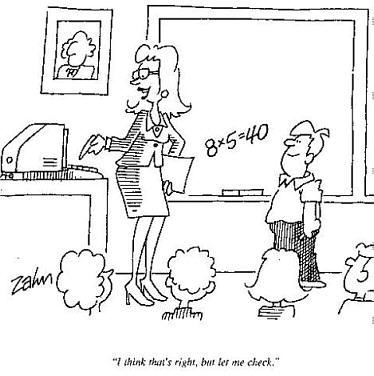
Sometimes I wonder how well Primary school maths teachers would go if they were forced to sit a basic skills maths examination. I fear many of them would stumble, especially in skills such as fractions.
New Westminster parents are pressing their school district to investigate what they say is an exception-ally high failure rate over many years for high-school students enrolled in math classes taught by a particular teacher.
But they say the district has brushed aside their finding that three out of four students in those New Westminster secondary school math classes failed last semester. And recently, in response to their freedom-of-information request for math marks for all Grade 8-12 students in the school, the district told them they would be charged $1,385 to cover the cost of research and photocopying.
One of the parents, Lisa Chao, said she was shocked by the bill and highly doubts that much work is required to produce the information parents believe would back their contention that the teacher has been unsuccessful in teaching the lessons for many years. “This is information … they should have been gathering at the end of every semester,” she said in an interview. “It shouldn’t take more than three hours to print off.”
Parents deserve the right to information when they suspect that a teacher is letting down their children. Schools shouldn’t shy away from being open and transparent, because when they use tactics like the one referred to above, they look like a party to a major cover-up. I have no problems with schools supporting their teachers, but sometimes even the school needs to take an impartial view.
This teacher should be given every opportunity to defend the allegations. However, the doubts about his/her effectiveness seem valid and require a response.
1- Pay attention to your students’ interests Now that I’ve been teaching 10 years and I’ve mastered my subject area and the pedagogy of how to teach and reach every child’s learning style, I’m able to focus on the interpersonal things that make a big difference.
Administrators, school boards, and districts may see numbers, but numbers are not children. No child is a number. Children have names and hobbies and interests and family lives. Children are individuals and it is my job as a teacher to help them find their unique talents. I want to be the one that helped them on their journey of self-discovery.
2- Tell your students what they need to hear not what they want to hear. I’m not here to be popular, I am here to teach. I am here to love these kids and to do what is right by their future selves. I believe I have succeeded when my students come back in 10 years and thank me. Sometimes they think I’m tough now and they groan, but I know that I’m doing right by them.
3- Take time to think about individual students. One of my heroes is the director of our learning lab here at Westwood, Grace Adkins. Every weekend she carries home a folder with the learning profiles, test results, and current work of 3 children who she works with in the lab, and she has been doing this for 60 years. She studies her students like a college student studies a textbook. She has doctors, lawyers, and bankers who credit her with helping them learn how to learn.
4- Learn to teach using many modalities. Lecture may be ok some of the time, but it is never ok to do this all the time. Good teachers learn about pedagogy, the methods used to teach. Yesterday, I had a student dress up in a chef’s outfit with a mixing bowl and a recipe book with labels on everything to teach how microprocessors work. When I finished, my students said, “that is easy to understand.” A good teacher can demystify a complex topic and make it simple to understand.
5 – Let your passion come through. If you love your topic, it will come through in your voice, your body language, and everything you do. There are times I’ve loved one subject more than another, but I can always get excited about teaching a child something for the first time that I know is valuable. I think it is important to let your own personality come through in your teaching.
The greatest challenge of teaching is reaching as many children as possible. Touching every student is an impossible task — but every moment in our lives as educators brings new opportunities.
I absolutely love this list. I think they have nailed some of the most essential methods for maintaining a strong connection between teacher and student.
It’s the first day of a new school year tomorrow and I’m suffering from my annual bout of self-doubt. I get very anxious before a school year starts. I worry about whether or not I will succeed at helping my students. I worry about whether my style of teaching will work on a new bunch of kids.
The week leading up to the start of the school year doesn’t help. It’s a week that is set aside for preparing the classroom. This involves displays, fancy name tags and innovative ways to use a small space to enhance learning. The female teachers I work with put a lot of emphasis on the look of their classrooms. Borders are replaced around noticeboards, name tags are put on everything (and I mean everything!) and the fear of death is reserved for the poor laminator who cops the brunt of all this activity.
When it comes to developing fun lessons, I am very comfortable. When it comes to decorating a classroom, I am completely out of my league! I have been getting comments ever since I started about the plainness of my classroom compared to the other teachers. My bosses have pointed out that my classroom looks far less inviting and colourful. This year I put up a beautiful piece of red material to cover my noticeboard, before being told that children don’t learn well in a room of red. Apparently the colour red has a negative effect on concentration and creativity. The comments certainly made me see red!
Then there’s the endless diatribe from those in charge about new responsibilities and expectations that all staff need to adhere to. These usually involve devoting a great deal of extra time. If there is something all teachers have in common, it is the absence of any extra time.
Handover isn’t much fun either. As the previous teacher reads each name from the class list, every child is presented as difficult to teach. There’s behavioural issues, Aspergers, ADHD, ADD, Oppositional disorder, social issues, anger management issues, language disorders etc. What is it with psychologists today? They have turned every personality type into a disorder. Why is every second child on a spectrum? What is this spectrum, and how did it get to be so big? In today’s age, the one kid who can’t manage to get on the spectrum of any modern psychological condition probably ends up feeling left out and abnormal.
All this makes me very uneasy. I get very frightened. I desperately don’t want to let my students down.
If I wasn’t a teacher I think I would have supported Michael Gove’s push for reduced summer vacation and longer school days. Non-teachers are quick to remind us teachers that our vacation time is too long and our contact hours are just as generous. These same people wouldn’t teach if their life depended on it!
Firstly, while it is true that are holidays are long, we teachers get burnt out by the demands of our job. As much as I love teaching, towards the end of a given term, I am crawling towards the finishing line. Teaching is such a physically and emotionally charged career, it is simply impossible to envisage a 4 week annual holiday like other professions experience.
Secondly, our working hours do not stop at the end of day bell. Unlike many other professions, teachers are expected to take their work with them. From planning and marking to writing reports, teachers are forever working. This includes night, weekends and yes, holidays!
Michael Gove seems to think that quality will come with quantity. I am not so sure:
The school day could be extended and summer holidays reduced, Michael Gove, the Education Secretary, said yesterday.
Under the proposals for the extended day, pupils could remain in school between 7.30am and 5.30pm and attend on Saturdays, with an extra two weeks potentially being added to school terms.
Over a five-year period, the extended hours would mean pupils gained as much as a year’s worth of extra education, allowing them to take vocational subjects in addition to their exam material.
Asked how this would affect teachers, he said: “If you love your job then there is, I think, absolutely nothing to complain about in making sure you have more of a chance to do it well.”
Mr Gove said the move would benefit “poorer children from poorer homes”, who “lose learning over the long summer holidays”.
Mr. Gove’s assertion that if teachers loved their jobs they would have nothing to complain about is quite insensitive and offensive. I love my job and do the best that I can. But I have limitations. I feel that if I was teaching in England, this proposal would burn me out earlier and more severely. I find it very sad that the Education secretary is so out of touch with teaching and the demands of a modern-day teacher.
Cases of cyber bullying are exploding and schools need to wake up about it. Anti-bullying programs are not sufficient. Schools must treat bullying via internet chat and social media sites as every bit as important as bullying in the playground.
The enraged father of one teenage schoolgirl became so incensed by comments he believed a boy had made about his daughter on a social networking site that he accosted him in the street and threatened to “slit his throat”.
The man approached the Year 8 boy as he walked to a bus stop on the state’s mid-north coast and pushed and threatened him before boarding the bus, where he issued further death threats to the boy and other students.
In another disturbing case, a mum went to a school in western NSW and urged her Year 10 daughter to assault another girl after an exchange on a social networking site.
Both girls were suspended, police were called and the mum was banned from entering the school under the Inclosed Lands Act.
In the Tuggerah Lakes area on the NSW central coast, comments on a social networking site led to a Year 8 female being assaulted by another Year 8 girl.
One of the students, who sustained swelling to her forehead and complained of feeling dizzy and nauseous, was taken to hospital. The other girl injured her hand.
Schools increasingly are asking police to investigate serious student online bullying and have shored up cyber safety programs in a bid to head off more trouble.
The reason why parents get involved (and in some cases overly involved) is simple. When schools refuse to act citing that the offense was made outside of school grounds it limits any possible consequence for the bully. To prove my point, I refer you to the following pathetic quote from this very article.
The Department of Education said Facebook could not be accessed on school computers.
What it really means is cyber bullying happens at home and needs to be sorted out exclusively at home.
This is simply a lazy and unworkable approach. The only way to tackle bullying successfully is with full school involvement.
It must be so hard for the cyber bullying victims parents. Sometimes it must feel like there’s no one to turn to and nobody who will listen. This must stop!
The continued debate between private and public school funding tires me out. I am a big believer of a well-funded (i.e. wisely funded) public school sector as well as a thriving private school sector. There is no reason why parents can’t be given choice and why supporting private schools must come at the expense of quality public education.
This is where the “Moneyball” analogy fits in.
Moneyball is the true story of Oakland A’s GM Billy Beane. Oakland is severly restricted due to the lowest salary constraints in baseball. Winning means beating teams with much better infrastructure and player payment capacities. Billy is presented with the unenviable task of finding a winning team with the miniscule budget offered. Together with a Harvard economics major, a system is devised that uses statistical data to analyse and value players they pick for the team.
Public schools need to take the same approach. Just like the big baseball teams of the time, plenty of money is spent on public schools, but much of it is wasted money. I look at education in a very traditional way. Whilst it is ideal to have the best sporting fields, technologies and building designs, none of these ingredients has been proven to be essential for teaching and learning the curriculum. The school across the road may be able to give each child their own i-Pad, but that shouldn’t explain a marked difference in maths, science or english results. A teacher should be able to deliver on the curriculum with or without such devices.
Whilst many get worked up when Governments subsidise private schools, there is a good reason why they do it.
1. It takes billions off the budget bottom line. This saves Governments money, resulting in reduced taxes and smaller class sizes in public schools.
2. It allows private schools to lower their fees. This is crucial for parents who are by no means wealthy, but are prepared to scrimp and save (and sometimes take on multiple jobs and a second mortgage) to get their children into private schools. These people should be commended. They work long hours, weekends, give up overseas travel and big screen TV’s, just to give their kids the best education possible. Government subsidies allow that to happen.
In Australia, the Government gives $13,000 to every public school per student. Private schools get $5,000. Factor in to the equation that many private schools are not elite schools with truck loads of money and resources (I work in such a private school, where I earn considerably less than a public school teacher), and you realise that the subsidy shouldn’t detract from a thriving public education system.
By constantly drawing attention to private schools, we risk bringing the private school system down to the public level. What we should be doing instead is trying to get the public school system improved to the level where it gives its private school equivalent a run for its money. That way, you have a private school that sets the bar for top quality education and a public school system that is structured to be able to go toe-to-toe with them based on prudent spending, good decision-making and a workforce of supported and fairly paid teachers.









 Topical Teaching