Posts Tagged ‘Santa’

Top 10 Most Unusual School Bans

November 4, 2013


Schools should be working on making the school going experience more manageable not more stifling. Below are the top 10 most usual school bans courtesy of ozteacher.com.au:


  1. Hugging This rule has been rolled out all over the country with school authorities suggesting it was introduced to protect children who may be hurt by the physical contact. The rule has been highly criticised by parents who say it is excessive.
  2. Handstands and cartwheels One Sydney school has banned handstands and cartwheels in the playground because it is too dangerous as the school doesn’t have enough ‘soft surfaces’.
  3. Red ink One Queensland school has banned its teachers from marking in red ink in case it upsets the children. It is suggested they use a ‘calming’ green ink instead. Traditionalists have condemned the ban as ‘absolutely barmy’, ‘politically correct’ and ‘trendy’.
  4. Having a best friend In the UK, teachers have banned school kids from having best pals so they don’t get upset by fall-outs. Instead, the primary pupils are being encouraged to play in large groups.
  5. Santa One Gold coast school sent a letter home to parents outlining the Kris Kringle tradition would now be referred to as ‘Secret Friends’ not ‘Secret Santa’. Education Queensland defended the ban, saying the teacher acted in a sensitive and respectful manner and in the best interests of all students, in line with their inclusive policy.
  6. Bikes Parents are “outraged” after an eco-friendly school in the UK banned pupils from cycling to school because of health and safety. Parents argue given childhood obesity is on the rise, promoting healthy eating and exercise is a must.
  7. Bake sales Several schools in Massachusetts placed a ban on school bake sales because it promoted unhealthy eating habits, but the decision was later overturned – meaning cupcakes, brownies and other biscuits will be spared the chopping block.
  8. Winning A few schools have decided to forgo the term ‘win’ in exchange for ‘doing your best’ and ‘completing.’
  9. Party invitations, unless the whole class is invited. This rule is becoming increasingly common in schools, and is enforced to avoid bullying and children feeling left out.
  10. Sunscreen One school in Washington State banned sunscreen on a student field day because it has so many additives and chemicals in it, it can cause allergic reactions. ABC News reports that because sunscreen is considered a medication in all 50 states with the exception of California, children are not allowed to bring it to school or apply it to themselves.

I must say I don’t have a problem with number 9, but I have a major problem with most of the rest.


Click on the link to read Rules that Restrict the Teacher and Enslave the Student

Click on the link to read This is What I Think of the No Hugging Rule at Schools

Click on the link to read Political Correctness at School

Click on the link to read What Are We Doing to Our Kids?

Click on the link to read Stop Banning Our Kids From Being Kids

Click on the link to read Banning Home-Made Lunches is a Dreadful Policy


Teaching Kids To Be Grateful

December 28, 2011

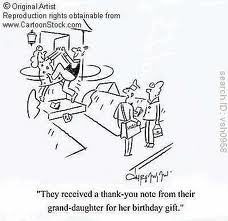
I have noticed that kids these days take things for granted on a far greater scale than when I was a child. It is much harder to please children and equally as hard to get a voluntary “Thank You.”

I imagine that Christmas is when this trend comes to the fore. As children are expecting gifts, there is a visible feeling of entitlement. The occasion mandates a good gift so what is there to be thankful for? If the gift isn’t up to their expectation, they feel that a public show of disappointment is appropriate because the gift bearer should had a better sense of occasion and made a better purchase.

What many young children may not be aware of is the stress involved with buying presents. Parents and family members go to great trouble and expense to buy quality gifts. All the child has to do is rip open the gift wrapping.

I like this piece by Stacey Schantz, about the importance of writing a thank you note:

I don’t know about you, but I’m still recovering from a fun-filled holiday. I have thoroughly enjoyed the look on my kid’s faces when they saw their presents Christmas morning, all the food, and most importantly, the quality family time.

But now that the presents are finished—and we’re putting our house back together—it’s important to me that my kids appreciate all the kindness and generosity that has been shown to them.

When I was growing up, my mother had a rule about presents: you couldn’t use the gift until you had properly said thank you. Many times, this meant a phone call to say thank you for the present. But as I got older, my mom instilled in me the importance of a thank you note.

I have been trying to instill that same gratitude for gifts in my children. We usually make a phone call or draw a picture, but now my 5-year-old is learning how to properly write a thank you note. In fact, I know the significance is getting through, because after receipt of one gift, my son whispered to me that he needed to write a thank you note because that was exactly what he had been hoping for—my heart melted.

This week, I’m determined to have my boys write notes to their grandparents, family and even Santa, to thank them for the wonderful gifts they received. We’re even going to include some drawings to sweeten the package.

Here are some tips to help your kids write thank you notes:

  1. Babies and young toddlers: Take a piece of construction paper and using finger paints, dip your child’s hand in the paint. Then make hand prints on the paper. Then you can write a thank you for the gift on the side. Trust me when I tell you that grandparents love this!
  2. Older toddlers: Have them color a picture, and then take a marker and then write in the thank you.
  3. Preschoolers: Take a piece of handwriting paper, have them draw a picture on the top half and then on the bottom half, pre-write the letter for your child using dotted-line letters that your child can trace and then sign their name.
  4. Elementary school: Give your child a head start by making them a template to follow. Sometimes the hardest part of a thank you note is knowing what to write. Elementary school kids can write the letters, but will feel less intimidated if you help them with the basic framework.  
  5. Middle/high school: Give your child a deadline. Tell them they have to have the notes completed by a certain date.

Believe it or not, your child will actually appreciate the present more because he or she took the time to do this. I know I always appreciate when people take the time to say thank you to me as well.

When Do I Admit That the Tooth Fairy Doesn’t Exist?

October 18, 2011

I read a brilliant article in The National about the lies we tell our children and when is the right time to confess that the Easter Bunny they are so fond of isn’t real.

Below is just an excerpt of the article.  I strongly encourage you to read the entire piece by following this link.

The world is a confusing place for small children, particularly as they only learn to distinguish between reality and fantasy between the ages of three and five. Jacqueline Woolley, a psychology professor at the University of Texas in the US, found that by the age of four, children learn to use the context in which new information is presented to distinguish between fact and fiction. So, before long, your little one will be figuring out that the tooth fairy isn’t who you said she is. Which begs the question: at what age should we tell our children that their beloved magical characters aren’t real? Or, should we even claim that they’re real in the first place?

Last Christmas I witnessed the most heated debate I’d ever come across on Facebook. It didn’t involve politics, religion or money. No; it was Santa Claus who caused the divide. One friend posed the question: “Should I tell Sophie Father Christmas is real?” What followed was a polarised debate between those who wanted their children to enjoy a magical gift-giving time and those who believed that perpetuating the story of Santa was being dishonest with their offspring. “I was devastated when I found out it was my mum, not Santa, who hung the stocking on the end of my bed,” admitted one father. Whereas others regretted never having the chance to believe in Santa because older siblings had spoilt it for them.

“I make a point of always being honest with my daughter and now she has turned six I’m feeling increasingly uncomfortable with perpetuating the lie of Santa Claus,” admitted Rosie Cuffley, a mother of two.

According to Carmen Benton, a parenting educator and educational consultant at LifeWorks, Dubai, Rosie shouldn’t worry. “Sharing the world of fantasy characters with our children is not a lie, but rather a playful way of storytelling and connecting as a family to fun events. Think about the joy and excitement that thoughts of characters such as Santa Claus can induce. You have the power to create a magical world of dreams, wishes and storytelling for your kids and I believe these are part of being a playful parent.”

It’s a different scenario when children ask directly whether Santa Claus, for example, is real. Most psychologists agree that children need to know they can trust their parents to tell them the truth, even about magical characters. “The majority of children will let go of a fantasy after the age of eight, and most would be happy for the years of the imaginary world they had been able to enjoy,” says Benton.

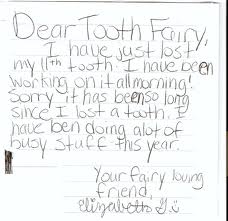
I feel terrible that my daughter still believes in the Tooth Fairy.  I don’t like perpetuating a lie (especially one I know will be uncovered sometime soon).  I have a feeling, irrational or otherwise, that when she does find out, her first thought will be, “What else is he lying to me about?”