It has been labelled “heartbreaking” and one of the most effective anti-smoking advertisements ever.
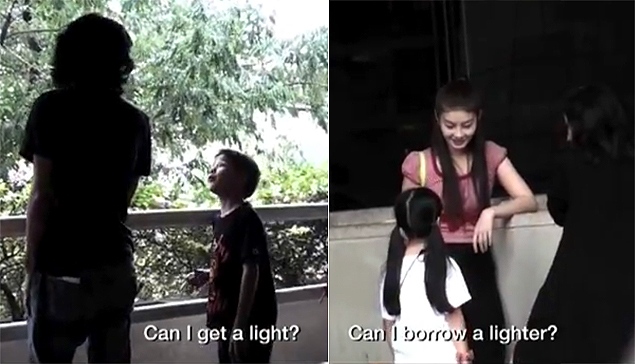
The new public service announcement from Thailand shows two small children approaching adults who are smoking and asking them for a light.
Not one of the adults shown in the ad gives the children what they ask for.
Instead the adults — who have no idea they are being set up — begin giving the children earnest lectures on why smoking is so bad for them.
“If you smoke you die faster,” one man tells a little boy.
“Don’t you want to live and play?”
“When you smoke you suffer from lung cancer, emphysema and strokes,” another says.
The children then reveal their trump card, a brochure they hand the adults which reads: “You worry about me. But why not about yourself?”
The video, produced by the agency Ogilvy Thailand on behalf of the Thai Health Promotion Foundation, was uploaded to YouTube a week ago and has since gone viral, attracting more than 350,000 views.
The foundation has reported a 40 percent increase in the number of calls it has received about how to stop smoking.
I’m sick of reading excuses for why a bus full of middle school children acted in a most deplorable way to their bus monitor. There are no excuses for such vile behavior. I don’t care what age you are, you have a responsibility to be a good citizen and decent person. It sickens me to see a pack bullying situation where a soft target is exposed and then tormented without any resistance whatsoever.
Explanations like this are both unhelpful and insensitive to poor bus monitor, Karen Klein:
When kids reach middle school, bullying becomes more common and more sophisticated, experts says.
“Middle school-age kids are sort of an age group that is notorious for an uptick in the intensity of bullying,” said Dr. Gail Saltz, a psychiatrist in New York and TODAY contributor.
During the middle school years, kids are facing intense peer pressure, the pack mentality is strong and kids feel a growing sense of independence – all while their moral compasses are still developing, she said.
“It’s a time when they’re figuring out who they are by sometimes crossing the line and breaking the rules,” Saltz says. “Their insecurity drives a lot of cliquishness and defining themselves as better by making someone else feel worse.”
Don’t even try to excuse this behaviour in any way based on the age of the perpetrators. This is a culture problem. The parents of these children need to do as much soul-searching as the children themselves.
I am saddened to hear about the families of the students getting death threats. What kind of response is that? What is the sense in dealing with bullying by continuing the chain of bullying? This is isn’t even about a bus full of children. This has even wider implications.
Middle school children worldwide should be put on notice. No more excuses. I don’t care how old you are. It’s time to grow up and treat others with respect!
Technology addiction is one of the most prevalent, yet socially acceptable addictions. It envelopes both children and adults and can ruin marriages, cost jobs and effect sleep.
1. Do you feel preoccupied with the Internet (think about previous online activity or anticipate next online session)? 2. Do you feel the need to use the Internet with increasing amounts of time in order to achieve satisfaction? 3. Have you repeatedly made unsuccessful efforts to control, cut back, or stop Internet use? 4. Do you feel restless, moody, depressed, or irritable when attempting to cut down or stop Internet use? 5. Do you stay online longer than originally intended? 6. Have you jeopardized or risked the loss of significant relationship, job, educational or career opportunity because of the Internet? 7. Have you lied to family members, therapist, or others to conceal the extent of involvement with the Internet? 8. Do you use the Internet as a way of escaping from problems or of relieving a dysphoric mood (e.g., feelings of helplessness, guilt, anxiety, depression)?
Other Symptoms Include:
• Failed attempts to control behavior • Heightened sense of euphoria while involved in computer and Internet activities • Neglecting friends and family • Neglecting sleep to stay online • Being dishonest with others • Feeling guilty, ashamed, anxious, or depressed as a result of online behavior • Physical changes such as weight gain or loss, backaches, headaches, carpal tunnel syndrome • Withdrawing from other pleasurable activities
Television, long seen as a negative influence on children has managed to turn the tide thanks to the recent spate of reality programming:
What do reality television shows The Block, MasterChef and Australia’s Got Talent have in common?
Your child.
According to a TV Tonight report, in 2011, those three shows were the most popular with children under 15.
It seems that feel-good family oriented sitcoms, popular with tweens and teens of the past generation have given way to talent quest shows and experts say that this is not necessarily a bad thing.
Competency based programs showcase hard work and discipline, while graphically depicting the euphoria of success and and the bitter disappointment of failure. In contrast, popular family sitcoms of the 80s and 90s like The Cosby Show or Full House featured safe, insular worlds, in which a happy ending was assured.
Laura Kiln, internationally recognised parenting expert and owner of Laura’s Place, a practice where she offers counselling to families, cautiously endorses reality TV saying some shows expose children to a wide spectrum of issues and offer useful advice without sugar-coating difficult matters.
Kiln notes that a show like The Biggest Loser can help children develop empathy by observing the severe impact of weight problems on contestants’ lives, especially in cases where the children’s own families have no experience of obesity.
Catering for gifted students is a significant challenge for a teacher. Teachers can go dizzy trying to find time with students at both ends of the spectrum, whilst also working to help the rest of the class progress.
SCHOOLS are failing the state’s best and brightest students, a damning parliamentary report has found.
A 15-month inquiry has found the education provided to gifted students is often inadequate – sometimes with severe and devastating consequences.
The report, tabled in Parliament today, said up to 85,000 Victorian students fit the category of gifted.
“These students are frequently frustrated and disengaged,” the education and training committee report said.
“And rightfully so: they are being let down by the education system. These neglected students represent our state’s future visionaries and innovators.”
All teachers should be capable of recognising and teaching the gifted, the report said.
Education Minister Martin Dixon welcomed the report and said he “looked forward to responding to it in detail”.
“Our job in education is to engage, excite and extend students,” he said.
This problem is very real, but let’s not forget the difficulties teachers face with an ever-increasing workload and an overcrowded curriculum.
A new study from the University of B.C. shows kids might be generous and giving because it makes them happy, contrary to the popular belief children are inherently selfish.
Adults report feeling better when spending money on other people instead of themselves and research shows the part of the brain that processes rewards is activated when donating to charity.
Three UBC researchers hypothesized very young children — under age two — experience similar emotional benefits from generosity. For adults, the happiness that results from giving could be caused by many things, like conforming with social pressure or receiving rewards.
“But looking at young kids helps us get a little closer to understanding whether this is something rooted in human nature or not,” said Lara Aknin, a PhD in social psychology. Aknin designed the study with her UBC thesis supervisor, Elizabeth Dunn, and developmental psychologist Kiley Hamlin.
This is the first study to look at the emotional benefits of giving in young children.
Aknin cited news and parenting websites that argue young kids are innately selfish and self-absorbed, and she admitted some studies have shown kids can be territorial with their possessions.
“But you also don’t have to look far to see really young kids wanting to share their soggy Cheerios,” she said. “There is this dichotomy when we look at kids, and I think most people’s assumptions are that kids are self-oriented and hoard things for themselves.”
It just goes to show how effectively adults can model good behaviour.
If I had to assess the effectiveness of our education system in one sweeping statement, it would be that our system is concerned with process over people.
What we must remember is, we are not only teaching human beings, we are teaching the next generation of citizens. The method in which we teach them and the way we treat them will have a dramatic impact on their view of the world. If we treat them with respect and empathy, they are more likely to grow up to be decent and generous people. If we treat them as guinea pigs the outcomes will not be as positive.
Autistic students are being told they can no longer attend specialist schools because their language skills are assessed to be too high in controversial year 6 tests.
Parents say their children, many of whom have attended autism schools all their lives, will be unable to cope and vulnerable to bullying if forced to go to a mainstream school.
Some have resorted to desperate tactics such as threatening to go to the media or applying to have their children reclassified as having a Severe Behaviour Disorder rather than autism so they can remain at autism schools.
Janeane Baker, whose 11-year-old son William has been at Northern School for Autism since prep, was horrified to learn her son no longer qualified for funding to remain at the school because he had passed a language test. ”It doesn’t matter that his mother has worked in the mainstream education system and knows that he would never survive there,” Ms Baker said. ”It doesn’t matter that his highly qualified teachers have never thought he would be able to be integrated. He can speak; therefore the government obviously thinks he is cured. They are very wrong – autism is for life.”Ms Baker had tried to integrate William with mainstream peers at junior cricket and Scouts but he got bullied because he was ”just that little bit too left of centre”.
Instead of treating this issue as a process dependant on academic evaluations, we must see this as a human issue. If children with disabilities are more likely to thrive in specialists schools we must do whatever we can to make sure that option is available to them.
Whilst I am sympathetic to the 13 year-old boy that wishes to play netball, I don’t think it’s appropriate for a teenage boy to play in an all-girls team. Not only will boys ruin the enjoyment that girls have for the sport but girls are entitled to raise concerns about the body contact that exists within the game.
MEMBERS of a junior netball club have slammed a VCAT decision to allow a 185-centimetre tall, 13-year-old boy interim permission to play in an all-girls’ competition.
Despite Netball Victoria discouraging teams from speaking out, the coach, parents and players from one of the boy’s rival teams, St Therese’s of Essendon, say it would be a disaster if VCAT made the ruling permanent that boys can play in the 15 and under matches.
They fear it would smash girls’ confidence on court, and spell an end to girls having the choice to play in a team of their own gender. St Therese’s head coach Dianne McCormack wrote to The Age saying it was not a personal comment on the boy, who plays for Banyule in the Parkville Netball association’s 15 and under C Grade.
A St Therese’s C-Grade player, Ally, 12, has written to the sports minister and Netball Victoria saying that when she played against the boy in the 13 and under competition, ”no one wanted to play a strong defence because it meant you had to put your body up against his”.Ally said when she got older she might want to play mixed, ”but now I just want to play against other girls”. ”Most boys I know are already bigger and stronger than me.
”Please stick up for me and all girls who play in girls’ competitions. I don’t think it’s fair for any boy to take away my right and any girl’s right to play in an all-girls’ competition.”
I noticed while teaching students about persuasive writing how difficult they find it to form opinions of their own. It is almost as if children today do what they have learned to do without ever reflecting on the reasons why. This poses a significant problem when it comes to peer pressure. If you don’t have the tools to work out right from wrong, positive from negative, you can be very easily lead.
WHILE parents have been teaching their kids not to argue with adults for generations, new research shows it may have its benefits.
A study by the University of Virginia shows that young teenagers who are taught to argue effectively are more likely to resist peer pressure to use drugs or alcohol later in adolescence.
“It turns out that what goes on in the family is actually a training ground for teens in terms of how to negotiate with other people,” said Joseph Allen, psychology professor and lead author of the study, results of which were published in a recent edition of the journal Child Development.
Prof Allen said that parents are often “scared to death about peer pressure” but also frustrated by argumentative children.
“What we’re finding is there’s a surprising connection between the two,” he said.
Prof Allen said that teens “learn they can be taken seriously” through interactions with their parents.
“Sometimes, it can be counterintuitive to tell parents to let their teens argue with them,” said Joanna Chango, a clinical psychology graduate student who worked on the study.
In fact, learning effective argumentation skills can help teenagers learn to “assert themselves and establish a sense of autonomy”, she said.
I don’t agree with the assertion that we should encourage our children to argue with us. Instead, teachers and parents alike, should encourage students to question everything, to feel confident to form their own opinions and not to follow a crowd just for the sake of safety in numbers.
I heard a very surprising fact on the radio the other week. A nutritionist asked the listeners what they thought the leading cause of death was. Like most, I thought the answer was something like heart disease, obesity or cancer. It was none of the above. Apparently, the leading cause of death is inactivity.
That’s why it is so vital that we help our children to become more active. Here are some helpful hints by Steve Ettinger, a children’s fitness expert and author:
Be creative
Whether you live in an urban, suburban or rural environment, use the space, time and resources you have to find ways to exercise. For example, if you live in the city and don’t have access to outdoor space, find indoor activities. Ettinger also says if kids are sitting in front of the TV, challenge them to exercise in short spurts during commercials. It is a far better solution than having them get up to snack on junk food.
Schedule time to exercise
Writing down time to exercise makes it much more likely that you will do it. Even if it’s just playing at the park, schedule that time in your calendar.
Ettinger also says children who eat poorly will naturally not have as much energy and as high of an activity level as children who eat nutritiously.
Get involved as a family
One of the best ways to get children to exercise is for the family to participate together. Find something that everyone enjoys doing, such as bike riding or going for a walk around the neighborhood, and do it together. That way, there are fewer safety concerns because kids aren’t out by themselves, and everyone in the family – including yourself – gets to benefit from moving around.
Find something your kids enjoy
One reason kids stop exercising is that they are forced into activities they don’t enjoy. If your child doesn’t like a particular activity or organized sport, be patient and take the time to explore different options. Ettinger says if kids find activities fun, they will usually stick with them. He also says it’s best to find an activity for children before age 10 – otherwise, inertia will become a habit.
Educate yourself
Modeling proper nutrition and exercise is the best way to teach your kids about maintaining a proper weight and a healthy lifestyle. Ettinger says he is amazed by the number of parents who have misconceptions about proper nutrition. Seek out resources so you can learn the basics and incorporate these lessons into your own life.







 Topical Teaching