Quality parenting is just not entertaining enough. As long as reality television continues to abound, the only parenting tips on offer will be from those we should be readily dismissing:
The hotly debated practice of breastfeeding beyond infancy has earned itself a close-up investigation as part of a new reality television show.
Extreme Parenting will look at a range of America’s kookiest parenting rituals, shedding a spotlight further on the much-hyped arguments for and against weaning your child after the age of one.
The show, created by the team behind Bridezillas and Dance Moms, picks up where Jamie Lynne Grumet left off in the debate when she graced the cover of Time magazine with her four-year-old son latched onto her breast.
Jeff Collins, president of Collins Avenue Productions, who is developing the show told Yahoo! Shine: ‘That cover proves what I’ve been saying for the last year – America has become a country of extremes.
Of course there is a place for serious discussions about breastfeeding and attachment parenting, but unfortunately you are unlikely to get it from this show.
Reality television parenting shows are responsible for setting back parenting standards. These shows allow parents who have a lot of growing to do the false satisfaction that “at least I am better than those people.”
What we really need is a show for serious parents that takes parenting seriously.
Bill Henson, a so-called artist, who makes his living by photographing (among other subjects) minors in the nude, is no expert on child welfare. I find it quite upsetting that a person who has grown to prominence by insisting that photographs of naked minors are somehow artistic, gets the platform to point the finger at the church and sport.
CONTROVERSIAL photographer Bill Henson has pointed to sport and the church as far more likely to harm children than anything involving the arts.
Mr Henson, who sparked outrage by including images of naked minors in a 2008 exhibition, told The Australian that the arts were the last thing likely to actually harm kids.
“We’re talking about the potential for harm,” he said. “If you want to talk about that in relation to real children and real harm, you’d have to start with priests in the church, or sport.
“If you want to talk about actual harm to actual kids, the last place you would start would be the arts.”
Henson has an exhibition opening in Sydney in September but said he had not decided whether it would include nude figures.
“There’s a lot of grassroots common sense out there in Australian society and I think a lot of people began to get a bit sick of it,” he said in reference to the furore over his 2008 exhibition.
I am not in favour of banning Mr. Henson’s work, but I am certainly not a devotee. In my opinion, there is no way to photograph a naked pre-pubecent child without being exploitative and without sexualising the “model”. Sure he might be talented, but talent isn’t an excuse for poor taste.
Mr. Henson should stop looking for easy diversions and grow up!
Food companies wouldn’t be “conning” well-meaning parents, would they?
CHILDREN are being conned by food companies who are making fatty and sugary foods appear to be healthy, a study suggests.
Some of Australia’s most popular brands, including Kellogg’s and Nestle, have been accused of making food that appeals to children look healthier than it actually is, the Flinders University study shows.
Researchers, led by lecturer Kaye Mehte, found 157 products on a major supermarket chain’s shelves with packaging designed to appeal to children through cartoons, competitions and give-aways.
More than three-quarters of these products were deemed to be unhealthy, primarily because they are high in fat and sugar.
But more than half of them had prominent nutrition claims on the packaging, boasting that the product is, for example, “99 per cent fat free”, “high in calcium” or has “no artificial colours”, they found.
“This has the potential to mislead and confuse children as well as parents who would be more inclined to purchase products carrying claims about health and nutrition,” Dr Mehte said.
Jane Martin, executive manager of the Obesity Policy Coalition said using the techniques to attract children to unhealthy food was “simply unethical”.
It’s ultimately the role of parents to ensure that their children are reading age appropriate books. Beyond that, I don’t think the major problem here is that some children are reading violent books. The real problem is that many children aren’t reading at all.
Bestselling children’s author GP Taylor believes that children’s literature has become too frightening and should be marked with an age certification system.
Taylor, appearing this morning on BBC Breakfast, said he plans to withdraw from the direction he has taken in his latest trilogy of books, the Vampyre Labyrinth series, which adds vampires to the backdrop of Yorkshire during the second world war. “I wrote the Vampyre Labyrinth, it came out, I hadn’t really read it when I wrote the book, and people who were reading it and reviewing it were saying this is the most frightening thing that has ever been written for kids,” said Taylor. “I have changed my mind: I think children’s literature has gone too far.”
His comments follow new analysis of recent award-winning children’s literature which shows that the books of today are more likely to feature abandoned children, with troubled or absent parents, as opposed to the fictional children of times past, who were carefree and happy and would set off on adventures of their own accord, rather than being forced out.
It’s very hard for parents to find time with their iPhones and iPads because children have a habit of getting to them first.
It was only a matter of time before manufacturers invented a toy that will give your children yet another reason to run off with your phone:
Any parent knows that irrespective of what engaging and exciting toys you buy for your children, they will always be more interested in your mobile phone or tablet computer. It’s an inescapable fact of modern day parenting. With this in mind, toy firm Little Tikes has revealed a range of iPhone-friendly toys which can connect with your iOS devices.
The iTikes toysiOS devices toys include a keyboard, map, microscope and an art canvas, all of which can be used as stand-alone toys. But it’s when you add an iPhone, iPad or iPod Touch running a free iTikes app, that the fun really begins and the toys gain additional (and considerably more high-tech) functionality.
I’m still waiting for the iCanMakeMyBed, iWillShareMyToys and the future bestseller iWillDoMyHomeworkWithoutComplaint.
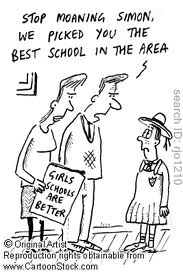
I am glad that I teach both boys and girls in my Grade 3 classroom. I find it more challenging and the social dynamic can be quite fascinating. At the same time, I can understand why many prefer a single-sex classroom to a co-ed one.
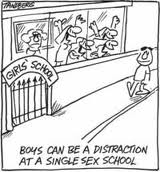
Some parents don’t want their children to be in mixed-gender classrooms because, especially at certain ages, students of the opposite sex can be a distraction.
Leonard Sax and others agree that merely placing boys in separate classrooms from girls accomplishes little. But single-sex education enhances student success when teachers use techniques geared toward the gender of their students.
Some research indicates that girls learn better when classroom temperature is warm, while boys perform better in cooler classrooms. If that’s true, then the temperature in a single-sex classroom could be set to optimize the learning of either male or female students.
Some research and reports from educators suggest that single-sex education can broaden the educational prospects for both girls and boys. Advocates claim co-ed schools tend to reinforce gender stereotypes, while single-sex schools can break down gender stereotypes. For example, girls are free of the pressure to compete with boys in male-dominated subjects such as math and science. Boys, on the other hand, can more easily pursue traditionally “feminine” interests such as music and poetry. One mother, whose daughter has attended a girls-only school for three years, shares her experience on the GreatSchools parent community: “I feel that the single gender environment has given her a level of confidence and informed interest in math and science that she may not have had otherwise.”
Few educators are formally trained to use gender-specific teaching techniques. However, it’s no secret that experienced teachers usually understand gender differences and are adept at accommodating a variety of learning styles within their mixed-gender classrooms.
Gender differences in learning aren’t the same across the board; they vary along a continuum of what is considered normal. For a sensitive boy or an assertive girl, the teaching style promoted by advocates of single-sex education could be ineffective (at best) or detrimental (at worst). For example, a sensitive boy might be intimidated by a teacher who “gets in his face” and speaks loudly believing “that’s what boys want and need to learn.”
Students in single-sex classrooms will one day live and work side-by-side with members of the opposite sex. Educating students in single-sex schools limits their opportunity to work cooperatively and co-exist successfully with members of the opposite sex.
At least one study found that the higher the percentage of girls in a co-ed classroom, the better the academic performance for all students (both male and female). Professor Analia Schlosser, an economist from the Eitan Berglas School of Economics at Tel Aviv, found that elementary school, co-ed classrooms with a majority of female students showed increased academic performance for both boys and girls. In high school, the classrooms with the best academic achievement were consistently those that had a higher percentage of girls. Dr. Schlosser theorizes that a higher percentage of girls lowers the amount of classroom disruption and fosters a better relationship between all students and the teacher.
The American Council on Education reports that there is less academic disparity between male and female students overall and a far greater achievement gap between students in different racial, ethnic and socioeconomic groups, with poor and minority students children faring poorly. Bridging that academic chasm, they argue, deserves more attention than does the gender divide.
Single-sex education is illegal and discriminatory, or so states the American Civil Liberties Union (ACLU) . In May 2008, the ACLU filed suit in federal court, arguing that Breckinridge County Middle School’s (Kentucky) practice of offering single-sex classrooms in their public school is illegal and discriminatory. The school doesn’t require any child to attend a single-sex class, yet the suit argues that the practice violates several state and federal laws, including Title IX and the equal Educational Opportunities Act.
Above is a video taken by Ridgefield, Connecticut couple David and Elena Barnes of themselves and their five-year-old daughter Anaia during a vacation with Power Boat Adventures in the Bahamas. In the 9-minute clip, the family snorkels in shallow water with a number of shark breeds (shown being fed by Power Boat employees at the opening of the clip), including mild nurse sharks as well as the more excitable and predatory lemon and Caribbean reef varieties. The video has hit 350,000 views on YouTube and provoked massive amounts of criticism from maritime professionals and parents alike. Before the comments were disabled, the San Franciso Gate’s Mommy Files blog reposted a sample YouTube response from commenter luigib0511:
“I’m an experienced diver who did work for the Oceanic Association scuba diving with sharks and other dangerous fish. What this people have done is an outrage and an extreme stupidity. Swimming with sharks is not a Sea World adventure.”
A HIGH school teacher allegedly obtained naked and semi-naked pictures of two 14-year-old girl students at his school after posing as a teenage boy on a fake Facebook profile.
It is understood police will allege the country teacher pretended to be a schoolboy of a similar age from another regional town in a ploy to prey on the girls.
The students are believed to have sent him naked and semi-naked photos of themselves via the social networking site.
The teacher, who has been sacked and cannot be named for legal reasons, faced court this week on two counts of involving a child in child exploitation.
Until now, The Sunday Times has been prevented from publishing any details of the case.
After successfully challenging the terms of the original suppression order on the case, The Sunday Times is now permitted to reveal certain aspects of the allegations, which have prompted a warning from cyber safety experts for parents to educate their children about the importance of safety settings on Facebook for the coming school holidays, which started yesterday.
This is why I am a strong proponent of the no contact rule in schools. Whilst the vast majority of teachers are good citizens, there are still too many sick, evil predators still to be exposed.
Click here to read my post, “Why Can’t Teachers Touch Kids any More? :O’Brien”.
A baby bodysuit with a woman’s silhouette printed on the front has parents in Southaven, MS outraged. “Inappropriate” is what several shoppers said when Action News 5 interviewed them outside of Gordman’s, the store selling the onesie.
Wild Child, a brand manufactured by Bon Bebe, sized the outfit for 18-month-old girls. But mom Cathryn McKee told the news station, “I just think that is a little ridiculous that you would put that on your child.” One father who spoke on camera says he wouldn’t let his daughter wear the “bikini” because “it gives people the wrong idea too quickly.”
Clever marketing should see this product be boosted by the negative publicity and sell like hotcake. I think we’ll pass on this one though.









 Topical Teaching