Posts Tagged ‘Parenting’

Confronting a Teacher Can Be Very Difficult

August 24, 2012

As approachable as I try to make myself, it’s often hard for students to get the courage to confide in me about things that are bothering them. That is why I am very glad Google has come up with Google Forms, a device which should improve communication between teachers and students.

Click on the link to read Shops Should Stop Selling “Sexy” Clothes for Children

Click on the link to read Our Children Must be Taught About Society’s Lie

Click on the link to read Most People Think This Woman is Fat

The Dog Eat Dog Style of Education

August 23, 2012

Classrooms are increasingly becoming a case of a battle of the fittest. The pressure to deliver individual achievement on curriculum benchmarks and standardized testing have not helped. More and more we are seeing classroom relationships fracture and a strong preference for achievement over effort.

A friend of mine discussed an issue he was having with his son’s school. He told me that his son’s teacher is rewarding some of his students for reaching a certain goal. His son, among others, are excluded from a field trip because they didn’t fully rote learn the expected material. He tried his best, but didn’t get there by the deadline. He is in Grade 4 and is already being excluded for not meeting benchmarks.

When I was doing my teaching rounds I encountered a scenario in the music room where a child had disturbed the class. The teacher was considering punishing the child by excluding him from the next activity. The teacher decided to ask the class to determine this child’s fate. The teacher gave them two options. The first was to give the boy one more chance, the second was to exclude him. I watched in amazement as the entire class voted to prevent him from taking part in the activity. The class were taught to be ruthless towards each other so that’s what they did.

When will our educators realise that a child cannot achieve their potential when they are not valued for their efforts or respected by their peers? All this talk of ‘child centered teaching’ and ‘teacher centered teaching’ is off the mark. I prefer, what I call, ‘classroom centered teaching‘ – where the needs of the group necessitate the style in which I teach. According to this method, it is my job as my first priority to ensure that each child feels valued for who they are, what skills they have and how they are treated by their peers.

This means that when there is a disagreement among students, I do not hesitate to use teaching time to work things out. The time I invest into the social environment in my class has a strong impact on academic progress. Those of you that have witnessed a rift between students or groups of students in the classroom may have noticed how hard it is to get the class to focus on classwork when the  playground politics is unresolved.

Whilst standardised testing doesn’t consider a child’s effort or the qualities and interests of a child, I can think of nothing more important. When a teacher decides to treat half the class at the expense of the other half, they are anointing winners and losers.

My students are all winners.

Click on the link to read Problem Kids, Suspensions and Revolving Doors

Click on the link to read The Solution to the Disruptive Student Has Arrived: Body Language Classes
Click on the link to read When Something Doesn’t Work – Try Again Until it Does
Click on the link to read Teachers Should Stop Blaming Parents and Start Acting

Is there Wisdom in Making Students Repeat the Year?

August 21, 2012

It is interesting to read that after shelving their policy of holding students back, schools are starting to revisit the notion of making students repeat the year.

Whilst I’m not an advocate of such a policy and up until now research seems to suggest if anything, it will do more harm to a child than good, I am open to it as an option. There is simply no point moving certain children up a grade. It is unfair to a child to be promoted to a grade based solely on psychological impact rather than academic necessity. I wonder whether the past research has proven so negative against the notion of holding back students because most schools do not have the support structure to make such a move accommodating and palatable for children.

The shift in thinking has come about, partly because recent research into this area has been far more supportive of retention policies:

Thousands of third-graders may have a sense of déjà vu on the first day of school this year: The number of states that require third-graders to be held back if they can’t read increased to 13 in the last year.

Retention policies are controversial because the research is mixed for students who are held back, but a report published on August 16th by the Brookings Institution suggests that at least for younger children who struggle with reading, repeating a grade may be beneficial.

The report, which examined a decade-old retention policy in Florida, was authored by Martin West of the Harvard Graduate School of Education. He argues that “the decision to retain a student is typically made based on subtle considerations involving ability, maturity, and parental involvement that researchers are unable to incorporate into their analyses. As a result, the disappointing outcomes of retained students may well reflect the reasons they were held back in the first place rather than the consequences of being retained.”

West comes to the following conclusion:

“Retained students continue to perform markedly better than their promoted peers when tested at the same grade level and, assuming they are as likely to graduate high school, stand to benefit from an additional year of instruction.”

There is no doubt that the psychological impact of the child should be our number one priority, but I believe that good, supportive schools can help effectively transition children to make repeating a year a far more positive experience.

Click on the link to read Teaching Children to Deal with Embarrassment

Click on the link to read What our System Does to Children Without Attention Spans

Click on the link to read Lessons Children Can Learn from the London Olympics

Click on the link to read A Class Full of Class Captains

Top 10 Math Apps for Children

August 21, 2012

Courtesy of teacherswithapps.com:


iDevBooks – Educational Math Apps, by Esa Helttula, are par excellence when it comes to educational tools! This suite of apps are a must-have for any school using mobile devices, as well as for parents who want to encourage mastery of math concepts for their children. This collection of 16 iPhone, iPod Touch, and iPad educational math apps are easy to use and offer intuitive interfaces. The iDevBooks math apps are used by schools, parents, and students worldwide. They are also popular in special education.

Jungle Time, Jungle Coins & Jungle Fractions!, by Andrew Short, of Jungle Education – We still need to learn to tell time, utilize money, and understand fractions. These three essential concepts are not easy to teach and harder to learn. Lots of hands on practice is needed and Andrew Short has got the “lots of” covered. All three games offer five levels of challenge, they start with the rudimentary concept and gradually progress over several grade levels. A MUST HAVE!

Motion Math: Hungry Fish, by Motion Math, is another MUST HAVE math game! Mental math is such a key component for success in building a strong foundation in math, and building on this early on helps all other math concepts fall into place with relative ease. Our students were enthralled by this simple, yet brilliant game – and they were polishing up on their number skills with smiles on their faces! Brilliant job Motion Math!

Math Evolve, by InterAction Education and Zephyr Games, has really pushed the envelope. This app introduces a revolutionary “video-like” gaming app for practicing math facts. One of our students called it, “The Call of Duty,” of math games. Adam Coccari, teacher and creator of Math Evolve, sums it up best when he says, “Achieving success in all levels of math starts with having a solid foundation in addition, subtraction, multiplication, and division.” Mastering these facts takes time and lots of practice, Math Evolve has taken care of all of that in an enormously engaging format.

Operation Math, by Spinlight Studios, is sizzling with excitement! The mission is possible with this new app, which grabs kids attention immediately and keeps them engaged on their quest to do good. The goal here is to help destroy Dr. Odd and practice your basic math facts along the way. In order to open the series of locked doors, you must perform either addition, subtraction, multiplication, division, or any combination of operations. You can first train in the infinite Base10 Training Room, where your performance will be tracked. When you are up for the challenge, you choose a mission.

Sums Stacker, by Carstens Studios Inc, is an amazing app. It incorporates critical thinking, problem solving, and strategic planning skills, all while you’re “playing” with math concepts, with great gaming style! Carstens’ says this about math, “It wasn’t until after my school years, that I became a lover of math. I managed to slip through all of those classes, text books, and homework assignments, without learning one of the most important math lessons of all – math is fun!” This app challenges your reasoning, your number sense, your addition and subtraction facts, and your knowledge of coin values, and oh yes, reading, if you so desire.

  iTooch MATH Grade 5, by eduPAD, is a terrific app that covers a lot of ground conept-wise and shouldn’t be limited to just fifth graders. This app combines a no-frills approach to content while still providing the user with an exciting learning experience. The mascot is adorable and keeps kids on task with lots of encouragement and there is a lesson summary available when needed. iTooch MATH now has grades three through five available.

Oh No! Fractions, by di Luna, came recently to our attention, but if a colleague hadn’t said, “It’s tough for kids to grasp fractions”, it may have slipped through the cracks. Luckily, it didn’t and we are here to sing its praises.Oh No! Fractions is as simple as it gets. This gorgeous app lets the user decide whether the given fraction is less or greater than another fraction. After the child has decided and chosen less or greater, it asks ”I’m Sure” and then “Prove It” where a visual representation of the two fractions is shown and manipulated by the child.

TallyTots, by Spinlight Studio, is a simple yet invaluable learning app to teach youngsters number concepts. The intent of the app is to teach your child number recognition, one-to-one correspondence, and how to count to 20 – all while having a delightful time. When the app starts, you are taken to a screen that has all 20 numbers. Your child chooses the number they want and the counting begins. Each number is outlined as it is counted up the number line.

KidgitZ, by TapDream Arts, is the second in a series of mental math challenges for kids of all ages. Addictive, it is! Students were so engaged that they never even heard the bell ring… and the next period was lunch and recess! Several students came looking for me and my iPad to continue playing during extra help. Their responses were all similar, with mentions of how hard it was to stop playing this AWESOME game!

Click on the link to read Maths is a Very Poorly Taught Subject

Click on the link to read The Obstacle Course that is Teaching Maths

Click on the link to read Girls and Maths

Click on the link to read Putting Your Children to Sleep With Math

“Take my iPhone and be Quiet!”

August 20, 2012

Interesting research has shown that households where the television and computers are in regular use don’t communicate effectively:

Jane Beale, a speech pathologist on the NSW central coast, said previous work focusing on television usage in the US had shown that, in households where TV usage was minimal, about 6000 words per day were spoken by the home’s occupants. That compared with the 500 words spoken in homes where TVs were on for most or all of the day.

“More and more now we have got not only TV and video games, but we have iPhones and iPads, and we have parents spending time on iPhones and iPads rather than engaging directly face-to-face . . . with their child,” Ms Beale said. “Because these devices are so tantalising to children, they are spending long periods of time with these devices if their parents don’t regulate that.”

Other speech pathologists agreed that, while there was as yet no evidence that devices were causing language delays, there was a developing suspicion that a link did exist.

Adelaide speech pathologist Debbie James said she “took a more cautious view” because of the limited evidence, but said there was “pretty clear evidence there’s about 20 per cent of children that have delayed speech and language skills”, compared with other children of the same age.

Her research had found a “strong association between the frequency with which parents speak with their children when they were nine months old, and the child’s language skills two years later”.

Click on the link to read The Top 50 Best Apps for Children

Click on the link to read Smartboards Must Become More than Just Classroom Decoration

Click on the link to read There is Still Some Love for the Forgotten Class Whiteboard

Is There Any Student Left Without a Disorder?

August 19, 2012

There used to be a stigma attached to those students diagnosed with a disorder. Soon the stigma will be reserved only for those yet to be labeled with one.

It is quite disappointing that it has come down to this. Instead of treating naughty behaviour as naughty behaviour, disrespect as disrespect and anger as …. you guessed it – anger, every socially unacceptable emotion must be aligned with a disorder.

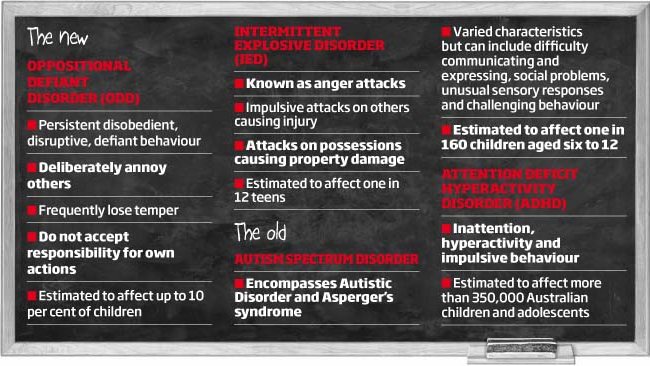
NAUGHTY kids are turning up to school with notes from doctors who have given their unruly behaviour a medical name – oppositional defiant disorder (ODD).

And children who lash out at teachers or students have also been diagnosed with a condition termed intermittent explosive disorder (IED).

Psychologists are diagnosing ODD – characterised by persistent anti-authoritarian behaviour – at a greater rate than autism.

Child psychologist Lisa Good said the condition was real and created a lot of stress for parents, who couldn’t understand why their child was mucking up.

Ms Good, from the Psych Professionals in Brisbane, said she had diagnosed more children with ODD and conduct disorders over the past two years than autism, attention deficit hyperactivity disorder (ADHD) or anxiety.

“It is a lot more common. I would say it was the majority of my appointments this year,” Ms Good said.

Teachers don’t know how to handle the aggressive students and governments do not recognise ODD for special classroom funding.

Queensland Teachers Union president Kevin Bates said schools were having a hard time dealing with the rise in behaviour disorders.

“It has become an extremely significant problem, that’s having severe effects on our schools now,” Mr Bates said.

“The sorts of things people think are just naughty kids now have a medical diagnosis.

“As (doctors) identify more and more disorders, (parents) expect the system will have a special response.”

Mr Bates said unlike with autism, the Government offered no extra help to deal with ODD students, and often they ended up being suspended or excluded.

So let’s take stock: There’s ODD, ADD, ADHD, IED and ASD.

What they really need to establish is OWMEAD – the Obsession with Making Everything a Disorder!

Click here to read my post, Who Needs Quality Teaching or Parenting When You Have Medications?

Click here to read my post, Get Your Kids on Ritalin Before Their Grades Suffer

Click here to read my post, It is Doctors Not Teachers Who Are Helping Children Get Good Grades

Click here to read my post, Doctors Create a New Normal by Over-Prescribing Drugs

The Courts and Their Love Affair With Terrible Teachers

August 19, 2012

When a teacher gets fired for allegedly feeding crayons to an autistic child there are no complaints from members of society. The school was so confident these claims were true they spent $50,000 in legal fees trying to keep this teacher out of the classroom.

If only the courts let educators make these sorts of decisions without interfering:

A Florida judge has recommended this week that a local teacher be reinstated after losing her job for allegedly disciplining a special needs student by forcing him to eat crayons dipped in hot sauce.Lillian Gomez was fired from Sunrise Elementary School in Kissimmee back in February after district officials said she soaked Play-Doh and crayons in the spicy condiment to punish an autistic boy in her class for eating art supplies.Gomez has denied ever force-feeding the student and said she only used the hot sauce to prevent him from eating the crayons.

According to district officials, Gomez first placed jumbo-sized crayons in a cup, then poured hot sauce over them and she later moved them to a bag and labeled it with the student’s name, and let the art supplies sit for days.

A judge has ruled that while her behavior was inappropriate, the district failed to demonstrate that Gomez’s intent was to punish the student.‘I think she made a bad judgment in the way she went about it but her purpose was good,’said Gomez’s attorney, Thomas Egan.

Whilst I don’t have enough evidence to label Ms. Gomez as a “terrible teacher”, what I have read so far doesn’t leave me with great confidence in her abilities.

Even if you believe her account of the incident, would you be comfortable having her teach your child? Sometimes bad judgement calls warrant a dismissal.

Click on the link to read Can a Teacher Be Forgiven for a Bad Joke?

Click on the link to read Why are so Many Teachers Child Predators?

Click on the link to read Drunk Lecturer Forces Students to Sit 23-Hour Exam Without Toilet Breaks

Click on the link to read Shocking Video of a Student Being Beaten Up by a Teacher

The Worst School Rule I Have Ever Come Across

August 18, 2012

At least 3 British schools have banned students from making best friends. That’s right – you haven’t read that incorrectly.

I have heard about some bizarre school rules, but this one definitely takes the cake.

TEACHERS are banning schoolkids from having best pals — so they don’t get upset by fall-outs.

Instead, the primary pupils are being encouraged to play in large groups.

Educational psychologist Gaynor Sbuttoni said the policy has been used at schools in Kingston, South West London, and Surrey.

She added: “I have noticed that teachers tell children they shouldn’t have a best friend and that everyone should play together.

“They are doing it because they want to save the child the pain of splitting up from their best friend. But it is natural for some children to want a best friend. If they break up, they have to feel the pain because they’re learning to deal with it.”

Oh, I’m sorry, I thought schools were supposed to prepare children for the real world. What a terrible rule this is!

Click on the link to read Kids Don’t Need Gold Stars

Click on the link to read Only Closed-Minded Schools Block YouTube

Click on the link to read Experts Push for Kids to Start Driving at 12

Click on the link to read Kids as Young as 3 are Getting Tutors

The Cafeteria Controversy

August 18, 2012

Talk about a lot of hot air. So what if a school uses a scanner to serve children with greater efficiency. Big deal! Honestly, sometimes parents complain for the sake of complaining:

Moss Bluff Elementary School in Louisiana is looking to streamline lunch payments by implementing a palm vein scanner program, but some parents aren’t pleased.

A letter to parents this week informed them of the new scanner that will allow the school’s nearly 1,000 students to move through the lunch line faster and with fewer payment mistakes — an issue that had arisen in the past, KPLC-TV reports.

While the letter notes that parents can opt their children out of the program, parent Mamie Sonnier told KPLC-TV that she was angry and disappointed by the program, as the scanner violates her beliefs. She contends that if the scanners actually make it to the school cafeteria, she’ll be transferring her kids to another school.

“As a Christian, I’ve read the Bible, you know go to church and stuff,” Sonnier said. “I know where it’s going to end up coming to, the mark of the beast. I’m not going to let my kids have that.”

Calderara notes that it’s just “technology that is used throughout our lives. Everywhere.”

Florida’s Pinellas Schools were the first to adopt palm scanning technology to pay for lunch last fall under a voluntary program. The technology uses infrared light to read unique vein patterns connected to meal plans.

It’s two seconds to buy a meal. Literally, two seconds,” Edward Rutenbeck, senior user support analyst with Pinellas Schools Food Services told WTSP.

Click on the link to read Insensitive ‘Parent Bashers’ Take Aim at Grieving Colorado Parents

Click on the link to read Mother Films Her Kids Fighting and Posts it on Facebook

Click on the link to read It’s Not Spying on Your Children, It’s Called Parenting