Posts Tagged ‘News’

When Will Teachers Ever Learn?

December 24, 2011

Some teachers must live under a rock. The only thing worse than calling your students names is calling your students names on Facebook. Any teacher found to be insulting their students on Facebook deserve what is coming to them.

Two teachers have quit after staff allegedly called pupils “thick” on Facebook.

Headmistress Debbie Johnson and teacher Nyanza Roberts resigned when comments were printed off and stuck up near the school they worked at.

Teacher Stuart Clark sparked the tirade after he declared he was “fed up of bumping into pupils in town”.

Nyanza Roberts replies: “By town, do you mean top end of holderness road? That’s bout as far anyone goes. No wonder everyone is thick..

“Inbreeding must damage brain development.”

Head Debbie Johnson jumps in and says: “You’re really on one today mrs… !! Xx.”

Colleague Jane Johnson posted: “Massive queue of year 5/6 kids in poundland! x”

Parents found out about the conversation by staff at Westcott Primary School in east Hull when copies were attached to fences in the streets surrounding the building.

Mary Wallace, chairwoman of governors at Westcott Primary School in Hull, said the two had “decided to relinquish their posts”.

Hull city council added: “We’re supporting the school and will focus on ensuring children get the best possible standards of ­education.”

There are thick people in this incident, but they are not the students.

Time To Shut Down Teacher Bullying Websites

December 22, 2011


I commend head teacher Andre Sohatski for not only standing up for himself and his reputation, but also for representing the downtrodden teachers and students victimised by scandalous bullying websites proliferating across the web.

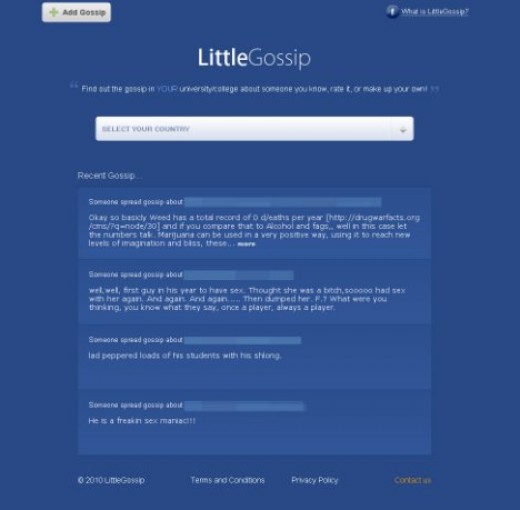
Web sites like RateMyTeacher.com allow students to post salacious accusations and damaging insults. These sites, together with sites that allow students to slander other students such as Little Gossip  have been allowed to remain unhindered under the guise of freedom of speech.

Until now …

Andre Sohatski, headteacher of Priory School in Dorking, Surrey, took action after being told by his pupils that children were being targeted on the website Little Gossip with homophobic, racist and sexist abuse.

The site contains abusive and explicit messages written by schoolchildren that can be rated “true” or “false” by their peers. It allows them to name their “targets” but the user remains anonymous.

Mr Sohatski called for the site to be shut down and said it could cause “really big problems,” for children.

“I think it’s irresponsible. It is a form of internet bullying. Any kind of comment posted anonymously about somebody is basically unfair and sometimes cruel,” he said.

Police said they would investigate the US-based website, which has previously faced heavy criticism, and said the consequences of online bullying were “worrying”.

I am a big believer in the freedom of speech. I can accept that people have the right to vent about any professional within certain boundaries. When a student slanders another student or a teacher with homophobic, racist, sexist or defamatory insults it is fair to say those boundaries have been well and truly crossed.

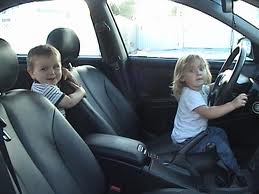
Let’s Teach 4-Year Olds How To Drive

December 20, 2011

Before you disagree with my proposal let me explain the rationale. At some point people need to know how to drive. We all want capable drivers on our roads, so what better time to teach them the intricacies of driving than when they are young.

Right?

Of course not.

Not only are 4-year olds too young to drive but they are also too young to learn other important life skills such as cyber safety. Why the Government expects kinder teachers to educate their young pupils on proper use of internet and the dangers of purchasing goods online beats me.

KINDERGARTENS will be urged to teach cyber safety to four-year-olds amid fears they could fall prey to online predators and bullies.

The Gillard Government will write to state education heads to encourage the take-up of cyber safety programs that teach children not to be mean online and keep their private information to themselves.

It comes amid revelations Victorian primary school children are “sexting” their friends and posting hate messages about their teachers on social networking sites.

A parliamentary committee report earlier this year recommended the Government consider the feasibility of helping deliver programs in preschools and kindergartens.

The Government yesterday accepted the recommendation in principle, but was waiting for a paper on cyber issues to be released in mid-2012 to give a detailed answer.

 In the meantime, it will encourage use of Australian Communication and Media Authority programs, including Cybersmart for Young Kids.

It features a bottlenose dolphin called Hector Protector and his friends teaching young children to keep “special information” private and tell mum or dad if they see anything scary or upsetting online.

It also encourages children to share passwords with their parents and to “be nice” to others.

And parents can download a “safety button” that children can click on to cover up anything upsetting they see online with a friendly picture.

Cyber safety expert Susan McLean said flexible, compulsory education should begin as soon as children switched on a computer, from kindergarten onwards.

“I’ve seen cyber bullying in grade 2. I’ve seen kids buying things on the internet at age seven after their parents have told them not to. That’s commonplace.”

Teaching kids skills too early is like not teaching them at all. I can’t see the value of making young children endure a program that will surely be too advanced for them and doesn’t relate to their present day lives.

Whats next? Teaching four-year olds how to work an electric drill?

Research Suggests That There’s no Such Thing as a Good Divorce

December 19, 2011

I feel very sorry for children of divorced parents who find themelves the center of a tug-of-war act between duelling parents on Christmas Day.

At Christmas time, like no other, family relationships are put to the test.

This time of year seems to bring not only a rise in domestic violence, but family tension and relationship breakdown.

So much for the season of peace and goodwill.

Fights over who will get the kids on Christmas Day are common, and children are often forced to spend Christmas traipsing across town to keep both parents happy.

Many argue that since divorce is so rampant, children are able to adapt with the change extremely well. This is simply not the case.

Research suggests that there’s no such thing as a good divorce: All you can do is have a breakup that is not as bad as it might be.

A US study of 994 families identified three types of post-divorce parents: Those who were co-operatively continuing to parent together, those who were parallel parenting with little communication, and those who were effectively single parents.

Children from the first group – the good divorce group – had the smallest number of behavioural problems and the closest ties to their fathers.

However, the differences were only minor, and the children in this group didn’t score any better than others on 10 additional measures, such as self-esteem, school grades, early sexual activity and closeness to their mothers.


Teacher Writes “Stupid” on Student’s Forehead

December 16, 2011

There is no doubt that teachers have a responsibility to maintain their calm and not give in to difficult and challenging students. Whilst this is harder than it sounds, teachers cannot afford to vent at their students.

When people ask me what are some of the most important skills required to be a good teacher, I always mention patience. To me, patience is an essential skill for every teacher. But patience doesn’t come straight away. It often requires years of practise and hard work.

That is why I think it is important to note that the teacher that wrote the word “stupid” on the child’s forehead was in his first year. Yes, he wrong to do what he did. Yes, he deserves to be sacked. But I hope he is not lost to teaching permanently just because of what he did.

A Tennessee teacher’s first year on the job could be his last. He could lose his job for something he did in the classroom.

It’s a simple school supply, but when a teacher, Alex Boles, used a permanent marker to write the word “stupid” on a student’s forehead, the director of Overton County Schools took immediate action.

“One word can break a child I mean I’ve got three children and I wouldn’t want it done to mine,” said Matt Eldridge, Director of Schools.

It happened last week at Allons Elementary. The K-8 school only has a few hundred students just outside Livingston, Tennessee.

One student had a question, and Boles responded and wrote the word on the student’s forehead in front of his classmates.

“The teacher said I was trying to joke with him and of course I’ve tried to talk to him and told him that’s not the way you joke with anyone,” said Eldridge.

Until last week, Boles taught math at Allons Elementary. He was new to the job, he just started this fall, and what many consider his lapse in judgment could cost him in the long haul.

“It’s kind of one of those mistakes that’s hard to correct,” said Eldridge.

The district will allow the teacher due process, but the director said he will insist that Boles lose his job. A big price to pay for a single significant mistake.

I still hold out hope that Mr. Boles has potential to be a very good teacher. It would be great if he was given the support to learn from his mistakes and is given a second chance in another school.  I also hope he apologises profusely to the child involved, as well as the child’s parents.

Encouraging a Nation of Cheats

December 11, 2011

I am very much opposed to cheating in every form. Teachers are entrusted with the responsibility of imparting the lessons of integrity and honesty. It is absolutely vital that they are practising what they preach.

is right when she argues that the current narrow, test dominated view of education is bringing about dishonest behaviour. This further encourages students to continue the trend of dishonesty. This also prevents students from developing skills in persistence and motivation:

This week, the heads of the four main examination boards and officials from Ofqual, the exam regulator, are in for a testing time. They will be required to explain to MPs why some of their profession have indulged in behaviour that prompted Michael Gove, the education secretary, to call the examination system “discredited”.

The revelations of the past week have only reinforced a profound unease on the part of many that while we may be educating our children, are they actually learning anything useful (except, perhaps, that cheating definitely does not come cheap)? Useful, that is, not just for their future employment prospects, but also to equip them to become rounded human beings who desist from giving up the first time they taste failure or hit a hump on the bumpy road to maturity ?

As Mick Waters, a former director of the government’s exam regulator says: “We need to strip back to the bone and decide what education is for. There are children who learn paragraphs all day, every day, in year 11, just so they can write them one day in June.”

Sadly, stagnant teaching methods anchored in the 19th century are not in the dock this week. Instead, MPs want to learn more about examiners’ “tip offs” to teachers on which questions might or might not figure in exams; the perennial issue of dumbing down of standards and grade inflation and the extent to which the pressure of league tables on headmasters is causing them to bend the rules in ways that Mr Chips could never have envisioned.

Qualifications matter, but our neglect of other facets of learning makes us look moribund for a modern society. Better than obsessing about teaching to the test, why aren’t we probing what stokes motivation? Ask any teacher and he or she will tell you a dozen stories of bright pupils who can’t or won’t stick at it; stymied by their own lack of grit. Given that we have thousands of disengaged young people mouldering in school, why are we not more curious about the positive deviants? Those boys and girls, some with low IQs, and against all the odds, who power ahead of their brighter peers for the simple reason that they refuse to give up?

Why aren’t we telling teenagers, captive in the classroom, an alternative story? Why isn’t there a stronger challenge to a child’s belief that they have been labelled “thick” – by implication, at an early age by a well-intentioned graduate teacher, often from a distinctly different background? And to make them realise that judgment may be far from true and certainly shouldn’t mould a lifetime’s choices?

The rest of her article is well worth reading. She has nailed a major issue which our dysfunctional system has to take more seriously. After all, a system that revolves around a test can be exploited.

A system that revolves around quality education outcomes, engaging lessons, a focus on questions, inquiry and everyday, real life experiences can not be exploited so readily.


YouTube Turns Bullied Teen into a Hero

December 11, 2011

There is a simple reason why the video confessional of a bully victim goes viral overnight. The amount of children bullied around the world is horrifying. Clips like the one made by Jonah Mowry certainly cuts at a raw nerve.

A bullied 14-year-old has stood up for himself in an online video – and has become a national icon.

Jonah Mowry’s heart wrenching video was made at 4 a.m. It starts out simply as a teenage boy telling us his name, but it quickly turns into an emotional confession.

With tears in his eyes, Mowry tells people watching that he’s been bullied since the first grade because he is gay.

The video was made in August before Jonah started school and in the video he says he’s not ready to go back because he’s scared the bullying will continue.

The video might have remained buried on YouTube, but last week, Perez Hilton blogged about it and then it went viral.

The video has now been viewed more than 7.4 million times.

Jonah got tweets of support from celebrities like Nick Jonas, Rosie O’Donnell, Jane Lynch and anti-bullying crusader Lady Gaga.

On Friday, Jonah appeared on ABC’s “Good Morning America”. He told those watching that if you’re being bullied, don’t be afraid to tell someone.

“You need to tell your parents, even if it will make it worse maybe. You need to tell someone because keeping it in just makes it a lot harder. If you tell someone, it’s a big weight lifted off your shoulders,” said Mowry.

Jonah says once his story became a viral sensation, he was called into the principal’s office.

“He told me if anything happens, that he’ll do his best to make sure it doesn’t happen again. So, when I came back to school, everyone was very supportive and very welcoming and nice,” Mowry said.

His final message to other kids being bullied is that it will get better. You can be happy. You just have to try.

The positive ending to his message will prove extremely heartening to victims of bullying who can see no end to the constant persecution in sight.

Let Principals Breathalize Their Students

December 9, 2011

If your school is being effected by intoxicated students, why shouldn’t you be allowed to do something about it?

I am very passionate about the importance of firm but fair leadership, especially when it comes to cleaning up a school’s culture and environment. Coming to school drunk is completely unacceptable and should not be tolerated.

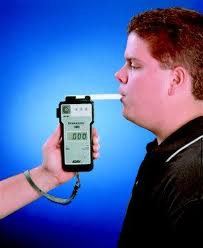
Whilst it is never ideal for a Principal to make his/her students take a  breathalizer test, doing nothing about the problem is far less ideal.

A high school principal in northern British Columbia has been asked to stop using a breathalyzer to test students in school for alcohol use.

A youth said that she and a friend were suspended from Fort St. James Secondary School last week after a blood alcohol screening test showed traces of alcohol.

Civil rights activists call the incident extraordinary and disturbing, but the Ministry of Education has no policy on the use of breathalyzers in public schools.

Kecia Alexis, a first nations student in Grade 11, said she and the other student were suspended after principal Ken Young confronted them when they arrived at school late after lunch.

Both agreed reluctantly to take the test after being threatened with suspension. Ms. Alexis, who said she hadn’t been drinking, said the device gave two “error” readings before she blew the lowest reading, a blood alcohol level of 0.01. (For drivers, the “warn” range for a blood alcohol level is 0.05 to 0.08, while a “fail” is over 0.08.)

Ms. Alexis said she argued with the findings, “but he said he doesn’t talk to students who are drunk. I said, ‘I’m not drunk.’”

She was given a three-day suspension. Despite high drop-out rates for first nations youth, Ms. Alexis returned this week determined to finish her schooling. She said she wants to be a teacher.

Civil rights activists can be a pain in the neck and this is a prime example of their constant interferences. When kids turn up to school and are suspected of being under the influence, it is surely the Principal’s right to do something about it. Breathalizing establishes that there is a problem and therefore fairly allows the Principal to metre out appropriate consequences.

It’s not as if a breathalizer test is invasive or painful. It’s not a blood test or vaccination – just a deep breath.

By not allowing Principals to effectively deal with the problem, civil rights activists are giving tacit approval to kids who decide to turn up to school under the influence. How is that a good thing?

Parents Revolt Against Teacher Who Removed the Word “Gay” From Christmas Carol

December 8, 2011

The teacher who swapped the word “gay”with “bright” so that her class wouldn’t giggle during their rendition of “Deck the Halls” was always going to draw the ire of at least one parents. As much as she may have made the change with the best of intentions, I am sure if she had her time over, she wouldn’t have fiddled with the lyrics:

A Michigan teacher chose to censor the word ‘gay’ from the festive holiday tune ‘Deck the Halls’ and was met by a frosty response from parents.

Parents thought the Cherry Knoll teacher had been naughty and not so nice when the elementary instructor replaced ‘gay’ with ‘bright’ after her students wouldn’t stop laughing when they sang the word.

They took to the school’s Facebook page ranting about the teacher’s decision to change that word in the traditional holiday carol.

Cherry Knoll principal Chris Parker told 7&4 News in Traverse City that he was disappointed the music teacher decided to change the lyrics, saying she could have used the moment for a learning opportunity on tolerance.

‘This would have been a great opportunity to teach that “gay” has more than one meaning and is not a bad word,’ he said.

Enraged parents took to the school’s Facebook page, which has since been disabled, to voice their complaints over the word-swap.

A teacher’s poor choice is not the real story here. The real story is the way the parents handled the situation. Instead of confronting the school or teacher with their displeasure, they did what many parents are now choosing to do, and turned their disapproval into a large-scale Facebook campaign.

I have no doubt that a few quiet phone calls from concerned parents would have been sufficient to provoke this teacher to revert back to the original lyrics and make a profuse apology to all offended. Instead, this teacher had to contend with a barrage of negative comments on Facebook, and now, worldwide media coverage.

This sends a shocking message. It says that whenever parents are upset over the actions of a classroom teacher they can turn to Facebook for a fully fledged smear campaign. This amounts to bullying of the worse kind.

Teachers make mistakes. Some small, some huge. But no well-meaning teacher deserves to be pillaged on Facebook – ever!

I Thought Christmas Was About Good Will?

December 4, 2011


I thought Christmas was about family, community, good will, acceptance, tolerance and togetherness.  Turns out I was wrong.

Should a teacher have told her class that Santa doesn’t exist? Of course not. Should she have told them that their presents are planted under the tree by their parents? Absolutely not.

But here’s where the parents of these children had a choice. They could have had a quiet word to the teacher, accepted her heartfelt apology, practised the long-lost art of forgiveness and not taken the matter any further.

Allowing this mishap to get overblown and on the nightly news suggests that Christmas may not be about real values, but rather, about the “real” Santa:

A teacher ruined Christmas for a class full of second-graders when she told them that there is no Santa Claus during a lesson about the North Pole at their Rockland County, N.Y., school.

The educator even told the youngsters, mostly 7 and 8-year-olds, that the presents under their trees were put out by their parents, and not St. Nick.

The stunning behavior caused a blizzard of outrage at the quiet George W. Miller Elementary School in Nanuet, where angry parents would like to see the teacher roasted like a chestnut over an open fire.

“If that happened to my daughter in her second-grade class … I’d be very upset,” according to 48-year-old Sean Flanagan, whose child was in second grade at the school last year. “If her brothers told her [there was no Santa], they would be punished. So I can’t imagine what should happen to the teacher.”

A nanny picking up a child at the school said that anyone who tells kids that Santa does not exist should get coal in their stocking.

“It’s outrageous that a teacher would strip a child of their innocence and try and demystify something,” 59-year-old Margaret Fernandez said.

A grandmother of a kindergartener added, “I think this is awful. If it happened to my granddaughter, I’d tell her [that] her teacher made a mistake, and there is a Santa.”

The unidentified teacher reportedly made her anti-Santa comments Tuesday during a geography lesson, when students told her that they knew where the North Pole was because that is where Santa lives.

School officials would not discuss the Christmas incident or say if the teacher would face any discipline.

District Superintendent Mark McNeill released a brief statement, saying only, “This matter is being addressed internally.”

Above is one of many scathing reports about this teacher. Let’s examine the facts.

Did she “ruin Christmas” for these kids? If so, their whole enjoyment of Christmas was founded on a lie. If the legitimacy of Santa is the only thing a 7-year-old can take out of Christmas, then they are missing a hell of a lot.

Was this “stunning behaviour”? No. It was a mere lapse in judgement.

Does she deserve to be “roasted like a chestnut over an open fire”? Absolutely not! Whoever wrote that line was being quite unfair and should have been made to delete it.

Did she “strip children of their innocence”? Hardly. Innocence isn’t just about believing everything adults want you to believe, it’s about seeing the good in people. It’s about not being judgemental and giving everyone a chance.

Apparently this teacher rang all the parents in the class and apologised. I think this is a fair consequence for her improper behaviour.

But I think this story is about more than a teachers conduct.

Is it possible that the mad scramble to make kids believe in Santa eclipses the very heart and soul of what the holiday is supposed to represent?