Posts Tagged ‘maths’

Where Have These So-Called “Master Teachers” Been All this Time?

July 19, 2012

I am very frustrated by the lack of investment from many of our “best teachers” in helping mentor their less experienced and less confident colleagues.

In a post in May, I raised the question – Do experienced teachers give enough back to the profession? I argued that these experienced teachers could be a vital resource for improving teacher quality.

It seems President Obama agrees:

President Barack Obama on Wednesday proposed a $1 billion program to recruit high-performing math and science teachers to mentor and evaluate their peers and help students excel.

The so-called Master Teacher Corps program calls for recruiting 2,500 such educators at the outset and increasing that to 10,000 over four years, paying them $20,000 stipends on top of their base salaries. Each teacher would be required to serve at least four years.

To help launch the program, the Obama administration has pledged to release $100 million already available to school districts that have made plans to develop and retain effective teachers of science, technology, engineering and math, or STEM.

Education Secretary Arne Duncan said the plan would raise the prestige of the profession and increase teacher retention.

I just wish experienced teachers could offer more voluntarily without having to be bribed to help with costly incentives.

Click on the link to read my post, Do experienced teachers give enough back to the profession?

The Maths Professor who Understands the Importance of Engaging a Class

July 13, 2012

http://www.youtube.com/watch?feature=player_embedded&v=8-RYxG4smgs

It’s fantastic to see a teacher who understands how important it is to keep the class involved and engaged:

Maths is not usually top of the list when it comes to favourite subjects at school.

But one teacher has found a novel way of getting his pupils attention.

Professor Matthew Weathers starts all his lessons with comical introduction piece – and now his endeavors are causing a stir on YouTube.

In the latest of his videos, the maths genius, who teaches at the Biola University in California, piques the curiosity of students learning about imaginary numbers with an impressive display of computer wizardry.

He creates a double of himself on a computer which appears on a white board behind his desk and then proceeds to chat to his imaginary self.

His class burst into fits of giggles as his double asks him to stop interfering in the lesson, asks him to leave the room and tells him off when he tinkers with the microphone.

The video has already amassed 17,000 YouTube hits.

Mr Weather said: ‘I like asking interesting questions or telling interesting stories but with a smaller class, it’s easier to do tricks on them.

‘I upload my videos on YouTube so my students can see them but then other people start looking at them.’

Children Exposed to Poor Maths Teachers: Ofsted

May 22, 2012

I am not particularly surprised by the finding that bright students, in particular, are being failed by poor maths instruction. It’s been my experience that most teachers come from a strictly humanities (i.e. English, Politics, History) background. These teachers often shirk maths and science as it isn’t their forte.

In a damning report, the watchdog warned that the scale of underachievement at school was a “cause of national concern” that risks robbing the country of well-qualified mathematicians, scientists and engineers.

It said that many of the most gifted children were “insufficiently challenged” at primary and secondary level after being set the same work as mid-ranking classmates.

Inspectors insisted that too much teaching focused on the use of “disconnected facts and methods” that pupils were expected to memorise and replicate without any attempt to solve complex problems in their heads.

Large numbers of pupils are also being pushed into sitting maths GCSEs a year early – forcing schools to completely ignore many of the most demanding algebra topics, it was revealed.

In a highly-critical conclusion, Ofsted said that teaching was not good enough in almost half of English state schools, with almost no improvements being made in the last four years.

I realise that what I am writing is a gross generalisation, but I believe that maths is generally taught in a very abstract and monotonous way. No wonder the students are not benefitting from maths instruction at the primary level. Traditional maths teaching involves worksheets, a mindless array of algorithms and plenty of other rote styled goodies.

The tragedy of it all is that maths can be taught in a completely different way. I find the basic skills of maths the most refreshing and creatively exciting subject to teach. The fact that maths is a composite of everyday skills means it translates wonderfully to problem solving activities.

Teaching Fractions: The Musical

March 22, 2012

As it is very difficult to convey the skills of fractions,  I am keen to see how a new programme that helps students learn fractions to music actually works. Fractions is often the skill that teachers dread to cover. I have heard of teachers that have demanded to teach lower grades just to avoid it.

That is why I am sure that this programme will generate plenty of interest:

For tapping out a beat may help children learn difficult fraction concepts, according to new findings due to be published in the journal Educational Studies in Mathematics.

An innovative curriculum uses rhythm to teach fractions at a California school where students in a music-based programme scored significantly higher on math tests than their peers who received regular instruction.

“Academic Music” is a hands-on curriculum that uses music notation, clapping, drumming and chanting to introduce third-grade students to fractions.

The programme, co-designed by San Francisco State University researchers, addresses one of the most difficult – and important – topics in the elementary mathematics curriculum.

“If students don’t understand fractions early on, they often struggle with algebra and mathematical reasoning later in their schooling,” said Susan Courey, assistant professor of special education at San Francisco State University.

“We have designed a method that uses gestures and symbols to help children understand parts of a whole and learn the academic language of math.”

It will be interesting to see if this programme becomes a success.

Parents Urged to do the Job of a Teacher

March 1, 2012

It is my belief that the job of a parent is to parent and the job of the teacher is to teach. Sure it’s wonderful when parents take it upon themselves to help reinforce skills taught in class. I am always appreciative of parents that spare some time to revise concepts covered during the school day. But essentially, I am paid to ensure that the parents can spend textbook-free quality time with their children. This is in my view essential to maximising the relationship of child and parent. Children often show a reluctance to work through school material with their parents and parents often get very anxious when trying to get their children to concentrate and listen to their explanations.

It is my job to see it that parents are free to spend time with their children without having to go through the ordeal of maths and science work. That’s what they pay me for.

But unfortunately, it seems that we are not doing a good enough job. It seems as if parents have often been given little choice but to try to fill in the gaps we have left behind. You hear too many stories of parents frantically trying to complete their own childs’ homework, sometimes struggling to work out the answers themselves:

A quarter of parents in Reading admit that helping their children with homework leads to family arguments, according to a survey.

Research by tuition provider Explore Learning also showed 9.2 per cent rarely helped their children with homework with more than two thirds struggling when they did.

Maths confuses parents the most with 41.2 per cent of parents finding the subject hard to grasp compared to the 11.1 per cent of parents who find English difficult.

Nationally, nearly a third of parents admitted homework had caused friction in the family with Reading not straying far from the average when it came to struggling in maths and English.

It’s time we let parents bond with their children instead of getting them to do our dirty work. Homework, if administered at all, should be revision of concepts covered in the class. If the children are not capable of doing it independently it shouldn’t have been given to them in the first place.

A Teacher Spits on a Student and I Lay Blame on the Student

February 21, 2012

Teachers that spit on their students should be punished accordingly. It is unprofessional, unhygienic and completely unacceptable behaviour. But there is more to the story of maths teacher David Pecoraro, who was caught on camera spitting at a boy and has since been relegated to administrative duties as a result of his moment of madness.

The video shows clearly a teacher pushed to the edge of sanity. A student trying to attach his used gum on the teachers rear is rightly put in his place by the teacher. Teachers, especially male teachers, are extremely sensitive with the dangers of being accused of inappropriate behaviour. Students that purposely touch a male teacher’s backside are putting that teacher in a very uncomfortable position.

The video also shows the lack of respect he was getting from his other students. As he screams “I want to teach you maths”, we see a student sleeping and others laughing and goading the defiant, foul-mouthed, gum chewing student.

A teacher was secretly filmed on a cell phone struggling with a male student before appearing to spit in the boy’s face.

David Pecoraro, a high school math teacher, is now working in ‘administration’, after the footage was uploaded to YouTube.

Pecoraro, who taught at Beach Channel High School in Queens, New York, has a row with the student for a few minutes before the confrontation turns physical.

Pecoraro is being investigated on allegations of corporal punishment.

The teacher, who has been in the profession for 19 years, can be heard saying in the clip: ‘You can’t make contact with me, that’s illegal.’

He then tries to explain a math problem to the student who is ignoring the lesson and covering his head with a jacket.

At one point, the student, whose identity isn’t revealed, appears to try to hit the teacher.

Pecoraro then tells the teenager: ‘You’re going to go to jail, you don’t touch me… I want to teach you math.’

The altercation is witnessed by a few other students in the class – along with one boy in front of the camera who is asleep with his head on the desk.

The row continues until the teacher appears to spit at the student who then spits back at him.

The grainy film cuts out after Pecoraro can be seen dragging the student out of his seat.

As bad a this teacher’s actions was, the behaviour of the class was absolutely deplorable. This video should be enough to implicate at least two students with some fairly serious breaches of protocol. First there was the student who should be expelled for inappropriate touching and insubordinate behaviour. Then there is the student who filmed the incident. I don’t care how juicy the footage is, any student filming class and uploading the footage on YouTube deserves to be punished.

Instead, I fear that the only person punished was the one who wanted nothing more than the ability to do his job without being touched, mocked or harassed. If those two other students got off without punishment, it reinforces their despicable behaviour, and allows them to continue their bloodsport.

I pity the replacement maths teacher. I fear they are mere fodder for the next potential YouTube hit.

Maths Teachers Who Can’t Pass Maths

February 19, 2012

Sometimes I wonder how well Primary school maths teachers would go if they were forced to sit a basic skills maths examination. I fear many of them would stumble, especially in skills such as fractions.

How much worse it would be to have specialist maths teachers in the high school system with gaps in their maths knowledge. This may or may not be a reason for the inability for some teachers in getting the desired results from their students:

New Westminster parents are pressing their school district to investigate what they say is an exception-ally high failure rate over many years for high-school students enrolled in math classes taught by a particular teacher.

But they say the district has brushed aside their finding that three out of four students in those New Westminster secondary school math classes failed last semester. And recently, in response to their freedom-of-information request for math marks for all Grade 8-12 students in the school, the district told them they would be charged $1,385 to cover the cost of research and photocopying.

One of the parents, Lisa Chao, said she was shocked by the bill and highly doubts that much work is required to produce the information parents believe would back their contention that the teacher has been unsuccessful in teaching the lessons for many years. “This is information … they should have been gathering at the end of every semester,” she said in an interview. “It shouldn’t take more than three hours to print off.”

Parents deserve the right to information when they suspect that a teacher is letting down their children. Schools shouldn’t shy away from being open and transparent, because when they use tactics like the one referred to above, they look like a party to a major cover-up. I have no problems with schools supporting their teachers, but sometimes even the school needs to take an impartial view.
This teacher should be given every opportunity to defend the allegations. However, the doubts about his/her effectiveness seem valid and require a response.

Maths is Taught So Poorly

February 13, 2012

I realise that what I am writing is a gross generalisation, but I believe that maths is generally taught in a very abstract and monotonous way. No wonder the students are not benefitting from maths instruction at the primary level. Traditional maths teaching involves worksheets, a mindless array of algorithms and plenty of other rote styled goodies.

The tragedy of it all is that maths can be taught in a completely different way. I find the basic skills of maths the most refreshing and creatively exciting subject to teach. The fact that maths is a composite of everyday skills means it translates wonderfully to problem solving activities.

The other day, whilst teaching ordering numbers up to 4 digits, I got my 8-year-old students into groups, each given a particular airline to reasearch. The groups had to find the 3 lowest airfares for a return domestic trip between certain dates and times, These prices were then compared and ordered from least expensive to most expensive. Isn’t that the whole point of ordering and comparing numbers?

Whilst engaging in the exercise, the students enjoyed working in groups, competing for a bargain against other groups, learning how to book airline tickets and simply use their imagination by pretending they were actually intending in going on the flight.

Isn’t that more interesting than a worksheet that has numbers on it to order?

This is why I am not at all surprised that British students leave Primary school ‘with the maths ability of 7-year-old’:

An analysis of last year’s SATs results has shown 27,500 11-year-olds are going on to secondary school with the numeracy skills of children four years their junior.

The figures equate to a staggering one in 20 of the total of those leaving primary school. Boys perform worse than girls, with 15,600 behind in their ability.

Separate statistics published two weeks ago also revealed that one in three GCSE pupils fail to get at least a grade C in maths.

The disclosure follows the launch of a Daily Telegraph campaign – Make Britain Count – to highlight the scale of the nation’s mathematical crisis and provide parents with tools to boost their children’s numeracy skills.

It comes amid concerns that schoolchildren are less likely to study maths to a high standard in England, Wales and Northern Ireland than in most other developed nations.

I appeal to Primary teachers to give the text-book a rest and don’t be afraid to try new and exciting ideas to engage your maths students.

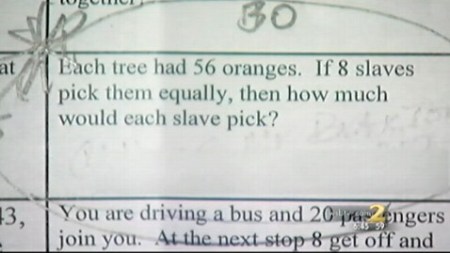
Teachers Administered “Slave” Maths Problems

January 11, 2012

When I first heard about the story of a teacher who wrote maths problems such as, “If Frederick got two beatings per day, how many beatings did he get in 1 week?”, I was as angry as many of the people calling for the teacher’s sacking.

After further contemplation, I am no longer as irate.

This teacher made an awful mistake (and one that will brand him/her, rightly or wrongly, as a racist). It was a very poor choice of maths problem and I am sure that the teacher involved feels very ashamed about their role in this incident. I have to say, that I don’t think this teacher was being racist. But I wont go too far in my defence, as some acts of stupidity defy any plausible defence.

A Georgia school insisted today there was no “maliciousness” intended when a third grade math quiz asked students to compute the number of beatings a slave got a week and to calculate how many baskets of cotton he picked.

But the Gwinnett County School District has launched an investigation to determine how the offending questions made it onto the students’ homework sheets.

The math homework assignment was given to more than 100 students at Beaver Ridge Elementary school in Norcross, Ga., as part of a social studies lesson, Gwinnett County school officials said. The assignment outraged parents, community activists and members of the Georgia NAACP.

Sloan Roach, a Gwinnett County school district spokeswoman, told ABCNews.com that the students were studying famous Americans and as an attempt to create a cross-curricular worksheet, one teacher used Frederick Douglass and slavery beatings for two of the questions.

Although only one teacher wrote out the controversial questions, another teacher made copies of the assignment and it was distributed to four out of nine third grade classes at Beaver Ridge, Roach said. The school is not publicly naming any of the teachers who are suspected to be involved.

In lashing out against the school and its teachers, I think people are missing a small but still important side story. There is a growing obsession in educational circles to integrate the curriculum. Teachers are called on to integrate all subjects under an unbrella topic. For example, as this year in an Olympic Year, many teachers will plan their maths, language, science, art and music classes around the Olympic theme. This can work well, as the topic lends itself quite easily to the subjects listed above.

But then you have a subject like American History and Slavery. You are the maths teacher, and you have to find a way to cover the curriculum whilst at the same time, covering the topic of slavery. This is neither an easy task nor a fair one. I am glad that I haven’t been asked to combine the two, as I would find it all too hard.

It is time we realised that not every topic can be integrated across the curriculum. Sometimes you have to let the maths teacher teach maths, without imposing on them a topic that doesn’t fit well with skills such as chance and data and order of operations.

Was this teacher in the wrong? Absolutely! Was he/she a racist. Probably not. Should the teachers found administering this worksheet be fired? I don’t think so. Should a maths teacher ever be expected to combine maths problems with a slavery topic?

I would have thought the answer to that question was obvious.

Teacher Writes “Stupid” on Student’s Forehead

December 16, 2011

There is no doubt that teachers have a responsibility to maintain their calm and not give in to difficult and challenging students. Whilst this is harder than it sounds, teachers cannot afford to vent at their students.

When people ask me what are some of the most important skills required to be a good teacher, I always mention patience. To me, patience is an essential skill for every teacher. But patience doesn’t come straight away. It often requires years of practise and hard work.

That is why I think it is important to note that the teacher that wrote the word “stupid” on the child’s forehead was in his first year. Yes, he wrong to do what he did. Yes, he deserves to be sacked. But I hope he is not lost to teaching permanently just because of what he did.

A Tennessee teacher’s first year on the job could be his last. He could lose his job for something he did in the classroom.

It’s a simple school supply, but when a teacher, Alex Boles, used a permanent marker to write the word “stupid” on a student’s forehead, the director of Overton County Schools took immediate action.

“One word can break a child I mean I’ve got three children and I wouldn’t want it done to mine,” said Matt Eldridge, Director of Schools.

It happened last week at Allons Elementary. The K-8 school only has a few hundred students just outside Livingston, Tennessee.

One student had a question, and Boles responded and wrote the word on the student’s forehead in front of his classmates.

“The teacher said I was trying to joke with him and of course I’ve tried to talk to him and told him that’s not the way you joke with anyone,” said Eldridge.

Until last week, Boles taught math at Allons Elementary. He was new to the job, he just started this fall, and what many consider his lapse in judgment could cost him in the long haul.

“It’s kind of one of those mistakes that’s hard to correct,” said Eldridge.

The district will allow the teacher due process, but the director said he will insist that Boles lose his job. A big price to pay for a single significant mistake.

I still hold out hope that Mr. Boles has potential to be a very good teacher. It would be great if he was given the support to learn from his mistakes and is given a second chance in another school.  I also hope he apologises profusely to the child involved, as well as the child’s parents.