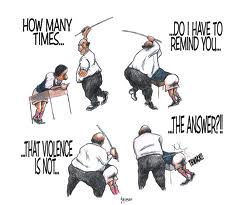
Imagine finally taking the important and highly necessary measure of banning corporal punishment only to take on another absurdly simple-minded strategy in its place. That is what India’s Sindhi Vidyalaya matriculation Higher Secondary School is guilty of:
Candy or cane? City schools seem to have dumped the primitive notion of spare the rod and spoil the child. Instead of wielding the stick, they are now offering chocolates to kids to encourage them in academic excellence and enforce discipline.
“We are strictly against corporal punishment. We hand out chocolates to students if they score good marks and behave well in school. We have realised that it greatly motivates our students,” said Gouri Ramarathinam, Principal, Sindhi Vidyalaya matriculation Higher Secondary School.
Why go from one extreme to another? Is it so difficult to replace a terrible educational policy for a sensible one?
Meanwhile, in Johannesburg banning corporal punishment didn’t change a thing:
Corporal punishment is still common in South African schools even though it was banned more than a decade ago. Recent research showed that up to 70% of primary school and 50% of high school pupils were still subjected to corporal punishment.
In Louisiana corporal punishment is here to stay. But don’t be concerned. They have come up with a foolproof measure for its responsible use – a checklist!:
Corporal punishment is here to stay in Rapides Parish public schools, and members of the Disciplinary Policy Review Committee on Wednesday discussed ways parents can inform a principal if they don’t want their children paddled for infractions.
“Corporal punishment is an acceptable discipline procedure by law … We try and use it as little as possible,” said Ruby Smith, the Rapides Parish School District’s director of child welfare and attendance. “When I was a child in school, corporal punishment worked like butter on toast. I receive few calls from parents saying that they don’t want their child to receive corporal punishment.”
Louisiana House Resolution No. 167 was passed last year that requires principals to fill out a “Corporal Punishment Incident Checklist.”
“Principals will send the checklist to the (School Board office), and once a month, it will be sent to the state Department of Education,” Smith said. “Our first reporting was due in Baton Rouge on the 11th of April, and principals will have to turn one in every month, regardless if they have an incident or not. The officials in Baton Rouge will probably do some study on the checklist.”
Corporal punishment never worked like “butter on toast” for students as it may have for teachers, Ms. Smith! I am sorry to tell you but your checklist isn’t worth the paper it’s written on.
To conclude my thought for the day on this awful means of disciplining kids, I will quote from an article entitled “Schools Under Pressure to Spare the Rod Forever,” Dan Frosch tells the story of one case, and then puts it into larger context:
When Tyler Anastopoulos got in trouble for skipping detention at his high school recently, he received the same punishment that students in parts of rural Texas have been getting for generations.
Tyler, an 11th grader from Wichita Falls, was sent to the assistant principal and given three swift swats to the backside with a paddle, recalled Angie Herring, his mother. The blows were so severe that they caused deep bruises and the boy wound up in the hospital, Ms. Herring said.
While the image of the high school principal patrolling the halls with paddle in hand is largely of the past, corporal punishment is still alive in 20 states, according to the Center for Effective Discipline, a group that tracks its use in schools around the country and advocates for its end. Most of those states are in the South, where paddling remains ingrained in the social and family fabric of some communities.
Each year, prodded by child safety advocates, state legislatures debate whether corporal punishment amounts to an archaic form of child abuse or an effective means of discipline.
This month, Tyler, who attends City View Junior/Senior High School, told his story to lawmakers in Texas, which is considering a ban on corporal punishment. The same week, legislators in New Mexico voted to end the practice there.
Texas schools, Ms. Herring fumed, appear to have free rein in disciplining a student, “as long as you don’t kill him.”
“If I did that to my son,” she said, “I’d go to jail.”


 Topical Teaching