Posts Tagged ‘Literacy’

Reading “Adds a Year to Children’s Education’

February 8, 2012

I’m not sure where Mr. Gibb gets his measurements from, but there is no doubt that our children are not investing nearly enough time to reading. Similarly, if children were to radically change their reading habits, strong improvement would surely follow:

Nick Gibb, the School Minister, said that reading books for just half an hour a day could be worth up to 12 months’ extra schooling by the age of 15.

Speaking ahead of today’s announcement, Mr Gibb said: “Children should always have a book on the go. The difference in achievement between children who read for half an hour a day in their spare time and those who do not is huge – as much as a year’s education by the time they are 15.

He added: “There is a group of children who can read but won’t read – the reluctant readers.

Currently, as many as one-in-six children are still struggling to read when they leave primary school, figures show. One-in-10 boys aged 11 has a reading age no better a seven-year-old.

Failure to pick up the basics at a young age is believed to have serious long-term consequences. A recent international report showed that almost four-in-10 teenagers in England never read for pleasure – considerably more than in other countries.

As teachers, we are responsible not only for seeing to it that our students read at home, but also that they grow to appreciate books. It is essential that our primary teachers choose relevant, engaging books to read to their students whenever the time permits.

The Unique Challange of Teaching Boys

January 31, 2012

There is no doubt in my mind that teaching boys is a more difficult proposition than teaching girls. It is also clear to me that boys have suffered from a traditional classroom setup which has proven far less successful in engaging them than it has for girls.

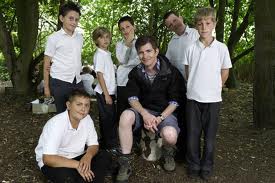
Currently in Australia, local television station ABC1 is showing a brilliant series entitled, Gareth Malone’s Extraordinary School For Boys. Gareth is a choir master and isn’t qualified to teach, but takes on an 8 week trial with a group of underperforming boys in an attempt to improve their literacy skills.

Mr. Malone draws on his three rules for teaching boys:

1. Make the work feel like play.

2. Have a real sense of competition

3. Have a real sense of risk.

I have just finished watching the first episode and fell in love with his unique and creative style. I also enjoyed watching his colleagues putting down his methods, clearly a byproduct of feeling threatened by this novice.

Below is episode 1 in its entirety. All episodes are available on YouTube.

Top 10 Best Children’s Books of 2011

December 18, 2011

Liz Rosenberg of the Boston Globe recently released her Top 10 children’s books of 2011.


“Little Owl’s Night’’ by Divya Srinivasan (Viking, ages 3-7)

This is the most visually and verbally gorgeous picture book of the year. Owl loves the beautiful night and hearing about mysterious daybreak when “[d]ewdrops sparkle on leaves and grass like tiny stars come down . . . the sky brightens from black to blue, blue to red, red to gold.’’ Simple, dazzling – and simply dazzling.

“E-mergency!’’ by Tom Lichtenheld and Ezra Fields-Meyer (Chronicle, ages 5 and up)

What happens when the letter “E’’ has an accident and slides out of the language? Sheer madness, enhanced by Lichtenheld and Fields-Meyers’s unceasingly witty, manic visual, and verbal jokes. “O’’ does most of the hard work; the reading is easy for children and their adults.

“Wonderstruck’’ by Brian Selznick (Scholastic, ages 9 and up)

A worthy follow-up to his Caldecott Medal-winning “The Invention of Hugo Cabret,’’ here Selznick creates a fast-paced illustrated novel full of mystery, pathos, beauty, and, yes, wonder. Whatever book you miss this year, do not miss this one. The twists and turns of plot are breathtaking, Selznick’s use of graphics nothing less than stunning.

“Jim Henson: The Guy Who Played With Puppets’’ by Kathleen Krull, illustrated by Lou Fancher and Steve Johnson (Random House, ages 4-10)

This tribute to the creator of the now iconic Muppets is among the year’s best children’s picture book biographies, alongside my next pick.

“The Watcher: Jane Goodall’s Life with the Chimps’’ by Jeanette Winter (Schwartz and Wade, ages 4 and up)

Both the Henson book and this one about anthropologist Jane Goodall celebrate the eccentricity and passion that drove these two very different characters to become pioneers in their fields.

“The Flint Heart’’ by Kathleen and John Patterson, illustrated by John Rocco (Candlewick, ages 7 and up)

Almost nothing is tougher to do well than a classic middle-grade fantasy novel. The Pattersons have created an inventive confection full of literary allusions, eccentric heroes and heroines, wild adventures, and oddities worthy of a new Alice. Not for the timid, but for adventure lovers with a sense of humor. Great read-aloud.

“The Romeo and Juliet Code’’ by Phoebe Stone (Arthur A. Levine, ages 9 and up)

Phoebe Stone introduced us all to the most irresistible 11-year-old British children’s hero since the inimitable Harry Potter. Felicity “Fliss’’ Bathburn Budwig is no wizard, but an ordinary, touching, witty girl who ferrets out the secrets of her family’s past and present. The prose simply sings.

“Okay for Now’’ by Gary D. Schmidt (Clarion, ages 10 and up.)

“Okay for Now’’ manages to juggle themes of family, bullying, abandonment, greed, art, friendship, and – believe it or not – John James Audubon, all in one remarkable novel. Gripping, hilarious, realistic, the perfect book both for avid and reluctant readers, “Okay for Now’’ should win some major prizes.

“The Barefoot Books World Atlas’’ by Nick Crane, illustrated by David Dean (Barefoot, ages 8 and up)

This atlas does more than simply provide a vivid and up-to-date view of the world -though it does that, too. It shows cultures and connections between countries, bringing a truly global perspective to children in eye-popping color. An altogether invaluable resource.

“What We Keep is not Always What Will Stay’’ by Amanda Cockrell (Flux, ages 12 and up)

When the stone statue of St. Felix comes to life, 15-year-old Angie wonders about more than miracles. Add Jesse to the mix, a troubled Afghanistan veteran with post-traumatic stress disorder. Cockrell balances on the knife’s edge between comedy and tragedy. The depth and darkness of her themes makes an absorbing read for older young adults.


4 Million Children in the UK Don’t Own a Single Book

December 5, 2011

If we continue to sit there passively watching whilst reading and literature dies a slow death, we will be all the worse for it. To read that books are extinct from up to 4 million British homes is quite distressing.

Almost 4 million UK children do not own a book, research suggests.

The latest report by the National Literacy Trust discloses that one in three does not have a book of their own.

The number has increased from seven years ago, the last time the poll was conducted, when it stood at one in 10 youngsters, meaning the number of children without books has tripled.

The latest survey, which was based on a survey of 18,000 children aged between eight and 16, shows that boys are more likely to be without books than girls.

Why parents buy the latest phone for their young children before something they really do need like a library of books is something I’ll never understand.

Cramming the Curriculum With Nonsense

August 20, 2011

I’m sick of losing valuable curriculum time for the purposes of teaching yet another program or peddling yet another campaign.  Whilst I believe that women should be able to breastfeed whenever and wherever they choose to, I don’t see why that message has to interfere with a literacy or maths lesson:

TEENAGERS may be taught in school that it is OK to breastfeed in public.

The Australian Breastfeeding Association wants future generations of mums and dads to view public breastfeeding as acceptable as seeing breasts on TV, in movies and in advertising.

Melbourne TV presenter Andi Lew is joining the awareness campaign, addressing a group of female students at Lalor Secondary College during an ABA presentation this week.

The ABA said research had shown exposure to breastfeeding at an early age positively influenced attitudes later in life.

“The evidence is accumulating that breastfeeding needs to be promoted in schools,” ABA spokeswoman Karen Ingram said yesterday.

“Despite every national and international health authority recommending exclusive breastfeeding for the first six months of a baby’s life, the latest research suggests that the mums and dads of the future don’t fully grasp the importance of breastfeeding.

Please stop taking the workload of teachers for granted by making them continually stop what they are doing in the name of yet another campaign?  Our primary job is to teach literacy, numeracy and science, please let us leave the breastfeeding advice to parents and doctors?

“They are unlikely to breastfeed in public because they feel it’s embarrassing.

Fired For Challenging an Imperfect System

August 9, 2011

The scariest thing about education today is not that it doesn’t seem to be nearly effective enough, but that those that challenge conventions and think outside the square get castigated for their opinions.

I have a great deal of respect for teachers that do things differently, whether their methods work or not.  Experimentation and ongoing reflection is necessary at a time when curriculums all over the world seem stale and soulless.

Firing a teacher for daring to point out the flaws in our system is not acceptable:

New York City teaching fellow Alice McIntosh is fighting for her job at a District 75 school in the Bronx after receiving unsatisfactory ratings from her supervisor – even though she was given glowing recommendations from parents and peers after her second year of teaching.

“Ms. McIntosh should have gotten an award,” said Theresa Smith, 47, whose daughter Vernisha suffers from attention deficit hyperactivity disorder.

Instead, the experienced educator was fired, she said.

Assistant principal William Green, who gave McIntosh satisfactory ratings during the 2009-10 school year at P10X in Throgs Neck, deemed she was unfit to teach this past school year.

“I asked, ‘Why are you U-rating me?'” McIntosh recalled. “[Green] said, ‘I’m not going to get into that right now. I would suggest in your next job that you be more of a team player.'”

A city Department of Education spokeswoman said she could not comment because she was unable to reach Green.

So what did she get fired for?  Merely pointing out the bleeding obvious:
McIntosh said that, as a literacy teacher at the special-needs school, she openly challenged the curriculum and used books she thought were less outdated.

According to observations during the 2010-11 year by Green, her methods appeared to work.

“The teacher activates prior knowledge and incorporates it into the new lesson…. The teacher conducts an excellent development of lesson with clear expectations,” one review reveals.

But that same review was used as a basis for her poor performance, which charges she flunked in “planning and preparation of work” and “control of class.”

Green also cited grounds for the dismal ratings from the 2009-10 school year – when McIntosh received glowing reviews.

It appears that Ms.McIntosh’s great crime was that she was prepared to do things differently in a system where conformity is expected and change is frowned upon.  You are not considered a team player if you are critical or ignore traditions.

This is what is going to be the result of the stinking teacher evaluations.  Teachers who conform and play it safe will keep their jobs, while teachers who challenge the system and try new things will be given a cardboard box to collect their belongings.

Captain Phonics to the Rescue!

July 7, 2011

It’s like the pest that wont go away.  Phonics sneaks up on us all the time, with it’s many proponents insisting it is the missing key in getting literacy levels up to standard.  I doubt that is the case.  In fact, while I think phonics has a minor secondary role to play, if you make phonics the key method for teaching reading, you will almost certainly turn your students off literature.

It seems some British MP’s agree with me:

MPs have criticised government plans to test pupils on their reading ability at the age of six, warning that it will put children off reading for pleasure.

The report criticises the government’s focus on phonics – in which children learn individual sounds and then blend them to read words – as a “mechanical” approach and warns that it will contribute to a decline in literacy.

Fabian Hamilton, who chairs the MPs’ group, said: “If there is a central theme to this, that is, reading must be a pleasure. Of course children need the tools to understand what sounds the symbols make, and what those sounds mean. Phonics is only one way of doing it, there are others.”

The MPs’ report says: “The phonics test is likely to demotivate children rather than ensure that they become eager and fluent readers.”The government is facing a backlash over phonics. Critics, including the United Kingdom Literacy Association, have written to education secretary Michael Gove lobbying him to abandon the test.

The schools minister, Nick Gibb, said: “High-quality evidence from across the world – from Scotland and Australia to the National Reading Panel in the US – shows that the systematic teaching of synthetic phonics is the best way to teach basic reading skills, and especially those aged five to seven.

“It is vital that we focus on the reading skills of children early on in their lives, and give those who are struggling the extra help they need to enable them to go on to enjoy a lifetime’s love of reading rather than a lifelong struggle.”

Surely the greatest contribution a teacher of reading can make is helping to nurture an appreciation and fondness of reading.  Phonics is for most students a giant slog.  Even the expression “systematic teaching of synthetic phonics” is a turnoff.

Phonics has its place, but enjoyment of reading is tantamount.  I want my students to enjoy reading about different people and places, connect with well drawn characters and gain insights. I want them to experinece how reading can trigger emotions, form opinions and nurture their imaginations.

I didn’t become a teacher to turn my students off reading.

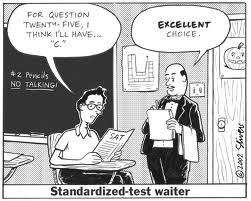
Another Day, Another Standardised Test

July 5, 2011

UK teachers are told to add mandatory phonics tests to the ever-expanding list.  Remember when teaching was about engaging the students not test practise?

This time next year, every year 1 pupil in England is likely to encounter a new national test assessing a central aspect of their ability to read.

The children, aged five and six, will be presented with 40 individual words on paper, and asked to sound them out to their teachers or to another adult. Some words will be familiar to most, while others will be made-up or “non” words such as “mip” or “glimp”, designed only to assess the child’s ability to follow the pronunciation rules, such as they exist, of written English.

The results of this test, or “screening check”, will then be collected, given to the child’s parents and also used to produce statistics on national and local performance and to inform Ofsted inspection judgments on schools.

One leading literacy figure has described the new test as potentially “disastrous”, while another told this newspaper it was an “abomination” and likely to be a major waste of taxpayers’ money. A petition with more than 1,000 signatures against it has been collected.

The debate surrounds the principle of teaching phonics, another boring, routine and old-fashioned way of teaching content that could be conveyed in a far more exciting and engaging way.

Beyond this debate, I feel there is another issue at stake.  The rise of obsessive testing inevitably leads to the curriculum being hijacked by test practise as well as pressure needlessly put on Primary aged students.  These students deserve to have their crucial first years of schooling without the stresses they will confront later on down the track.


Sometimes the Unions Don’t Help

June 26, 2011

There are times when the Education Unions just make me shake my head.  At a time when respect for teachers is at an all time low, unions have the opportunity to help promote the good work teachers do.  Instead, they often make things so much worse.  Take this story for example:

Students will not be allowed to enter teacher training in England if they fail basic numeracy and literacy tests three times, under tougher rules to raise teaching standards.

At present students are allowed to take unlimited re-sits while they train.

The Department for Education said one in 10 trainees takes the numeracy test more than three times, while the figure is one in 14 for the literacy test.

The National Union of Teachers said it considered the tests “superfluous”.

The aim is to improve the standard of students entering teaching.

From September 2012, candidates will have to pass the assessments before they are permitted to begin their training courses.

The tests are the same for both primary and secondary school teacher trainees, who must also have achieved a grade C or above in GCSE maths and English.
What is “superfluous” about ensuring that teachers have basic skills in the areas they teach?  What profession would allow trainees to practice without the requisite knowledge or skill?  It’s not as if the questions are so hard.  Here are a sample of the questions on such a test:

SAMPLE QUESTIONS

  • Q: Teachers organised activities for three classes of 24 pupils and four classes of 28 pupils. What was the total number of pupils involved?
  • A: 184.
  • Q: There were no ” ” remarks at the parents’ evening. Is the missing word:
  • a) dissaproving
  • b) disaproveing
  • c) dissapproving
  • d) disapproving?
  • A: d
  • Q: For a science experiment a teacher needed 95 cubic centimetres of vinegar for each pupil. There were 20 pupils in the class. Vinegar comes in 1,000 cubic centimetre bottles. How many bottles of vinegar were needed?
  • A: 2
  • Q: The children enjoyed the ” ” nature of the task. Is the correct word:
  • a) mathmatical
  • b) mathematical
  • c) mathemmatical
  • d) mathematicall
  • A: b

Too Many Struggling Students Lack Support

June 20, 2011

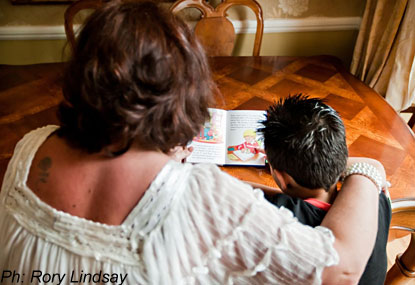
I read a disturbing article about a young boy who struggles with dyslexia, and the trauma his mother has gone through as his school makes little to no effort to assist him.  It is a difficult article for a teacher to read, but a very important one.  There are too many students that fall between the cracks.  Too many that don’t get the attention and support that they so desperately need.  As teachers, we must fight for the social, emotional and academic wellbeing of all our students, whilst ensuring that they are all, without exception, getting the care and attention they need.

Below is an excerpt of the article.  I truly recommend that you read the whole story,

David is an artistically gifted boy with a photographic memory. The 10-year-old’s dining-room table is full of intricately designed Lego battleships, his art displays such originality that his teacher calls him “the next Picasso”, and he has an extraordinary ability to recall facts from the History Channel documentaries he watches on TV.

“The other day,” his 41-year-old mother Margaret recalled, “we were driving along and he said, ‘mummy, you were born in the year the first man landed on the moon’.”

But there is one big problem with David that overshadows his life. He cannot read. He has been assessed as “severely dyslexic” and “having the reading age of a child aged four years and four months”. His schooling has been a disaster and according to educational psychologist reports seen by the Standard, he has progressed “just one month in five years”.

You might assume that David attends a failing, inner-city school, but you would be wrong. His south London state primary is rated “good” by Ofsted, attended almost exclusively by white British-born pupils, and is located in a street of £3million houses. He is also well behaved.

Yet David, his mother said, has been “catastrophically let down by everyone: by his teachers, by the school and by the council”, all of whom failed to give him the specialised help he needs.

Margaret said: “At school the other kids call him ‘odd’ and ‘weirdo’ and he often comes home crying. He is still reading flashcards and has not progressed beyond words like ‘cat’ and ‘dog’. He has no real friends – how can he? He doesn’t get their jokes or their games. To the other kids, he is a misfit who doesn’t understand anything that’s going on because he can’t read.”

“My son was nine and he still couldn’t read a word,” said Margaret. “What were they waiting for? Why didn’t they do something?” 

Finally the school arranged for David to have some specialist teaching – three hours a week at a nearby literacy centre at a cost to the school of £1,000 a term – as well as 15 hours a week one-on-one with the teacher assistant. For the first time he made a glimmer of progress, improving by “one month in a year”. Margaret says the teacher assistant and the literacy centre are not experts in teaching severely dyslexic children.

There is a growing tendency to allow students to pass the year, regardless of their level of skill or maturity.  The reason for this is quite sensible.  Holding a child back can have strong emotional repercussions.  But because such a system exists, not enough questions are asked of students who are languishing.

I am not suggesting for a second that young David should have been kept down.  I am simply suggesting that since teachers no longer have to explain why a child is ready to be promoted, there is less incentive to put the time and energy into children like David.

It is time that we looked into the issue of students being promoted without the basic skills, and ensure that teachers are made accountable for the progress of their students.  David was allowed to fall into the gaps and starved of the support he needed because there isn’t enough pressure on teachers to reach benchmarks.

The story of David breaks my heart because he is a victim to poor teaching, an inept education system and a misnomer that dyslexia renders one academically incapable.