Posts Tagged ‘life’

What Facebook Age Restrictions?

August 4, 2011

There is age rstrictions on Facebook for a reason.  The potential outcomes when a pre-teen uses Facebook are severe enough to warrant it a 13+ age requirement.

But does that stop under age kids opening their own account?  Of course not.

Washington: Some 7.5 million of the 20 million minors who used Facebook in the past year were younger than 13, and a million of them were bullied, harassed or threatened on the site, says a study released Tuesday. Even more troubling, more than five million Facebook users were 10 years old or younger, and they were allowed to use Facebook largely without parental supervision leaving them vulnerable to threats ranging from malware to sexual predators, the State of the Net survey by Consumer Reports found.” Read the rest, here.

And this is a trend we are seeing all over the world.  As important as it is to have this age requirement, it seems too easy to sidestep it.

I believe that if Facebook really wanted to ban under 13’s from setting up accounts, they could.

But do they really want to?

Don’t Expect an Influx of Male Teachers Sometime Soon

August 3, 2011


In an incredibly pointed and honest comment, reader Eric succinctly sums up the difficulties of being a male primary teacher.

As long as society remains in a state of collective hysteria regarding children, more and more adults (especially men) will rightly fear situations where they are in close proximity to children other than their own. Personally, I go out of my way to avoid certain parks, playgrounds and other areas where children congregate, because an unaccompanied adult male seen walking near such areas will arouse suspicion. I don’t mind this situation; I’d much rather be far away and unseen than fall prey to the lynch mob.

Any efforts to “recruit” more men into teaching will only ensnare some naive, unwary men into situations that could land them in prison in the blink of an eye, their lives ruined forever. Men, you have been warned!

These sentiments are almost never expressed but is not a minority view.  Eric is clearly a responsible and ethical person who is all too aware of the constant news reports about sick, deranged and evil male teachers.  Eric and the average parent have every right to feel this way.  The safety and security of children is much more important than the welfare of the male teaching fraternity.

The warning expressed above may not be verbalised very often but it is not lost on men who fleetingly consider teaching before thinking better of it.

Personally, I enjoy my job immensely, pride myself on my professional approach and can cope with the fact that male and female teachers are judged differently in the eyes of some parents.

But for those that desperately want more males in the system – don’t expect an influx too soon.

Putting Your Kids First

August 2, 2011

A recent survey seems to show that many parents prefer rest and a quiet drink than spending time with their kids:

A new survey has revealed that stressed adults prefer to kick back with a bottle of wine, rather than spending time with their partners or children.

Six in ten adults said drinking was their top choice after a stressful day, reports the Daily Mail.

While 28 per cent said spending time with their children helped them relax only 26 per cent opted for talking to their partner, according to the poll of 825 adults conducted by industry-funded charity Drinkaware.

It found people battle stress with up to four drinks on a typical evening at home.

Family dynamics have changed over the years.  Something like the family dinner is quite different now to what it was in the 60’s and 70’s.  Whilst a few drinks is clearly more relaxing than getting the kids ready for bed, it is still important that they receive the love and attention they need.

Ultimately, they need to feel as though they are more important than a drink at the end of a taxing and stressful day.


Introducing -The Truacy Drug!

August 2, 2011

Sooner or later there will be a drug for everything.  No problem self-made or genetic will be without its own medication.

And we will all be worse for it.

I have a very cynical view of the pharmaceutical industry.  I don’t believe what they are telling us about how they are giving children with poor concentration a quality of life they wouldn’t ordinarily have.  Maybe I should buy in to it, but I don’t.  Instead, I believe that they are replacing one problem with the threat of a much bigger problem.  The effect of drugs on a child isn’t fully known yet.  I fear that when we do have comprehensive data on the effects of drugs such as Ritalin on young children, we won’t like what we see.

The latest drug to concocted is a truancy drug.  That’s right, a drug for not wanting to go to school!  It is recommended that no child under 18 take it, but whoops, that rules out school aged children!  Not much point making a truancy drug for adults.

So  they scrap the idea, right?  Nope.  They find a way to trial the drug on kids aged as young as 11:

SCHOOL truants as young as 11 are being given a powerful ADHD and antidepressant drug in a controversial trial.

The drug, Lovan, is not recommended for anyone under the age of 18 but is being prescribed for children as part of a School Refusal Program being led by Professor Bruce Tonge.

Prof Tonge is chairman of a federal government committee setting new guidelines for the treatment of attention deficit hyperactivity disorder.

But the side-effects are minimal, right?  Nope.

Prof Tonge said the children on the trial and their parents had been warned of potential side-effects of Lovan, including suicidal tendencies.

The question I am bursting to ask is, why do we need a drug for something which is a product of  factors likely to be unrelated to the child’s mental state.

But asking that questions will show me up as a pharmaceutical non-believer.  Because logic isn’t important here.  What is important is that every problem must have its own approved drug.

I’d love to write more on this issue but I’ve got to take my pills now.  I’m trialling a new drug for people who don’t enjoy paying bank fees.

Sparing Young Children the Affliction of Body Image

July 31, 2011

A mother not associated with my school told me of her concerns regarding her 3-year old child.  The 3-year old is much shorter than others in her age bracket and the comments about her childs’ height have started to make the child self-conscious.  The mother is worried that the stigma of being much shorter than her peers may deeply erode the child’s self-confidence.  Doctor’s have recommended starting the child on growth hormones to alleviate some of the height discrepancy.  The mother is extremely dedicated and loving, and refuses to take that option as she doesn’t see it in the best interests of her child.

This example highlights a problem that keeps getting bigger and more difficult to deal with.  Why are young children more self-conscious about their body now than ever before?  What are we doing about it?

It seems as if the problem is getting worse and we are becoming less able to respond to it.

Pre-teens have never been so obsessed with their looks and so insecure about their imperfections. I read an article that points to a recent study in the UK where almost 600 children below the age of 13 have been treated in hospital for eating disorders in the past three years.

Many point to the advertising industry.  They blame magazine covers and their gaunt models for creating an unrealistic perception of the average body size and type.

But isn’t advertising just a mirror of our own hopes and dreams?  If they put more meat on Barbie’s unhealthily skinny body, wouldn’t sales be adversely affected?

What bothers me is that parents face an uphill battle with empowering their children to be content with their own looks.  No matter how much time and energy they put into trying to make their children feel secure and attractive, peers and others in society tend to tear them down.

Has the problem gone too far to remedy?  Is blaming the advertisers and media really worth the trouble?  How much power do parents have in helping their children overcome societies unhealthy and unrealistic obsession with body image and beauty?

900 British Students Suspended Per Day

July 29, 2011

It seems student violence is a major issue in Britain.  Reading that 900 students are suspended each day for physical and verbal violence towards teachers and classmates, indicates to me schools in Britain are at crisis point.  It seems that whatever they are doing clearly isn’t working:

Bad behaviour is blighting Britain’s schools with almost 900 children suspended every day for attacking or verbally abusing their teachers and classmates, new figures show.

Every school day 13 pupils are permanently expelled for attacks and abuse and 878 are suspended in England’s primary and secondary schools.

The figures, from the Department for Education, include physical assaults, racist abuse and threatening behaviour.

In total, they show school children were suspended on 166,900 occasions for assault or abuse.

And pupils were expelled on 2,460 occasions.

And the level of violence in primary schools was also high with children aged four and under suspended 1,210 times and expelled 20 times.

Across all of England’s primary, secondary and special schools, boys were around four times more likely to be expelled than girls, with boys accounting for 78 per cent of expulsions

Corporal Punishment and Those 19 American States

July 28, 2011

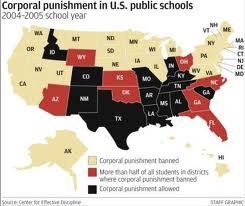
You shouldn’t need a study to tell you that corporal punishment is not a legitimate and ethical means of classroom discipline.  Yet, as I write this, 19 American States still allow corporal punishment.

It’s time they stopped!

Hitting misbehaving kids with sticks might result in immediate obedience, but new research suggests it does more damage than good in the long term.

A new study compared kindergarten and Grade 1 students in two West African private schools. In most ways, the kids were similar. They came from the same urban neighbourhood, and their parents were mostly civil servants, professionals and merchants.

The difference was in how their schools doled out discipline. One school beat disobedient kids with sticks, slapped them on the head or pinched them. These punishments were administered for a wide range of offences, from forgetting to bring a pencil to class to disrupting lessons.

The other school favoured non-physical punishment, with teachers issuing time-outs or verbal reprimands for bad behaviour.

Researchers gave students from both schools “executive functioning” tests, measuring their ability to plan, think in the abstract and delay gratification. While test results for the kindergarten kids were similar across the board, the Grade 1 students from the school with corporal punishment performed significantly worse.

The study’s authors, who hail from the University of Toronto, McGill University in Montreal and the University of Minnesota, say the results are consistent with previous research that showed kids will immediately cease bad behaviour after getting physically punished, but they fail to internalize the morals or rules behind the punishment.

What this means, the authors note, is these kids aren’t really learning the difference between right or wrong, and are likely to re-offend.

“This study demonstrates that corporal punishment does not teach children how to behave or improve their learning,” said Victoria Talwar of McGill University.

“In the short term, it may not have any negative effects; but if relied upon over time it does not support children’s problem-solving skills, or their abilities to inhibit inappropriate behaviour or to learn.”

The Insanity of Modern Educational Thinking

July 27, 2011

Below is an article that exemplified the absolute lack of balance and common sense in our Education system.  To have three separate school uniforms in the one school grounds, with each uniform representing a different learning ability, is just plain insane!  It is demeaning, offensive, inexcusable and achieves the exact opposite of what a school is supposed to achieve.

A school isn’t just a place where information is disseminated.  Schools serve as  a microcosm for society as a whole.  They prepare students for the challenges faced in the real world.  They are supposed to help children realise the importance of responsibility, empathy, teamwork, leadership, perseverance and acceptance.

But do they really?

Children from aged 11 are being segregated, taught in colour-coordinated buildings, playing in separate fenced-off areas and eat lunch at different times.

The move has caused concern that it is stigmatising children who are placed in lower quality sets.

Pupils are ranked as they leave primary school and placed into one of three mini schools at Crown Woods College, Greenwich.

The brightest go to Delamere and wear purple ties and purple badges. The rest go to Ashwood, which wears blue, or Sherwood, which wears red.

The two latter schools are made up of pupils with mixed abilities but are still streamed into three tiers.

Critics have warned that the move is demoralising for pupils and encourages resentment and animosity amongst those in different sets.

Michael Murphy, the head teacher at the comprehensive, said: “I felt if we made explicit the provision for high-ability children we would be able to attract those children and their parents who would rather not put them in to a grammar.”

“Mrs Thatcher said you can’t ignore the market, you have to respond to it.”

Kevin Courtney, deputy secretary of the National Union of Teachers has condemned the practice.

He said: ‘The idea of taking a large school and turning it into three mini schools is likely to be good for [the school’s] relationships, but streaming is a step backwards. It leads to competition for children rather than improvement in teaching.”

Labelling a student based on their current learning level is extremely damaging.  Schools should be doing all they can to eliminating labels and focussing not on what makes us different, but rather, on the things which unite us.  We all want to feel respected and cared about.  We want to be appreciated for the skills we have and supported in obtaining skills that don’t come easy to us.

Instead of drawing attention to discrepancies in ability, we should be drawing attention to the fact that each and every child has unique qualities which make them important.  Just like a vibrant society requires people from all walks of life, political perspectives and skills, a schoolyard does too.

How would teachers like it if they were colour coded according to their teaching ability?

7 Strategies for Dealing With Office Politics

July 26, 2011

The school staff room, like any other office environment, can pose challenges when it comes to dealing with colleagues.  Lawrence Cheok gives 7 fantastic strategies for overcoming  office politics and managing a hostile or competitive work environment.

HABIT #1 – BE AWARE YOU HAVE A CHOICE

The most common reactions to politics at work are either fight or flight. It’s normal human reaction for survival in the wild, back in the prehistoric days when we were still hunter-gatherers. Sure, the office is a modern jungle, but it takes more than just instinctive reactions to win in office politics. Instinctive fight reactions will only cause more resistance to whatever you are trying to achieve; while instinctive flight reactions only label you as a pushover that people can easily take for granted. Neither options are appealing for healthy career growth.

Winning requires you to consciously choose your reactions to the situation. Recognize that no matter how bad the circumstances, you have a choice in choosing how you feel and react. So how do you choose? This bring us to the next point…

HABIT #2 – KNOW WHAT YOU ARE TRYING TO ACHIEVE

When conflicts happens, it’s very easy to be sucked into tunnel-vision and focus on immediate differences. That’s a self-defeating approach. Chances are you’ll only invite more resistance by focusing on differences in people’s positions or opinions.

The way to mitigate this without looking like you’re fighting to emerge as a winner in this conflict is to focus on the business objectives. In the light of what’s best for the business, discuss the pros and cons of each option. Eventually, everyone wants the business to be successful; if the business don’t win, then nobody in the organization wins. It’s much easier for one to eat the humble pie and back off when they realize the chosen approach is best for the business.

By learning to steer the discussion in this direction, you will learn to disengage from petty differences and position yourself as someone who is interested in getting things done. Your boss will also come to appreciate you as someone who is mature, strategic and can be entrusted with bigger responsibilities.

HABIT #3 – FOCUS ON YOUR CIRCLE OF INFLUENCE

At work, there are often issues which we have very little control over. It’s not uncommon to find corporate policies, client demands or boss mandates which affects your personal interests. Bitching and complaining are common responses to these events that we cannot control. But think about it, other than that short term emotional outlet, what tangible results do bitching really accomplish? In most instances, none.

Instead of feeling victimized and angry about the situation, focus on the things that you can do to influence the situation – your circle of influence. This is a very empowering technique to overcome the feeling of helplessness. It removes the victimized feeling and also allows others to see you as someone who knows how to operate within given constraints. You may not be able to change or decide on the eventual outcome, but you can walk away knowing that you have done the best within the given circumstances.

Constraints are all around in the workplace; with this approach, your boss will also come to appreciate you as someone who is understanding and positive.

HABIT #4 – DON’T TAKE SIDES

In office politics, it is possible to find yourself stuck in between two power figures who are at odds with each other. You find yourself being thrown around while they try to outwit each other and defend their own position. All at the expense of you getting the job done. You can’t get them to agree on a common decision for a project, and neither of them want to take ownership of issues; they’re too afraid they’ll get stabbed in the back for any mishaps.

In cases like this, focus on the business objectives and don’t take side with either of them – even if you like one better than the other. Place them on a common communication platform and ensure open communications among all parties so that no one can claim “I didn’t say that”.

By not taking sides, you’ll help to direct conflict resolution in an objective manner. You’ll also build trust with both parties. That’ll help to keep the engagements constructive and focus on business objectives.

HABIT #5 – DON’T GET PERSONAL

In office politics, you’ll get angry with people. It happens. There will be times when you feel the urge to give that person a piece of your mind and teach him a lesson. Don’t.

People tend to remember moments when they were humiliated or insulted. Even if you win this argument and get to feel really good about it for now, you’ll pay the price later when you need help from this person. What goes around comes around, especially at the work place.

To win in the office, you’ll want to build a network of allies which you can tap into. The last thing you want during a crisis or an opportunity is to have someone screw you up because they habour ill-intentions towards you – all because you’d enjoyed a brief moment of emotional outburst at their expense.

Another reason to hold back your temper is your career advancement. Increasingly, organizations are using 360 degree reviews to promote someone.

Even if you are a star performer, your boss will have to fight a political uphill battle if other managers or peers see you as someone who is difficult to work with. The last thing you’ll want is to make it difficult for your boss to champion you for a promotion.

HABIT #6 – SEEK TO UNDERSTAND, BEFORE BEING UNDERSTOOD

The reason people feel unjustified is because they felt misunderstood. Instinctively, we are more interested in getting the others to understand us than to understand them first. Top people managers and business leaders have learned to suppress this urge.

Surprisingly, seeking to understand is a very disarming technique. Once the other party feels that you understand where he/she is coming from, they will feel less defensive and be open to understand you in return. This sets the stage for open communications to arrive at a solution that both parties can accept. Trying to arrive at a solution without first having this understanding is very difficult – there’s little trust and too much second-guessing.

HABIT #7 – THINK WIN-WIN

As mentioned upfront, political conflicts happen because of conflicting interests. Perhaps due to our schooling, we are taught that to win, someone else needs to lose. Conversely, we are afraid to let someone else win, because it implies losing for us.

In business and work, that doesn’t have to be the case.

Learn to think in terms of “how can we both win out of this situation?” This requires that you first understand the other party’s perspective and what’s in it for him. Next, understand what’s in it for you. Strive to seek out a resolution that is acceptable and beneficial to both parties. Doing this will ensure that everyone truly commit to the agree resolution and not pay only lip-service to it.

People simply don’t like to lose. You may get away with win-lose tactics once or twice, but very soon, you’ll find yourself without allies in the workplace. Thinking win-win is an enduring strategy that builds allies and help you win in the long term.


Should Violent Video Games Be Banned?

July 26, 2011

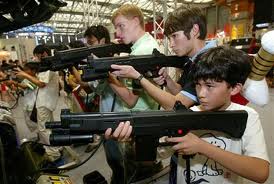
I am glad to see that the recent events in Norway isn’t prompting any knee-jerk reactions in banning violent video games.  Although I dislike violent video games and would not want them in my house, I am not an advocate for banning them from the public.  As much as I despise violence of any kind, I don’t believe that violent games causes violent outbursts.

Proper censorship classifications is a much better approach:

THE Australian government will not back away from new classifications for violent video games despite suggestions they might have played a part in the Norwegian horror, says Home Affairs Minister Brendan O’Connor.

State and federal attorneys-general last week ended years of debate and agreed to support an R18+ classification for video games, with the exception of NSW’s Greg Smith, who abstained.

Mr O’Connor has rejected calls for governments to reconsider their position after revelations that the man accused of carrying out the bomb and shooting attacks in Norway, Anders Breivik, was obsessed with violent video games.

“Because there’s a madman who has done just such atrocities in Norway, I don’t think means that we are going to close down film or the engagement with games,” he told ABC TV yesterday.

Mr O’Connor said that under the new R18+ classification, the 50 most popular adult games could no longer be played by 15-year-olds.