Posts Tagged ‘Family’

The Most Effective Anti-Smoking Ad Ever Conceived

June 22, 2012


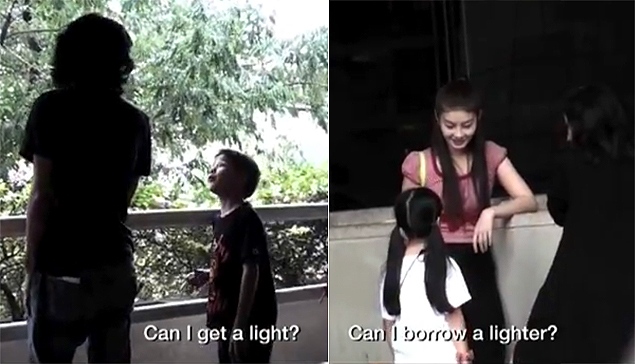
Pure genius! Getting children to ask smokers for a light is a brilliant way to sell the anti-smoking message:

It has been labelled “heartbreaking” and one of the most effective anti-smoking advertisements ever.

The new public service announcement from Thailand shows two small children approaching adults who are smoking and asking them for a light.

Not one of the adults shown in the ad gives the children what they ask for.

Instead the adults — who have no idea they are being set up — begin giving the children earnest lectures on why smoking is so bad for them.

“If you smoke you die faster,” one man tells a little boy.

“Don’t you want to live and play?”

“When you smoke you suffer from lung cancer, emphysema and strokes,” another says.

The children then reveal their trump card, a brochure they hand the adults which reads: “You worry about me. But why not about yourself?”

The video, produced by the agency Ogilvy Thailand on behalf of the Thai Health Promotion Foundation, was uploaded to YouTube a week ago and has since gone viral, attracting more than 350,000 views.

The foundation has reported a 40 percent increase in the number of calls it has received about how to stop smoking.

Are you Addicted to the Internet?

June 21, 2012

Technology addiction is one of the most prevalent, yet socially acceptable addictions. It envelopes both children and adults and can ruin marriages, cost jobs and effect sleep.

Courtesy of Dr Oz and Dr. Kimberly Young, I have accessed a quiz to determine whether or not one is addicted to the internet:

1. Do you feel preoccupied with the Internet (think about previous online activity or anticipate next online session)?
2. Do you feel the need to use the Internet with increasing amounts of time in order to achieve satisfaction?
3. Have you repeatedly made unsuccessful efforts to control, cut back, or stop Internet use?
4. Do you feel restless, moody, depressed, or irritable when attempting to cut down or stop Internet use?
5. Do you stay online longer than originally intended?
6. Have you jeopardized or risked the loss of significant relationship, job, educational or career opportunity because of the Internet?
7. Have you lied to family members, therapist, or others to conceal the extent of involvement with the Internet?
8. Do you use the Internet as a way of escaping from problems or of relieving a dysphoric mood (e.g., feelings of helplessness, guilt, anxiety, depression)?

Other Symptoms Include:

• Failed attempts to control behavior
• Heightened sense of euphoria while involved in computer and Internet activities
• Neglecting friends and family
• Neglecting sleep to stay online
• Being dishonest with others
• Feeling guilty, ashamed, anxious, or depressed as a result of online behavior
• Physical changes such as weight gain or loss, backaches, headaches, carpal tunnel syndrome
• Withdrawing from other pleasurable activities


Teaching Children How to Argue

June 19, 2012

I noticed while teaching students about persuasive writing how difficult they find it to form opinions of their own. It is almost as if children today do what they have learned to do without ever reflecting on the reasons why. This poses a significant problem when it comes to peer pressure. If you don’t have the tools to work out right from wrong, positive from negative, you can be very easily lead.

This unfortunate consequence was part of the findings of a recent study undertaken by the University of Virginia:

WHILE parents have been teaching their kids not to argue with adults for generations, new research shows it may have its benefits.

A study by the University of Virginia shows that young teenagers who are taught to argue effectively are more likely to resist peer pressure to use drugs or alcohol later in adolescence.

“It turns out that what goes on in the family is actually a training ground for teens in terms of how to negotiate with other people,” said Joseph Allen, psychology professor and lead author of the study, results of which were published in a recent edition of the journal Child Development.

Prof Allen said that parents are often “scared to death about peer pressure” but also frustrated by argumentative children.

“What we’re finding is there’s a surprising connection between the two,” he said.

Prof Allen said that teens “learn they can be taken seriously” through interactions with their parents.

“Sometimes, it can be counterintuitive to tell parents to let their teens argue with them,” said Joanna Chango, a clinical psychology graduate student who worked on the study.

In fact, learning effective argumentation skills can help teenagers learn to “assert themselves and establish a sense of autonomy”, she said.

I don’t agree with the assertion that we should encourage our children to argue with us. Instead, teachers and parents alike, should encourage students to question everything, to feel confident to form their own opinions and not to follow a crowd just for the sake of safety in numbers.
Click on the link to read my post on beating peer pressure.

Protecting Your Kids on the Internet

June 13, 2012

Seven very helpful tips on protecting your children online courtesy of expert Dr. Leigh Baker:

1.  Spend time with your child on the computer. Put the computer in a place that can be easily accessed by the entire family. Use the Internet with your child to play games, plan for a family vacation, or learn about new places and people. Ask your child to teach you more about the computer and to show you certain tricks he or she may have learned. Not only will you gain computer knowledge, you will also get valuable information on just how savvy your child is on the computer. Make sure to ask your child what he or she likes on the Internet and to show you favorite sites.

2.  Let your child know that you will be periodically watching and monitoring his or her online activities. (Internet security software from companies like OnlineFamily.Norton often include parental controls that can help you encourage safe surfing.)

3.  Share an online pseudonym, password, and email account with your child. In this way, you can monitor online correspondences and the Internet sites that your child has accessed.

4.  Never, under any circumstances, allow your child to have face-to-face contact with someone they met online without your permission. If you agree to the meeting, accompany your child and arrange for it to take place in public.

5.  Don’t allow your child to go into private chat rooms without your permission and supervision.

6.  Monitor your credit card bill. Many pornographic online vendors require credit cards in order to have access to their sites.

7.  Alert your Internet provider if you or your child come across sexually obscene material.

I hope this proves helpful.

Student Sues School for Failing to Get into Preferred Law Course

May 17, 2012

Does anybody want to take personal responsibility for anything anymore? We are become a society of ‘blamers’. Fancy a student in an exclusive Private school suing for a lack of assistance! Those schools give so much more support than Private school. Did it ever occur to her that getting into a course relies on ones own aptitude over anything else? Did it ever occur to her that there were students studying night and day to get into that course? Meanwhile, it is claimed, she was serving suspensions for coming to class late and failing to complete set work tasks.

A former student of one of Australia’s most prestigious private schools is suing the academic institution after she failed to get into the law course of her choice.

Rose Ashton-Weir, 18, claims that the elite Geelong Grammar School, where Britain’s Prince Charles spent two terms as a student in 1966, did not provide her with adequate support, The Age reported Thursday.

As a result, the teenager’s final high school score was insufficiently high enough to gain admittance to law at the University of Sydney, the Victorian Civil and Administrative Tribunal heard Wednesday.

Ashton-Weir is currently pursuing an arts and sciences degree at the University of Sydney.

She had attended Geelong Grammar, 48 miles (77km) south of Victoria’s capital city Melbourne, in 2008 and 2009, but left to continue her high school education in Sydney.

Ashton-Weir told the Geelong Advertiser that the school had failed her.

‘It was incredibly detrimental to my academic skill and development,’ she said.

Ashton-Weir, who was a boarder at the school, reportedly struggled with mathematics, and scored eight out of 68 in one test. Despite this, she was placed in a regular class. The school’s representative, Darren Ferrari, said every effort had been made to help the teen.

Ashton-Weir’s mother, Elizabeth Weir, is also suing Geelong Grammar, The Age reported.

Weir wants AU$39,000 (US$38,740) compensation for rent she paid when they moved to a new home after her daughter relocated from Geelong to Sydney.

Weir also claims that Ashton-Weir’s move resulted in her giving up her cookie business which would have raked in AU$450,000 over a three-year period.

Ferrari told the tribunal that Ashton-Weir had been suspended several times at Geelong Grammer, was absent from classes often and had failed to complete required school work.

I suppose if she wins this case, it would be ironic. Trust a future lawyer to endorse dodgy lawsuits that puts the ‘blame game’ over personal responsibility.

Adults Need Positive Rolemodels Too

May 2, 2012

Thanks to the explosion of reality television shows we have a vast selection of horrendous parenting examples to choose from. Shows like Toddlers and Tiaras and The Real Housewives of New Jersey as well as Jon and Kate Plus 8 showcase styles of parenting that are not to be emulated.

These shows sicken me because they are intended to make deeply flawed parents feel better about their half-hearted approach to parenting by presenting them with examples of worst practice.  It is not responsible for television networks to give parents the impression that as long as they resist spray tanning their toddler they are doing a satisfactory job of raising their kids.

The trials and tribulations of Octomom is a perfect example of gutter television appealing to parents who haven’t yet earned the right to judge. By focussing on the exploits of Octomom, we have denied parents what they should really be seeing on television – examples of good parenting. Adults, like kids, need to see positive rolemodels who can inspire them to make positive change, alter their priorities and help them make good, sensible and selfless life choices.

It may not rate, but it’s got to be better than this:

“Octomom” Nadya Suleman filed for bankruptcy this week, citing $1 million in debts to her landlord, her father, the water department, DirecTV and Whittier Christian School, where several of her 14 children are students.

In 2008, Suleman, 36, famously conceived octuplets through in-vitro fertilization (as she had done with her previous six children) by Dr Michael Kamrava, and became a national obsession. Since the birth, she has cut deals with media outlets and posed in tabloid photo spreads and promoted products and books that somehow never made it to market. In 2009 she turned down a $1 million offer to appear in an adult video for Vivid Entertainment and is currently relying on welfare, food stamps and Social Security disability payments to raise her 14 children, who are all under the age of 10.

Speaking of sound decision-making, in a reversal of her 2009 decision to pass on porn, Suleman told reporters on Monday night’s “Showbiz Tonight” that these days she’ll do just about anything for the benefit of her brood: “You know if the opportunity comes up, I’ll be the first to admit, I’m gonna eat my words,” she said. “Because all that matters is that I can take care of my family.”

Reality television was supposed to allow the viewer to experience the life of another. This can be a very useful device. It can help the average viewer relate to another person by allowing them to experience life in their shoes. Instead, reality television is content in providing us with the very worst society has to offer.

As a parent with a lot to learn, I am sick and tired of being bombarded with ‘polluted parenting’ on the small screen. Where are the shows that explore helpful advice by experienced parents who have overcome adversity and addressed major challenges?

Surely there is a place for a bit of balance in television scheduling?

Tips for Helping Your Child Adjust to a New School

April 29, 2012

Many parents don’t realise just how difficult it is for children to adjust to a change of school. School cultures can vary radically and the look and feel of a new school (not to mention the rules) can be completely different to what the child has experienced before.

Jason Ladcock from healthguidance.org has compiled a list of helpful tips for assisting children in managing the transition to a new school:

• Before the first day of school, make an appointment to meet with the school principal. Introduce your child to the principal and his new teacher. By doing this, you are helping the child feel comfortable because they feel like they already know someone in their new school on their first day.

• When the child isn’t present, talk to the teacher, and discuss your child’s strengths and weaknesses. This will prevent the child from being placed in classes that are too difficult or easy for them. Trying to keep up in a class that is too hard for your child can add extra stress for them at a time when they don’t need it. Being placed in a class that is too easy has its own problems. Your child may become bored and act out or just not fit in with the other children. Talking with the teacher and ensuring proper placement will ease the transition into a new classroom.

• Be positive. The parent’s attitude has more affect on the child than all the other factors put together. If you have a negative attitude about the move or show nervousness, it will affect your child. Be positive and talk about what a good experience it is to have the “opportunity” to move to a new city and school. Explain that it offers all sort new experiences that they will enjoy.

• Acknowledge your child’s feelings and let him express them. Be sure to tell your child that he can talk to you at any time about problems he is having at school or feelings that he is having. Knowing that you’re there for him will take a lot of stress away.

• Make the first day at school as smooth as possible. Prepare everything the night before – clothes, lunches, school supplies, etc. Rushing on the first day at his new school will make the child nervous before he ever enters the school.

• Let your child know that he is welcome to invite new friends home from school.

• Host an activity at your home for your child’s classroom. This is a great way for your child to get to know the other kids.

• Help your child join extracurricular activities at school. When your child has a common interest with other kids, it is easier to get to know them.

I hope these tips prove helpful. I would love to get your feedback about what has worked for you.

Both a Parents’ Best Friend and Worst Enemy

April 21, 2012

I witnessed a 10 year-old boy having a major meltdown at the shoe shop last Sunday. He acted in an obnoxious way and completely embarrassed his mother. Kicking out in obvious frustration, he berated his mother for taking him to the shop (even though she took him because he needed new shoes!) He screamed out on a number of occasions, “This is so boring!”

It took a while for the mother t0 react decisively. At first she tried to reassure him, then sweet talk him. Finally she decided to threaten him. Nowadays, when a parent threatens their child there seems to be a standard “go to” consequence – the use of the family game console. The mother said, “That’s it! No more Playstation for the rest of the day!”

And then she paused, if only to reflect on what she had just done and whether she was comfortable with the challenges that come with setting such a punishment.

“What?” came the boy’s reply. “No Playstation? For the whole day? Why?”

“Because of your tantrum. I’m fed up with it!”

“But that’s not fair! I was just bored, that’s all!”

And then, as if the penny dropped, the mother realised what she had done. In a haste to punish her child, it dawned on her that she had in fact punished herself. She realised that her child is tolerable in front of the Playstation and a considerable challenge away from it. So she scrambled for an “out clause.”

“If you behave for the rest of your time here I might reconsider.”

Unfortunately, this is becoming standard practice among parents. As much as they hate watching their children becoming couch potatoes and gaming addicts, as much as they wish that they could get their attention quicker and steer them away from these distractions when it’s time to do homework, they have come to rely on it for peace and quiet. Here this mother had the perfect punishment for her son’s terrible exhibition. Following through would certainly be a “game changer.” It would make the statement that if you want to misbehave like that in public again it may come at a major price.

But no, this parent wasn’t prepared to risk ruining the rest of her Sunday for the sake of this statement. She probably wanted her son to be out of sight and mind for the rest of the day and there was no way that was going to happen with the punishment she nominated.

I am not trying to judge this parent. We have all breathed a sigh of relief as our child has camped in front of television or computer screen at some stage.

I am merely commenting on the stranglehold this technology has over parents, children and families.

What Happened to Honesty and Integrity?

April 11, 2012

My generation is going to point to today’s youth at some point (if they haven’t already) and blame them for having less respect and being more selfish than they were when they were young.

That may be so, but who do you think is really to blame?

Last week, as I went to pick up my daughter from school a driver smashed into my parked car.

Did he (could have been a “she”, but I’ll stick with “he” for convenience sake) stop and wait for me to return?

Nope.

Did he leave a note with his insurance details and a contact number?

Nope.

That’s right, he just drove away like some kind of gutless chicken. He probably thought that my insurance would cover the damage and there would be no loss to me.

In reality, even though I have full cover, my insurance company will only pay for the damage over $1000 (I would have to pay for the first $1000). My car is probably not worth that much more than $1000 and I can’t afford to buy another at this stage, so it looks like I’m going to have to walk to work!

This story is not a new one. One of my friends experienced a similar thing on the very same day!

We can blame today’s children for plenty if we want to. But on further reflection, one has to ask – How are they supposed to end up if we can’t get our own act together and become more responsible rolemodels.

The Difficulties of Parenting a Special Needs Child

March 10, 2012


Teaching a Special Needs child can be a most difficult proposition, but parenting one is infinitely harder.

I read a brilliant piece entitled, “6 Things You Don’t Know About a Special Needs Parent.” It’s honesty provides the reader with great insight into the difficulties of raising a child that suffers from a disability. Maria Lin, the author of this wonderful article, is the parent of a 3-year-old suffering from a disorder of the 18th Chromosome. Up until now she has been tight-lipped about her experiences. I have no doubt that this article will serve to educate people like myself and will provide some comfort to other parents who are in a similar situation.

Below is her list of 6 insights:

1. I am tired. Parenting is already an exhausting endeavor. But parenting a special needs child takes things to another level of fatigue. Even if I’ve gotten a good night’s sleep, or have had some time off, there is a level of emotional and physical tiredness that is always there, that simply comes from the weight of tending to those needs. Hospital and doctors’ visits are not just a few times a year, they may be a few times a month. Therapies may be daily. Paperwork and bills stack up, spare time is spent researching new treatments, positioning him to sit a certain way, advocating for him in the medical and educational system. This is not to mention the emotional toll of raising a special needs child, since the peaks and valleys seem so much more extreme for us. I am always appreciative of any amount of grace or help from friends to make my life easier, no matter how small, from arranging plans around my schedule and location, to watching my son while I am eating.

2. I am jealous. It’s a hard one for me to come out and say, but it’s true. When I see a 1 year-old baby do what my son can’t at 4 years-old (like walk), I feel a pang of jealousy. It hurts when I see my son struggling so hard to learn to do something that comes naturally to a typical kid, like chewing or pointing. It can be hard to hear about the accomplishments of my friend’s kids. Sometimes, I just mourn inside for Jacob, “It’s not fair.” Weirdly enough, I can even feel jealous of other special needs kids who seem to have an easier time than Jacob, or who have certain disorders like Downs, or autism, which are more mainstream and understood by the public, and seem to offer more support and resources than Jacob’s rare condition. It sounds petty, and it doesn’t diminish all my joy and pride in my son’s accomplishments. But often it’s very hard for me to be around typical kids with him. Which leads me to the next point…

3. I feel alone. It’s lonely parenting a special needs child. I can feel like an outsider around moms of typical kids. While I want to be happy for them, I feel terrible hearing them brag about how their 2 year-old has 100 words, or already knows their ABCs (or hey, even poops in the potty). Good for them, but it’s so not what my world looks like (check out Shut Up About Your Perfect Kid). It’s been a sanity saver to connect with other special needs moms, with whom it’s not uncomfortable or shocking to swap stories about medications, feeding tubes, communication devices and therapies. Even within this community, though, there is such variation in how every child is affected. Only I understand Jacob’s unique makeup and challenges. With this honor of caring for him comes the solitude of the role. I often feel really lonely in raising him.

4. I wish you would stop saying, “retarded,” “short bus,” “as long as it’s healthy… “ I know people usually don’t mean to be rude by these comments, and I probably made them myself before Jacob. But now whenever I hear them, I feel a pang of hurt. Please stop saying these things. It’s disrespectful and hurtful to those who love and raise the kids you’re mocking (not to mention the kids themselves). As for the last comment, “as long as it’s healthy,” I hear a lot of pregnant women say this. Don’t get me wrong, I understand and share their wishes for healthy babies in every birth, but it’s become such a thoughtless mantra during pregnancy that it can feel like a wish against what my son is. “And what if it’s not healthy?” I want to ask. (My response: you will be OK. You and your child will still have a great, great life.)

5. I am human. I have been challenged and pushed beyond my limits in raising my son. I’ve grown tremendously as a person, and developed a soft heart and empathy for others in a way I never would have without him. But I’m just like the next mom in some ways. Sometimes I get cranky, my son irritates me, and sometimes I just want to flee to the spa or go shopping (and, um, I often do). I still have dreams and aspirations of my own. I travel, dance, am working on a novel, love good food, talk about dating. I watch Mad Men, and like a good cashmere sweater. Sometimes it’s nice to escape and talk about all these other things. And if it seems that the rest of my life is all I talk about sometimes, it’s because it can be hard to talk about my son. Which leads me to the final point…

6. I want to talk about my son/It’s hard to talk about my son. My son is the most awe-inspiring thing to happen to my life. Some days I want to shout from the top of the Empire State Building how funny and cute he is, or how he accomplished something in school (he was recently voted class president!). Sometimes, when I’m having a rough day, or have been made aware of yet another health or developmental issue, I might not say much. I don’t often share with others, even close friends and family, the depths of what I go through when it comes to Jacob. But it doesn’t mean that I don’t want to learn how to share our life with others. One thing I always appreciate is whenever people ask me a more specific question about my son, like “How did Jacob like the zoo?” or “How’s Jacob’s sign language coming along?” rather than a more generalized “How’s Jacob?” which can make me feel so overwhelmed that I usually just respond, “Good.” Starting with the small things gives me a chance to start sharing. And if I’m not sharing, don’t think that there isn’t a lot going on underneath, or that I don’t want to.