I wonder if the firing of a yoga teacher for setting sensible standards of behaviour will soon apply to us school teachers:
For years, yoga instructor Alice Van Ness has started her classes with a simple request – that students turn their cell phones off.
She brought that policy with her to Facebook, where she began teaching a weekly class at the company’s Menlo Park campus in March. But it proved to be a hard policy to follow for at least one employee, who began tapping away on her phone in the middle of class. And after Van Ness shot her a disapproving look, the instructor found herself out of a job.
The 35-year-old San Carlos resident was fired last month after managers at the fitness contractor she worked for explained that saying “no” to Facebook employees is a no-no.
A HIGH school teacher allegedly obtained naked and semi-naked pictures of two 14-year-old girl students at his school after posing as a teenage boy on a fake Facebook profile.
It is understood police will allege the country teacher pretended to be a schoolboy of a similar age from another regional town in a ploy to prey on the girls.
The students are believed to have sent him naked and semi-naked photos of themselves via the social networking site.
The teacher, who has been sacked and cannot be named for legal reasons, faced court this week on two counts of involving a child in child exploitation.
Until now, The Sunday Times has been prevented from publishing any details of the case.
After successfully challenging the terms of the original suppression order on the case, The Sunday Times is now permitted to reveal certain aspects of the allegations, which have prompted a warning from cyber safety experts for parents to educate their children about the importance of safety settings on Facebook for the coming school holidays, which started yesterday.
This is why I am a strong proponent of the no contact rule in schools. Whilst the vast majority of teachers are good citizens, there are still too many sick, evil predators still to be exposed.
Click here to read my post, “Why Can’t Teachers Touch Kids any More? :O’Brien”.
Facebook has done a great deal in highlighting examples of horrible parenting to the rest of the world. Incidents which were once conducted behind closed doors are going public.
Video posted to Facebook is causing outrage in many circles, and Missouri’s Department of Social Services may be investigating it. The images show a fist fight between two small children, with the mother of one of the kids egging them on, even offering instructions to the tiny combatants.
“Got some action! Got some action!” the woman can be heard yelling as she shoots the video. “Y’all better ball up some fists!”
The video was posted to Facebook on Sunday. An acquaintance of the mother in question alerted FOX 2. She asked not be identified, but spoke in an interview Tuesday.
“It’s just sickening and I feel like there should be some kind of criminal action taken,” she told us. “I couldn’t even watch the whole video. I had to stop it and look again. It was sad.”
She says the urging of the mother was as disturbing as the pictures themselves.
“Ball up your fist. It’s like she’s training her before she starts school or something. It’s sad because today’s society in the black community its really sickening that these kids are learning how to fight, get guns and stuff, and it shouldn’t be going on.”
“Wow,” was the initial response of St. Louis child psychologist Russell Hyken after we showed him the images.
“That’s pretty overwhelming. Those are small children that really don’t even understand what is going on. I mean one child is screaming and the other child continues to go after her. I mean what is going on here?”
I have absolutely no sympathy for child sex offenders and I am happy to strip them of all privileges that can be used to trap children.
Merlyn Horton is wrong to argue that educating children is better than banning sex offenders from social media. All children must be educated on issues related to cybersafety. But education is not nearly enough. We have a duty to do far more than educate our children. We have a duty to do everything in our power to protect impressionable kids:
Educating children is a better way to protect them from online predators than banning sex offenders from social media sites or forcing them to disclose their crimes on social networks, says an online-safety spokeswoman.
Merlyn Horton was commenting after recent moves in the U.S. to use legislation to crack down on Internet sex predators.
For predatory pedophiles, social networks and the Internet are an “open avenue,” expert Merlyn Horton said, adding resources would be better directed to educating youth rather than trying to enforce bans or requiring Internet users to disclose crimes.
Horton noted there have been cases in Canada where individuals have been barred from using the Internet because of their crimes against children. But instead of through legislation, this has been done through conditions on parole or bail release, she said.
Even then, people can find ways to easily circumvent the restrictions.
“I remember a particular case I got called on,” she said. “The guy was accessing and luring children through the public library.”
Two Californian brothers have been arrested after allegedly making a video showing two young children punching, kicking and choking each other as a group of kids and an adult watch.
Gabriel and Agustin Gamboa, 23 and 24 respectively, were arrested on June 29 and charged with contributing to the delinquency of a minor after Los Angeles TV station KTLA saw the footage and alerted police.
Agustin posted the video on his Facebook page last Wednesday under the title “My nephew messed him up for picking on his home boy”.
The two-minute video shows two boys aged four and five wrestling on the ground and kicking and punching each other.
At one point in the clip Gabriel can be seen moving some cheering children out of shot so his brother can have a clear view as he films.
Facebook are using their own lack 0f vigilance as an excuse to relax very important age restrictions. Instead of giving up on protecting minors, Facebook should try harder to stop under ages kids from accessing their own Facebook page:
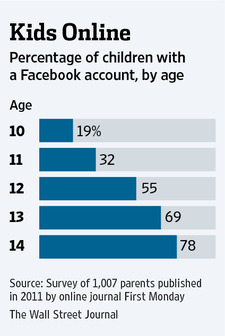
Facebook is still mulling over whether to open its doors to those aged under 13, but in Malaysia, nearly 250,000 children, some as young as seven, have already signed up on the world’s biggest social network.
The young Internet users, like millions worldwide, have managed to avoid the age-restriction ruling by lying about their age, sometimes with the help of their parents.
When a nasty Facebook page that invites children to bully others is “flooded” by students of a particular school, isolated punishments is not enough. The most important step in this circumstance is to investigate the school’s culture and ask the following question:
Why, with all the awareness about bullying, are our students engaged in spreading rumours and making sexual taunts?
GEELONG students have flooded a Facebook page built to spread sexual taunts, rumour and nasty gossip.
The page victimising students from years 7 to 12 at Oberon High School features swags of hurtful, bullying comments.
A parent said she became distressed after stumbling across the Facebook page earlier this week.
She said her child had been bullied at the school and she feared others would suffer emotional and social effects similar to her child.
“When I got on to the page and I just felt totally disgusted and really horrible because half of the kids on this page I know and you couldn’t get sweeter kids,” the woman, who asked for her identity to be withheld, said.
“They’re the kids that won’t speak up and say this is wrong so somebody has too.
“These types of things can have serious effects on kids.”
Oberon High School is investigating the page with acting principal Elizabeth Kelly saying the school, which was made aware of it on Tuesday, was in the process of speaking with students.
I am glad that the school has not washed their hands of this incident. They have a lot of work to do.
Whilst I am sympathetic to the 13 year-old boy that wishes to play netball, I don’t think it’s appropriate for a teenage boy to play in an all-girls team. Not only will boys ruin the enjoyment that girls have for the sport but girls are entitled to raise concerns about the body contact that exists within the game.
MEMBERS of a junior netball club have slammed a VCAT decision to allow a 185-centimetre tall, 13-year-old boy interim permission to play in an all-girls’ competition.
Despite Netball Victoria discouraging teams from speaking out, the coach, parents and players from one of the boy’s rival teams, St Therese’s of Essendon, say it would be a disaster if VCAT made the ruling permanent that boys can play in the 15 and under matches.
They fear it would smash girls’ confidence on court, and spell an end to girls having the choice to play in a team of their own gender. St Therese’s head coach Dianne McCormack wrote to The Age saying it was not a personal comment on the boy, who plays for Banyule in the Parkville Netball association’s 15 and under C Grade.
A St Therese’s C-Grade player, Ally, 12, has written to the sports minister and Netball Victoria saying that when she played against the boy in the 13 and under competition, ”no one wanted to play a strong defence because it meant you had to put your body up against his”.Ally said when she got older she might want to play mixed, ”but now I just want to play against other girls”. ”Most boys I know are already bigger and stronger than me.
”Please stick up for me and all girls who play in girls’ competitions. I don’t think it’s fair for any boy to take away my right and any girl’s right to play in an all-girls’ competition.”
The moment Facebook first made the sensible and responsible age requirement rules they have been trying to soften, if not repeal them. The age restriction guidelines exist for the safety and wellbeing of underaged children. Yet we are constantly confronted with the reality that Facebook is desperate to recruit the underaged demographic.
An alliance of consumer rights groups on Monday pressed Facebook not to aim advertisements at preteen children or track their activities online if it formally opens its site to them.
Facebook has millions of underage users who claim to be over the required age of 13, and the company has had discussions with some advocacy groups over how to keep children safe on the site if they insist on signing up.
The topic of whether children under 13 should be on Facebook is hugely contested. One side argues that under no circumstances should young children be permitted on a social networking site, and another argues for an array of restrictions and conditions on how they can use the site.
The groups that sent the letter on Monday to Mark Zuckerberg, chief executive of Facebook, include Consumers Union, the Center for Digital Democracy, Consumer Action and the Consumer Federation of America. They called on Facebook to refrain from tracking children under 13 both on the Facebook site and on other sites that have Facebook widgets, such as the “like” button. In addition, they called on Facebook to enable parents to monitor and review their preteen children’s activities, offer parents “granular control” over every application they use on the Facebook platform and keep children’s account settings as private as possible.
The letter read: “We want assurances that any space created for children under the age of 13 on the site is safe, parent-guided and controlled, and, most importantly, free of ads.”
Advertising is not the only reason Facebook would want to allow under-13s on its site. It could widen its user base, guard against children becoming attached to another social network, and potentially build a trove of information on users as they grow into adulthood. By developing special conditions for them, the company could also protect itself from a federal regulation that requires companies that gather information about children under 13 to obtain written consent from their parents; those regulations are being revised.
It seems as though Facebook cares more about indoctrinating more young lemmings onto their database than protecting the safety and wellbeing of our children. I have stated before my firm belief that children under 13 do not have the maturity to warrant the privilege of having a Facebook page.
You may argue that many 13 year-olds defy that rule and go and get one anyway. This is unfortunate, and something their parents ought to take an interest in, but at least in this instance there are laws that are being broken. It would be decidedly worse if the age requirement rule was abandoned altogether.
Facebook Inc. is developing technology that would allow children younger than 13 years old to use the social-networking site under parental supervision, a step that could help the company tap a new pool of users for revenue but also inflame privacy concerns.
Mechanisms being tested include connecting children’s accounts to their parents’ and controls that would allow parents to decide whom their kids can “friend” and what applications they can use, people who have spoken with Facebook executives about the technology said. The under-13 features could enable Facebook and its partners to charge parents for games and other entertainment accessed by their children, the people said.
Facebook currently bans users under 13. But many kids lie about their ages to get accounts, putting the company in an awkward position regarding a federal law that requires sites to obtain verifiable parental consent before collecting personal data from children.
Any attempt to give younger kids access to the site would be extraordinarily sensitive, given regulators’ already heightened concerns about how Facebook protects user privacy. But Facebook, concerned that it faces reputational and regulatory risks from children already using the service despite its rules, believes it has little choice but to look into ways of establishing controls that could formalize their presence on the site, people familiar with the matter said.








 Topical Teaching