Posts Tagged ‘Education’

Another Sickening Case of Bullying

May 20, 2011

No school should ever congratulate itself on any achievement until they have adequately tackled bullying.  I am sick of reading about horrific cases of bullying.  I hope those involved in the alleged incident below get a fair hearing.  But if they are found guilty of bullying, I advise the school to make an example out of them:

DALLAS – A 12-year-old special needs student in Dallas says he doesn’t want to finish the school year after he was allegedly wrapped in tape and beaten by a group of students.

The district is investigating the incident that apparently happened Monday at Bowde-Storey Middle School during Martin Mitchell’s science class. A substitute teacher was in the classroom.

“I went in the science room and people were in there acting crazy and stuff and throwing paper around and listening to stuff on the computer that they weren’t supposed to be listening to,” Mitchell said. “And the teacher, he was just sitting there watching them.”

With his mother and grandmother present, he described how he said four boys taped him up and beat him.

“They put me in a headlock and they had wrapped tape around my body and stuff where I couldn’t breathe at all,” he said. “They had hit me then I fell to the other side and they start kicking me and stuff. That’s when I start crying and one little girl she helped me get out of the tape.”

District officials said the students were allegedy involved in the incident will be disciplined according to the student code of conduct. The substitute teacher has been placed on the “do not call” list.

Police were at the school on Thursday interviewing students.

“I just didn’t realize what my child was going through at school everyday,” said Keneshia Robinson.

She said her son had complained about students taunting him because he has special learning needs.

“He was already getting beat up at school and I wish I had of listened and I wish them teachers had of listened,” Robinson said.

The boy said doesn’t want to go back to school.

“’Cause that school be out of control and stuff,” he said.

A video of the story is available by clicking on this link.

I hope the substitute teacher never teaches in the classroom again.  Additionally, I hope that girl who stripped away the tape and came to the boy’s aid gets commended for her actions.  I would love it if the media could giver her 15 minutes of fame.  She sounds like the perfect role model for young impressionable kids.
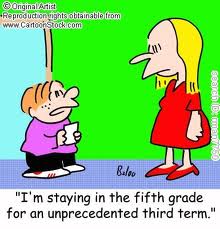

Is There Any Benefit in Children Repeating a Year of School?

May 20, 2011

The findings of a study I came across recently claims that not only is there no benefit in making a student repeat a year level of school, but that it actually does some harm:

The study, by Deakin University’s Dr Helen McGrath, also found students who repeated a year were 20 to 50 per cent more likely to drop out, compared to similar students who progressed.

Dr McGrath reviewed dozens of studies by academics in Australia and the United States over the past 75 years comparing the outcomes for students with specific needs who were either held back or allowed to progress.

She said those studies failed to support the popular assumption among teachers and parents that repeating a year helped a student’s academic performance.

“There may be an occasional student who is the exception, but for most students providing them with more of what didn’t work for them the first time around is an exercise in futility,” she said.

“In fact, repeating a year confirms to a student that they have failed.

“They experience stress from being taller, larger and more physically mature than their younger classmates. They miss their friends who have moved on to the next year level.

“They also experience boredom from repeating similar tasks and assignments. Their self esteem drops. All of these factors ultimately lead many to drop out.”

There also appears to be no benefit in holding children back from starting school because they were not seen to be “school ready”.

“If a child is old enough to enter primary school, then holding them back and enrolling them in an additional year of preschool appears to provide no academic or social advantages and may in fact be detrimental in many cases,” she said.

Dr McGrath said simply promoting the struggling student to the next year level was not the answer either.

She said schools needed to consider more effective alternatives to support students who experienced social, behavioural or academic difficulties.

These included identifying problems at pre-school level and developing programs to address them, creating individual education plans, providing specialist support and adapting the curriculum to the needs of the student.

“Multi-age classrooms and peer tutoring also provide ways of supporting students who may be struggling,” she said.

Whilst I respect the findings of this study, the trend of promoting students for no other reason than to protect their self-esteem is quite challenging for teachers.  It means that the child is often far behind, is often missing basic skills and therefore cannot understand advanced concepts and sometimes disrupts the other students.  It means that there will be students that can’t read or write properly entering into high school.

How is that beneficial to the child?  How does being set vastly different work to ones classmates make that child feel any less of a failure?

Teachers will generally do anything they can to accelerate the divide between struggling students and the rest of the class.  The last thing they would ever want is for any of their students to suffer emotionally.

At the same time, the current closed mindedness of education experts when it comes to repeating year levels is a concern.  Surely, at some point, the child has a better chance repeating a year than they do being promoted on the back of under developed skills?

I am in no way an advocate for making children repeat year levels.  But I am also mindful that gaps can grow, and the result of a skills divide in the classroom can have a lasting effect on both class and struggling student.

I suppose it just goes to show the importance of good teaching in the early years, alertness in spotting any learning problems or difficulties and a well run and resourced Special Education/Remedial Education department.


Cyberbullying Even More Prevalent Among Girls

May 18, 2011

A recent survey found that girls are especially affected by cyberbullying:

Tweens and teens are both flocking to social networking sites like Twitter and Facebook to stay connected with each other. While used correctly this can be a positive thing the sites are also being used as weapons to facilitate cyberbullying.

Norton Canada recently completed a study called The Norton Cyberbullying Survey asking Canadian parents about their children’s online experiences. A quarter of the parents said that their child had been involved in a cyberbullying incident. Of those children 66 percent of the parents said their child was a victim and 16 percent admitted that their child was the bully.
More shocking is that 32 percent of parents are unsure of their children’s online behaviours but 44 percent fear that their child’s online behaviour could involve coming in contact with an online predator.

While on the schoolyard the victims of bullies often are male when it comes to the cyberspace playground girls are the ones being bullied. Parents revealed that 86 percent of those bullied were their daughters compared to a rate of 55 percent when it came to their sons.

Computers are not the only tools being used as a weapon for cyberbullying. Cyberbullies turn to cell phones with middle schoolers using this tool more often.

Even though it’s not legal for children under the age of 13 to access social networking sites 43 percent of parents are comfortable when their children aged 8-12 have an account as long as the parents can supervise them. While almost half of parents claim they have an open dialogue with their children about their online behaviour 32 percent feel that they can’t control all the environments where their children have access to social networking. This access includes what their children are doing in school.

One wonders how parents can be comfortable with their underage children on Facebook considering these damning statistics.  Firstly, aiding your children in breaking a law is not a good example to set, and secondly, supervising your child’s internet and social media use is easier said than done.  Why does an 8-year old need a Facebook page anyway?

Boys and Reading: The Constant Struggle

May 18, 2011

The results of a recent survey found that boys don’t enjoy reading and fail to get past 100 pages of a classroom text.  Should we be surprised?  Boys have been disconnected from reading for years, and the question has to be asked – what have we done about it.

The findings are an indictment on how inflexible we are at altering the way we teach:

Many secondary school boys do not have the stamina to read beyond the 100th page of a book, research suggests.

Teachers also revealed that classics of English literature, such as those by Jane Austen, are putting boys off reading.

Some 70% of the 500 teachers surveyed for publishers Pearson said boys had switched off by the 100 page mark.

This is leading many teachers to ditch longer novels in favour of shorter books, it adds.

Teachers were asked to identify points where boys would switch off in class when novels were being read.

A quarter said that the interest cut-off point happened within the first few pages of a book.

A further 22% said interest waned within the first 50 pages, while a further quarter identified the 100 page mark.

Nearly a third of the teachers questioned said boys were put off before the book had even been opened, if they saw it had more than 200 pages.

According to the research, Shakespeare plays including The Tempest, Macbeth and A Midsummer’s Night Dream were particularly unpopular, as was Steinbeck’s 1930s classic, Of Mice and Men.

The reluctance to read could partly explain the achievement gap between boys and girls.

Last year 85% of 11-year-old girls reached the expected level in English for their age compared to 76% of boys. In reading, the gender gap was even more stark at 79% for girls and 64% for boys.

According to children’s organisation Unesco, the biggest single indicator of a child’s future success at school is whether they read for pleasure.

The research is timed to coincide with the launch of a new series of books called Heroes aimed at secondary school pupils which aims to switch boys back on to reading and get them past the crucial 100-page mark.

Best-selling author Frank Cottrell Boyce, consultant editor on the series, said: “Pleasure can’t be taught. Pleasure can only be shared.”

He added that boys should be started on shorter books.

Jonathan Douglas, director of the National Literacy Trust, said its research showed that boys lag behind girls not just in literacy skills, but in the amount they read and in the extent to which they enjoy reading.

“This gets worse as children get older. This is a vital issue and one the National Literacy Trust is working hard to address. More needs to be done to engage boys’ and building on their own interests.”

He added that publishers had a crucial role to play in this.

On the subject of publishers, an author who recently read my yet to be published manuscript, commented that had I made my main character a girl instead of a boy, I would have an easier time convincing publishers to publish the book.  She said that since boys don’t read, a girl would have been a more appropriate choice. The comment shocked me.  At no stage did I ever envisage the book to be strictly a book for boys.  I always thought it would be of universal appeal.  But apparently publishing companies don’t see it that way.

Shakespeare and Steinbeck are wonderful, but were never intended to be ones first foray into literature.  Is it so wrong to choose something of lesser literary acclaim for something more contemporary?  The sad reality is, teachers tend not to gravitate to Steinbeck and Shakespeare for their own leisure reading and don’t have strong connection to the texts the curriculum requires them to teach.  For a teacher to effectively inspire their students to love reading, they must love reading.  For students to read beyond page 100, the teacher needs to do more than set reading homework – they need to show the class how enjoyable and meaningful the book is to them.

When I read my manuscript to kids, I am overwhelmed by how much they enjoy the characters and situations.  I love how they connect with the main character and his issues and are able to relate to what he is going through.  Somebody once asked whether the kids enjoy it, not so much for the quality of the writing, but because the author, who has such a deep connection to the material, reads it out with such enthusiasm and joy.

Maybe so.  But isn’t that the key?  For boys to enjoy reading, they must see that their teacher enjoying it too.  If that means dispense with the classics and let the teacher decide what texts to introduce to the classroom – so be it.

Parenting, Like Teaching is a Balancing Act

May 17, 2011

Society only knows two ways of dealing with a given problem.  The two ways I speak of, are the two extremes at opposite ends of the spectrum.

Take teaching for example. On the one hand you have the advocates for a teacher centred approach.  This philosophy maintains that the teacher must be strong, exact discipline and be emotionally distant from the students.  It considers empowering students to be weak and counter productive.

Pretty extreme, huh?

Well unfortunately, so is the alternate philosophy.  The child centered approach to teaching, puts the emphasis on the child to direct learning, make critical choices and set the agenda.  Discipline takes a back seat in this approach as does rules and the authority of the teacher.

Both approaches are extreme.  Both have good ideas, but miss the most important aspect of any philosophy – balance.  In truth, both approaches can be melded into one by a teacher who can incorporate both styles of teaching through constant adjustment and introspection.

Unfortunately, parenting experts tend to take on unbalanced and incredibly extreme positions.  A few months ago we had the infamous Tiger Mother, who postulated that restricting her children from enjoying play dates and leisure time helped instill happiness in their lives.

Of course, there will always be an extreme position, advocating the exact opposite:

MEET the “serenity parents” – pizza and cartoons are in, too much sport or trombone lessons are out.

A US author is urging parents to lighten up and let their children have more fun, instead of obsessing over their lives.

Dr Bryan Caplan said modern mums and dads worried too much, and should take a back seat.

He advocated “serenity parenting” as an antidote to tight control and a plethora of extra-curricular activities, saying they would make no difference when children grew up.

Dr Caplan gives guilt-ridden parents the nod to let their children watch more television, and quit activities they don’t enjoy.

The father of three, including twins, has penned the new book, Selfish Reasons To Have More Kids: Why Being A Great Parent Is Less Work And More Fun Than You Think.

Dr Caplan, an economics professor at George Mason University in Virginia, said research on twins had shown genetics was more important than upbringing in moulding children.

“The most prominent conclusion of twin research is that practically everything – health, intelligence, happiness, success, personality, values, interests – is partly genetic,” he wrote in a Wall Street Journal column.

“With a few exceptions, the effect of parenting on adult outcomes ranges from small to zero.”

South Morang mother of two Renee Mayne relates to serenity parenting, saying she strives to create a stress-free home for daughters Maddison, 4, and Milly, 2.

“If we can balance a relaxed environment, where we listen, create boundaries and instil good values it’s not only serenity parenting, but a balanced lifestyle,” she said.

Parenting is the hardest job in the world.  So-called parenting experts try to give us quick fixes that sound easy, but miss the mark on two crucial factors.

1.  No child is the same.  There is no perfect parenting technique that will work on all kids;

2.  These methods almost uniformly lack balance.  Whilst it wouldn’t sell books, the best approach to take is to try a whole series of common sense ideas, whilst continually modifying and adjusting ones style according to what works for a particular child at a particular time.

I find that the best experts don’t preach to others, because they are aware that every child responds differently to situations and parenting styles.  And every child presents a unique challenge to their parents.

No, Dr Caplan, parenting children effectively invariably isn’t  “less work  than you think.”

Brilliant Clip of a Head Teacher Dancing

May 13, 2011

One of the great education clips of the year!  It showcases the best in what this wonderful profession can offer:

Teachers at Bell Baxter High School in Cupar, Scotland shocked pupils by breaking into an impromptu dance routine in the school canteen.

Led by the rector Phil Black, the event was watched by 600 people.

Senior pupils were about to go on exam leave and the teaching staff wanted to give them something to smile about before the hard work began.“They asked if the grumpy old head teacher would lead the way so I was delighted,” Black said.

The routine, which featured The Village People’s YMCA and Michael Jackson’s Thriller had to be rehearsed in secret but according to organiser and student Chloe Simpson, it was time well spent.

“It was crazy,” Simpson said. “The whole school knew something was going to happen but didn’t know what.

“When Mr Black just started dancing, it was amazing … just absolutely incredible.”

Other students said they never expected it get such a reaction overseas – thousands around the world have watched it via the internet – and the BBC coming to the school to interview them.

If only the staff in my school could have done something like that when I was a student.  It certainly beats detention!

Should a Teacher Intervene When a Fight Erupts?

May 12, 2011

What is a teacher to do when a fight erupts in their classroom?  That is the question doing the rounds at the moment, thanks to the case of a Dallas teacher who responded to a fist fight in his classroom by doing absolutely nothing.

Video of a student punching another student in a local classroom has sparked a debate about student safety. More precisely, should teachers get involved to break up fights?

The Dallas Independent School District said it is still investigating a fight that apparently happened this past Thursday at Seagoville High School. The district believes YouTube video of the incident likely tells only part of the story.

The video shows 17-year-old Michael Milczanowksi getting punched over and over during geometry class. His teacher stands by watching as he appears to take several blows to the head.

While it may seem the teacher could have intervened, a teacher’s union president said that is not what teachers are told to do.

“In today’s society which is a violent society, you do not touch the student. That should be left up to the administration,” said Rena Honea of Alliance-AFT. “I believe that that is for the safety of number one the students, but for the individual teacher as well.”

The district said it has no policy on how teachers should handle student fights because every situation is different.

“The altercation on the video shot at Seagoville High School is clearly inappropriate. The district has zero tolerance for violence in the classroom and has responded accordingly,” DISD said in a statement.

DISD said the student who threw the punches in the video has faced disciplinary action and could face assault charges. But the district would not comment on if the teacher was disciplined because “it’s a personnel matter.”

The video of the fight can be viewed by following this link.

The teacher has been supported by both school and union based on the fact that teachers are not covered for injuries incurred from breaking up a fight.  Why not?  Why can’t a teacher in today’s age have insurance cover for injuries, both incidental and reckless, at the hands of students?

And just because he may have the right to refrain from breaking up a fight, how is it excusable for him to sit back and watch as his student is being punched by a classmate?  Why wasn’t the teacher instructing someone to call for help?  Where is the urgency?  Why doesn’t he react in any way?

What is the point of calling yourself a safe and secure environment for children if you are not compelled to actively and decisively do everything in your power to ensure that your students are safe?

It’s time for insurance companies to remove the stumbling block that deters teachers from breaking up fights.  It’s time for schools to improve their culture and hand out severe consequences for bullies and bullying behaviour.  And it’s time for teachers to do what they can to curb bullying and protect victims.

Too Many Underage Kids Use Facebook

May 11, 2011

I personally believe that the age restrictions for setting up a Facebook page is quite reasonable.  A child 13 and over is able to make far better decisions and possesses a much greater depth of perception and maturity than a pre-teen.  I think it is very unfortunate that millions of children under 13 have bypassed these restrictions and currently have their own Facebook accounts.  The potential harm of misusing Facebook can not be overstated:

Millions of children are active on Facebook in violation of the site’s terms of service, which require users to be at least 13 years old, according to a survey released Tuesday by Consumer Reports.

The magazine said it estimates that 7.5 million of the 20 million minors on Facebook are younger than 13. More than 5 million children in this group are 10 and younger. These youngsters are vulnerable to predators and bullies, as well as Internet viruses and malware, because they are using Facebook with little parental oversight, Consumer Reports said. The magazine said it projects “1 million children were harassed, threatened or subjected to other forms of cyberbullying on the site in the past year.”

Minors can skirt Facebook’s terms of service by falsifying their birth date when they register for the free site. Facebook has procedures in place to find underage users, including reports from other users, and will permanently delete those accounts if detected.

Consumer Reports said the best way for parents to monitor their children’s Facebook activities is to “friend” them via the site. However, only 18 percent of parents of children 10 and younger have done so. This figure rose to 62 percent for parents of children 13 and 14.

In a response to the Consumer Reports survey, Facebook noted that “there is no single solution to ensuring younger children don’t circumvent a system or lie about their age. We appreciate the attention that these reports and other experts are giving this matter and believe this will provide an opportunity for parents, teachers, safety advocates and Internet services to focus on this area, with the ultimate goal of keeping young people of all ages safe online.”

Online security is a concern for adults as well as minors. Consumer Reports’ survey showed that 21 perent of Facebook users with children at home have posted those children’s names and photos on the site. According to the magazine, 15 percent of Facebook users have posted their current location or travel plans and 34 percent have shared their full birth date. This exposes consumers to identity theft and stalking, Consumer Reports said. In addition, one in five Facebook users has not used the site’s privacy controls.

The magazine compiled its results from its national State of the Net survey, which covered 2,089 online households and was conducted earlier this year. About 150 million Americans are on Facebook.

The social networking company has addressed safety as recently as last month, announcing that it has revamped its Family Safety Center, an online portal with resources for parents and teens. Facebook also said in April  that it plans to release a free guide for teachers on how to safely use social media in the classroom.

“We agree with safety experts that communication between parents/guardians and kids about their use of the Internet is vital,” Facebook said, adding: “Just as parents are always teaching and reminding kids how to cross the road safely, talking about internet safety should be just as important a lesson to learn.”

So is it the role of a teacher to teach children about safe internet practices and responsible internet use?  Yes, to an extent.  However, as one of my readers, Anthony Purcell, wrote so succinctly in a comment on a similarly themed post:

I am a little frustrated that teachers are being the ones that are to teach children how to be good digital citizens. Where are the parents? They should be helping out as well. Unfortunately, I know that many parents don’t know how to be a good digital citizen. There are sites out there that teachers can build to help students out with this. Should they be on Twitter and Facebook in primary school? No, but we can set up ways to help them begin their good digital citizenship roles.

I couldn’t agree more.  Parents, we can only do so much to ensure that your children make responsible decisions on the internet as well as in other spheres.  The rest is up to you!

National Testing Leads to Bad Teaching

May 10, 2011

Today school students all around Australia are going to be sitting the dreaded NAPLAN tests – a National test covering language, literacy and numeracy.  A test many children don’t take all that seriously, leaving their teachers to explain disappointing results and unmet expectations.  The students will often sit for the test without ever finding out how they went afterwards.  Why should they?  For all they know, this test is nothing more than a hurdle requirement that seems to stress the teacher out far more than themselves.

And that’s where these tests fail.  The pressure placed on the teacher forces them to teach to the test.  Weeks out from the NAPLAN date, teachers forgo their best laid plans, and instead force their students to undergo countless practice tests and mindboggingly boring skills sessions.  The students don’t know what hit them!  All of a sudden, they are bombarded with these tedious, non-interactive lessons, where the teacher often loses his/her temper in a state of panic and utter desperation.

“Guys, if you don’t listen, you wont know what to do come NAPLAN time.”

This argument is futile.  They know that if they don’t understand how to answer a question, all they have to do is leave it out, or better yet, guess.  No need to lose sleep over it!

For teachers, these tests are becoming even more important, now that test results are connected with teacher bonuses:

TEACHERS are continuing to “teach to” national literacy and numeracy tests, despite warnings from education authorities.

The first of three days of NAPLAN testing begins for year 3, 5, 7 and 9 students across the country today.

But educators warned the pressure being put on schools to perform well was having unintended consequences.

And the weight placed on NAPLAN results will increase today when the Government links them to financial bonuses for the country’s best teachers.

Today’s Budget is expected to commit $425 million to provide bonuses of up to $8100 to the top 10 per cent of teachers.

Victorian Association of State Secondary Principals president Frank Sal said that some schools were already under pressure to post high NAPLAN scores, even before they were linked to teacher bonuses.

While many schools have been doing practice exams to prepare for this week’s tests, parents have been told they can do nothing to boost their children’s performance.

Australian Curriculum, Assessment and Reporting Authority chair Prof Barry McGaw said regular learning was the best preparation for students: “NAPLAN is not a test students can prepare for, because it is not a test of content.”

Gone are the days where good teaching meant innovative and engaging lessons.  Gone are the days when teachers were valued for new, fresh approaches to developing skills and nurturing the collective sel-esteem of the class.  No, nowadays teaching is about meticulously preparing for a test that comes every 2 years in a student’s life and ultimately doesn’t truly capture what they know and what they are truly capable of.

These lessons can be monotonous, lack opportunities for critical discussion and go against the grain of authentic teaching, but as long as you persist, there may be a bonus in it for you.

YouTube: The WikiLeaks of Education

May 9, 2011

YouTube is doing to schools what WikiLeaks has done to governments.  It is threatening to blow the lid on the kind of events that used to remain hush-hush.  Yet again, a damaging YouTube clip has surfaced, that exposes the violence in our schoolyard.  No longer can we pretend it doesn’t exist:

Click on the link below to watch the video.

School fight club.

DRAMATIC footage of a punch-up between students at a Melbourne high school will be investigated.

The clip, posted on YouTube, shows two Hampton Park Secondary College students trading blows while being egged on by up to 20 onlookers.

One combatant suffers a bloodied nose, while spectators call “Knock out, knock out”.

Acting principal Sue Glenn said she was shocked by the footage, and would investigate and punish those involved.

“I was completely unaware of this incident or video. However on now seeing it, I am totally appalled,” she said.

“This is not the behaviour we accept at Hampton Park Secondary, which has 1300 students who are well behaved and great kids.

“I will be taking this matter extremely seriously and definitely investigating this incident and then taking the appropriate action.”

Ms Glenn said the two students involved in the fight were no longer at the school, but the involvement of all onlookers would be investigated.

Students are heard calling “Go crazy at him” and “Do it, do it” as blood drips from the nose of one of the fighters.

At least two people filmed the fight last year. It was put on YouTube in January.

Education Minister Martin Dixon said the internet posting of schoolyard fights and bullying was a concern.

“We still have a real issue out there in our schools and we still need to be doing more in terms of educating our children and teachers and parents,” he said.

Mr Dixon said the Government had committed $14.5 million to anti-bullying programs in schools in this week’s Budget.

He said social media had made tackling bullying and schoolyard violence all the more difficult.

“It’s a complex problem, and when we see it manifested in these sorts of videos, it just shows there’s a large degree of misunderstanding (about the consequences),” Mr Dixon said.

“It shows an abject ignorance to what bullying and violence is doing to victims.”

Where do I start?

Firstly, here is another case of a Principal unaware of a major fight in the very schoolyard they preside over.  Where are the teachers?  Who is supervising?  How did this big crowd and the attention this fight would have garnered, go completely under the radar of the authorities?  How was a child with what looks like a broken or at least badly bloodied nose, able to hide his injuries?  And don’t tell me this was the first incident of such a nature.  Those onlookers seem like they have seen it all before.

And what about the minister who shows concern, not for the violence at school, but instead to the filming and public dissemination of the violence:

Education Minister Martin Dixon said the internet posting of schoolyard fights and bullying was a concern.

It sounds like a case of ,” I am not too bothered by schoolyard fights, just as long as they don’t go viral.”

I am very happy to hear that the onlookers are going to get punished for their involvement and I think that filming acts of violence is abhorrent.  However, now that the clip has been broadcast, it is important to use it as an impetus for positive change.

The following is my advice to schools:

Hampton Park Secondary School is now going to have to make swift and decisive changes to its procedures.  It is going to have to improve its quality of supervision, enforce stronger consequences for taking part in acts of violence in the schoolyard and punish passive onlookers.  Take note of what they do, and employ their new policies in your school instead of waiting for something like this to make your school look bad.

As uncomfortable as it is to be exposed in the way that WikiLeaks and schoolyard YouTube clips have been able to do so well, it does teach all involved a very important message.

It’s high time you started lifting your game!