Posts Tagged ‘Cyber Bullying’

Engaging in Gossiping Isn’t as Pleasurable as it Seems

August 15, 2013


face

Not enough is done to confront the issue of gossiping at classroom level, even though it is a significant factor in bullying (cyber related bullying in particular). Gossiping does monumental harm in the classroom. It is divisive, negative and presents enormous problems for a teacher trying to improve the mood of the class and confidence levels of each student.

It is important to draw attention to a recent study showing that engaging in gossiping isn’t as pleasurable as it first seems:

It is used by millions of people to stay in touch with friends and family.

But far from brightening their day, Facebook could be making its users more unhappy.

Scientists have found the more time individuals spend on the social networking site, the worse they subsequently feel.

More than one in three Britons use Facebook every day, with 24 million logging on to share their latest goings on.

‘On the surface, Facebook provides an invaluable resource for fulfilling the basic human need for social connection,’ said lead researchers Dr Ethan Kross, a psychologist at the University of Michigan.

‘But rather than enhance well-being, we found that Facebook use predicts the opposite result – it undermines it.’ Research carried out earlier this year at the University of Chester suggested Facebook friends are no substitute for the real thing.

It found people are happier and laugh 50 per cent more when talking face-to-face with friends or via webcam than when they use social networking sites.

And the current study backed these findings, with participants who had direct interactions with other people feeling better over time.

In contrast, the more individuals used Facebook during the period, the greater the reduction in their life satisfaction levels.

‘This is a result of critical importance because it goes to the very heart of the influence that social networks may have on people’s lives,’ said co-author John Jonides, a cognitive neuroscientist at the University of Michigan.

The research, published in the journal Public Library of Science ONE, looked at the browsing habits of 82 young adults, all of whom had smartphones and Facebook accounts.

5 Internet Safety Rules to Share With Your Kids

July 29, 2013


cyber

Courtesy of Millionaire Hoy:


1. Never give out any personal information

The internet can be a very misleading place for a child. When they think of the internet, they think of games, funny video and pictures, and having a great time; not internet predators. Internet predators leverage the happy perception children have of the internet and come off as nice people in order to pry information from unsuspecting children. Let your children know that they should never share their real name, address, school, city, parent’s information, or any clues that can lead an identity thief or pedophile to your child.

2. Downloading is off limits without supervision

Downloading is one of the most popular activities on the internet, but it can be dangerous. Make sure your children understand that while downloading wanted files, they might be downloading unwanted things as well. Virus authors, identity thieves, and online con artists know that parents are hip to most of their tricks and are now targeting free children’s gaming sites, because they can easily fool children. Let your children know that they never allowed to download files unless you are there to monitor their downloading.

3. Strangers are still strangers even if they are online

As I stated earlier, children look at the internet in a very different way than adults and children make friends very easily. It’s likely that your children know not to talk to strangers in the real world, but online adults can pose as children. It may be hard for your children to understand this and they might not even be aware why an adult would want to pose as a child. Let your children know to be suspicious when making friends online and tell them to let you know any time they make a new friend.

4. Keep your passwords private

If your child makes a friend online, they might be led to do things that they wouldn’t do, if not for the sake of friendship. A child might feel that they are betraying their child if they don’t do what’s asked and online predators will take advantage of this situation. It’s important that your child never reveal their online passwords because online scammers can compromise their accounts and gain private information associated with the account.

5. Bring any suspicious or uncomfortable information to your parents

If your child encounters something online that makes them feel uncomfortable or someone that makes them feel pressured, it’s important that they know to bring it to your attention immediately. If your child is sent pictures in poor taste, contacted by someone that’s asking uncomfortable questions, see something disturbing online, or are linked to a strange website, they need to know to stop what they are doing immediately and let you know about the situation.


Click on the link to read Introducing the App that will Give Parents Nightmares

Click on the link to read Teachers Who Rely on Free Speech Shouldn’t be Teachers

Click on the link to read Bullying is Acceptable when it’s Directed to a Teacher

Click on the link to read Punish Bullies and Then Change Your Culture

The Researchers into Cyberbullying Should Review Their Findings

June 27, 2013

palm

The latest research into cyberbullying claims that boredom is responsible for this immensely damaging practice. Well, I believe the research is completely and utterly wrong.

Boredom is not responsible for a person acting in a harassing manner. Boredom doesn’t compel a person to systematically go about about damaging the reputation and self-esteem of another. No, cyberbullying comes about when the perpetrator either has a low opinion of himself, is angry with their life or is playing up to the wrong people.

Research like this is not helpful because it takes a abhorrent activity and reduces it to something innocent – boredom:

Boredom is behind many incidents of cyberbullying and trolling on social media sites, according to the first major study into the matter.

Linguistics expert Dr Claire Hardaker, of Lancaster University, studied almost 4,000 online cases involving claims of trolling.

She has revealed the methods most regularly used by trolls on sites such as Facebook and Twitter to trigger outrage for their own amusement.

Click on the link to read The Use of Facebook in Cyberbullying Activity
Click on the link to read A Positive Approach to Tackling Cyberbullying

Should Schools Intervene to Stop Cyberbullying?

August 11, 2012

Schools need to decide what they represent. Are they merely a place for learning or are they also a place where students can feel safe and secure. If the latter is true, schools must do everything in their power to protect their students, regardless of whether the fight is online, offline, on school property or in the local mall.

Unfortunately, some school officials see it differently:

In reviewing its existing bullying and cyber bullying policies during Monday night’s meeting, administrators and school board members discussed what role the district should play in cyber bullying, particularly when purported bullying takes place out of school.

“I don’t think we need to be the police and the DA’s office for everybody,” board member Louis Polaneczky said. “Have we done enough to exclude things that really aren’t our jurisdiction?”

A caring school will make it their jurisdiction!

Click on the link to read Psychologist Claims Cyberbullying Concerns are Exaggerated

Click on the link to read Teachers Who Rely on Free Speech Shouldn’t be Teachers

Click on the link to read Bullying is Acceptable when it’s Directed to a Teacher

Click on the link to read Punish Bullies and Then Change Your Culture

Psychologist Claims Cyberbullying Concerns are Exaggerated

August 5, 2012

I can’t believe a psychologist would go on record claiming that the recent attention on cyberbullying is overstated:

Old-style face-to-face bullying is still the way most young people are victimized, even though it’s cyberbullying that seems to get all the headlines, an international bullying expert told psychology professionals Saturday.

Reports of a cyberbullying explosion over the past few years because of increasing use of mobile devices have been greatly exaggerated, says psychologist Dan Olweus of the University of Bergen in Bergen, Norway. He says his latest research, published this spring in the European Journal of Developmental Psychology, finds not many students report being bullied online at all.

“Contradicting these claims, it turns out that cyberbullying, when studied in proper context, is a low-prevalence phenomenon, which has not increased over time and has not created many ‘new’ victims and bullies,” the study finds.

The reason that such attention has been devoted to cyberbullying awareness is three fold:

1. Cyberbullying numbers are growing. Why should we dismiss something until it becomes a problem we are not prepared for?

2. Cyberbullying is, more than likely, the most destructive for of bullying. Unlike face-to-face bullying that happens in schoolyards and parks amongst a finite group of people, cyberbullying penetrates the safest room (the victim’s bedroom) and can be easily disseminated to an audience of thousands.

3. Teachers can deal with school bullying. It is much harder for significant adults to monitor cyberbullying.

Cyberbullying should never be diminished in any way.

Click on the link to read Social Media: A Playground for Bullies

Click on the link to read Teachers Who Rely on Free Speech Shouldn’t be Teachers

Click on the link to read Bullying is Acceptable when it’s Directed to a Teacher

Click on the link to read Punish Bullies and Then Change Your Culture


Social Media: A Playground for Bullies

August 3, 2012


For all it’s benefits, social media is an invitation for bullies to wreak havoc:

The Internet can be a hostile place, and Twitter is no exception. According to a new study, about 15,000 bullying-related tweets are posted every day, meaning more than 100,000 nasty messages taint the digital world each week.

To further understand what happens in the virtual world, researchers from the University of Wisconsin in Madison trained a computer to analyze Twitter messages using an algorithm created to point out important words or symbols that may indicate bullying. In 2011, during the time of this study, 250 million public tweets were being sent daily — a number almost 10 times the population of the state of Texas.

Click on the link to read Teachers Who Rely on Free Speech Shouldn’t be Teachers

Click on the link to read Bullying is Acceptable when it’s Directed to a Teacher

Click on the link to read Punish Bullies and Then Change Your Culture

If You Can’t Beat Them, App Them

July 15, 2012

Fantastic story of a father who was so concerned about his son being bullied at school that he created an app to help his son and others deal with the problem:

A SYDNEY dad whose son was bullied at school has fought back by creating an iPad app in order to help other children dealing with the same problem.

The first program of its kind, The Dandelion Project has been taken on by Apple and it will be rolled out globally in August.

Galvin Scott Davis, 40, from Marrickville, came up with the concept for the story when his son Carter, now eight, was being bullied at school.

Created as a book series as well as an app, he used a dandelion because it grows in most countries and is associated with the idea if you blow on it you can make a wish.

He said: “Some kids aren’t really in a position to counteract bullying. The story was created to make something which would get him to talk to me about it.”

The child in the story, Benjamin Brewster, can’t physically counteract the bullies so he uses his imagination.”

On the app, children can blow on the dandelion and see it scatter, while making a wish.

The project will also include the topics of cyber bullying, female bullying, and look at the story of the bullies themselves.

Luke Enrose, who worked on the Harry Potter films and Charlotte’s Web, also took part in the project.

Click here to read my post, ‘The Meteoric Rise of the Educational App’.
Click here to read my post, ‘The Benefits of Educational Apps’.

Bullying is Acceptable when it’s Directed to a Teacher

July 3, 2012


Bullying of all kinds is abhorrent.

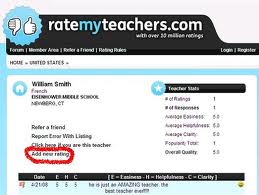
When a child is bullied it is rightly considered unlawful, yet when a teacher is bullied it’s considered free speech. The only thing stopping the vulgar website Rate My Teachers from being banned is the fact that it is an American website which is allowed to operate under the guise of free speech.

The teachers’ union wants the Education Department to shut down a website it says allows students to make defamatory and slanderous comments about their teachers.

The State School Teachers Union council resolved recently to write to the department asking it to close the Rate My Teachers website that some students use to abuse teachers personally and professionally.

“The website has allowed anonymous postings for some years, many of which would be found to be defamatory and slanderous of teachers if tested against legislation,” the resolution said.

The US-based website’s rules state posts will be removed if they contain profanity, name-calling or vulgarity, but recent comments about WA schoolteachers include “She is a whore”, “He is a douche bag” and “Sadistic bitch, she is a horrible teacher”.

Other posts say teachers are “bad” or “completely incompetent”. The website emerged in Australia six years ago, but this is the first time the union has made a formal request for help from the department.

Can you imagine if there was a website called ‘Rate My Students’?

Freedom of speech? I don’t think so!