Posts Tagged ‘Children’

Kids Fight Back Against Bullying

September 10, 2011

I just watched an absolutely incredible movie featuring 4th and 5th Grade students about dealing with bullies and bullying.  As the intro to the movie explains:

The following movie was developed with a cast and crew of only 4th and 5th Graders (and one 1st Grader) from Glendaal Elementery School.  They worked during recess, lunch, before and after school for 3 months.  They hope it helps shed some light on the issues of bullying, and helps anyone who might be experiencing the effects of bullying.

As someone who is currently preparing to make a movie with my Grade 5’s, I was blown away by this technical and artistic achievement.  The kids act beautifully, the direction is solid and the script is very effective.  I hope this garners worldwide attention and gets used in classrooms all around the world.  These kids have done more for bullying awareness than any anti-bullying program I know of.

Please show this video to your kids/class and let them enjoy the message.  You may want to use it to inspire your class to make a powerful film of their own.

Enjoy!

Parents are Worried and So They Should Be

September 9, 2011

Parents are clearly worried about their children’s online activities.  They are worried about the content they get access to and the people they befriend and chat with on social media sites such as Facebook.

In a nationwide survey conducted by legal information website FindLaw.com, it was revealed that 67 percent of 627 parents are extremely worried (10%), very worried (18%) or somewhat worried (39%) about their children’s safety online. About 20% said that they are not very worried while 14% are not worried at all. The study was done with a small sampling but FindLaw.com said that it was demographically representative.

Most parents are taking steps to restrict their children’s use of the Internet. Steps taken vary, including: monitoring which sites they visit (35%); using site-blocking software (21%); restricting their access to computers (19%); restricting the use of social networks (18%); reading their emails or social posts (17%); and not allowing any Internet use (8%).

I recently attended a Professional Development session on cyber culture.  The survey conducted by AISV interviewed thousands of kids from Grade 4 to Year 8 and collected information about their internet habits.  Some of the interesting findings included:

  • 1 in 5 year 5/6′s don’t consult parents about their internet activity.
  • 15% of year 5′s and 20% of year 6′s have internet access in their bedrooms.
  • Half the respondents claim they don’t have parent imposed internet rules.
  • 30% of respondents know ways in which to circumvent parental controls such as bypassing net filters and minimising pages when parents approach.
  • 40% of respondents name their school or city on social media sites such as Facebook.
  • 84% use chat rooms on a daily basis.
  • Approx. 3/4 don’t use privacy function on their social media pages.

I have 2 tips for parents to help keep their children safe.

1.  Don’t allow them to have a computer (or move the i-Pad or notebook) in their bedroom.  Instead keep the computer in the living room or another room that is open to you and other adults.

2.  Please watch the clip below with your children.  It is a brilliant clip about cybersafety.  I have posted it before and will continue to do so when discussing this issue.

Love of Learning Not Considered a Priority

September 8, 2011

There are too many realities of education that are accepted without being properly challenged.  One such reality is that pre-school kids generally love learning whilst older kids don’t.  Pre-schoolers like to ask questions, think creatively, learn new things and take risks with their learning.  Preschool teachers seldom experience the negativity we Primary school teachers see on a daily basis.

A few years later that same Pre-school class will become a Middle-Years Primary class.  Invariably things will be very different.  Academic and social pressures start to show, the kids become self-conscious about getting answers wrong,  are less likely to put their hands up and don’t enjoy their learning as much, if at all.  What has happened in such a short time period?  How did such enthusiastic learners become so dispirited and negative so quickly?  What is the system doing wrong?

In my opinion, part of the blame falls on the endless obsession of benchmarks and accountability.  Whilst it is important to make schools accountable for the quality of their teaching and as important as it is to provide parents with current data about their childs’ progress, look at the price the students have had to pay for this to happen.

The child is subjected to frequent rigorous standardised testing where they are pressured to perform not only to preserve their own self-esteem but also to bolster their school’s reputation.  Innovative, fun and creative lessons are being replaced by pre-tests, practise tests and formal tests.  Trial and error and experimentation is being replaced by methods, short cuts and rote learning.  Curriculums are overloaded, dead boring and politically charged.

And so severe is the pressure from schools to comply with these rigid expectations, that naturally, some are going to unethical lengths to restore their reputations:

Some teachers feel pressurised into altering pupils’ marks to imply they are making good progress in class, research suggests.

Three separate studies suggest teachers are changing assessments after pressure from senior school staff worried about making the school look good.

The government said it trusted schools to make correct judgements when grading pupils.

And all three, being presented to the British Educational Research Association on Wednesday, suggest that some teachers feel pressure from school management to show that their pupils are steadily hitting targets.

Teachers typically have to provide information at least once a term on which level of the national curriculum a child has reached as they move through the school.

The author of one of the studies, Professor Martin Fautley of Birmingham City University, said assessment was being used for an entirely different purpose than was intended.

“Assessment has become a measure of school effectiveness rather than simply a measure of how pupils are performing.

“Management are telling teachers that pupils should be achieving at a certain level, and some teachers are then feeling forced into saying that they have achieved it, whether or not this is appropriate.”

What this article and many ones like it don’t tell you is what implications all this pressure has on the students and on the way teachers teach.

The sad reality of all this is the creative child that buzzes about their experiences on the way back from pre-school later becomes the child that refuses to talk about their day only a few years later.


 

Give Parents a Break

August 30, 2011

Whilst there has and will always be bad parents, society seems very keen to judge well-meaning and loving parents far too harshly.

Parenting isn’t easy.  For all my dedication, there are times when I feel like I’ve got it wrong.  I make mistakes and I reflect and try to improve.  I’m not perfect and I’m never going to be, but it doesn’t stop me from trying my very best.

Yet the media keeps on reporting about mothers who don’t breastfeed, children who are overweight, parents who don’t discipline enough or who over-discipline or who choose childcare for their babies etc.  It’s almost as if there is an unofficial game between some members of society to make themselves feel better about their own parenting performance by panning others.

One of the trends becoming more and more popular is for children to sue their parents.  We are not talking about for child abuse or criminal activity, but rather for nothing more than being flawed parents.  Take this example doing the rounds about children suing their mother over a birthday card:

They alleged Garrity failed to take Kathryn to a car show and threatened Steven II with phoning police if he did not buckle his seatbelt.

The children claim she ‘haggled’ over dress prices and called at midnight to tell Kathryn to come home from a party, reported the Chicago Tribune.

The birthday card in question was labelled ‘inappropriate’ by Steven II as it allegedly failed to include any money.

Whilst I am relieved that common sense prevailed and the children were not successful, I wonder why the legal process took 2 years before the lawsuit could be thrown out at the appeal stage.  The court system must make a strong and unambiguous statement about the rights of parents to parent as they see fit as long as they act lawfully.
If we spend our time judging scornfully about the practices of other parents we will allow ourselves to be blinded by the improvements required in our own parenting approach.  Every child must be taught according to their own individual personality type and every child must be parented according to their own personality type.  No self-help book applies to all kids and no parenting style works on all kids.
So my advice is, stop judging others and concentrate on your own practice.

Diet Book For Children Is a Concern

August 28, 2011

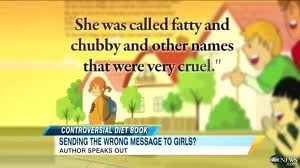
There are two significant problems with a book like Maggie Goes on a Diet, which is pitched at pre-teens and preaches dieting as the best form of weight loss.

The first problem is that young children should not be dieting.  On the child related health website, Kidshealth.org, it states that, “Diets that don’t include a variety of nutritious foods, or have too few calories, can be dangerous for kids.”

My second concern is the type of messages we send kids about weight.  At a time when these young children are trying to work out who they are and trying to find a sense of self it is terribly destructive to focus on their weight.  Children who need to lose weight don’t need a novel to tell them that.  They need a support network of loving parents and dietitians who will be able to consider the child’s virtues as well as their struggles.

As much as childhood obesity is a concern, in my view children lacking in confidence is of far greater concern.  It is not sufficient to tear down a childs self-esteem by recommending diets and drawing attention to their weight.  To be motivated to do anything positive one has to be in a positive mindframe.  You have to believe in yourself and think of yourself as worthy of the breakthrough.

I too have written a book (albeit not yet published) that focusses on an obese child.  But I have taken a very different approach.  My child learns not to obsess about his weight and see the bigger picture.  He is not going to get thin tomorrow, but in trying to improve his health he will reflect on the things he has learnt about himself over the course of the journey.

I don’t think the carrot stick for potato chip packet works or is very responsible.

8 Strategies for Standing Up to Bullies

August 28, 2011

I stumbled on a very useful article by Amy Kuras, giving advice for standing up to bullies.  I hope you find these suggestions very useful.

DO victim-proof your child. Kids who are different in some way tend to be targets, whether they have trouble learning, look goofy, or even are seen as being “stuck up.” It’s a fine line to walk between not stifling their individuality and making them feel like there’s something wrong with them. Help them develop social skills and enough confidence to deflect the bullies. If your child has a learning problem, enlist the school to help you help him. A counselor can teach better social skills. And if your child is kind of funny-looking, remember that everyone spends part of childhood in an “awkward phase.” Remind your kids of this if anyone picks on them for their appearance — and don’t forget to say you think they are perfect-looking the way they are!

DON’T mistake normal ebbs and flows of friendship for bullying. Bullying is behavior that is intentional, repetitive, hurtful, and comes from an imbalance of power between two kids or groups of kids. Someone not inviting your child to a birthday party isn’t necessarily bullying; someone announcing to the whole class who they invited and didn’t invite may be.

DO teach them assertive behavior. Teach your child how to take calming breaths, look the bully in the eye, say, “Stop doing that,” and walk away — or maybe they can turn it around on the bully and laugh, as if their behavior is just too ridiculous to be taken seriously. Bullies expect their victims to just roll over and take it; most won’t keep it going if they face resistance.

DON’T tell them to fight back. This is likely to backfire on your child in a big way … a classic bully move is to goad someone until they lash out, at which point the bully goes running to the nearest authority figure and plays the wounded party. As satisfying as it would be to punch that mean kid right in the nose, it’s just going to make things worse and will bring your child down to the bully’s level. And, um, this goes for you too, Mom.

DO encourage them to seek help from others. Make sure they know you’re proud of them for telling you about it. It takes a lot of courage for a kid to admit he’s being victimized. Talk to the teacher, the principal, and/or a school counselor. Most have finally gotten the message to take bullying seriously. It might also help your child to “buddy up” with a friend in the hall, the lunchroom, or the bus; if the bullying has isolated them to the point that they are socially radioactive with their peers, ask an older kid not involved in the drama to keep an eye on them. And stay on school administrators if you’re not getting satisfying results.

DON’T tell them to just ignore it. Saying this is like saying to them that you plan to ignore it too. And if your child could ignore the bullies, he would. Bullies want a reaction and will escalate their behavior until they get it.

DO talk to your child about bullying before it starts. Even if your kid never is victimized and never picks on someone, the bystander has an important role to play by letting the bully know that behavior is not okay. Encourage your child to stand up to bullies, even if he doesn’t like the kid being victimized. After all, bullies make life harder for everyone.

Most importantly, DO make sure your home is a place where your children can feel loved and accepted for who they are. Encourage them to pursue their passions through after-school activities that can help them meet more like-minded kids, boost their self-esteem, and gain confidence. That’s the best way to stop your kid turning into a bully’s OR victim.

Click on the link to read my post about the mistreatment of a girl who stood up to bullies.

Lazy Parenting is Good Parenting?

August 24, 2011

I think I’ve heard it all.  It seems you can take any position nowadays, no matter how crazy or usual it sounds and sell it to a world of impressionable and desperate people.  Advocating a more lazy, hands-off approach to parenting is certainly unconventional.  The claim that families are suffering from “family fatigue” just seems odd:

Children need time and space just to play and to be – if not they’ll end up psychologically damaged and useless, says a British parenting writer and philosopher.

Tom Hodgkinson is author of The Idle Parent, a book that encourages parents to adopt a hands-off approach so that their children become more self-reliant and capable.

… the less free time parents allocate to their children, the more anxious parents seem to become.

Rather than ferrying kids to music lessons, sports games and playgroups, it seems we should be saving our energy and staying at home, dragging out the dress-up or craft box, or sending the kids out into the backyard.

What’s next, a book condoning absent parents?

Mother That Publicly Shamed Son is Shameful

August 23, 2011

I resist criticising parents, because as one myself, I know that it’s not an easy job.  Parents make mistakes, it’s just a fact of life.  But some mistakes, parents just can’t afford to make.  Shaming a ten year-old in the way that this mother does, takes a small problem and turns it into much larger one:

A Townsville mother has punished her son by making him sit in public wearing a sign that read, “Do not trust me. I will steal from you as I am a thief”.

The boy, who was also wearing a pair of Shrek ears and writing lines, spent almost an hour near a waterpark on Sunday while his family ate lunch nearby, the Townsville Bulletin reported.

Diane Mayers told the Bulletin that she was so “horrified” when she saw the boy, thought to be about 10, that she alerted Child Safety Services.

The former Child Safety Services worker said the long-term effects of the public humiliation would be greater than any form of physical abuse.

“A lot of people walked past and were laughing at him, including boys who would have been his age,” she said.

She said the parents had clearly put a lot of work into the punishment, with the boy wearing laminated signs on both his back and his front.

Ms Mayers told the Bulletin the boy took the Shrek ears off at one point when her daughter overheard the boy’s mother say, ‘Put them back on or I’ll smack your head in’.

That boy may never steal again, but does the punishment really fit the crime?  Not even close.

Should Teachers Visit Their Students’ Homes?

August 19, 2011

I think in certain circumstances it would be a most valuable experience for teachers to visit the homes of their students.  By doing this they will get a clearer picture about the environment in which that child lives in and unique aspects of their lifestyle.

The new chief of the Chicago public schools, Jean-Claude Brizard, suggested recently that teachers visit the homes of their students. Many people reacted to that badly, as math teacher Jason Kamras’s principal did when Kamras dropped in on his students’ apartments near Sousa Middle School in Southeast Washington.

The Sousa principal feared for his young teacher’s safety in a high-crime area. Kamras, however, found the visits invaluable. He understood his students better. Parents were more supportive. Now a D.C. schools official, Kamras is one of many educators who think unannounced visits can be worth the risk.

In the District, officials are looking at the possibility of home visits for elementary school students. The nonprofit Concentric Educational Solutions has been knocking on the doors of persistent truants for the past year. The group’s executive director and co-founder, David L. Heiber, said the visits would be even more effective if they occurred before students got into trouble. “Home visits by themselves do not correlate into academic achievement,” he said. “However, if done with academic goals and targets as the objectives, they do work.”

I commend Mr. Brizard for his brave and innovative suggestion and I’m disappointed it got so much backlash:

That thought is dismissed in many schools. Administrators such as Kamras’s principal see danger in some neighborhoods, and don’t think their staffs have the time or the energy for such after-school and weekend enterprises. “Teachers are overworked already,” Heiber said he has been told. He said administrators say that “our social workers only see our special needs students” or that “we are short staffed as it is.”

A Nut Allergy is Not a Disability

August 16, 2011

Being a father of a young girl with a nut allergy, I really hope that schools work hard to reduce the stigma of a child with anaphylaxis.  It would be a shame if she was ostracised or treated differently because of the allergy.  I personally am in awe of how she can deal with eating differently from her peers without so much as a whimper.  She just accepts her lot and doesn’t let it get her down.

I hope she never gets bullied because of it:

Children with potentially deadly nut allergies are being bullied for being different, say researchers.

And their parents are stigmatised as ‘neurotic and attention-seeking’ by other parents, they found.

Relatives of some victims of the condition are even suspected of deliberately giving a child nuts to check they really are allergic.

Overall, the impact of a nut allergy is so great that it could be considered a disability, the Leicester University researchers found.They interviewed 26 families from the Leicester area about their experiences.

Some children told how they were bullied by classmates, who taunted them about their allergy and threatened to trigger it.

What loving family member in their right mind would feed nuts to a child with a severe nut allergy to check if they are really allergic?    And for those parents that think we are “too neurotic” about ensuring that our children are safe and not exposed to substances that can kill them, take a long walk down a short pier.