Posts Tagged ‘Boys’

Girls Performing Much Better in the Classroom

May 1, 2011

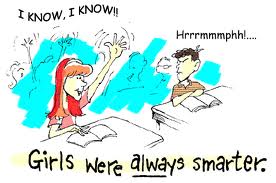
It is no surprise that girls are out doing boys in the classroom.  This has been the trend for quite some time.  But it should focus our energies on how we can teach boys in a more effective manner.

Girls are teaching their male classmates a lesson, blitzing them in almost every subject in Victoria’s classrooms.

Details of NAPLAN tests conducted last May also show Melbourne students narrowly outscore their country cousins, while those with highly educated or professional parents get the best marks.

Girls scored better than boys in 19 of the 20 categories measured in Years 3, 5, 7 and 9.

Nationwide, boys fell behind in almost all categories. Overall, Victoria’s students placed second in half the categories and lead the nation in three.

Year 9 boys were cause for the most worry – 15 per cent failed to meet the writing standard. However, their struggles matched those across Australia, meaning Victoria was still the best in the subject.

There are matters I would like to raise on this topic:

1.  We must do more to engage our boys.  Whether it’s a lack of male teachers or a teaching style that doesn’t work as well with boys, we must get to the heart of the problem and help mend the disparity.

2.  It is absolutely mind-boggling that in todays age we do not have more women in high positions and on multi-national company boards.  It is insane that we even need to talk about employing a quota system to get more female C.E.O’s.  Whilst it isn’t always the choice of women to sacrifice other aspects of their lives for a time-consuming and stressful career, there are many who are keen to get as far as they can go up the corporate ladder.  The argument that positions should be filled by those who are most qualified and capable is true.  However, that should result in females overtaking males in these leadership positions, because they are proving how much better they are in critical areas of learning and thinking.  Unfortunately, I suspect competency has nothing to do with it.

The Cost of Sedating Our Boys

February 20, 2011

I recently came across an interesting opinion piece by Elizabeth Farrelly in the Sydney Morning Herald.  Whilst I wouldn’t go as far as to connect the lack of representation of male teachers to the number of boys on Ritalin, some of her points do resonate.  There is no doubt that Ritalin does have a place, but with the numbers of children (boys in particular) taking the drug climbing markedly from year to year, it is more than fair to raise some strong concerns.  Ms. Farrelly certainly does just that:

The Ritalin wars are usually treated as just another tussle between the pharmaceutical companies and the rest, but is there something else going on here as well? Is it part of a more generalised, covert war on boyhood? //

Thirty years ago Australian primary schools employed five male teachers for every four females. By 2006 there was one male teacher for every four females. This overwhelming feminisation of primary education, and of culture generally, has made boy-type behaviour stuff to frown upon. Are we in danger of seeing boyhood itself as a disorder?

When Christopher Lane, author of Shyness: How Normal Behaviour Became a Sickness, quoted a psychoanalyst saying “We used to have a word for sufferers of ADHD; we called them boys”, he probably did not expect it to become the most famous line of his book.

What was once introversion is now “avoidant personality disorder”, nervousness is “social anxiety disorder” (SAD) or dating anxiety disorder (DAD) and so on. It’s not that these disorders don’t exist, says Lane, a Guggenheim fellow studying the ethics of psychopharmacology, but that our definitions are so broad that the entire mysterious subconscious is reduced to chemical balance, and any deviation looks like disease.

Why, he asks, is ADHD so commonly diagnosed in boys? Is it new behaviour? Or just a new attitude to that behaviour?

But why the gender imbalance, and why now? We know that boys tend to be late maturers anyway, but Scott concedes there are also social and perceptual factors at play. Teachers with “less structured” teaching style and “more distracting” classroom environments, he says, yield many more of his clients than their more disciplined (my word) colleagues.

Whereas ADHD girls “sit quietly in a corner”, the boys are more disruptive and more noticed, more referred, more medicated. And although much the same is true of ”normal” boys and girls, the upshot is that ”girl” is a norm to which boys are expected to strive. Scott sees it as “an unintended consequence of how society operates”.

But consequences this important should be either clearly intentional, if girlifying boys is really what we want, or remedied. Personally, I reckon the crazily creative are types we’ll need more of, rather than fewer of, in the future, even if they are male.

The above are just some snippets from this very thought-provoking opinion piece.  It has never sat well with me that such a large proportion of children taking Ritalin are boys.  Whilst I wouldn’t go as far as to blame it on few male teachers, it does make you wonder whether we are getting it right.

It seems like society may be letting boys down very badly.

We Can Do More!

December 20, 2010

Teaching boys especially, requires greater investment and further innovation on the part of the teacher.  Boys are falling way behind, and there is no point sitting on our hands.  We can’t let it get any worse.

According to figures obtained by the BBC’s Today programme, one in 11 boys begin secondary school with the reading skills of an average seven-year-old.

Educational experts point out that once children reach secondary school age, it can be very difficult for them to catch up to the reading levels of their peers.

Speaking to the BBC, education secretary Michael Gove said it is “unacceptable” that children leave primary school without adequate reading skills.

“We want to ensure that those schools where children are not being taught to read are tackled,” he stressed.

Teaching kids to read is a fundamental role of the Primary teacher.  Since I joined the blogosphere, I have encountered brilliant blogs from all around the world that has informed me, shared ideas and strategies and opened my eyes to new technologies to introduce to the classroom.  This kind of collaboration has such a profound effect on teaching and learning and has helped me become a better educator.

That’s why I think we can address issues such as those quoted above together.

Let’s work cooperatively in trying to improve literacy and numeracy, allow our students the opportunity to express themselves and think creatively and let us ensure that both girls and boys are achieving.