Give Parents a Break

August 30, 2011

Whilst there has and will always be bad parents, society seems very keen to judge well-meaning and loving parents far too harshly.

Parenting isn’t easy.  For all my dedication, there are times when I feel like I’ve got it wrong.  I make mistakes and I reflect and try to improve.  I’m not perfect and I’m never going to be, but it doesn’t stop me from trying my very best.

Yet the media keeps on reporting about mothers who don’t breastfeed, children who are overweight, parents who don’t discipline enough or who over-discipline or who choose childcare for their babies etc.  It’s almost as if there is an unofficial game between some members of society to make themselves feel better about their own parenting performance by panning others.

One of the trends becoming more and more popular is for children to sue their parents.  We are not talking about for child abuse or criminal activity, but rather for nothing more than being flawed parents.  Take this example doing the rounds about children suing their mother over a birthday card:

They alleged Garrity failed to take Kathryn to a car show and threatened Steven II with phoning police if he did not buckle his seatbelt.

The children claim she ‘haggled’ over dress prices and called at midnight to tell Kathryn to come home from a party, reported the Chicago Tribune.

The birthday card in question was labelled ‘inappropriate’ by Steven II as it allegedly failed to include any money.

Whilst I am relieved that common sense prevailed and the children were not successful, I wonder why the legal process took 2 years before the lawsuit could be thrown out at the appeal stage.  The court system must make a strong and unambiguous statement about the rights of parents to parent as they see fit as long as they act lawfully.
If we spend our time judging scornfully about the practices of other parents we will allow ourselves to be blinded by the improvements required in our own parenting approach.  Every child must be taught according to their own individual personality type and every child must be parented according to their own personality type.  No self-help book applies to all kids and no parenting style works on all kids.
So my advice is, stop judging others and concentrate on your own practice.

Diet Book For Children Is a Concern

August 28, 2011

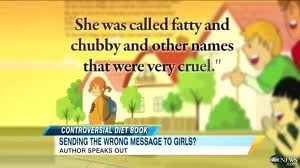
There are two significant problems with a book like Maggie Goes on a Diet, which is pitched at pre-teens and preaches dieting as the best form of weight loss.

The first problem is that young children should not be dieting.  On the child related health website, Kidshealth.org, it states that, “Diets that don’t include a variety of nutritious foods, or have too few calories, can be dangerous for kids.”

My second concern is the type of messages we send kids about weight.  At a time when these young children are trying to work out who they are and trying to find a sense of self it is terribly destructive to focus on their weight.  Children who need to lose weight don’t need a novel to tell them that.  They need a support network of loving parents and dietitians who will be able to consider the child’s virtues as well as their struggles.

As much as childhood obesity is a concern, in my view children lacking in confidence is of far greater concern.  It is not sufficient to tear down a childs self-esteem by recommending diets and drawing attention to their weight.  To be motivated to do anything positive one has to be in a positive mindframe.  You have to believe in yourself and think of yourself as worthy of the breakthrough.

I too have written a book (albeit not yet published) that focusses on an obese child.  But I have taken a very different approach.  My child learns not to obsess about his weight and see the bigger picture.  He is not going to get thin tomorrow, but in trying to improve his health he will reflect on the things he has learnt about himself over the course of the journey.

I don’t think the carrot stick for potato chip packet works or is very responsible.

8 Strategies for Standing Up to Bullies

August 28, 2011

I stumbled on a very useful article by Amy Kuras, giving advice for standing up to bullies.  I hope you find these suggestions very useful.

DO victim-proof your child. Kids who are different in some way tend to be targets, whether they have trouble learning, look goofy, or even are seen as being “stuck up.” It’s a fine line to walk between not stifling their individuality and making them feel like there’s something wrong with them. Help them develop social skills and enough confidence to deflect the bullies. If your child has a learning problem, enlist the school to help you help him. A counselor can teach better social skills. And if your child is kind of funny-looking, remember that everyone spends part of childhood in an “awkward phase.” Remind your kids of this if anyone picks on them for their appearance — and don’t forget to say you think they are perfect-looking the way they are!

DON’T mistake normal ebbs and flows of friendship for bullying. Bullying is behavior that is intentional, repetitive, hurtful, and comes from an imbalance of power between two kids or groups of kids. Someone not inviting your child to a birthday party isn’t necessarily bullying; someone announcing to the whole class who they invited and didn’t invite may be.

DO teach them assertive behavior. Teach your child how to take calming breaths, look the bully in the eye, say, “Stop doing that,” and walk away — or maybe they can turn it around on the bully and laugh, as if their behavior is just too ridiculous to be taken seriously. Bullies expect their victims to just roll over and take it; most won’t keep it going if they face resistance.

DON’T tell them to fight back. This is likely to backfire on your child in a big way … a classic bully move is to goad someone until they lash out, at which point the bully goes running to the nearest authority figure and plays the wounded party. As satisfying as it would be to punch that mean kid right in the nose, it’s just going to make things worse and will bring your child down to the bully’s level. And, um, this goes for you too, Mom.

DO encourage them to seek help from others. Make sure they know you’re proud of them for telling you about it. It takes a lot of courage for a kid to admit he’s being victimized. Talk to the teacher, the principal, and/or a school counselor. Most have finally gotten the message to take bullying seriously. It might also help your child to “buddy up” with a friend in the hall, the lunchroom, or the bus; if the bullying has isolated them to the point that they are socially radioactive with their peers, ask an older kid not involved in the drama to keep an eye on them. And stay on school administrators if you’re not getting satisfying results.

DON’T tell them to just ignore it. Saying this is like saying to them that you plan to ignore it too. And if your child could ignore the bullies, he would. Bullies want a reaction and will escalate their behavior until they get it.

DO talk to your child about bullying before it starts. Even if your kid never is victimized and never picks on someone, the bystander has an important role to play by letting the bully know that behavior is not okay. Encourage your child to stand up to bullies, even if he doesn’t like the kid being victimized. After all, bullies make life harder for everyone.

Most importantly, DO make sure your home is a place where your children can feel loved and accepted for who they are. Encourage them to pursue their passions through after-school activities that can help them meet more like-minded kids, boost their self-esteem, and gain confidence. That’s the best way to stop your kid turning into a bully’s OR victim.

Click on the link to read my post about the mistreatment of a girl who stood up to bullies.
Coloring Book of the 9/11 Tragedy is in Bad Taste

August 26, 2011

I have no problem with children learning about the 9/11 tragedy and I think it is appropriate to commemorate those that perished in terrorist attacks on that fateful day.  What I don’t condone is the idea that kids coloring in the burning twin towers is a good way of imparting such information.  To me, this is disrespectful to children and creates unhelpful tensions.

As Bruce Felps writes:

Titled “We Shall Never Forget 9/11 ‘The Kids’ Book of Freedom,’ ” the book engages kids to color in a depiction of the flaming, smoking, about-to-collapse World Trade Center towers. It also includes an image of a Navy SEAL firing on Osama bin Laden, complete with a bullet in mid-flight. (See that page here)

So, what color is tragedy? What shade of cowardice hides behind a woman when facing his certain death?

The book looks to be intended for kids about 6, 7, 8 years old … too much for that age or too ageless a lesson to delay?

The book also contains narrative. In a press release, publisher Wayne Bell of Really Big Coloring Books Inc. said it “was created with honesty, integrity, reverence, respect and does not shy away from the truth.”

One page, illustrating the immediate aftermath of the attacks, depicts what looks like a TV news anchor reporting that bin Laden was, indeed, the mastermind.

That page includes the line, “These attacks will change the way America deals with and views the Islamic and Muslim people around the world.” Shouldn’t that be “extremist Islamic terrorists” and not the religion and its adherents as a whole?

Fixing Math Education

August 25, 2011

I just read a brilliant article in the New York Times about a suggested overhaul to teaching math.  It argues that much of what is on the standard curriculum will never apply to the average adult.

THERE is widespread alarm in the United States about the state of our math education. The anxiety can be traced to the poor performance of American students on various international tests, and it is now embodied in George W. Bush’s No Child Left Behind law, which requires public school students to pass standardized math tests by the year 2014 and punishes their schools or their teachers if they do not.

All this worry, however, is based on the assumption that there is a single established body of mathematical skills that everyone needs to know to be prepared for 21st-century careers. This assumption is wrong. The truth is that different sets of math skills are useful for different careers, and our math education should be changed to reflect this fact.

Today, American high schools offer a sequence of algebra, geometry, more algebra, pre-calculus and calculus (or a “reform” version in which these topics are interwoven). This has been codified by the Common Core State Standards, recently adopted by more than 40 states. This highly abstract curriculum is simply not the best way to prepare a vast majority of high school students for life.

For instance, how often do most adults encounter a situation in which they need to solve a quadratic equation? Do they need to know what constitutes a “group of transformations” or a “complex number”? Of course professional mathematicians, physicists and engineers need to know all this, but most citizens would be better served by studying how mortgages are priced, how computers are programmed and how the statistical results of a medical trial are to be understood.

Whilst this is not news to us, the suggestions given for overcoming this problem are very simple yet quite brilliant all the same.

A math curriculum that focused on real-life problems would still expose students to the abstract tools of mathematics, especially the manipulation of unknown quantities. But there is a world of difference between teaching “pure” math, with no context, and teaching relevant problems that will lead students to appreciate how a mathematical formula models and clarifies real-world situations. The former is how algebra courses currently proceed — introducing the mysterious variable x, which many students struggle to understand. By contrast, a contextual approach, in the style of all working scientists, would introduce formulas using abbreviations for simple quantities — for instance, Einstein’s famous equation E=mc2, where E stands for energy, m for mass and c for the speed of light.

There’s not many common sense ideas in education at the moment.  It’s good to stumble upon one that is clearly steeped in common sense.

Lazy Parenting is Good Parenting?

August 24, 2011

I think I’ve heard it all.  It seems you can take any position nowadays, no matter how crazy or usual it sounds and sell it to a world of impressionable and desperate people.  Advocating a more lazy, hands-off approach to parenting is certainly unconventional.  The claim that families are suffering from “family fatigue” just seems odd:

Children need time and space just to play and to be – if not they’ll end up psychologically damaged and useless, says a British parenting writer and philosopher.

Tom Hodgkinson is author of The Idle Parent, a book that encourages parents to adopt a hands-off approach so that their children become more self-reliant and capable.

… the less free time parents allocate to their children, the more anxious parents seem to become.

Rather than ferrying kids to music lessons, sports games and playgroups, it seems we should be saving our energy and staying at home, dragging out the dress-up or craft box, or sending the kids out into the backyard.

What’s next, a book condoning absent parents?

Mother That Publicly Shamed Son is Shameful

August 23, 2011

I resist criticising parents, because as one myself, I know that it’s not an easy job.  Parents make mistakes, it’s just a fact of life.  But some mistakes, parents just can’t afford to make.  Shaming a ten year-old in the way that this mother does, takes a small problem and turns it into much larger one:

A Townsville mother has punished her son by making him sit in public wearing a sign that read, “Do not trust me. I will steal from you as I am a thief”.

The boy, who was also wearing a pair of Shrek ears and writing lines, spent almost an hour near a waterpark on Sunday while his family ate lunch nearby, the Townsville Bulletin reported.

Diane Mayers told the Bulletin that she was so “horrified” when she saw the boy, thought to be about 10, that she alerted Child Safety Services.

The former Child Safety Services worker said the long-term effects of the public humiliation would be greater than any form of physical abuse.

“A lot of people walked past and were laughing at him, including boys who would have been his age,” she said.

She said the parents had clearly put a lot of work into the punishment, with the boy wearing laminated signs on both his back and his front.

Ms Mayers told the Bulletin the boy took the Shrek ears off at one point when her daughter overheard the boy’s mother say, ‘Put them back on or I’ll smack your head in’.

That boy may never steal again, but does the punishment really fit the crime?  Not even close.

Should Schools Punish Their Students For Their Online Behaviour?

August 22, 2011

Whilst I feel that the courts made the correct ruling, preventing an Indiana high school from punishing two girls for posting racy photos online, I applaud the school for trying to address the behaviour.  This was clearly not a school issue and therefore not within their jurisdiction.  This was something the parents of the two girls could either address or ignore.  But what I like about this story is that a school cared enough about their reputation, setting an example of proper behaviour and helping those two girls reflect on their actions.

Two Indiana girls — one 16, one 15 — took racy photos of themselves at a slumber party and posted them online. When their high school found out, it suspended the girls from participating in a certain amount of their extracurricular activities. Can the school legally do that?

A federal district court in Fort Wayne, Ind., recently ruled that it cannot — because the punishment violated the girls’ First Amendment rights. The legal question of what rights students have to post provocative material on the Internet, and what rights schools have to restrict such postings, is still unsettled.

I hope schools become far more active on the subject of cyberbullying and cybersafety, two issues which are not clearly within the jurisdiction of schools.  For too long schools have been only too happy to turn a blind eye to what their students do outside the school gates.

This was not the appropriate time to act but at least it wasn’t summarily ignored like so many other matters are.

The Lost Art of Conversation

August 22, 2011

Remember when quality time with another involved talking?  Remember when a family dinner was a daily not twice yearly occasion?  Well, times have changed and some think that the lack of real conversation between family and friends is quite acceptable and just a new feature in the era we live in.

That may be so, but it just doesn’t feel right.  The notion that smartphones and video games are bringing families closer together doesn’t sit at all well with me:

Four in five parents described playing video games with their children as “quality time”, while 32 per cent of parents play computer games with their kids every day.

Many grandparents revealed that they play video games with their tech-savvy grandchildren, in a bid to get closer to them.

Dr Tomas Chamorro-Premuzic, Reader in Psychology at Goldsmiths said: “These findings are important because they highlight the social benefits of playing videogames.

“Previous research has tended to look only at the individual effects of video games, but in the era of social networking games appear to play a vital role in enhancing social relationships. The fact that both parents and grandparents are using games to connect with their children and grandchildren, and quite successfully, suggests that video games can improve social skills and make a key contribution to both effective parenting and child development.

The social benefits of playing video games?  Are you a doctor of psychology or a rep for Nintendo?  Just because parents are resorting to these lengths in a bid to connect with their kids doesn’t mean that it’s the best way to communicate with them.  You can spend hours every night playing Mario Bros. with your child and never begin to understand how they are feeling, what their troubles are and what excites them etc.

Imagine if dates consisted of smartphone operations and video game playing instead of dinner and romantic walks?  How would that work?  The answer is it wouldn’t, because people need to actually converse in order to connect.

Why should it be any different with kids?

Cramming the Curriculum With Nonsense

August 20, 2011

I’m sick of losing valuable curriculum time for the purposes of teaching yet another program or peddling yet another campaign.  Whilst I believe that women should be able to breastfeed whenever and wherever they choose to, I don’t see why that message has to interfere with a literacy or maths lesson:

TEENAGERS may be taught in school that it is OK to breastfeed in public.

The Australian Breastfeeding Association wants future generations of mums and dads to view public breastfeeding as acceptable as seeing breasts on TV, in movies and in advertising.

Melbourne TV presenter Andi Lew is joining the awareness campaign, addressing a group of female students at Lalor Secondary College during an ABA presentation this week.

The ABA said research had shown exposure to breastfeeding at an early age positively influenced attitudes later in life.

“The evidence is accumulating that breastfeeding needs to be promoted in schools,” ABA spokeswoman Karen Ingram said yesterday.

“Despite every national and international health authority recommending exclusive breastfeeding for the first six months of a baby’s life, the latest research suggests that the mums and dads of the future don’t fully grasp the importance of breastfeeding.

Please stop taking the workload of teachers for granted by making them continually stop what they are doing in the name of yet another campaign?  Our primary job is to teach literacy, numeracy and science, please let us leave the breastfeeding advice to parents and doctors?

“They are unlikely to breastfeed in public because they feel it’s embarrassing.