Archive for the ‘Engaging Students’ Category

What a Brilliant Science Experiment! (Video)

June 15, 2015

fire1

Wow! I wish I could do cool experiments like this one for my students.


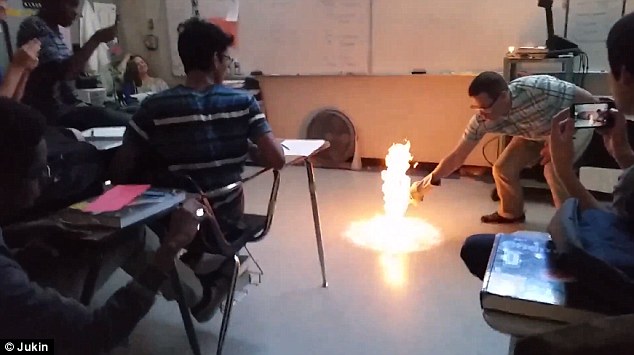
A chemistry teacher wowed his class by setting the floor on fire during a lesson.

The risky stunt was captured on camera by a student and shows the teacher standing at the front of the classroom in America holding a flaming test tube.

The compound used in the demonstration is liquid methane, which as it boils releases a flammable gas.

fire2

fire3


The video of the experiment can be found here.


Super Bowl Lesson Ideas

January 29, 2015

superbowl-classroom


Below are ideas on how to make the Super Bowl relevant to your curriculum. Courtesy of the nytimes.com:


History and Civics:

  • The First Super Bowl: Read the original Times article about the first Super Bowl in 1967. Compare it to an article reporting on a recent Super Bowl, then create an infographic — perhaps a Venn diagram or a timeline — showing how the event has changed over time.
  • Sports and Leadership: Use sports to help students think about leadership with our Super Bowl lesson from 2001, in which students answer questions like “Why do you think the success of a sports team has such an impact on the city it represents?” and “What is ‘morale’ and what do you think leaders can do to ‘boost’ it? (Our recent piece on Teaching the Penn State Scandal also poses questions about leadership.)
  • A Museum of Athletes: Have students reflect on the qualities that make an exceptional athlete, then design museum exhibits celebrating their achievements, using our lesson plan “The Sporting Life.”
  • New Orleans Super Bowl History: “Super Bowls in the Crescent City were often as spicy as the Cajun food,” reports Dave Anderson in a story about “unusual subplots” that have surfaced in New Orleans during past games. Students might use this piece as inspiration for delving into local history in their area through the lens of a sport or hobby that interests them.

Language Arts:

Media Studies:

Science:

Math:

  • Data and Statistics: In a recent lesson plan, Put Me In, Coach! Getting in the Quantitative Game with Fantasy Football, students use statistical analyses and quantitative evaluations to get the edge in fantasy football. By looking at data, measuring match-ups and making projections, students put their analytic skills to the test.
  • Determining “Greatness”: Use sports statistics to create graphs. In this lesson, students explore both the objective and subjective criteria used to determine the ‘greatness’ of a person or team. Students create graphs comparing sports statistics and argue the need for other criteria to adequately judge whether a person or team is ‘the best’ in their profession.


Click on the link to read Teacher Encourages Students to Plot Her Death

Click on the link to read The Questions that Great Teachers Ask Every Day

Click on the link to read Learning as an Experience

Click on the link to read I Love it When Teachers are Excited to Come to Work

Click on the link to read Every Science Teacher’s Worst Nightmare (Video)
Teacher Encourages Students to Plot Her Death

January 19, 2015

Patricia Lorenzen


I am a big advocate for finding new and engaging ways of teaching the same skills. Having said that, I don’t think I would go this far:


If students were going to die of boredom in an English class it wasn’t going to happen on Patricia Lorenzen’s watch.

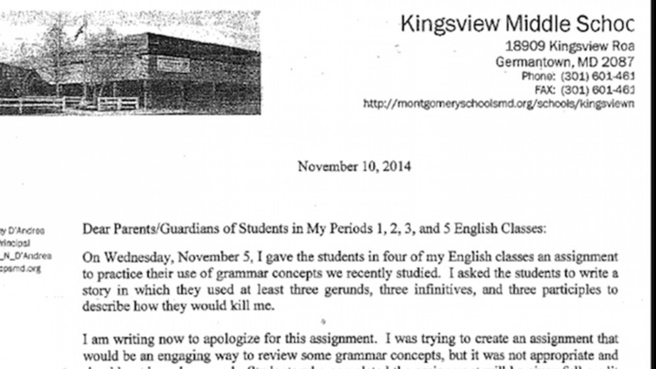
Last November, the Maryland English teacher decided to set an unorthodox assignment asking her students to describe how they would kill her.

The story had to include at least three gerunds, three infinitives and three participles and was an attempt by Ms Lorenzen to engage students while teaching them grammar.

However, parents were not so keen on the idea and many voiced concern over the content of assignment.

It was only after she received some complaints the Ms Lorenzen realised not all the content of the stories would be PG-rated.

Ms Lorenzen ended up writing a letter to parents apologizing for setting the task.

“I was trying to create an assignment that would be an engaging way to review some grammar concepts, but it was not appropriate and should not have happened,” she wrote.

The school’s principal told The Washington Post that this is the first time the school has received complaints about Ms Lorenzen.


Click on the link to read The Questions that Great Teachers Ask Every Day

Click on the link to read Learning as an Experience

Click on the link to read I Love it When Teachers are Excited to Come to Work

Click on the link to read Every Science Teacher’s Worst Nightmare (Video)

The Questions that Great Teachers Ask Every Day

December 11, 2014

question

Courtesy of the wonderful Mark Barnes. I particularly like question 3:


1-What if my homework assignments are a waste of time?

Facebook is rife with parent complaints about homework. There are numerous Facebook pages and groups dedicated to abolishing the horrible homework practices that contribute nothing to learning and ignite a hatred of school in many children. Here is one example of traditional homework that a friend recently posted; oh, it’s worth noting that this homework was for a seven-year-old:

Tuesday homework: 1. Math worksheet 2. Read aloud 1 page story, answer 3 comprehension questions and have it signed 3. Put 14 spelling words in ABC order 4. Sort all spelling words by noun, verb, adjective, or “other” 5. Pick a word from each category and write a sentence, underlining the spelling words 6. Read 26 page storybook aloud, have sheet signed 7. “Optional homework” read silently for 20 minutes.

Great teachers recognize that burying a second grader in piles of senseless homework serves no purpose. Spelling homework is one of the biggest wastes of time in the history of bad homework. The only useful part of the above assignment is the optional part–voluntary reading. This homework assignment is a crutch for either an ill-prepared newbie or a tired veteran who lives in a that’s-the-way-I’ve-always-done-it world.

2-What if my students use mobile devices?

A fantastic, fearless teacher understands that learning simply can’t be measured.

Today’s classrooms are filled with iStudents. Kids who come to school with billions of resources in the palms of their hands, only to be told by teachers and school administrators to leave these powerful assets in their lockers or, worse, at home. Great teachers realize that we live in the digital age, and they are not threatened by the idea that students can become amazing independent learners, using mobile learning devices, web tools and social media. The best teachers realize that embracing mobile learning is the future of education.

3-What if my planned class activity is boring?

Far too many teachers rely on ancient textbooks, dusty worksheets, canned lectures, and last year’s multiple choice tests as their go-to teaching tools. “Kids need discipline, and learning doesn’t have to be fun,” they argue. Great teachers, though, say “Learning should always be fun.” Great teachers envision lessons and class activities and say, “If it isn’t going to be engaging and fun,” I’m throwing it out.

4-What if my room is noisy and chaotic?

A teacher walked into my classroom one day and said, “Wow! It’s kind of crazy in here.” When I informed her that we liked it this way, she shrugged, shook her head and quickly disappeared. For a very long time, my classroom was quiet and orderly. Students wouldn’t dream of leaving their seats without permission, and most would consider peeing their pants before asking me for a bathroom break. Fear and control were the order of the day, and learning was at best a rumor. After one amazing summer of change, I rebuilt my attitude and my classroom. Students worked collaboratively, moved about freely, talked openly, laughed, jumped, shouted and, best of all, had fun. Show me a silent room, and I’m betting it’s a place that is bereft of real learning.

5-What if I don’t grade this?

The thought of a class without traditional grades makes many teachers shudder and scoff. A fantastic, fearless teacher understands that learning simply can’t be measured. It’s impossible to effectively assess with numbers, percentages and letters. The best teachers give their students objective feedback. They observe and ask questions; they provide alternatives. Most important, they encourage students to revisit prior learning and rework activities in an effort to achieve mastery. The best teachers help kids understand that failure is necessary and should never be punished with a low mark.

6-What if the Common Core is just another bad idea concocted by bureaucrats?

Even if they think the Common Core might be a good thing (there’s no evidence right now that it is), the best teachers question Common Core State Standards and high stakes testing every day of their lives. Great teachers may see how the Common Core can be successfully integrated into some classes, but they always wonder if their own standards and learning outcomes that their students want are the best standards for our children. The best teachers know how to teach. They don’t need a prescription dreamed up by nonprofits to tell them what is right for their students.


Click on the link to read Learning as an Experience

Click on the link to read I Love it When Teachers are Excited to Come to Work

Click on the link to read Every Science Teacher’s Worst Nightmare (Video)

Learning as an Experience

October 30, 2014

learning

I love this pictorial comparison between traditional modes of teaching and experiential learning. Via


Click on the link to read I Love it When Teachers are Excited to Come to Work

Click on the link to read Every Science Teacher’s Worst Nightmare (Video)

I Love it When Teachers are Excited to Come to Work

September 9, 2014


What a way to start a school year!


Click on the link to read Every Science Teacher’s Worst Nightmare (Video)
Every Science Teacher’s Worst Nightmare (Video)

August 27, 2014

https://www.youtube.com/watch?v=GKJaBUSbGM4


This demonstration probably wont make the Science Teacher’s Handbook:


A teacher in Thailand has accidentally set his classroom alight during what appears to be an experiment with fire that goes horribly awry.

Footage uploaded to LiveLeak this week shows the male teacher flail his arms as he enthusiastically explains the experiment.

On the bench in front of him sits a small beaker of flammable liquid.

It appears he is about to run his hand through the flame when he accidentally knocks it over.

Several students in the classroom can be seen filming their clumsy instructor, almost pre-empting what will happen next.

Within seconds metres-high flames engulf the workspace and the student body lets out a collective panicked cry.

Luckily the teacher is quick to act and the fire is soon extinguished, leaving a thick cloud of smoke in its wake.

Little information is known about when the video was shot or what was the purpose of the experiment.

When Teachers Prank Their Students (Video)

July 28, 2014


I just love it when teachers go to the trouble to make their students laugh. Laughter in the classroom, when it isn’t at someone’s expense, adds so much to the environment.

Take the above April Fools Day prank this teacher organised.


Click on the link to read 18 Tips For Getting the Best Out of Your Students

Click on the link to read Michael Michalko’s 7 Principles of Creative Thinking

Click on the link to read Why Many Teachers Don’t Bother Making Their Lessons Interesting

Click on the link to read Why is it Always the Kids’ Fault?

Click on the link to read Student Shot by Teacher Protests His Sacking

Click on the link to read Science Not For the Faint Hearted (Video)

18 Tips For Getting the Best Out of Your Students

July 17, 2014

Courtesy of teachthought.com:


reach


Click on the link to read Michael Michalko’s 7 Principles of Creative Thinking

Click on the link to read Why Many Teachers Don’t Bother Making Their Lessons Interesting

Click on the link to read Why is it Always the Kids’ Fault?

Click on the link to read Student Shot by Teacher Protests His Sacking

Click on the link to read Science Not For the Faint Hearted (Video)

Click on the link to read 7 Tips for Building a Better School Day

Michael Michalko’s 7 Principles of Creative Thinking

May 28, 2014


creative

Courtesy of edutopia.org:


1. You Are Creative

Artists are not special, but each of us is a special kind of artist who enters the world as a creative and spontaneous thinker. While creative people believe they are creative, those who don’t hold that belief are not. After acquiring beliefs about their identity, creative people become interested in expressing themselves, so they learn thinking habits and techniques that creative geniuses have used throughout history.

2. Creative Thinking is Work

You must show passion and the determination to immerse yourself in the process of developing new and different ideas. The next step is patience and perseverance. All creative geniuses work with intensity and produce an incredible number of ideas — most of which are bad. In fact, more bad poems were written by major poets than by minor poets. Thomas Edison generated 3,000 different lighting system ideas before he evaluated them for practicality and profitability.

3. You Must Go Through the Motions

When producing ideas, you replenish neurotransmitters linked to genes that are being turned on and off in response to challenges. Going through the motions of generating new ideas increases the number of contacts between neurons, and thereby energizes the brain. Every hour spent activating your mind by generating ideas increases creativity. By painting a picture every day, you would become an artist — perhaps not Van Gogh, but more of an artist than someone who has never tried.

4. Your Brain is Not a Computer

Your brain is a dynamic system that evolves patterns of activity, rather than simply processing them like a computer. The brain thrives on creative energy that results from experiences, real or fictional. The brain cannot tell the difference between an “actual” experience and one that is imagined vividly and in detail. Both are energizing. This principle helped Walt Disney bring his fantasies to life and also enabled Albert Einstein to engage in thought experiments that led to revolutionary ideas about space and time. For example, Einstein imagined falling in love and then meeting the woman he fell in love with two weeks later. This led to his theory of acausality.

5. There is No Right Answer

Aristotle believed that things were either “A” or “not A.” To him the sky was blue or not blue — never both. Such dualistic thinking is limiting. After all, the sky is a billion different shades of blue. We used to think that a beam of light existed only as a wave until physicists discovered that light can be either a wave or a particle, depending on the viewpoint of the observer. The only certainty in life is uncertainty. Therefore when trying to produce new ideas, do not evaluate them as they occur. Nothing kills creativity faster than self-censorship during idea generation. All ideas are possibilities — generate as many as you can before identifying which ones have more merit. The world is not black or white. It is gray.

6. There is No Such Thing as Failure

Trying something without succeeding is not failing. It’s producing a result. What you do with the result — that is, what you’ve learned — is the important thing. Whenever your efforts have produced something that doesn’t work, ask the following:

  • What have I learned about what doesn’t work?
  • Can this explain something that I didn’t set out to explain?
  • What have I discovered that I didn’t set out to discover?

People who “never” make mistakes have never tried anything new. Noting that Thomas Edison had “failed” to successfully create a filament for the light bulb after 10,000 attempts, an assistant asked why the inventor didn’t give up. Edison didn’t accept what the assistant meant by failure. “I have discovered ten thousand things that don’t work,” he explained.

7. You Don’t See Things as They Are –
You See Them as You Are

All experiences are neutral and without inherent meaning until your interpretations give them meaning. Priests see evidence of God everywhere, while atheists see the absence of God everywhere. Back when nobody in the world owned a personal computer, IBM’s market research experts speculated that there were no more than six people on earth who needed a PC. While IBM saw no market potential for PCs, two college dropouts named Bill Gates and Steve Jobs viewed the same data as IBM and perceived massive opportunity. You construct reality by how you choose to interpret your experiences.


Click on the link to read Why Many Teachers Don’t Bother Making Their Lessons Interesting

Click on the link to read Why is it Always the Kids’ Fault?

Click on the link to read Student Shot by Teacher Protests His Sacking

Click on the link to read Science Not For the Faint Hearted (Video)

Click on the link to read 7 Tips for Building a Better School Day

Click on the link to read Student Rant Goes Viral