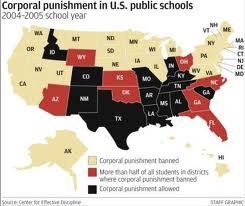
You shouldn’t need a study to tell you that corporal punishment is not a legitimate and ethical means of classroom discipline. Yet, as I write this, 19 American States still allow corporal punishment.
It’s time they stopped!
Hitting misbehaving kids with sticks might result in immediate obedience, but new research suggests it does more damage than good in the long term.
A new study compared kindergarten and Grade 1 students in two West African private schools. In most ways, the kids were similar. They came from the same urban neighbourhood, and their parents were mostly civil servants, professionals and merchants.
The difference was in how their schools doled out discipline. One school beat disobedient kids with sticks, slapped them on the head or pinched them. These punishments were administered for a wide range of offences, from forgetting to bring a pencil to class to disrupting lessons.
The other school favoured non-physical punishment, with teachers issuing time-outs or verbal reprimands for bad behaviour.
Researchers gave students from both schools “executive functioning” tests, measuring their ability to plan, think in the abstract and delay gratification. While test results for the kindergarten kids were similar across the board, the Grade 1 students from the school with corporal punishment performed significantly worse.
The study’s authors, who hail from the University of Toronto, McGill University in Montreal and the University of Minnesota, say the results are consistent with previous research that showed kids will immediately cease bad behaviour after getting physically punished, but they fail to internalize the morals or rules behind the punishment.
What this means, the authors note, is these kids aren’t really learning the difference between right or wrong, and are likely to re-offend.
“This study demonstrates that corporal punishment does not teach children how to behave or improve their learning,” said Victoria Talwar of McGill University.
“In the short term, it may not have any negative effects; but if relied upon over time it does not support children’s problem-solving skills, or their abilities to inhibit inappropriate behaviour or to learn.”


 Topical Teaching