Posts Tagged ‘UK’

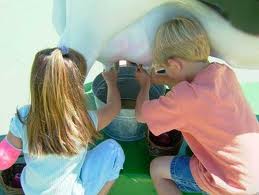
UK Kids Don’t Know Where Milk or Bacon Comes From!

June 17, 2012

What is the point of filling curriculums with the latest in nonsensical new-age methodology and a raft of programs that are time-consuming but utterly ineffective when our children don’t even know the basics? It seems that we are allowing our kids to become selfish and insular, far more concerned about themselves than the world around them. It is essential that our children become more aware of the world around them.

More than a third of 16 to 23-year-olds (36%) do not know bacon comes from pigs and four in 10 (40%) failed to link milk with an image of a dairy cow, with 7% linking it to wheat, the poll of 2,000 people for charity Leaf (Linking Environment and Farming) found.

Some 41% correctly linked butter to a dairy cow, with 8% linking it to beef cattle, while 67% were able to link eggs to an image of a hen but 11% thought they came from wheat or maize.

A total of 6% of those questioned knew that salad dressing could come from rapeseed oil, compared with the national average among all age groups of 24%.

Although four in 10 young adults (43%) considered themselves knowledgeable about where their food comes from, the results revealed a “shocking” lack of knowledge about how the most basic food is produced, the charity said.

Leaf chief executive Caroline Drummond said: “We often hear reports that our food knowledge may be declining but this new research shows how bad the situation is becoming.

“Despite what they think, young adults are clearly becoming removed from where their food comes from.

“Three in 10 adults born in the 1990s haven’t visited a farm in more than 10 years, if at all, which is a real shame as our farmers not only play an important role in food production but are passionate about engaging and reconnecting consumers too.”

The charity, which is organising an Open Farm Sunday event this weekend, also found almost two-thirds of young adults (64%) did not know that new potatoes would be available from British farms in June, and one in 10 (10%) thought they took less than a month to grow.

OnePoll surveyed 2,000 C adults online between May 11 and 14.

4 Million Children in the UK Don’t Own a Single Book

December 5, 2011

If we continue to sit there passively watching whilst reading and literature dies a slow death, we will be all the worse for it. To read that books are extinct from up to 4 million British homes is quite distressing.

Almost 4 million UK children do not own a book, research suggests.

The latest report by the National Literacy Trust discloses that one in three does not have a book of their own.

The number has increased from seven years ago, the last time the poll was conducted, when it stood at one in 10 youngsters, meaning the number of children without books has tripled.

The latest survey, which was based on a survey of 18,000 children aged between eight and 16, shows that boys are more likely to be without books than girls.

Why parents buy the latest phone for their young children before something they really do need like a library of books is something I’ll never understand.

One-in-Five High School Students ‘Learn Nothing’

September 20, 2011

There is a 1983 film entitled Teachers, which while universally panned by critics and eventually bombed at the box office, stands as one of the most accurate portrayals of schools caught on celluloid.  Starring Nick Nolte, the film is a satire of American Government High Schools.  Those not familiar with the way a school runs found it over-the-top, unfunny and irritating.  Whilst the film is badly made, it contains some insights and observations that are perceptive, extremely funny and just as relevant today.

There is no better example of this than the fact that the school in the film is being sued by a former student that was allowed to graduate without being able to read or write.


Now contrast that scene with these findings:

The UK is falling behind international rivals because one-in-five children “learn nothing” throughout their secondary education, according to the head of Britain’s top private schools’ group.

Figures show that almost one-in-five pupils left primary school this summer without reaching the standard expected of the average 11-year-old in reading. Some one-in-10 boys had the reading skills of a seven-year-old or worse.

Perhaps what worked most against the success of the movie Teachers was that it was too clever and too accurate for its own good.

A Sensitive Issue that Drives Male Teachers Away

January 11, 2011

I don’t like talking about it and neither does many of my male colleagues, but it is a major reason for why there are so few male teachers in Primary/Elementary schools.  The fear of being maliciously and unfairly accused of inappropriate conduct with students drives male teachers away from the early years.  I wrote a post just last month which showed that “the main reason (Canadian) men avoid these young grades is they don’t want to be accused of being pedophiles.”

Recently, a new training video urging teachers never to engage in physical contact with pupils, even when adjusting the position of a child’s hand on an instrument was released.

The film, called Inappropriate Demonstration, shows a violin lesson in which a pupil fails to play the right notes. The teacher explains the technique by placing a hand on the pupil’s shoulder and holding his fingers in the right position on the violin. He then explains it a second time by demonstrating on his own violin the correct position. The pupil then plays the correct notes.

The film advises teachers: “It isn’t necessary to touch children in order to demonstrate: there’s always a better way.”

Thankfully, Michael Gove, the Secretary of State for Education in the UK, condemned the video.

That approach “plays to a culture of fear” among children and adults, he said, as he ordered schools to abandon “no contact” rules between teachers and pupils. It was “positively right” for teachers to comfort distressed pupils by putting an arm around them, or demonstrate sports skills through physical contact with a child, he said.

The mother of one of my best friends is a teacher who was maliciously accused of improper conduct with a student because she touched the students hand in an attempt to guide him in correct handwriting technique.  It’s scares me personally, because as careful as I am to stay professional and squeaky clean, it is much easier (in  this respect) teaching older kids.

To make matters worse, the kids are used to getting hugs from, and sitting on the lap of, female teachers.  I literally have to tell my students on the first day that under no circumstances can they hug, pat or touch me.  They don’t understand, but thankfully they comply.

I believe that the fear of an inappropriate teacher is a natural one.  The media reports on a new  “monster” every day, who takes the privilege of teaching children and abuses it in the very worst way.  I believe that the prime responsibility is to safeguard the children.  Their safety is far more important than my working conditions and pressures.

However, all things said and done, when you are told that you can’t readjust the grip of your music student, you are reminded why male teachers look elsewhere for a career.