Posts Tagged ‘Toronto’

Corporal Punishment and Those 19 American States

July 28, 2011

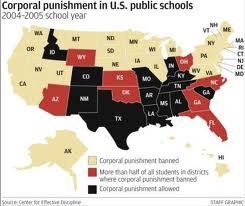
You shouldn’t need a study to tell you that corporal punishment is not a legitimate and ethical means of classroom discipline.  Yet, as I write this, 19 American States still allow corporal punishment.

It’s time they stopped!

Hitting misbehaving kids with sticks might result in immediate obedience, but new research suggests it does more damage than good in the long term.

A new study compared kindergarten and Grade 1 students in two West African private schools. In most ways, the kids were similar. They came from the same urban neighbourhood, and their parents were mostly civil servants, professionals and merchants.

The difference was in how their schools doled out discipline. One school beat disobedient kids with sticks, slapped them on the head or pinched them. These punishments were administered for a wide range of offences, from forgetting to bring a pencil to class to disrupting lessons.

The other school favoured non-physical punishment, with teachers issuing time-outs or verbal reprimands for bad behaviour.

Researchers gave students from both schools “executive functioning” tests, measuring their ability to plan, think in the abstract and delay gratification. While test results for the kindergarten kids were similar across the board, the Grade 1 students from the school with corporal punishment performed significantly worse.

The study’s authors, who hail from the University of Toronto, McGill University in Montreal and the University of Minnesota, say the results are consistent with previous research that showed kids will immediately cease bad behaviour after getting physically punished, but they fail to internalize the morals or rules behind the punishment.

What this means, the authors note, is these kids aren’t really learning the difference between right or wrong, and are likely to re-offend.

“This study demonstrates that corporal punishment does not teach children how to behave or improve their learning,” said Victoria Talwar of McGill University.

“In the short term, it may not have any negative effects; but if relied upon over time it does not support children’s problem-solving skills, or their abilities to inhibit inappropriate behaviour or to learn.”

Should Teachers Have Students as Facebook Friends?

April 12, 2011

My answer to this question is a categorical no.  Whilst my own teachers were generous with their time, even giving out their phone numbers (when I was in 12th grade) to offer help after hours, this sort of generosity is now just plain unprofessional.  Teachers should not accept invitations to be Facebook friends with their students, nor should they be giving out their phone numbers.

It seems that this issue is a concern around the world.  A study was recently conducted in Ontario, which featured the following recommendations:

A report, to be released Monday, recommends teachers neither accept — nor send out — Facebook friend requests involving students. They should avoid texting, and never communicate by email using a personal account, says the advisory from the Ontario College of Teachers, the body that oversees the profession.

Online communications should be via “established education platforms” such as web pages set up for a school project or class, says the report, obtained by the Toronto Star.

Teachers should also only contact students electronically during the same times they’d feel comfortable calling home.

“When we are communicating with students, face-to-face or in more traditional ways, we are trying to replicate that in other media,” said Michael Salvatori, the college’s registrar.

“The informal language of texting is not the kind of interaction a teacher and student would have … there are lots of ways teachers can be available for students without texting.”

The report comes as school boards try to figure out how to create rules around the use of social media, without hampering efforts by educators to engage students by using it.

And, increasingly, just as in their real life, teachers’ conduct online is also coming under scrutiny. Recently, in the U.S., teachers have been suspended for posting inappropriate comments on their personal Facebook pages, on their own time; one said he hated his job and students, another compared herself to a “warden” supervising “future criminals.”

This is only the third advisory the college has ever issued, and it will follow up with information sessions around the province this month and next.

Few school boards have a social media policy as yet, trusting to general guidelines around teacher and online conduct to cover it for now.

That’s because social media has exploded in the past few years, said Paul Elliott, vice-president of the Ontario Secondary School Teachers’ Federation, which put out a pamphlet for teachers on the issue a while ago.

It’s the newly graduated teachers who tend to have a tough time at the start, he added.

They’ve been active on Facebook, and they are moving into a profession where behaviour that wasn’t considered objectionable before is now inappropriate — such as posting a picture enjoying a beer with friends, he said.

As for texting, it can sometimes prove “a useful tool of communication in the classroom, with the curriculum — but that’s the only time it should be in use,” he said.

The college has also warned teachers that anything they post online can be altered, and that “innocent actions” can be “easily misconstrued or manipulated.” The report cites several disciplinary cases, albeit extreme ones, where emails or other online communications were involved.

There is no good reason for a teacher to be communicating with students through Facebook or any other forms of social media.  While I respect and appreciate my teachers for giving me the opportunity to call on them after hours with queries or concerns, I don’t think the current day teacher should be allowed to do the same today.  Teachers must be responsible and careful in their dealing with their students.  There is nothing responsible about being a Facebook friend with your student.