Posts Tagged ‘technology’

Both a Parents’ Best Friend and Worst Enemy

April 21, 2012

I witnessed a 10 year-old boy having a major meltdown at the shoe shop last Sunday. He acted in an obnoxious way and completely embarrassed his mother. Kicking out in obvious frustration, he berated his mother for taking him to the shop (even though she took him because he needed new shoes!) He screamed out on a number of occasions, “This is so boring!”

It took a while for the mother t0 react decisively. At first she tried to reassure him, then sweet talk him. Finally she decided to threaten him. Nowadays, when a parent threatens their child there seems to be a standard “go to” consequence – the use of the family game console. The mother said, “That’s it! No more Playstation for the rest of the day!”

And then she paused, if only to reflect on what she had just done and whether she was comfortable with the challenges that come with setting such a punishment.

“What?” came the boy’s reply. “No Playstation? For the whole day? Why?”

“Because of your tantrum. I’m fed up with it!”

“But that’s not fair! I was just bored, that’s all!”

And then, as if the penny dropped, the mother realised what she had done. In a haste to punish her child, it dawned on her that she had in fact punished herself. She realised that her child is tolerable in front of the Playstation and a considerable challenge away from it. So she scrambled for an “out clause.”

“If you behave for the rest of your time here I might reconsider.”

Unfortunately, this is becoming standard practice among parents. As much as they hate watching their children becoming couch potatoes and gaming addicts, as much as they wish that they could get their attention quicker and steer them away from these distractions when it’s time to do homework, they have come to rely on it for peace and quiet. Here this mother had the perfect punishment for her son’s terrible exhibition. Following through would certainly be a “game changer.” It would make the statement that if you want to misbehave like that in public again it may come at a major price.

But no, this parent wasn’t prepared to risk ruining the rest of her Sunday for the sake of this statement. She probably wanted her son to be out of sight and mind for the rest of the day and there was no way that was going to happen with the punishment she nominated.

I am not trying to judge this parent. We have all breathed a sigh of relief as our child has camped in front of television or computer screen at some stage.

I am merely commenting on the stranglehold this technology has over parents, children and families.

Children Outsmart Their Parents Online

April 14, 2012

They keep on telling us that this is the age of computer technology and that online skills are vital to success. Why then does our standardised tests not recognise this very theory. Standardised testing worldwide ignores the very skills our students are told they need to obtain.

Perhaps it is because our kids are fast outsmarting us when it comes to online activity:

MORE than half of Australian children are smarter than their parents when it comes to going online, enabling them to outwit adult restrictions.

Fifty nine per cent of children have ways of hiding what they’re doing online – and their parents know it, a survey by internet security specialist McAfee has found.

Of all age groups, children are the most adept at managing their “digital footprint”, or how they appear online.

“Children are far better at managing their profile controls and what their identity looks like to others,” Young and Well Co-operative Research Centre CEO Associate Professor Jane Burns said.

In a thetelegraph.com.au survey, one in four people said they had been left behind by their children’s online knowledge and one in three were worried they weren’t able to protect their children from web dangers.

Associate Professor Burns said that, rather than be embarrassed about asking for help, parents should embrace their children’s cyber smarts.

“There is a great capacity for them to be a teacher for you,” she said.

Building trust and rapport early was the key to being a parent in the online age: “Young people are far more technically savvy than their parents.

The reality is, even if parents think that they have control of what their children are doing online, they are pretty savvy and eventually the shift will occur. Children will tell them to back off.”

She said parents should treat internet conversations the same way they first taught their children to cross the road or play in the park.

“The first time you do this you make sure they’re with you and they’re holding your hand and you explain to them why it is important,” she said.

“If you’ve got the rapport it becomes a lot easier to ask your children to show you how they keep themselves safe – and they can teach you things as they get older.”

She said parents trying to start a conversation with their children should understand that they saw the web in completely different ways.

“Technology is now so embedded in children’s lives that they don’t differentiate between online and offline worlds,” she said.

“There is no distinction – you are creating relationships, full stop – and they can teach you things.”

“If you’ve got the rapport it becomes a lot easier to ask your children to show you how they keep themselves safe – and they can teach you things as they get older.”

“If you’ve got the rapport it becomes a lot easier to ask your children to show you how they keep themselves safe – and they can teach you things as they get older.”

Whilst this survey clearly presents a worrying case when it comes to cybersafety issues, it also goes to show that our young are very confident online. Why shouldn’t their skills be taken into account like all other skills currently contained in National standardised tests?

There is Still Some Love for the Forgotten Class Whiteboard

March 22, 2012

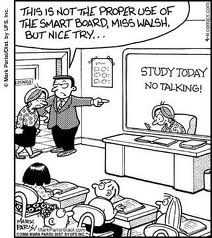
I’ve inherited a class that does not have a whiteboard. Well actually it does, but it is covered up by a Smart Board. It seems that my school was so excited to install brand new Smart Boards (interactive whiteboards) that they set it up directly on the existing board. They were so keen to set up the Smart Boards it didn’t even occur to them to take down the whiteboards first!

As much as I love my Smart Board, I find it much easier to write and present maths problems on a traditional whiteboard.

So I got my school to order one for me. Last December ….

And it only arrived today!

Meanwhile, my Smart Board died two weeks ago. The projector just decided it couldn’t facilitate any longer (I hope it didn’t have anything to do with my ghastly interactive whiteboard handwriting). A teacher without a whiteboard is like a carpenter without a drill. It is a huge challenge to teach without a board. A challenge that has proved frustrating and in a sense, quite revealing.

It has taught me that no matter how incredible modern technology has become. No matter how much education has been transformed because of touch screens, blogs, the internet, YouTube, Wikipedia etc. Nothing can replace the simple whiteboard!

Kids Need Meaningful Relationships More than Mobile Phones

March 12, 2012

No matter how advanced technology becomes, nothing will stop us from needing human contact and real interaction. You might be able to stockpile Facebook friends, but nothing can replace the loyalty and support offered by a real friend.

Sometimes I feel that we have allowed ourselves to live in glass cubicles, shielded from real people, real conversations and real experiences. The same technology which was devised to bring us closer together has been misused and ultimately, has kept people out.

Teachers have been instructed to keep emotional distance from their students, the local small business operator who cared about his/her community as much as their bank balance, has been replaced by people not interested in the place where they work or the people who frequent their establishment. People are much less likely to say things like, “I just met someone on the train. We got talking and she told me all about her interesting life.” The only talking on trains is via mobile phone.

Is this really a natural way to live? Is this how we want our children to grow up? Are we really surprised to read that children don’t play with other children like they used to?

A new study that found almost 50 per cent of kids don’t play every day has prompted an expert’s warning about a generation of depressed and anxious youngsters.

The study, hailed as the first of its kind in Australia, carried out a total of 1397 interviews, including 344 with children aged between eight to 12.

About 40 per cent of them said they don’t have anyone to play with while 55 per cent say they’d like to spend more time playing with their parents.

Forty-five per cent said they were not playing every day.

The MILO State of Play study, which also interviewed 733 parents and 330 grandparents, found that more than 94 per cent of them believed play was essential for child development.

But it is still rapidly falling off the list of priorities, said child psychologist Paula Barrett.

“The longer we de-prioritise it, the more likely we are to have unhappy and inactive Australian kids which are more likely to be anxious and depressed, resulting in a raft of social problems in adulthood,” she said.

Dr Barrett said unstructured, active play was essential to help children learn important life skills, develop imagination and creativity.

“This finding highlights a concerning yet common misperception that many parents share – they dont think that kids need to play regularly after the age of eight,” she said.

Many will criticise me for drawing a parallel with the state of society and the development of new technologies. Of course technology isn’t solely to blame for a lack of real and personal interactions. But let’s face it, they have made the issue more serious. Just look at the advertisement above. Do we really want life’s pleasures to be about how nifty our touch screens can become?

In 2005 a landmark movie was released entitled, Crash. It depicted New York as a place where people are too insecure and selfish to interact with others. The only way a person can have any dialogue with a stranger is if they, quite literally, crash into each other.

Our children need real friends, not Facebook friends, they need play dates not peer-to-peer gaming sessions and they need the adults in their lives (including teachers) to scrap any notions of emotional distance and become engaged.

Let’s tear down the barriers and bypass the touch screens and actually … talk with each another!

The Problem With IT in the Classroom

February 19, 2012

The problem with the wonderfully diverse technologies available to teachers is that it can sometimes breed lazy teaching. A SmartBoard doesn’t make a teacher. The challenge for teachers is not to rely on the technologies at hand, but to simply use them in conjunction with a well-developed lesson.

When reports show that computers don’t make a difference to learning, I wonder if they are really saying that teachers haven’t learned to capitalise from them yet:

Kids love using computers and gadgets in the classroom but the technology has not made them better learners, suggests a new report.

The non-profit Media Awareness Network interviewed a small sample of plugged-in elementary and high school teachers from across Canada and found there’s work to be done to better incorporate technology into schools.

The report suggests many students aren’t really as good at using the Internet as it may seem. While it’s assumed today’s kids are quick to learn how to use computers, the authors found many students are great at social media or finding something to watch on YouTube but their digital skills end there.

Teachers reported that some of their kids had a hard time effectively using search engines like Google and weren’t able to consistently sort out valuable sources from the clutter on the web.

“Digital literacy is not about technical proficiency but about developing the critical thinking skills that are central to lifelong learning and citizenship,” the report states.

The finding wasn’t particularly surprising, said Matthew Johnson, director of education for the Media Awareness Network.

“It’s something we’ve seen before but this really underlined it. I always like to draw a distinction between literacy and fluency,” he explained.

“When we watch a young person sit down on the computer and open a dozen different screens and do a dozen different things at once, we’re really seeing (digital) fluency — the same fluency that lets a 10-year-old talk a mile a minute. But it doesn’t necessarily show genuine literacy, it doesn’t show they understand what they’re doing, it doesn’t even show necessarily that they’re skilled at what they’re doing.”

Are Children Getting Enough Sleep?

February 14, 2012

Kids seem to be looking and feeling mored tired than ever before.

A recent study indicates otherwise:

It is a common complaint of our modern age that kids and teens don’t get enough sleep.

Video games, TV, social media, and other trappings of our increasingly tech-centric lives are often blamed, but a new study shows that long before Facebook or PlayStation 3, kids were sleeping less than experts said they should.

When researchers in Australia reviewed sleep recommendations and actual sleep times among children over the past century, they found that kids consistently slept about 37 minutes less than recommended at the time.

Each time, new technological marvels — be it the light bulb in the early 1900s, TV in the 1950s, or computer gaming systems and social networking today — were blamed for declining sleep times.

“The message that children don’t get enough sleep has been the same for over 100 years,” says researcher Tim S. Olds, PhD, of the University of South Australia.

I wonder if children today experience a different form of tiredness. A tiredness as a result of late nights, a lack of physical exercise, a carb dominated diet and excess weight. Perhaps the tiredness is the same as always, but the presentation of the tiredness is more extreme.

Are High-Tech Classrooms Just a Lot of Hype?

February 4, 2012

There is a current obsession with technology in the classroom. Even so, I would have thought that it was only sensible to bring as much technology as possible into the classroom. After all, we are trying to help children develop life skills. In today’s world technology is all around us. It is integral that our students have a familiarity if not competency with the latest in technology.

Michael Hiltzik of the LA Times disagrees:
Something sounded familiar last week when I heard U.S. Education Secretary Arne Duncan and FCC Chairman Julius Genachowski make a huge pitch for infusing digital technology into America’s classrooms.

Every schoolchild should have a laptop, they said. Because in the near future, textbooks will be a thing of the past.

Where had I heard that before? So I did a bit of research, and found it. The quote I recalled was, “Books will soon be obsolete in the schools…. Our school system will be completely changed in 10 years.”

the nirvana sketched out by Duncan and Genachowski at last week’s Digital Learning Day town hall was erected upon a sizable foundation of commercially processed claptrap. Not only did Genachowski in his prepared remarks give a special shout out to Apple and the iPad, but the event’s roster of co-sponsors included Google, Comcast, AT&T, Inteland other companies hoping to see their investments in Internet or educational technologies pay off.

How much genuine value is there in fancy educational electronics? Listen to what the experts say.

“The media you use make no difference at all to learning,” says Richard E. Clark, director of the Center for Cognitive Technology at USC. “Not one dang bit. And the evidence has been around for more than 50 years.”

Almost every generation has been subjected in its formative years to some “groundbreaking” pedagogical technology. In the ’60s and ’70s, “instructional TV was going to revolutionize everything,” recalls Thomas C. Reeves, an instructional technology expert at the University of Georgia. “But the notion that a good teacher would be just as effective on videotape is not the case.”

Many would-be educational innovators treat technology as an end-all and be-all, making no effort to figure out how to integrate it into the classroom. “Computers, in and of themselves, do very little to aid learning,” Gavriel Salomon of the University of Haifa and David Perkins of Harvard observed in 1996. Placing them in the classroom “does not automatically inspire teachers to rethink their teaching or students to adopt new modes of learning.”

I am a bit in the middle on this issue. I am in favour of all types of technology in the classroom, just not as a replacement for standard teaching. Those schools that are dominated by devises, lose out from the benefits of teacher/student interaction. But that is not to say that i-Pads in the classroom wont make any difference. It just means that those i-Pads are not more important to education than a quality teacher.

The Meteoric Rise of the Educational App

January 25, 2012

We are in the midst of an educational app bonanza. The educational app is fast taking over, with the startling statistic that more than a quarter of all parents have downloaded apps for their children to use. In a recent study entitled, iLearn II: An Analysis of the Education Category on Apple’s App Store, the popularity of the educational app was discussed as was recommendations for future growth.

Below are some of the findings of the report:

1. Apps are an important and growing medium for providing educational content to children, both in terms of their availability and popularity.

  • Over 80% of the top selling paid apps in the Education category of the iTunes Store target children.
  • In 2009, almost half (47%) of the top selling apps targeted preschool or elementary aged children.  That number has increased to almost three-­‐quarters (72%).
  • The percentage of apps for children has risen in every age category, accompanied by a decrease in apps for adults.

2. Early learning apps for toddler/preschool are particularly prominent. Developers should consider potential saturation of this market.

  • Apps for toddlers/preschoolers are the most popular age category (58%), and experienced the greatest growth (23%).
  • General early learning is the most popular subject (47%), and there are significantly more general early learning apps than the second most popular subject (math, 13%).

For those interested in a more comprehensive summary of the report please follow this link. If you would like to read the entire report please click on this link.

Facebook and Teachers: How Evil Predators are Ruining it For the Rest of Us

January 25, 2012

It sickens me to read about teachers misusing their privileges and being accused of engaging in inappropriate dealings with students. Similarly, it upsets me no end that these horrendous people end up making life even harder for well-meaning, caring and decent teachers.

Male teachers will be completely aware with what I am saying. It is hard to be a male teacher (especially Primary teacher) in an age where there are daily stories doing the rounds about teacher sexual abuse. We have to be careful to the point of obsession. Whilst female teachers wouldn’t hesitate to talk to a student alone behind closed doors, a male teacher cannot afford to. Whilst female teachers cuddle and get kids to sit on their laps without the slightest of hesitation, male teachers wouldn’t even extend their hand for a handshake. I am not trying to complain about this. In fact, I am a big advocate of these rules. It’s the fear of being falsely implicated that makes it a struggle.

And it’s not just male teachers who are effected by these evil people. They have also taken technology like social media, which I hear has incredible benefits as an educational tool, and prevented good, hard-working teachers from freely using it to assist their students.

One in 10 misconduct cases from schools involved teachers using social networking sites like Facebook to start inappropriate relationships with their pupils, it was reported.

n 43 of the 336 cases referred to the General Teaching Council for England last year for “unacceptable professional conduct”, teachers had used online forums, emails and websites like Facebook and Twitter to contact children.

A total of 14 were suspended and 18 were given prohibition orders, according to the Guardian.

The figures also revealed a wide variation in school policy over social networking websites with some banning teachers from having accounts while others allow staff to be “friends” with pupils.

The GTC registrar, Paul Heathcote, told the Guardian: “Often the use of social media by teachers can be positive and make a valuable contribution to a teacher’s practice, to pupils or to the school.

“Only if the use of social media by a teacher is relevant and serious enough to potentially affect a teacher’s registration is it likely to progress to a hearing.”

I would argue that it has become too risky to use Facebook as an educational tool between teacher and student. And we know exactly who to blame for that.

101 Ways for Teachers to Cope With Stress

January 24, 2012

101 useful tips from the wonderful blog smartteaching.org. To read the whole list follow this link. Below is just a taste:

Organization Tools

Staying organized will also beat back stress, as you’ll be able to meet deadlines, remember projects and field trips, and have more time for yourself.

  1. Google Calendar: Set up events and schedules for lesson plan submission dates, in-service workshops and more by using Google Calendar.
  2. ubernote: This cute tool lets you dump lists, contact information, event plans, special project ideas, field trip materials and more into several different notepads that keep you organized and on track.
  3. Notesake: This tool is great for teachers who are pursuing a higher degree, going to workshops or earning more credit hours for their certification. You can take notes faster and organize your notes so that you’ll be able to find them once you want to plan a lesson.
  4. eFax: Keep your runs to the teachers’ lounge to a minimum by using eFax, which lets you send out permission reports, progress reports and anything else you need signed over the Internet.
  5. Backpack: This very popular tool lets you “centralize and share information” with other teachers in your department. You can maintain a department calendar, share pages and a to-do list.
  6. Toodledo: Toodledo sends reminders to your mobile phone so you never forget a task.
  7. Project Stat.us: Keep your principal and supervisors updated with new project information or your certification process with this collaboration tool that lets you organize your progress online.
  8. Evernote: Use this beta tool to capture images and websites on your computer or your mobile phone. You can then organize your notes and presentations for class wherever you are.
  9. Tools and Templates: If you don’t have time to design your own certificates, game tools, or work sheets, pull from this list of tools and templates for teachers.
  10. Google for Educators: Here you’ll find some of the best available Google tools and apps just for teachers.