Posts Tagged ‘Teaching’

Natalie Munroe is No Hero!

February 18, 2011

I can’t believe the amount of support blogger Natalie Munroe is receiving after she was caught complaining about her students on a public blog.

Sure, she may not have named them when she called them “… rude, disengaged, lazy whiners. They curse, discuss drugs, talk back, argue for grades, complain about everything, fancy themselves entitled to whatever they desire, and are just generally annoying.”

She didn’t even use her full name.  So what did she do wrong?

When you write a blog that complains about the people you work with or for, be very careful that the secret doesn’t come out.  When a school board is presented with complaints from parents who were angry that their children were insulted online, they have no choice but to issue a suspension.  It’s a really bad look – especially from a teacher.

Ms. Munroe’s defenders say she was just telling the truth.  Firstly, she wasn’t telling the truth.  Truth applies to fact, this is opinion.  The old adage that one’s opinions is best left to one’s self certainly applies here.  The school would look ridiculous if they allowed Ms. Monroe to write what she likes and they certainly couldn’t have defended it on the basis of truth.

But many disagree with me
:

However, it is high time for teachers to speak up even at the loss of their jobs. United in this effort, they could turn the tables and help students achieve better educations. And they could have a better, safer, environment.

It might be noted here that she did not direct her statements to any specific student. There has been a Facebook group organized to support her.

Every classroom in America is filled with students like this, and sometimes it must be like working in a zoo. It might be an easier job than trying to reach and teach kids who could care less about school, respecting those in authority, and those who hold back other students who really want to learn.

This is not the forum for teachers to have a go at their own students.  If they disguise their comments in general statements about the nature of kids in modern society that is acceptable, but when they make judgements about the personalities and behaviours of their own students, they must accept the consequences of these revelations should they reach the parents.

My own take on this is that she made a mistake.  She is not a bad person or necessarily a bad teacher.  Whilst it’s not a good look for a teacher to be caught out venting their frustration, it happens all the time, and given the time, place and circumstance it won’t lead to suspension.  But seriously, Natalie Munroe is no hero!

Why Students Misbehave

February 16, 2011

There are many reasons given for poorly behaved students:

  • The teacher doesn’t enforce discipline
  • The students are spoilt
  • The students are not parented properly
  • Kids are rude nowadays, and haven’t been properly taught manners.

All these reasons are decent explanations for an unruly child or class.  But there is one glaring omission from this list, which doesn’t get nearly the amount of coverage as other reasons – the students are bored!

My experience with unruly behaviour, is that it is more prevalent in a classroom that is taught in a bland style.  I have observed some brilliantly dedicated and hard-working teachers, who spend countless hours planning their lessons using the latest graphic organisers and programs, only to watch their hard work fizzle before their very eyes.  The most thorough preparation can go out the window when it results in a unsipiring lesson.

So much of today’s educational resources concentrates on breaking skills down, organising thoughts and following scientific trends.  What they fail to do is assist teachers in delivering fun, enjoyable lessons.

The latest trend in Australian education is direct instruction.  Direct instruction involves reading from a script.  In Australia this is how many schools teach their maths and spelling.  The class teacher is presented with a manual and asked to read from a script (the script even tells you when to pint at the board and when to pause!).  The students job is to listen, repeat after the teacher, and answer questions in their workbooks.  No hands are answered, no discussion takes place.  It’s just the teacher talking and the students responding.

The strengths of this style of teaching are worth noting.  The program is comprehensive, it fixes gaps in student learning, it helps improve the student’s listening skills, it makes for a quiet classroom and cuts planning time.  But among the weaknesses for such a program is the fact that it is so boring, firstly for the teacher, and also for the student.

Boring classes often leads to disruptive behaviour.

Have you ever watched the behaviour of teachers during a boring PD or staff room meeting?  And that’s adults!  We can control our behaviour far better than our students.  It’s just that when you are bored, it’s not so easy to maintain focus and avoid distraction.

In my own teaching, I find that my most difficult classes come as a result of an inability to properly engage my students.  Because I am not a strict or authoritative teacher, I rely very much on the strength of my lessons to maintain decorum in the classroom.

Among the many questions we teachers must ask ourselves when we reflect on behavior management in our classrooms is, what are my lessons like?  Could they be more relevant to the interests and life experiences of my students?


How is Hitting Students Still Legal?

February 15, 2011

I don’t know if it was naivety on my part or just the fact that I’m from Australia, but I had no idea that corporal punishment was still legal in 20 US states.  A third-world country maybe – but the US?  In Australia it is absolutely illegal to strike a student, and so it should be.  I just assumed that the America had the same protocols.  Turns out I was wrong.

In response to the dreadful story of the elementary teacher charged with assault for allegedly choking and punching 8 first grade students, the Washington Post recently wrote an expose on the issue of legalised corporal punishment:

In June, Rep. Carolyn McCarthy (D-N.Y.) introduced the Ending Corporal Punishment in Schools Act, which would ban corporal punishment as a form of punishment or way to modify undesirable behavior at all public and private schools with students that receive federal services.

Congress apparently had other things to do. The bill was sent to a committee but never made it further in the legislative process.

Last year a congressional committee had a hearing on the issue. The panel learned that:

  • School officials, including teachers, administered corporal punishment to 223,190 schoolchildren across the nation during the 2006-07 school year (according to conservative government estimates, the latest year for which national statistics were available).
  • As a result of that punishment, 10,000 to 20,000 students requested medical treatment.
  • Students are typically hit on their buttocks with a wooden paddle, about 15 inches long, two to four inches wide and a half-inch thick, with a six-inch handle at one end.
  • Most students are paddled for minor infractions, such as violating a dress code, being late for school, talking in class or in the hallway, or being “disrespectful.”
  • Almost 40 percent of all the cases of corporal punishment occur in Texas and Mississippi.
  • Current studies indicate that physical punishment is most common in kindergarten through eighth grade, in rural schools, in boys, and in disadvantaged and nonwhite children.
  • African American students are 17 percent of all public school students in the United States but are 36 percent of those who are victims of corporal punishment, more than twice the rate of white students.

Supporters of corporal punishment will defend the method as being effective in dealing with unruly behaviour.  In my opinion, it is a lazy option that should never be allowed.  As much as I wish it weren’t the case, not all teachers care deeply about their students.  Many get disenchanted, flustered and resentful.  While a vast majority of teachers want nothing more than to see their students thrive, others will surely exploit any means possible to shut them up.

Australia and the United States have a close relationship and share many of the same values and ideals.  But corporal punishment isn’t one of them.  How can 20 States continue to allow such an extreme form of punishment in today’s age?  Please don’t wait for more horrible stories about unprofessional and violent teachers before doing something about this.

No matter how badly behaved they may be, kids deserve better than this!

Be Careful How Much Power You Give Schools

February 14, 2011

Multiple choice time:

You have a 6-year old boy suffering from separation anxiety because his father, an Army commander, is leaving for Iraq.  The boy is found drawing zombies and writes underneath the drawings that he wants to die.

As a school administrator, do you:

a. Take the child aside and offer help, sympathy and a listening ear.

b. Call his mother to set up a plan for how to join forces and help the child during this tough period of his life.

c. Refer the situation to a counsellor or recommend that the mother take the child to a psychologist to get expert help.

d. Call an ambulance and get that child to a psychiatric ward, so he can be committed to a 72-hour psychiatric hold.

If you answered “d” you are probably from Los Angeles, the home of mystifying school decisions.

A mother has criticised school authorities for committing her six-year-old son to a psychiatric ward against her wishes because of a picture he drew in class.

Jack Dorman was pulled out of his elementary school classroom after he sketched a drawing of zombies and stick figures and wrote that he wanted to die.

But the boy’s furious mother, Syndi, said her son was simply upset that his soldier father was being deployed to Iraq.

She said the way Los Angeles school officials treated her son ’was right up there with my worst nightmare.’

Mrs Dorman added: ‘They said they were concerned about a picture he drew. I said he plays video games and it’s a picture from a video game.’

She claims Jack suffers from separation anxiety and was particularly upset on the day he drew the disturbing picture after learning his father, an Army commander, was leaving for Iraq on Thursday.

‘I explained to them what was happening, that my husband was being deployed to Iraq, that he was upset when he came to school today, that he wanted to be at home,’ she said.

‘I’m saying, “I will deal with it, that we have a therapist and that we’ll make sure he’s seen today”.’

‘They said it was out of my hands. They said they were in control and they could do this and had already called an ambulance.

‘I said, “Can you do this?” and they’re like, “Yeah”, Mrs Dorman said in an interview with NBC. ‘I’m just like, “What? Can I get a lawyer? How is this happening?”.’

Mrs Dorman said the ambulance ride was terrifying for her son, who was already seeing a therapist because he became anxious when he was separated from his family.

‘I was trying to reassure him that it would be okay and he asked if I’d come back for him and I said of course I am going to come back for you,’ added Mrs Dorman.

Jack was released after 48 hours, but his mother fears the ordeal has traumatised her son.

‘My son doesn’t want to go back to school. He’s afraid they are going to take him away again,’ she said.

In a statement, Los Angeles Unified School District Superintendent Ramon Cortines insisted his staff took the appropriate action.

‘We did the right thing here,’ he said. ‘I can unequivocally state that correct procedures and protocols were followed, including contacting the parents and accessing community resources such as the Los Angeles County Psychiatric Mobile Response Team.

‘When any student indicates a desire to take his or her own life, the LAUSD is required to follow strict protocols to ensure the safety of the student. The safety of LAUSD students is paramount,’ he added.

Where is the common sense in this story?  The boy is 6-years old!  A 6-year old boy with a father being sent off to war who threatens his life on the back of a drawing needs care and support from his school.  He needs the school to be sensitive and compassionate.  So what do they do to this poor kid?  They send him off to a psychiatric ward!  The person that was responsible for calling the ambulance is a more suitable candidate for the ward!  What were they thinking?

The unfortunate modern reality of living in a litigious world, in my opinion,  is that school’s care more about being sued than for the rights of the children.  It is for this reason, we need to be mindful that in all kinds of sensitive circumstances, school’s are likely to put their interests ahead of the child’s.  We must be careful how much power we give them.  This includes teacher’s being given authority to greatly influence the decision of a doctor in prescribing powerful medications to a child.

And it isn’t just the school that is to blame.  It’s the regulations which were instituted with one massive, gaping hole in it – the common sense clause. Even with the best of intentions, a law that ignores common sense, is a terrible law!

And notice the lack of apology.  No, they are still defending their decision!  Shame on you!

Time to change the law folks

My Solution to a Major Problem in Education

February 11, 2011

THE PROBLEM

There are two different categories of teacher that are affected by this problem.

Category 1: In my opinion teacher training is ineffective. New teachers don’t get enough practical exposure to the workings of a classroom and do not come fully prepared to deal with the issues that arises when teaching their own class. Because they are new, and yet to earn their stripes they are less comfortable than most to ask for help or seek guidance. They also often begin on trial 1 year contracts, thus pressurising them into showing their worth and instilling confidence in their colleagues. Such a teacher will not want to seem incapable or lacking in proficiency.

Category 2: Many teachers are being roundly criticised at the moment for not performing up to standard. It seems to be in vogue to blame teachers, when in truth there is a lot wrong with education – it isn’t just about the quality of teachers. These teachers do exist and require much more support rather than the threat of being cut and left unemployed.

THE SOLUTION

The solution that I propose is two tiered:

1. Experienced teachers who are deemed to be excelling at a certain standard are offered a mentoring role for higher wages. If accepted to take on that role, these teachers would offer new teachers the chance to spend a few days in their classroom, let them observe their lessons, give them access to the their planning material and be someone out of that teacher’s school environment who can deliver advice and guidance via email and phone. This challenges the mentor teacher to strive in their new position as well as their underling.

2. For the second category of teacher, I recommend that newly retired teachers, who have left the profession with a wealth of knowledge and an eagerness to maintain links with the profession, be paid to mentor and assist teachers who have not been performing at the required benchmarks. Instead of firing teachers in the first instance, I propose that these teachers get the opportunity to improve with a greater deal of support and collaboration.

WHAT THIS SOLUTION ACHIEVES

• Provides the opportunity for excellent teachers to be better paid;

• Allows retired teachers to maintain links with their profession and share their wealth of experience;

• Gives new teachers greater confidence and a non-judgemental mentor who they can approach; and

• Allows teachers currently not working at their premium a second chance that may reinvigorate and refresh them.

Why Aren’t Kids Held Back Anymore?

February 11, 2011

“It is our policy not to hold kids back unless there are exceptional circumstances.”

This is the standard line that Principals use nowadays when a teacher raises the topic of kids repeating grades.

Why isn’t it school policy?  What is stopping schools from having the courage to recommend it?

EXCUSE 1: “There is a stigma about kids that are forced to repeat a year.”

Well, that stigma is partly generated by an educational system that refuses to think logically about this issue.  When policy makers decide that some students would greatly benefit from redoing the year, they are assisting in breaking that stigma.  When they decide that they would prefer letting thE child flounder in a year level they aren’t equipped for they are helping to maintain the stigma at the cost of progress.

EXCUSE 2: “A child’s confidence could be tarnished by making them repeat.”

Since when is a school content in letting students fail, looking out for their self-esteem?  How is being miles apart from the rest of the class a confidence boost?  On the contrary, a child can get a new lease on life when they repeat a year.  They are given extra time to fill in the gaps and improve their basic skills.

EXCUSE 3:“But the parents would be devastated if we even raised it.  They may even remove the child from the school. “

A school that makes its decisions based on whether or not the parents will remove their child, is deeply compromised and lacks integrity.  The reason why parents may be devastated is because such an occurrence is rare.  The reason why it is rare to recommend that a child repeat a year is because schools don’t do it enough.  You have to break the cycle before such a measure gains wider acceptance.

Ultimately, a school should do what is right for the child, not what is popular or easy.  That is why I congratulate the Indianapolis school system for its brave new policy:

A new statewide third grade reading test will be a new test developed by the same company that produces the ISTEP statewide exams. About a third of third grade students fail the English and language arts ISTEP test each year, but the new exam will be designed with the expectation that all students who can read will pass the test.

“This is so fundamental to a child’s success, I think we absolutely must draw a line in the sand,” said board member Jim Edwards.

Under provisions adopted by the board Tuesday, students who do not pass the test on the first try could attempt the test again during locally-offered summer school, and could move to fourth grade if they pass on that attempt. All students would have to pass the exam to advance unless they qualified for one of the plans’ three exemptions: one for special education students, one for English language learners and one for students that have been retained twice prior to fourth grade.

I realise that repeating a year has implications, and that sometimes the result of doing so will end up being negative.  I simply feel that schools should be caring and supportive enough to do the right thing by the child and help replace stigmas with good decisions.

Teachers Can Now Be Fired For Being Human!

February 10, 2011

Reality check: Teachers are REAL people!  They are not robots, and yes, they make mistakes.  Sure, teachers are role-models with a responsibility to act with dignity and professionalism at all times.  But that doesn’t mean that they can’t enjoy the same privileges and opportunities as other people.

To fire a teacher over an innocuous Facebook photo is absolutely disgraceful!

A US teacher was fired for posting a picture of herself holding a glass of wine and mug of beer on Facebook, a report has said.

The happy holiday snap cost Ashley Payne her job after a parent spotted it on Facebook – and complained, the Daily Mail reports.

The picture was reportedly taken while travelling around Europe in the summer of 2009.

According to the Daily Mail, Payne, 24, was shocked when she was summoned to the head teacher’s office at Apalachee High School, in Winder, Georgia, and offered an ultimatum.

She reportedly told CBS News: “He just asked me, ‘Do you have a Facebook page?’

“And you know, I’m confused as to why I am being asked this, but I said, ‘Yes’, and he said, ‘Do you have any pictures of yourself up there with alcohol?’”

He then offered her an option: resign or be suspended.

She chose to resign.

Readers of my blog would be aware that I have previously written about the challenges that Facebook and other forms of social media has on educators and education as a whole.  I have been critical of teachers who post inappropriate material, as well as advised teachers to ensure that their privacy settings are on.  What makes this case different is that this teacher wasn’t doing anything illegal or unprofessional, especially since her settings were switched to private:

The English teacher reportedly later found out it was one anonymous emailer who turned her into the school board after seeing the picture on the social networking site.

But she is baffled how a parent could gain access to her page when she has all her privacy settings on “high””, meaning only her closest friends have permission to see her pictures.

According to the Daily Mail, she admits putting the “offensive” photos on Facebook but says she now feels as if she had stashed them in a shoebox at home for them to be stolen and showed to the head teacher.

Let our teachers have a life!  Let’s not fire every teacher who has holiday photos!

Payne added: “I just want to be back in the classroom, if not that classroom, a classroom. I want to get back doing what I went to school for, my passion in life.”

All those resposible for this teacher’s resignation – shame on you!

The Obstacle Course that is Teaching Maths

February 9, 2011

Below is the second maths lesson in a series of original maths lessons I have devised over the years:


Maths Obstacle Course

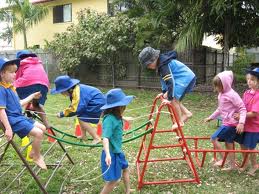
I devise a simple obstacle course using whatever playground equipment the school has.  Slides, monkey bars, polls, ladders and bridges are all useful.  The obstacle course doesn’t need to be intricate, long or complex.  Students should be able to finish it within half a minute maximum.

I take the students out to the playground.  They have no idea what we are doing.  They may ask me, but my reply is “You’ll see.”  The reason why I don’t tell them it’s a maths lesson is because maths has a stigma, and just the mention of it will deflate some students’ expectations.

Usually outdoor lessons require pencils, worksheets and clipboards.  The students are relieved when they find out that none of these implements are required.

With the students congregating around the playground equipment, I tell them that they are going to be doing an obstacle course.  I show them the route they need to take and tell them that each individual will be timed while doing the course.  Each student gets one attempt only, with their personal time written down.  On completion, I order the times privately while the students get a drink of water.

Only the 5 quickest times are read out, so as not to upset or demoralise any of the slower performing students.  Of course, if other students request to know their time, I tell them.  At this point we walk back to the classroom.

On arrival, I write the times in random order on the board.  Using the times, students will take part in some of the activities below, depending on their age and maths proficiency:

Activity 1:  Order the times from quickest to slowest;

Activity 2:   Round the times to the nearest second, tenth of a second etc;

Activity 3:  Work out the total time taken cumulatively over the entire class;

Activity 4:  Work out the average time for the entire class;

Activity 5: Chart the times using Excel and create a chart such as a column graph which presents the data in graphical form; and

Activity 5: Students estimate what time they think they would get should they be given a second attempt.  They will also be asked to give reasons for their answer (e.g. it could be faster the second time around due to a greater awareness of the route, or an improved strategy, yet it could be slower due to fatigue or the pressure to perform).

Even though the main chunk of the lesson is spent doing something that can hardly be called maths, it serves as a basis for engaging the students.  The skills covered in the lesson include measuring time, adding decimals, ordering number, rounding, IT, graphing, averaging and predicting.

It’s a great feeling watching the students get a shock when they find out that the PE lesson they thought they were taking part in, ends up being referred to as a maths lesson.

And ultimately, that’s the point.  Maths is in everything – even the things that give the students pleasure.

Parents, Don’t Do Your Kids’ Homework!

February 7, 2011

The other day I took my daughter to the museum to see an exhibit on Africa.  We sat down to do an African inspired craft activity where I witnessed a loving mother helping her daughter design and decorate her artwork.  I use the word “help” very loosely, because in fact she was basically doing the whole thing for her.  Soon the child’s father joined them.  What ensued was a disagreement between the child’s father and mother over what design strategy to use and what colours worked best.  What was supposed to be an activity for the child, became a chance for the parents to let their child sit aimlessly while her parents took over.

This is a common syndrome when it comes to homework.  Parents often end up doing their child’s homework.  Whilst I understand that they do this out of love as well as to diffuse some of their child’s anxiety over the complexity of the set task, I strongly urge parents to desist from this practice.  Even though in the short-term the child is grateful that the homework can now be submitted without too much heartache, in the long-term they have neither demonstrated capability in successfully mastering the task nor have they managed to calmly work through a challenge.  I accept that parents use homework as a chance to spend some quality time with their kids on a weeknight (where time with the kids is often at a premium), but there are better ways to show your children that you love them and support them.

Whilst there are some strong arguments for abolishing homework (which I will cover at a later date), I’d instead like to focus on what homework should be and how parents can help without feeling a need to take over:

  1. Homework should be revision.  It should not introduce a new concept or skill.  It should simply be a vehicle for students to demonstrate how well they understood what was covered in class that week.  If the child is bringing home work that was not introduced in class, I advise you to see the teacher.
  2. Most teachers give a few days to complete the homework.  I strongly urge my students to use night one to read over the homework and circle any question that they don’t understand.  Then, instead of approaching their parents, come see me the next day.  Of course, I am not restricting the parents from helping their kids, I am merely offering my help as the first option.  In my opinion, parents have already spent most of their youth completing homework, they have paid their debt to education and should now be allowed to enjoy a homework-free life.
  3. When the student approaches the teacher early on about difficulties in the homework, they are showing a great deal of responsibility and assertiveness.  This isn’t lost on the teacher.  So if the students maintains this sort of dialogue with their teacher, extensions are likely to be given should they struggle to meet the deadline.
  4. The best help you can give your children, when assisting them through a homework task is patience and perspective.  Offer your services by all means, but ensure that unlike the girl at the craft table, they end up having ownership of their work.  Kids are not proud of their parents homework, they are proud of their own achievements.  Whilst instilling independence and confidence in children may sometimes feel like an overwhelming proposition, the payoff is huge.  I would rather my students hand in a piece of homework that they took ownership of that was full of mistakes than a brilliant piece ultimately done by mum or dad.

We can easily look at parents who are doing their children’s homework in a judgmental light, whilst calling them enablers and accusing them of spoiling their children.  This is not the right approach.  These parents are often loving parents that don’t know how best to act in a complex situation.

Hopefully the above tips are of some assistance.

You Don’t Get Elite Teachers with Elitism

February 4, 2011

In my opinion, one of the biggest factors concerning the current failures of our educational system is the inadequate and substandard teacher training programs offered by our Universities.  Not just the minnow Universities but also the elite ones.

The idea proposed by Lord Adonis that every secondary school should have teachers who attended elite universities is not only unworkable but costly and simplistic.

Addressing the Independent Academies Association (IAA) conference in central London, Lord Adonis said: “You need a good mix of teachers, of course, at any successful school, but you cannot be a successful school unless you at least have a certain proportion of your teachers who have themselves come from leading universities in to which you intend to send your best students.”

Lord Adonis warned delegates it would not be possible to transform admissions to top universities “unless you can develop a cadre of teachers in your own schools that have that background themselves.”

I attended one of Australia’s elite Universities and I can tell you without a shadow of a doubt that there was precious little that I was taught that was of value to me in the classroom.  From my experience the training of teachers needs an overhaul.  Teaching theory is all well and good but it needs to be complemented with proper practical instruction.  I’ve seen teachers who are more academic  and have sharper intellects than I do, who floundered in the classroom because sometimes all the knowledge in the world on the right and left brain and metacognition can’t help you get through to a hostile or challenging class.

My lecturers were mostly former teachers who left the classroom because they couldn’t manage anymore.  They were a fountain of knowledge when it came to theory, but clearly relieved to be out of the classroom.  Their pearls of wisdom included “Use them or lose them”, concerning the number of paid sick days available to teachers.  Sure, it can be seen as good advice to cash in on your paid sick leave, but it isn’t the positive and responsible message to be sending to future teachers.

Lord Adonis may be right.  Perhaps it is easier to get pupils, particularly those from poorer areas, into top universities when their teachers have studied at those institutions too.  But for my daughter, I am satisfied with a teacher that is caring, dedicated, and prepared to challenge educational norms by experimenting and taking responsible risks.

You don’t need an elite University to educate, prepare and nature an elite teacher.