Posts Tagged ‘Teaching’

If You Respect Teachers, Please Stand Up

May 15, 2012

There is a growing hostility against teachers from the Government down, and children are picking up on it. There is little use reinforcing the message that respect for teachers is paramount to students whose own parents openly treat the classroom teacher with disdain. Teachers are not trusted to do their job, are having to write-up ludicrously long and detailed planners to prove they are covering the curriculum and are subjected to a distasteful smear campaign from elements within the educational system looking for someone to blame.

Why should we be surprised if children exploit the lack of respect for teachers within elements of society?

A STUDENT holds a replica pistol to the head of a staff member in the playground – while a Year 9 boy at another school sprays urine on his teacher.

These disturbing scenes are happening at schools across NSW, just two of 218 serious incidents logged during term four last year in reports to the Department of Education and Training.

The reports show teachers being abused, assaulted and sometimes forced to disarm out-of-control students during fights.

One student fight even featured a didgeridoo as an improvised weapon, while in another incident a pupil stole a teacher’s handbag and made off with her car.

Last November, a Year 8 student threatened a teacher with a replica pistol from the drama department at a south coast school. The deputy principal tried to intervene and was abused by the student.

Meanwhile, at an Illawarra school, a Year 9 student urinated into a bottle and sprayed it on a male teacher on playground duty.

Precise details of the schools, students and teachers involved are removed from the reports, which are published by the department with one-term delays.

A department spokesperson said nine in 10 schools did not report a single incident during term four.

“From time to time, incidents affect schools just as they affect society,” the spokesperson said.

Psychologist Dr Michael Carr-Gregg said the number of violent incidents in schools wasn’t rising but were being noticed and documented “more vigorously”.

“Teenagers tend to be impulsive – all accelerator and no brakes,” Dr Carr-Gregg said.

“Violence as entertainment has desensitised teenagers and made them see violence as a problem solving device.”

He said another factor was teenagers becoming disaffected with rates of family breakdown increasing.

Kids Don’t Need Gold Stars

May 11, 2012

In my opinion, the look that children give when they receive a gold star is misleading. Sure, they look excited, but that excitement is sometimes relative. In truth, kids don’t need gold stars and essentially, that is not what they are after when they produce good work.

What they really want is something – anything. They want a compliment, a smile, a gesture that will make them feel better about themselves. School can be such an overwhelming place. Teachers are so good at being critical. Critical of the way students dress, sit, answer back, talk, the speed in which they work, the neatness of their handwriting etc. The gold star doesn’t just signify an achievement of sorts, it breaks the cycle of criticism and balances the ledger somewhat.

As teachers, we need to be aware that our students crave our acceptance and approval. They may superficially be doing this by trying to earn a gold star, but essentially, all they really want is a confidence boost.

I enjoyed the tips for showing recognition to students by bestselling author and confessed ‘gold star junkie’, Gretchen Rubin:

1. Be specific. Vague praise doesn’t make much of an impression.

2. Find a way to praise sincerely. It’s a rare situation where you can’t identify something that you honestly find praiseworthy. “Striking” is one of my favorite fudge adjectives.

3. Never offer praise and ask for a favor in the same conversation. It makes the praise seem like a set-up.

4. Praise process, not outcome.This particularly relevant with children. It’s more helpful to praise effort, diligence, persistence, and imagination than a grade or milestone.

5. Look for something less obvious to praise – a more obscure accomplishment or quality that a person hasn’t heard praised many times before; help people identify strengths they didn’t realize they had. Or praise a person for something that he or she does day after day, without recognition. Show that you appreciate the fact that the coffee’s always made, that the report is never late. It’s a sad fact of human nature: those who are the most reliable are the most easily taken for granted.

6. Don’t hesitate to praise people who get a lot of praise already. Perhaps counter-intuitively, even people who get constant praise – or perhaps especially people who get constant praise – crave praise. Is this because praiseworthy people are often insecure? Does getting praise lead to an addiction to more praise? Or – and this is my current hypothesis – does constant praise indicate constant evaluation, and constant evaluation leads to a craving for praise?

7. Praise people behind their backs. The praised person usually hears about the praise, and behind-the-back praise seems more sincere than face-to-face praise. Also, always pass along the behind-the-back praise that you hear. This is one of my favorite things to do!

The Loss of Common Sense in Education

May 6, 2012

Teacher Kathy Kenney-Marshall mourns the lack of common sense in education and shares some stories which highlight the double standards of some parents:

Lately though, one particular sentence repeats itself in my head when I read my school email. The line says, “Common Sense took a turn for the worse when parents attacked teachers for doing the job that they themselves had failed to do in disciplining their unruly children.”

I find this to be all too common as my teaching career marks nearly a quarter of a century. This includes, but is not limited to, expecting that kids do their homework.

Recently for example a parent was incensed when her child was not given a sticker on a homework assignment that was not completed according to directions! A sticker!!

It happened every once in a while when I was newer to the profession; a child on the verge of permanent punishment made up a story to “get me in trouble”: “MOM! The teacher is making me write every spelling word from the whole year 5,000 times each and it’s May!” “MOM! She’s making me write a 17-page paper on the 17 countries in West Africa…by TOMORROW!”

Most of the time the parents of these embellishment makers, will write a note asking why I am torturing children, but for the most part, I get a very nice call or note letting me know about the tall tales that are coming home to deflect the attention off themselves and whatever it is they have or haven’t done, and onto me, the evil teacher in room B29.

But, as I spend more and more time in the classroom, I find myself addressing situations that make me believe that Common Sense is, if not dead, rushing out the doors of many homes. Not too long ago, I had a parent call me to say that she was having trouble putting her child to bed. She asked what I could do to help her. I thought perhaps she dialed the wrong number and really meant to call the pediatrician. But sadly, I was mistaken.

She literally asked me if I could come to her home to help her put her unruly-at-home son to bed because I didn’t seem to have trouble with him at school.

Another day, I received a phone call from a distraught mother whose child was new to our school. She was upset because her very bright daughter wrote a very messy essay and reported, “Mrs. KKM said to do it this way.”

The mother berated me for forcing her child to do a bad job. It didn’t take long to figure out the confusion; I asked the children to do a rough draft, but since they are only 8, and I like to rhyme, I call it a “sloppy copy” and apparently I failed to explain the term properly to an appropriately literal third- grader. The mother and I had a laugh and so did the student the next day.One of my favorites of late was a parent of a child who transferred from a very religious private school. The parent called to inquire about a discussion that her son relayed to her from the day. The conversation went something like this:

Parent: “Are you teaching about the family in school?”

Me: “No, there is a family/community unit in first grade, but not in third.”

P: “Well are you teaching about alternative lifestyles?” (Now I was interested)

M: “Hmm….no. I can’t figure out where you’re going with this, why do you ask?”

P: “Mrs. Kenney-Marshall! We are a very conservative and religious family! Are you teaching homosexuality?!” (I almost choked on my water.)

What I wanted to say and almost did, but MY Common Sense took over just in time, “No, Ma’am, that’s not until fourth grade.” After a few more questions from me, I realized what she was talking about; in math class, I had talked about how certain numbers are related. For example; 4, 3, and 12 are related in multiplication and division. She was immensely relieved, but as I hung up the phone, I shook my head and found myself missing my good friend Common Sense who had apparently vacated her home that day.


Tips for Helping Your Child Adjust to a New School

April 29, 2012

Many parents don’t realise just how difficult it is for children to adjust to a change of school. School cultures can vary radically and the look and feel of a new school (not to mention the rules) can be completely different to what the child has experienced before.

Jason Ladcock from healthguidance.org has compiled a list of helpful tips for assisting children in managing the transition to a new school:

• Before the first day of school, make an appointment to meet with the school principal. Introduce your child to the principal and his new teacher. By doing this, you are helping the child feel comfortable because they feel like they already know someone in their new school on their first day.

• When the child isn’t present, talk to the teacher, and discuss your child’s strengths and weaknesses. This will prevent the child from being placed in classes that are too difficult or easy for them. Trying to keep up in a class that is too hard for your child can add extra stress for them at a time when they don’t need it. Being placed in a class that is too easy has its own problems. Your child may become bored and act out or just not fit in with the other children. Talking with the teacher and ensuring proper placement will ease the transition into a new classroom.

• Be positive. The parent’s attitude has more affect on the child than all the other factors put together. If you have a negative attitude about the move or show nervousness, it will affect your child. Be positive and talk about what a good experience it is to have the “opportunity” to move to a new city and school. Explain that it offers all sort new experiences that they will enjoy.

• Acknowledge your child’s feelings and let him express them. Be sure to tell your child that he can talk to you at any time about problems he is having at school or feelings that he is having. Knowing that you’re there for him will take a lot of stress away.

• Make the first day at school as smooth as possible. Prepare everything the night before – clothes, lunches, school supplies, etc. Rushing on the first day at his new school will make the child nervous before he ever enters the school.

• Let your child know that he is welcome to invite new friends home from school.

• Host an activity at your home for your child’s classroom. This is a great way for your child to get to know the other kids.

• Help your child join extracurricular activities at school. When your child has a common interest with other kids, it is easier to get to know them.

I hope these tips prove helpful. I would love to get your feedback about what has worked for you.

Smartboards Must Become More than Just Classroom Decoration

April 24, 2012

As a classroom teacher, I see new parents taking guided tours of our school all the time. Nowadays parents find it particularly important to sign up to a school while their child is still a newborn. This means that schools are becoming inundated with requests from new parents for guided tours.

During these tours parents openly show an appreciation for the Smartboards that adorn the classrooms.

“So there’s a Smartboard in every single classroom?” they ask in amazement.

As impressive as Smartboards look, in itself they haven’t revolutionised teaching. The challengef or us is to get the technology to compliment our teaching rather than become the focus. Similarly, it is also essential that this technology doesn’t become a mere piece of decoration that manages to impress parents without actually being used for any real educational benefit:

A disruptive technology is one that radically alters an existing market – the iPod displacing the Walkman, for example, or tablets eating into sales of PCs. In the same way, new technologies have the potential to disrupt the education system, bringing about major changes in the way pupils learn and challenging the way schools and colleges are run.

… everyone seems to agree that, as exciting as new technologies are, they should not be seen as a panacea for all ills, or a short cut to more effective teaching. “We’ve seen a lot of whiteboards go into schools, and that’s good because you can have more interactive things on the screen,” says Mills. “But it doesn’t necessarily shift the paradigm of a teacher talking to kids. If done badly, all that investment can just reinforce a model of teaching that isn’t putting the tools in the hands of children.”

Teachers will need more support and resources to embrace the digital classroom idea. “When people spend so much money on the hardware and software, the advice would be you need to spend at least the same amount of money on staff training and development,” says Doug Belshaw, a researcher at JISC infoNet, which provides resources promoting good practice and innovation within the education sector, and co-kickstarter of the Purpos/ed Community Interest Company. “Otherwise you’re never going to get any effectiveness from it.”

Of course, many teachers already know the obvious: that new technologies have the potential to be a disruptive force of the good kind, breaking down barriers between schools and the wider world, the timetable and more flexible forms of learning, pupil ability and the requirements of the curriculum. They can empower children and better prepare them for life in our fast-paced online world. But we are yet to make the leap from pockets of innovation to a mainstream embrace of the digital classroom within our schools.

Where are the Teachers When a Fight Erupts?

April 17, 2012

Either it’s just me or the quality of yard duty supervision is severely lacking. In the short time I have been working on this blog, I have encountered many cases of schoolyard bullying occurring amongst a crowd of student onlookers, yet without a teacher anywhere in sight. Either this has to do with an awareness issue among teachers or schools that have yet to properly address the supervision requirements for their school. There should be sufficient numbers of teachers on duty to deal with incidents as well as to patrol potential blindspots.

Here is but one example of a fight that occurred without being picked up by a teacher:

Marshall Brooks’s cheekbone was broken in two places and his eye socket shattered when one of his classmates gave him a vicious beating last week just outside their Westwood Senior High School yard.

But what was most horrifying to the seasoned police officers and school principal who viewed video footage of the attack in Hudson is that not one of the 50 or so students looking on tried to stop the beating or bothered to call 911.

Instead, they captured the action on their cellphones, eager to upload the drama to the Web. Only after the damage was done did someone step in.

“I saw the video and can’t believe no one intervened, or called police or even tried to help the young man,” said Sûreté du Québec spokesperson Sgt. Bruno Beaulieu.

“It was an unfair fight, like between David and Goliath, with the attacker at least twice the size of the victim.”

A 17-year-old student at the school, who can’t be named because he’s a minor, was charged with assault causing bodily harm and was released to his parents on a promise to appear in court at a later date.

He’s not allowed on school property for the rest of the academic year.

Brooks, 17, is recuperating at his Rigaud home after having reconstructive surgery at the Montreal General Hospital. Doctors feared he might lose the sight in his left eye, but, fortunately, it has returned – albeit a bit blurry.

“The kids didn’t seem to get that what they were watching was something dangerous,” said Brooks’s mother, Tina.

“Some were his friends and didn’t or couldn’t do anything and instead of calling 911, they were creating something cool and funky for Facebook.”

Brooks said he remembers being put in a headlock, pulled to the ground and punched repeatedly. But he said the fact that no one came to his rescue – and worse, recorded his suffering – doesn’t surprise him.

“It’s high school tradition to record everything and every fight,” he said.

“And compared to what you can find on TV or the Internet, a fight is nothing.”

The video of the beating has since been taken down from YouTube.

Australia has very strict procedures and regulations when it comes to yard duty. Perhaps these standards should be adopted worldwide.

Students Should not be Prosecuted for False Allegations

April 10, 2012

Those of you who follow my blog know how concerned I am about the threat of false allegations against teachers. Data has shown that it is one of the major factors for driving potential male teachers away from the profession. I have a friend who was accused of innapropriate touching by a child for doing nothing more than guiding the child’s hand in a handwriting exercise. She did nothing more than help the child hold the pencil correctly and it landed her in hot water, until the child recanted on his original claim.

But as much as I abhor false accusations, I am aware that the role of the teacher is to put the welfare of the child over their own. If students were prosecuted for false claims, it would have dire consequences for the wellbeing of the student population. The threat of prosecution would ultimately deter students from speaking up against teachers who have genuinely molested them. It is already difficult for victims of sexual assault to speak out and name their perpetrators, lets not put any stumbling block that may keep them quiet.

Still, it seems as though I am in the minority of teachers on this one:

Pupils should be routinely reported to the police after making unfounded claims simply to get their own back on teachers, it was claimed.

The NASUWT union said lying schoolchildren “must understand there is a consequence” to making allegations that are “unjust and malicious”.

The comments came as new figures showed the vast majority of claims made against teachers were unsubstantiated.

Data from the NASUWT shows that fewer than one-in-20 allegations of unlawful behaviour made against teachers last year – including assault, sexual abuse and serious threats – resulted in court action.

Addressing the union’s annual conference in Birmingham, activists insisted that pupils who make false claims should be prosecuted.

Ian Brown, a teacher from North East Derbyshire, said: “Schools must have procedures in place where, when allegations are made, the pupil is made aware at the earliest point of the investigation, through their parents if necessary, that if they wish to proceed with the allegation and are found to be lying, then they will face sanctions.

“They must understand there is a consequence in making those allegations if they are found to be unjust, lies and malicious.”

According to figures from the NASUWT, most allegations made against teachers last year failed to result in court action.

Some 103 claims were made, with no further action being taken in 60. Some 39 are yet to be concluded, although the union claim the vast majority are unlikely to ever make it to court.

Just because most claims against teachers fail to lead to conviction doesn’t mean they were erroneous. Protecting the welfare of children is tantamount, even when it comes to the expense of teachers.

As much as I would like to see children punished for any salacious lie, I desperately don’t want any prohibitive regulation that would deter genuine victims from seeking justice from their perpetrator.


One of the Most Overrated Skills in the Classroom

March 28, 2012

Whilst I can obviously see the value of teaching spelling skills, I don’t think it is anywhere near as important as schools make out.

The emphasis that spelling gets when it comes to teaching allotments, testing and reporting is astounding. Surely there are more vital skills such as maths, writing and reading that can profit from taking some of the ‘treasured’ spelling time.

Many skills now have specialised spelling programs complete with up to 5 weekly periods per class from the Second Grade upwards. Talk about overkill! My daughter recently brought home a form requesting our written consent to take her out of her classes in order to strengthen her spelling skills. What makes this request even more bizarre is that she is only in the first grade! I can understand taking her out for maths or English, but spelling?

What upsets me most about the obsession with children and spelling is what it does to our students. Our children know whether they are good spellers or not. They have been tested countless times and their work is often given a ‘dose of red’ where every misspelled word corrected. What then tends to happen, is that students become self-conscious about their spelling capabilities and try to avoid the dreaded red ink corrections. Instead of using the most appropriate word for their written work, they choose words they know how to spell. This has a severe negative impact on the quality of their writing.

I am a big fan of minimising the emphasis of spelling. I want my students to write freely, to choose words that best fits their work and have a fearless approach to spelling difficult words. To me, a free and unhampered piece of writing replete with spelling errors far outweighs a dreary, disjointed piece of work with correct spelling.

I’m not against the teaching of spelling and I certainly believe that spelling rules and the understanding of morphographs have a place in the classroom. I just don’t think these skills are anywhere near as important as many would have you believe.

There is Still Some Love for the Forgotten Class Whiteboard

March 22, 2012

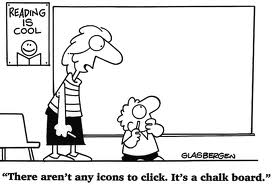
I’ve inherited a class that does not have a whiteboard. Well actually it does, but it is covered up by a Smart Board. It seems that my school was so excited to install brand new Smart Boards (interactive whiteboards) that they set it up directly on the existing board. They were so keen to set up the Smart Boards it didn’t even occur to them to take down the whiteboards first!

As much as I love my Smart Board, I find it much easier to write and present maths problems on a traditional whiteboard.

So I got my school to order one for me. Last December ….

And it only arrived today!

Meanwhile, my Smart Board died two weeks ago. The projector just decided it couldn’t facilitate any longer (I hope it didn’t have anything to do with my ghastly interactive whiteboard handwriting). A teacher without a whiteboard is like a carpenter without a drill. It is a huge challenge to teach without a board. A challenge that has proved frustrating and in a sense, quite revealing.

It has taught me that no matter how incredible modern technology has become. No matter how much education has been transformed because of touch screens, blogs, the internet, YouTube, Wikipedia etc. Nothing can replace the simple whiteboard!

If Teachers Were Paid More I Wouldn’t Have Become One

March 20, 2012

Another year, another impending strike. I know I am a lone voice on this  one, but I find the notion of teachers striking very distasteful and selfish. The job of a teacher is to support and nurture their students. When a teacher decides not to front up to work, they are robbing children of a day of school.

I have never met a teacher that went into the caper for the money. It is a well-known fact that teachers don’t get paid vast sums of money. Partly, this is due to tradition and partly it is due to the fact that Governments simply cannot afford to offer large pay increases across the board.

Am I suggesting that teachers should not be paid more? Absolutely not. I think I work hard enough to justify an increase of salary (currently 3% less than a public school teacher). There is enough wasted money spent on education, I think it would be quite appropriate for some of that misspent money to be allocated to teachers.

What I don’t agree with is the argument that teachers should be given a marked increase. If that was to happen before I started my teacher training, I never would have become a teacher. A large wage increase would have led to a greater popularity in teacher enrolments. The flow on from this would have been that to get into a teaching course, the tertiary rank (based on Year 12 results) would have been much harder. I simply would not have had the grades to get a place.

Some would see that as a positive. Teachers should, according to many, posses outstanding academic credentials. After all, the smarter the teacher, the better the teacher, right?

Not necessarily. I was a late bloomer. I struggled throughout school. My teachers found me very frustrating. No matter how much I applied myself, simply passing was a huge challenge for me. And yet, it is this struggle that has made me become a decent teacher. It has provided me with patience and it allows me to understand the struggles of students with learning difficulties and confidence issues. I try to be the very teacher I felt I needed, but never had.

Whilst I believe that teachers do a wonderful job and they deserve to be paid accordingly, I would like to reach that point without strikes and without Education Unions (they shouldn’t be allowed to be called the Education Union – they aren’t representing what is best for education). I would like potential teachers to join this wonderful profession more for the passion and dedication they have for the job than the money.

I expect that I will be critcised roundly for my stance. I look forward to reading your take on this.