Posts Tagged ‘Teacher Training’

Crying in Front of Your Students

November 20, 2011

I have never cried in front of my students.  However, in my first years of teaching, there were times when I felt completely out of my element and had to keep my resolve and try by best to pull through.

I’ve just read a brilliant piece by Caitlin Hannon, a first year teacher, whose introduction to teaching reduced her to tears.  And who can blame her?

I broke a cardinal rule of teaching several times last year: I cried in front of my students.

Sometimes it happened out of frustration. Just as often, I was overcome during very honest conversations about the struggles my students face within and beyond the school building. At least twice the tears were brought on by uncontrollable laughter at a student’s joke.

As a first-year teacher, I figured tears (of some kind) were inevitable.

I knew I wanted to make a difference, and I thought that difference needed to start in the classroom — not in an office as a policymaker, with little or no connection to, and understanding of, what happens inside schools.

This desire, and my nontraditional education background, led me to Teach For America, a program that trains recent college graduates from various backgrounds to teach in public schools. I spent my first year teaching English at Tech High School, which served a predominantly low-income, minority population. This year, I am teaching seventh-grade language arts at Emma Donnan Middle School.

By the end of that first year, I realized that the life I’d changed the most was my own.

Who is prepared to read a child’s disclosure of abuse in a journal entry?

Who is an expert at helping a student handle the loss of several close family members in a bout of gang violence over the weekend?

I experienced both of these scenarios and more during my first year, and it’s hard to imagine a traditional route to the classroom making it any easier to deal with such heartbreak.

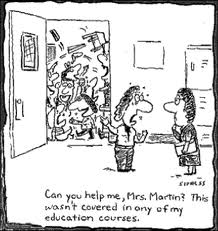
Above is just an excerpt of the article.  I encourage you to read the entire piece. It strengthens my long-held position, that teachers are not fully prepared for the rigours of a classroom due to the failings of the teacher training programs. I also feel that new teachers are left to their own devices when they really need a non-judgemental mentor to help show them the ropes and counsel them through the tough times.

Ms. Hannon may not have had her last cry at school, but her passion and teaching philosophy suggests that she is going to have a great future. Her students are going to be the great beneficiaries of her blood, sweat and, yes, tears …


The Reason Why New Teachers Often Struggle

October 31, 2011

Ofsted is wrong. Teacher training doesn’t need to be tougher, it needs to be smarter. The reason why our new teachers find it so hard is not because they cruised through their training but because their training didn’t prepare them for the classroom.

Tougher teacher training is not going to achieve anything:

Tougher training should be given to teachers in a bid to raise standards in the classroom, an education watchdog has proposed.

The guidelines, drawn up by Ofsted and published on Monday, would see a greater emphasis on teachers’ behavioural management and ability to teach pupils to read, including those with special educational needs.

The ways in which trainee teachers are currently assessed would also change; inspectors will rate trainees’ effectiveness in few categories but according to a tougher criteria. The inspection will include an increased focus on trainees’ subject knowledge and the quality of training.

My University course was as tough as they come, but it was too steeped in the theoretical.  I needed far more exposure to classrooms than 5 weeks in year one and 9 in the second and final year of my degree.  I needed to see how different teachers and different schools operated. I needed to be in touch with resources that was shown to work and methods that I could employ later on.

Instead, I was treated to mindless theory and useless advice.  It was an extremely tough course, but one that offered me precious little in terms of real experience and practical insight.

The Teacher Blame Game Isn’t Fair

October 28, 2011

It seems to be more fashionable than ever to knock teachers.  Teachers are being dubbed as lazy and inept.

In truth it is easy to criticise teachers but very hard to be one.

We need more articles like this one by Patricia McGuire to defend teachers and set the record straight.

Yes, teachers should certainly be held accountable for excellence in teaching and for measurable results in the progress their students make each day. Teachers are on the front line of student learning assessment, since they really do know better than anyone else what makes a child successful or lackadaisical, engaged or detached in class. Standardized tests rarely measure the real progress that teachers make with some of the most challenging pupils whose learning styles are far off the normed curves.

The current fashion in education reform treats teachers as lazy slugs who care little about whether their students are learning anything. The assumption behind using standardized testing for teacher evaluation is that the only way to make teachers care about learning is to embarrass them publicly when their students do not perform according to someone else’s idea of norms. This assumption is what is truly preposterous!

For teachers who choose to devote their life’s work to some of the most difficult classrooms in America, such as here in the District of Columbia, the testing imperative becomes a monumental disincentive to stay in the classroom for any length of time, since the opportunities for sustained superior results on standardized tests are rare, while the risks of frequent subpar results are very high. It’s no secret that the widely-hailed Teach for America program has ingrained two-year turnover in its teaching corps. TFA teachers rarely stay to wrestle through the down years, which are frequent among students in marginalized communities.

Governments are so busy trying to find a negatively geared incentive for teachers and a scale that compares their effectiveness that they have lost sight of the most important pieces of the Education reform puzzle:

1.  Revolutionise teacher training programs to focus on the practical instead of the theoretical.

2. Have measures in place that allow all teachers (especially new teachers) the support they need.

3.  Spend more time critiquing schools with questionable cultures of bullying and harrasment.  Give these school’s the support they need to better handle their affairs.

Teacher Evaluations Are Doomed to Fail

October 22, 2011

Notionally, I have no problem with being evaluated.  I suppose it is a good way for me to get objective advice from an impartial other.  This could then potentially have a positive effect on my future teaching.

But I have been evaluated before.  All Australian student-teachers are put through a series of evaluations before qualifying for their teaching degrees.  My evaluations proved a heart-rendering, confidence sapping, irritating, period of despair.  The feedback I got was that “the students liked me too much”, that they “behaved for me rather than because of me”, that I “teach too much like a male teacher” (what does that even mean?) and that I “need to be more emotionally distant” ….

One of the main reasons that I decided to become a teacher was so that I could offer my students an alternative from the garbage I got dished up when I was a child.  The sad thing is, if I get evaluated, there is a great chance it will be by the very type of educator I am trying not to be.

Bill and Melinda Gates touch on it in their brilliant piece in The Wall Street Journal:

It may surprise you—it was certainly surprising to us—but the field of education doesn’t know very much at all about effective teaching. We have all known terrific teachers. You watch them at work for 10 minutes and you can tell how thoroughly they’ve mastered the craft. But nobody has been able to identify what, precisely, makes them so outstanding.

This ignorance has serious ramifications. We can’t give teachers the right kind of support because there’s no way to distinguish the right kind from the wrong kind. We can’t evaluate teaching because we are not consistent in what we’re looking for. We can’t spread best practices because we can’t capture them in the first place.

Our Education System is so flawed at the moment that I am not sure effective teaching can be properly measured.  There are plenty of teachers like me (most are far better) that want to buck the trend because we want something different for our students. We want to try new things, we want to engage our students, and against the advice of some we do not want to practice ’emotional distance’ from our students.  If we were evaluated we may be judged poorly, but our students love our classes and their parents are satisfied with our performance and that should be all that matters.

And why just evaluate the teachers?  Who is evaluating the Principals?  What about the school culture?

It’s like evaluating the pasta in a pasta dish.  Sure the pasta is the most important ingredient, but if the sauce and other ingredients tastes bad, no matter how good the quality of pasta is, the dish will be a failure.

Until we have a better measure for judging good teaching and until we evaluate all stakeholders and elements of education together, the results will be tainted and ‘unique’ teachers will be forced to follow the herd.

Teaching is Worth It!

October 5, 2011

People who don’t know me well assume that I fell into teaching because it pays my bills.  They look at a male primary teacher and think that I must have been low on choices to pick a profession that the average man wouldn’t opt for in a million years.

Their impressions are all wrong.  In fact, I did have choices, but all I wanted to do was to teach.  It’s hard to explain to those who associate teaching with low pay, long hours, high stress, immense pressure and classroom management headaches.

I read a brilliant piece by student teacher Stephanie Vincent, entitled Why I Really Shouldn’t Be a Teacher. She lists 3 reasons why she shouldn’t go down the path she is going – the workload, lack of recognition and the challenges stemming from difficult parents.

Yet, with all those detracting factors, she is very happy with her choice:

By becoming a teacher I will be lucky enough to spend every day doing something that I’m passionate about. From the first day of my teaching practicum I felt as though I had entered a sacred world, and I can confidently say that I want to spend my future there. Quite simply, I love teaching and children.

Luckily, I don’t seek recognition or a prestigious job. I want a job that excites me. Every day students remind teachers why they teach. This was made clear to me throughout my practicum experience. When I was able to connect with students or when I saw students’ eyes light up when they finally understood a difficult concept, I felt deeply rewarded. Students are why teachers teach.

But what about those difficult parents I mentioned? Although I have not yet had to deal with upset parents, I did deal with an upsetting experience. I worked with one student in particular in a one-on-one setting, and we developed a close bond. During my practicum her entire life was essentially flipped upside down, and she reached out to me. It was devastating to know what she was going through. I was helpless and questioned my ability to deal with it. I discussed my fears with my teaching associate, and as always, she was amazing. She reminded me that, as a teacher, I could help this student. Teachers are in a unique position in that they can provide every child in their class with a positive environment, for at least part of their day, and show them that someone cares.

Suddenly those three reasons I talked about above for not becoming a teacher seem far away. I cannot think of anything that I would rather do. I want to learn how to teach so that I can spend every day with students and so that we can learn from each other. Each and every student brims with energy and unrealized possibility. I want to help them release that energy and realize their potential. In the end, teaching is the most rewarding and enjoyable job anyone can do.

This was just a pleasure to read.  There is so much negativity surrounding this great profession, it is a joy to read from a passionate and driven teacher.  I wish Stephanie all the best during her training and beyond.  She presents as the type of teacher you’d want looking after your child.  She reminds disillusioned teachers that if they don’t feel the same way as she does, they should perhaps consider a change of career.

It’s Time That Teachers Get Trained Properly

September 28, 2011

It’s just bewildering how unprepared our system seems to be in dealing with students who turn up to school without basic language skill.

When a person fronts up to a doctor with an ailment that came about from unhealthy eating habits and reckless behaviour, the doctor doesn’t throw his/her hands up in the air and tell them that they can’t properly help them because of their inability to look after themselves.

When a plumber gets called to a house to inspect a toilet that has been clogged due to the owners stupidity and laziness the plumber doesn’t refuse to take the job citing that they can’t fix a problem that wouldn’t have existed had the owner stuck to flushing toilet paper only.

There are professionals that are prepared to take on all kinds of cases regardless of the negligence or challenges involved.  And then there’s teachers …

Traditionally, teachers seem to crumble when presented with students who haven’t acquired basic skills at home.  I am glad to hear that our wonderful profession is taking more positive steps in dealing with this problem:

In socially deprived areas more than 50% of children begin school without the ability to speak in long sentences, which experts say can lead to problems in later life. Schools across England are taking part in a day without pens to tackle this speech deficit.

It took the whole class of five and six-year-olds six attempts to reassemble these jumbled words into a coherent sentence: “Past the walked we shops.”

Partly it was the noise in the classroom which made listening difficult.

Partly it was the distracting presence of a man from the BBC with a microphone.

But mostly it was unfamiliarity with the basic rules of English, their first language, which made the exercise so long winded.

The children, from Baguley Hall Primary School in Wythenshawe, south Manchester, are bright and normal children.

But they have had few opportunities to develop conversation skills.

It is a poor area with high unemployment and a large proportion of children living in lone parent households.

 Family discussions do not happen very often.
Of course I am making a generalisation  (and I am not comparing a child with a clogged toilet!). There are plenty of teachers fully equipped at dealing with this issue.  But there are too many that aren’t.
For me this has little to do with effective teaching and more to do with effective teacher training.  Teachers are not fully prepared for the child that doesn’t know how to carry a conversation because practical skills aren’t properly covered in a Teaching degree.
Whilst it would be nice for parents to ensure their children turn up to school with basic language skills this just can’t be relied upon.  Teachers need to be prepared for all types of scenarios.
Unfortunately, they are not prepared at all!

Private School Teachers Are Not Necessarily Better Teachers

September 21, 2011

Whilst I like the idea of experienced and outstanding teachers helping to mentor student teachers, I am very bewildered by a proposal to have private school teachers mentor public school teachers.

Who thought of this crazy plan?

It is such a simplistic generalisation that private school teachers are superior to their public counterparts.  So what if private school kids get better academic results.  We all know that the credit doesn’t solely fall on the classroom teachers.  Private school students are given higher expectations by their parents and often have tutors to help them when they are behind.

That is why it was refreshing to read an article by lecturer, James Williams:

The results that private schools achieve may be impressive – but results are one thing, raising aspirations in a cohort of disaffected youths, when your experience is of children with Cath Kidston pencil cases who holiday in the Bahamas is quite another.

The problem with such debates is that they miss an important point.

Not all teachers, regardless of how they have been trained, can teach in all schools.

The reality of teacher training is that there is no ‘one method’ of training that instantly produces excellent teachers who can turn their hand to any school, any challenge and any system.

An important skill for those who are teacher trainers, like me, is recognising your trainee’s strengths and weaknesses and guiding them to teach in the right school for them.

It is very good to hear that teacher training is under the microscope.  For too long the problems to do with teacher training was swept under the carpet.  Teachers spend years of their lives slaving away for a degree that ultimately does precious little for preparing them for the realities of the classroom.

I like the idea of a mentor system, I just don’t like this one.


Sometimes the Unions Don’t Help

June 26, 2011

There are times when the Education Unions just make me shake my head.  At a time when respect for teachers is at an all time low, unions have the opportunity to help promote the good work teachers do.  Instead, they often make things so much worse.  Take this story for example:

Students will not be allowed to enter teacher training in England if they fail basic numeracy and literacy tests three times, under tougher rules to raise teaching standards.

At present students are allowed to take unlimited re-sits while they train.

The Department for Education said one in 10 trainees takes the numeracy test more than three times, while the figure is one in 14 for the literacy test.

The National Union of Teachers said it considered the tests “superfluous”.

The aim is to improve the standard of students entering teaching.

From September 2012, candidates will have to pass the assessments before they are permitted to begin their training courses.

The tests are the same for both primary and secondary school teacher trainees, who must also have achieved a grade C or above in GCSE maths and English.
What is “superfluous” about ensuring that teachers have basic skills in the areas they teach?  What profession would allow trainees to practice without the requisite knowledge or skill?  It’s not as if the questions are so hard.  Here are a sample of the questions on such a test:

SAMPLE QUESTIONS

  • Q: Teachers organised activities for three classes of 24 pupils and four classes of 28 pupils. What was the total number of pupils involved?
  • A: 184.
  • Q: There were no ” ” remarks at the parents’ evening. Is the missing word:
  • a) dissaproving
  • b) disaproveing
  • c) dissapproving
  • d) disapproving?
  • A: d
  • Q: For a science experiment a teacher needed 95 cubic centimetres of vinegar for each pupil. There were 20 pupils in the class. Vinegar comes in 1,000 cubic centimetre bottles. How many bottles of vinegar were needed?
  • A: 2
  • Q: The children enjoyed the ” ” nature of the task. Is the correct word:
  • a) mathmatical
  • b) mathematical
  • c) mathemmatical
  • d) mathematicall
  • A: b