Posts Tagged ‘social media’

Are you Addicted to the Internet?

June 21, 2012

Technology addiction is one of the most prevalent, yet socially acceptable addictions. It envelopes both children and adults and can ruin marriages, cost jobs and effect sleep.

Courtesy of Dr Oz and Dr. Kimberly Young, I have accessed a quiz to determine whether or not one is addicted to the internet:

1. Do you feel preoccupied with the Internet (think about previous online activity or anticipate next online session)?
2. Do you feel the need to use the Internet with increasing amounts of time in order to achieve satisfaction?
3. Have you repeatedly made unsuccessful efforts to control, cut back, or stop Internet use?
4. Do you feel restless, moody, depressed, or irritable when attempting to cut down or stop Internet use?
5. Do you stay online longer than originally intended?
6. Have you jeopardized or risked the loss of significant relationship, job, educational or career opportunity because of the Internet?
7. Have you lied to family members, therapist, or others to conceal the extent of involvement with the Internet?
8. Do you use the Internet as a way of escaping from problems or of relieving a dysphoric mood (e.g., feelings of helplessness, guilt, anxiety, depression)?

Other Symptoms Include:

• Failed attempts to control behavior
• Heightened sense of euphoria while involved in computer and Internet activities
• Neglecting friends and family
• Neglecting sleep to stay online
• Being dishonest with others
• Feeling guilty, ashamed, anxious, or depressed as a result of online behavior
• Physical changes such as weight gain or loss, backaches, headaches, carpal tunnel syndrome
• Withdrawing from other pleasurable activities


Facebook and Child Exploitation

June 19, 2012

The moment Facebook first made the sensible and responsible age requirement rules they have been trying to soften, if not repeal them. The age restriction guidelines exist for the safety and wellbeing of underaged children. Yet we are constantly confronted with the reality that Facebook is desperate to recruit the underaged demographic.

The latest news sees Facebook advertisements target the very children they are supposed to be turning away:

An alliance of consumer rights groups on Monday pressed Facebook not to aim advertisements at preteen children or track their activities online if it formally opens its site to them.

Facebook has millions of underage users who claim to be over the required age of 13, and the company has had discussions with some advocacy groups over how to keep children safe on the site if they insist on signing up.

The topic of whether children under 13 should be on Facebook is hugely contested. One side argues that under no circumstances should young children be permitted on a social networking site, and another argues for an array of restrictions and conditions on how they can use the site.

The groups that sent the letter on Monday to Mark Zuckerberg, chief executive of Facebook, include Consumers Union, the Center for Digital Democracy, Consumer Action and the Consumer Federation of America. They called on Facebook to refrain from tracking children under 13 both on the Facebook site and on other sites that have Facebook widgets, such as the “like” button. In addition, they called on Facebook to enable parents to monitor and review their preteen children’s activities, offer parents “granular control” over every application they use on the Facebook platform and keep children’s account settings as private as possible.

The letter read: “We want assurances that any space created for children under the age of 13 on the site is safe, parent-guided and controlled, and, most importantly, free of ads.”

Advertising is not the only reason Facebook would want to allow under-13s on its site. It could widen its user base, guard against children becoming attached to another social network, and potentially build a trove of information on users as they grow into adulthood. By developing special conditions for them, the company could also protect itself from a federal regulation that requires companies that gather information about children under 13 to obtain written consent from their parents; those regulations are being revised.

Facebook Doesn’t Seem to Care About Kids

June 5, 2012

It seems as though Facebook cares more about indoctrinating more young lemmings onto their database than protecting the safety and wellbeing of our children. I have stated before my firm belief that children under 13 do not have the maturity to warrant the privilege of having a Facebook page.

You may argue that many 13 year-olds defy that rule and go and get one anyway. This is unfortunate, and something their parents ought to take an interest in, but at least in this instance there are laws that are being broken. It would be decidedly worse if the age requirement rule was abandoned altogether.

A new proposal to allow children under the age of 13 to have legal access to Facebook is the first step in a concerted effort to rescinding these important regulations:

Facebook Inc. is developing technology that would allow children younger than 13 years old to use the social-networking site under parental supervision, a step that could help the company tap a new pool of users for revenue but also inflame privacy concerns.

Mechanisms being tested include connecting children’s accounts to their parents’ and controls that would allow parents to decide whom their kids can “friend” and what applications they can use, people who have spoken with Facebook executives about the technology said. The under-13 features could enable Facebook and its partners to charge parents for games and other entertainment accessed by their children, the people said.

Facebook currently bans users under 13. But many kids lie about their ages to get accounts, putting the company in an awkward position regarding a federal law that requires sites to obtain verifiable parental consent before collecting personal data from children.

Any attempt to give younger kids access to the site would be extraordinarily sensitive, given regulators’ already heightened concerns about how Facebook protects user privacy. But Facebook, concerned that it faces reputational and regulatory risks from children already using the service despite its rules, believes it has little choice but to look into ways of establishing controls that could formalize their presence on the site, people familiar with the matter said.

The Impact of Social Media on Kids

May 13, 2012

I agree with many of Jim Steyer’s points in regard to the need to educate children about using the personal setting on Facebook, as well as the addiction issues relating to children and social media. I am a big fan of his suggested “erase” button, which would enable children to delete any uploaded information they regretted putting on their pages.

Facebook’s big stock offering on Wall Street must be followed by an intensive debate on Main Street about social media’s powerful impact on children, an expert on the topic says.

Jim Steyer, founder of Common Sense Media, a San Francisco think tank focusing on media and families, said the technology that Facebook represents is having “an enormous impact” on youngsters, families and schools worldwide.

“We need to have a big national, if not global conversation about the pros and cons of that,” Steyer, a father of four who is also a civil rights lawyer and Stanford University professor, told AFP in an interview.

While social media such as Facebook, Google Plus and Twitter offer “extraordinary possibilities” in such areas as education, he said, “there are also real downsides in a social, emotional and cogitative development way.”

Steyer was in Washington to promote his just-published book “Talking Back to Facebook: The Common Sense Guide to Raising Kids in the Digital Age,” which argues for greater parental involvement in their children’s online lives.

“Whether we like it or not, kids are now spending far more time with media and technology than they are with their families or in school,” – as much as eight hours a day on average in the United States alone, he wrote.

Children face the triple peril of what Steyer calls RAP – relationship issues, attention and addiction problems, and privacy issues – as well as cyberbullying, online pornography and, for girls, body image fears.

“There is an arms race for data, and to build things as fast as possible … but that’s not a great strategy when you’re talking about kids,” he said, accusing tech outfits for “not respecting the concept of privacy.”

Earlier this week, a Consumer Reports survey found nearly 13 million US Facebook users – out of 157 million, and 900 million worldwide – do not use, or are not aware of, the site’s privacy controls.

Girls are especially vulnerable, Steyer said, with studies indicating that many body-conscious teens are photoshopping images of themselves so as to look thinner and score more “likes” among their friends.

On a governmental level, Steyer suggested the United States follow Europe’s lead in privacy regulation and introduce an “eraser button” enabling users to wipe off anything they might have posted in the past.

“We need clear and simple rules (around privacy) for the tech companies, too, because right now they’ve dominated the debate and they’ve set the rules themselves,” he said.

But the immediate responsibility, he said, falls on moms and dads.

“It’s part of parenting 2.0 today, so you have to do your homework,” he said.

“You have to actually learn the rules of the road… and then you have to set clear and simple limits for kids, set clear rules of behaviour – and you have to be a role model.

“If you’re constantly addicted to your cellphone or your ‘CrackBerry’ then that’s not sending a very good message to your kids.”

Parents of Underage Facebook Users Should Be Reported: Principal

May 7, 2012

I am a big advocate of Facebook’s age requirement specifications. Children under 13 have no place having a Facebook page. They are simply too young to manage a Facebook page with maturity.

As much as I approve of the age requirements, everyone knows that underage kids have no difficulties getting their Facebook page and Primary schools are teaming with underage Facebook users. This poses deep concerns from a cybersafety and cyberbullying point of view.

However, to suggest that parents of underage children should be reported to child services, both cheapens the important role that child services play in the welfare of our children and labels well-meaning but naive parents as incompetent and unfit for the job:

The issue of underage children creating profiles on social networking sites like Facebook and how to control it can be a problem for both privacy and security — something one UK principal apparently believes should be taken further.

Sister site CNet reports that as there are so many underage children on Facebook — signed up with or without parental consent — one educator believes official, legal consequences for breaking the rules should be put in place.

The school principal of St. Whites School in the Forest of Dean, Paul Woodward, has reason to believe over half of the students in his school are on social networking sites including Facebook. However, the problem is that St. Whites School’s attending students are between the ages of 4 and 11 — far below Facebook’s minimum age in relation to its Terms of Service.

Woodward, speaking to the Daily Mail, believes this issue is serious, and it may be something that official channels should become involved in:

“It’s illegal for you to do this, you shouldn’t be doing it for your child. You need to close down that account, or I might have to tell the safeguarding people that you are exposing your child to stuff that’s not suitable.”

The ’safeguarding people’ are child-protection services, usually reserved for cases of abuse, domestic problems or suspicions of violence. Perhaps this could be considered a drastic move, but as online networks often contain material not suitable for children of a certain age, the logic is understandable. If parents facilitate their child’s access to such networks, then perhaps they can be considered culpable.

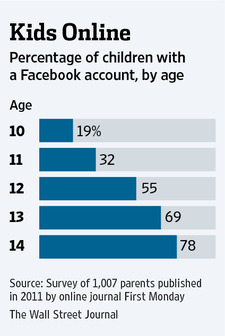
A survey completed earlier this year by company Minor Monitor indicated that while over 70 percent of parents were concerned with their child’s activities on Facebook, 38 percent of all children on the social networking site are under 13 — and 4 percent are under 6 years of age.

Facebook says it removes approximately 20,000 underage users daily, but it is also important to note that parents are creating profiles for their children. New parents — you may want to remove that profile you created for your baby. (They probably won’t appreciated their baby photos being online once they’ve grown anyway).

Educating parents is a far more workable strategy than threatening them. I have never heard of a Principal who has gone public with a threat to report half the parents in their school to social services. That’s courage for you!

I commend Mr. Woodward for his conviction and his desire to see that his students stay safe and follow the law. I just think that in doing so, he went way too far.

When Will Principals Start Taking the Side of a Teacher Over a Parent?

April 3, 2012

Those who read my blog know how nervous I am about teachers who have readily accessible Facebook pages. I have read too many stories of teachers whose careers and reputations have been jeopardised by an update status or cheeky photo.

But the story below story reminds us that there is another important factor at play here. Teachers are people like everyone else. We have every right to enjoy the sorts of pleasures that non-teachers do. Teachers should be able to, within reason, use their Facebook page without the need to have it monitored or vetted by a superior.

And if a parent complains about content on a teacher’s Facebook page, or any other matter that doesn’t qualify as extremely serious, I’d love to see the hierarchy defend their teachers.

Principals and superintendents seem far too reluctant to back their teachers in the face of controversy. A healthy school culture requires parents to be involved in the running of the school. An unhealthy school culture has the parents actually running the school.

When a parent complained about a PG-13 photograph on a teacher’s Facebook page, the superintendent should have defended his/her teacher:

When Kimberly Hester of Cass County, Mich. posted with permission a photo a coworker sent her on Facebook, she didn’t think it would offend the public school where she taught, or lead the superintendent to demand access to her Facebook page.  But a photo of her coworker with her pants down did just that.

Hester, 27, was a full-time peer professional, or teacher’s aide, at Frank Squires Elementary in Cassapolis, Mich. for about two years. In April 2011, a coworker texted a photo showing herself with her pants around her ankles, with the message “thinking of you” as a joke.

“She’s actually quite funny.  It was spur of the moment,” Hester said, adding that there was nothing pornographic about the picture, which only showed the pants, part of her legs, and the tips of her shoes.

“I couldn’t stop laughing so I asked for her permission to post it [on Facebook],” she said.  The coworker agreed.  Hester said all this took place on their own time, not at or during work.

Hester said a parent (not of one of her students) showed the photo to the superintendent, calling it unprofessional and offensive.  Hester said the photo could only be viewed by her Facebook friends.  The parent happened to be a family friend.

In a few days, the superintendent of Lewis Cass Intermediate School District, Robert Colby, asked Hester to come to his office.

“Instead of asking to take the photo down and viewing it from my friend’s point of view, they called me into the office without my union,” she said.  Hester is a member of the Michigan Education Association, which represents more than 157,000 teachers, faculty and support staff in the state, according to its website.

The superintendent asked that she show her Facebook profile page.

“I asked for my union several times, and they refused.  They wanted me to do it right then and there,” Hester said.

Hester’s story echoes reports of employers asking job applicants for access to their Facebook pages.

Hester said she and her coworker pictured in the photo were put on seven weeks of paid administrative leave, and they were eventually suspended for 10 days.  She said the coworker, who was up for tenure, was forced to resign.

Hester said she returned to work in September when the school year began.  While Hester previously worked assisting a teacher for emotionally impaired students in kindergarten through the fourth grade, she was assigned another program and was placed under a strict directive.  She said she was instructed not to speak with coworkers unless it was about a student and could not go to the bathroom before asking.

She said her contract allowed her 14 paid days off but the school would not let her use them.  She said she was also directed to read books about communication and to take 49 online classes.  She said that and the work environment at school took a toll on her emotionally in November 2011.

“I had a nervous breakdown, went to hospital and was put on medication,” said Hester, who has been on unpaid leave since November.

I greatly respect parents who are actively involved in their childs’ progress. However, if they ever raise concerns over a teacher, that teacher should be given the support and assurance they deserve.


Kids Need Meaningful Relationships More than Mobile Phones

March 12, 2012

No matter how advanced technology becomes, nothing will stop us from needing human contact and real interaction. You might be able to stockpile Facebook friends, but nothing can replace the loyalty and support offered by a real friend.

Sometimes I feel that we have allowed ourselves to live in glass cubicles, shielded from real people, real conversations and real experiences. The same technology which was devised to bring us closer together has been misused and ultimately, has kept people out.

Teachers have been instructed to keep emotional distance from their students, the local small business operator who cared about his/her community as much as their bank balance, has been replaced by people not interested in the place where they work or the people who frequent their establishment. People are much less likely to say things like, “I just met someone on the train. We got talking and she told me all about her interesting life.” The only talking on trains is via mobile phone.

Is this really a natural way to live? Is this how we want our children to grow up? Are we really surprised to read that children don’t play with other children like they used to?

A new study that found almost 50 per cent of kids don’t play every day has prompted an expert’s warning about a generation of depressed and anxious youngsters.

The study, hailed as the first of its kind in Australia, carried out a total of 1397 interviews, including 344 with children aged between eight to 12.

About 40 per cent of them said they don’t have anyone to play with while 55 per cent say they’d like to spend more time playing with their parents.

Forty-five per cent said they were not playing every day.

The MILO State of Play study, which also interviewed 733 parents and 330 grandparents, found that more than 94 per cent of them believed play was essential for child development.

But it is still rapidly falling off the list of priorities, said child psychologist Paula Barrett.

“The longer we de-prioritise it, the more likely we are to have unhappy and inactive Australian kids which are more likely to be anxious and depressed, resulting in a raft of social problems in adulthood,” she said.

Dr Barrett said unstructured, active play was essential to help children learn important life skills, develop imagination and creativity.

“This finding highlights a concerning yet common misperception that many parents share – they dont think that kids need to play regularly after the age of eight,” she said.

Many will criticise me for drawing a parallel with the state of society and the development of new technologies. Of course technology isn’t solely to blame for a lack of real and personal interactions. But let’s face it, they have made the issue more serious. Just look at the advertisement above. Do we really want life’s pleasures to be about how nifty our touch screens can become?

In 2005 a landmark movie was released entitled, Crash. It depicted New York as a place where people are too insecure and selfish to interact with others. The only way a person can have any dialogue with a stranger is if they, quite literally, crash into each other.

Our children need real friends, not Facebook friends, they need play dates not peer-to-peer gaming sessions and they need the adults in their lives (including teachers) to scrap any notions of emotional distance and become engaged.

Let’s tear down the barriers and bypass the touch screens and actually … talk with each another!

Facebook Ignoring Their Own Age Restrictions

March 4, 2012

Facebook have done the right thing by setting age restrictions. Children under 13 should not have their own Facebook page. We have seen enough carnage caused by children misusing their Facebook page to know that a bit of maturity is essential to having the privilege of being part of the Facebook community.

That’s why I am appauled to read that Facebook may be trying to recruit underage children:

FACEBOOK claims it can reach more than 150,000 children in WA under the age of 13, according to the social networking giant’s advertising database.

Cyber safety experts say Facebook’s estimated reach shows that many young children are accessing the website despite guidelines stating it is only for older teenagers.

Online Child Exploitation Det-Snr-Sgt Lindsay Garratt warned young children were exposing themselves to risks such as sexual predators, cyber bullying and identity theft on social networking sites.

Facebook allows users access to its database statistics if they’re planning to advertise on their website.

It says advertisers wanting to target young teens in WA could reach an estimated 177,220 users aged 13 or under.

Facebook doesn’t let users sign up unless they claim to be over 13. But users often give away their true age by listing information such as the primary school they attend.

Sen-Sgt Garratt said it was important that parents monitored the websites their children were visiting.

Unless Facebook moderators can show they are doing everything in their powers to stop underaged children from having their own page, Facebook should be legally culpable for cybersafety and cyberbullying incidents as a result of their sneaky tactics and general lack of scrutiny.

Are Children Getting Enough Sleep?

February 14, 2012

Kids seem to be looking and feeling mored tired than ever before.

A recent study indicates otherwise:

It is a common complaint of our modern age that kids and teens don’t get enough sleep.

Video games, TV, social media, and other trappings of our increasingly tech-centric lives are often blamed, but a new study shows that long before Facebook or PlayStation 3, kids were sleeping less than experts said they should.

When researchers in Australia reviewed sleep recommendations and actual sleep times among children over the past century, they found that kids consistently slept about 37 minutes less than recommended at the time.

Each time, new technological marvels — be it the light bulb in the early 1900s, TV in the 1950s, or computer gaming systems and social networking today — were blamed for declining sleep times.

“The message that children don’t get enough sleep has been the same for over 100 years,” says researcher Tim S. Olds, PhD, of the University of South Australia.

I wonder if children today experience a different form of tiredness. A tiredness as a result of late nights, a lack of physical exercise, a carb dominated diet and excess weight. Perhaps the tiredness is the same as always, but the presentation of the tiredness is more extreme.

Bullying a Rape Victim is Beyond Disgraceful

February 10, 2012

Upon hearing about the disgusting cyberbullying of a young rape victim I became very upset. I hope these perpetrators get charged for their insensitive and heartless behaviour.

Not only has this poor girl had to deal with the worst form of torture, but she has had to endure this awful campaign as well:

After being attacked and going to the police, she was then branded ‘a lying little skank’ and worse on internet sites.

She was told her home would be burnt down unless she withdrew her evidence. The sustained threats of violence meant that she had to be accompanied everywhere by her mother, even going to and from school.

Her rapist was jailed this week, so at least some justice has been served, which might bring a little comfort.

Yet isn’t it appalling that her physical ordeal was followed by a form of mental terrorism lasting months, with the police all but powerless to stop it, even though what happened amounted to nothing less than intimidation of both witnesses and victim before a court case?

The schoolgirl’s torment began in January 2011, when she was raped in an alleyway near Clitheroe Football Club. She was found by a dog walker naked from the waist down and covered in mud.

Her parents, who had been trying to locate her, had called the girl on her mobile and heard some of the attack, including their daughter screaming: ‘Stop it’. They, too, were quickly on the scene.

And as a side note, guess what the rapist received for his cowardly crime?
This week, he was jailed for 31 months.

Pathetic!