Posts Tagged ‘Parenting’

Tips for Parents on Helping Their Children Overcome Obesity

September 19, 2011

It was great to read a list of suggestions by Joanna Dolgoff M.D. with suggestions for parents with obese children.  It was a welcome departure from the “name, shame and threaten” methods being employed by some sections of society on parents who clearly require support.

These suggestions are steeped in common sense and encourage a positive approach:

What Parents Can Do to Help

Be supportive: Overweight children need support, acceptance and encouragement from their parents. Children’s feelings about themselves often are based on their parents’ feelings about them. It is also important to talk to your children about weight, allowing them to share their concerns with you.

Don’t use food as a punishment or reward: Withholding food as a punishment may lead children to worry that they will not get enough food which may result in overeating. When foods, such as sweets, are used as a reward, children may assume that these foods are better or more valuable than other foods. For example, telling children that they will get dessert if they eat all of their vegetables sends the wrong message about vegetables.

Set a good example: Children are good learners and they learn best by example. Set a good example for your kids by eating a variety of foods and being physically active. Involve children in food shopping and preparing. Children may be more willing to eat or try foods that they help prepare.

Teach healthy habits: Teaching healthy eating practices early will help children approach eating with the right attitude: Food should be enjoyed and is necessary for growth, development and essential energy. Guide their choices rather than dictating foods. This will help your children learn how to make healthy food choices. Encourage your child to eat slowly. A child can detect hunger and fullness better when eating slowly.

Cut down on some fats: Reducing fat is a good way to cut calories without depriving your child of nutrients. Simple ways to cut the fat in your family’s diet include eating low-fat or non-fat dairy products, poultry without skin and lean meats, and low-fat or fat-free breads and cereals. However, make sure not to cut out healthy sources of fat such as walnuts, almonds and avocado.

Healthy snacking: You should make snacks as nutritious as possible, without depriving your child of occasional chips or cookies, especially at parties or other social events. Healthy snacks include: applesauce, carrot sticks with hummus, peanut butter on apples, yogurt, dried fruit, fruit juice popsicles, low fat cheese etc.

Increase your physical activity: Regular physical activity, combined with healthy eating habits, is the most efficient and healthful way to control your weight. Some simple ways to increase your family’s physical activity include the following: Plan family activities like walking, dancing, biking or swimming.

For example, schedule a walk with your family after dinner instead of watching TV or playing video games. Overweight children may feel uncomfortable about participating in certain activities so it is important to help your child find physical activities that they enjoy and that aren’t embarrassing or too difficult.

Instead of judging parents with obese children negatively, I feel it is important to encourage, educate and support parents.  Dr. Dologoff’s list is a reminder that the answers lie with positive change and the adcocation of healthier living.


Every Teacher’s Worst Nightmare Realised

September 19, 2011

I commend all students brave enough to speak out against teachers who have abused them physically or emotionally.

To those students who make up false allegations, I hope you realise what damage such a claim makes to the teacher and his/her family.  Shame on you!

I hope William Stuart’s story serves as a reminder for such misguided and selfish students to think carefully about the implications of a false allegation:

After a 23-year unblemished career as a teacher, William Stuart was arrested six months ago and accused of assaulting a 15-year-old girl in a corridor at Graham School, Scarborough.

During the court case, magistrates heard that the girl and friends had smeared an iced bun over the wall of the school canteen. Mr Stuart, an assistant head teacher, had shouted at the group to remain in the dining hall to clean up but the girl refused and began to walk away.

It was then, according to the girl’s testimony, that a “really, really angry” Mr Stuart followed her and backed her up on to coat pegs before pushing her to the floor.

Mr Stuart’s account was very different. The girl barged into him several times and threw a punch as he tried to block her path.

On Thursday it became clear whose version the magistrates believed. Mr Stuart was acquitted with the full endorsement of the bench and to cheers from the packed court. His wife, Sarah, cried tears of relief that the family’s nightmare was finally over.

Whilst we must severely punish any teacher found dealing inappropriately with students we must also do everything we can to deter students from making erroneous claims against their teachers.

Mr Stuart was just doing his job.  He did absolutely nothing wrong.  Yet for 6 months he had lost everything.

Who is the Real Bully, Daphne Melin?

September 15, 2011

I can understand how a parent can feel frustrated and powerless when they find that their child is bullied at school.  I am not surprised to hear that many schools are slow to act on bullying (if at all).  Schools should not hide behind draconian policies and soft and ineffective consequences and should start taking real affirmative action with bullying behaviour.

But it is not the place for a parent to confront the bully, instruct their child to beat up the bully and most of all it is not a parents place to strike their child’s bullies.  Daphne Melin might have tried to help her daughter ward off bullies, but in doing so she exposed herself as the real bully in this sad and sorry episode:

Cell phone cameras recorded Daphne Melin egging on her 12-year-old daughter, as she fought with another girl.

And then, the 32-year-old mother lashed out at a third preteen, grabbing her by the hair and kneeing her at least twice in the face.

“I don’t encourage fighting, I think it’s the wrong thing to do,” Melin told Eyewitness News on Tuesday night.

She blamed the William Floyd School District, insisting her daughter had been the victim of bullying and threats of physical violence online, actions she claims administrators did nothing to stop.

So at her wits end, Melin’s lawyer Michael Brown says she drove her daughter to the schoolyard to confront her tormenters.

“You get very frustrated with a couple of things. The lack of response by the authorities coupled with the fact that your daughter, who is an innocent person, is being continuously harassed,” she said.

Whilst I feel that this should be a lesson to all schools that are not doing enough to address their bullying problems, the biggest lessons of all are reserved for parents.  Not even the frustration of an inactive and non-compliant school warrants such behaviour.  Ms. Melin should have known better.  Her conduct, especially in relation to a concerned bystander was just appalling.

Teacher Escapes With 3-Month Ban for Kissing Student

September 13, 2011

Unprofessional behaviour sets a terrible example for teachers and undermines the essence of what teaching is all about.  Parents send their kids to us hoping we can help make them safe and take care of them.  When teachers break that trust and cross the line of professional standards there must be consequences befitting the crime.

To get a three-month suspension for kissing a student is a disgrace that cheapens the entire teaching profession:

Emma Walpole, 28, had accepted lifts from three of her year 13 pupils — aged 17 or 18 — and made sexually provocative comments to one during the journey. She invited another into her home where she tried to give him alcohol and kiss him.

She admitted unacceptable professional conduct. In a ruling published by the General Teaching Council, the committee said that Miss Walpole would be suspended for three months but felt further sanctions were not necessary as she had expressed remorse and it was felt she would not pose a further threat.

The council was told that Miss Walpole, a teacher at Denstone College in Uttoxeter, Staffs, had befriended the pupils between September 2007 and June 2010.

She sent and received about 25 inappropriate text messages with one of the youngsters between May 2010 and June 2010, some of them of a sexual nature. In May 2010, she requested that he give her a lift in his car and made “sexually provocative” comments to him during the journey.

I’m glad that Miss Walpole regrets her actions and has promised not to reoffend but that doesn’t excuse her behaviour.  The punishment received is tantamount to a slap on the wrist.  It sends the message to other teachers that they can exploit teenagers for the barest of consequences.

Miss Walpole should consider herself very lucky.  If I was on the Council I wouldn’t have been anywhere near as charitable.

Parents Are Warned About SpongeBob

September 13, 2011

I think I’m in the wrong profession.  Perhaps I should give up teaching and apply for a research grant.  Every day the papers are rife with some obvious or completely warped research intended in making already insecure parents feel even more uneasy about the job they are doing.

Today’s message of fear to parents is a warning to avoid letting their kids watch shows like SpongeBob SquarePants which will bring on terrible (I use that word with the greatest of sarcasm) side-effects:

Researchers say this could be because children mimic the chaotic behaviour of their favourite TV characters, or because the fast-moving and illogical cartoons make them over-excited.

In other words children enjoy the show, they respond to it in an imaginative way and it excites them.  That’s a good thing, right?  Well, apparently not:

Tests showed that four year-olds who watched just a few minutes of the popular television show were less able to solve problems and pay attention afterwards than those who saw a less frenetic programme or simply sat drawing.

As a result, they suggest that parents consider carefully which programmes they allow their offspring to watch, as well as encouraging them to enjoy more sedate and creative activities such as playing board games.

Angeline Lillard from the University of Virginia, who carried out the experiment, said: “Parents should know that children who have just watched SpongeBob Squarepants, or shows like it, might become compromised in their ability to learn and behave with self-control.

“Young children are beginning to learn how to behave as well as how to learn. At school, they have to behave properly, they need to sit at a table and eat properly, they need to be respectful, and all of that requires executive functions.

What is wrong with varying forms of stimulus?  Sure watching too much television isn’t good for a child, but why can’t they combine drawing and board games with other activities that excite them?

Perhaps the problem is that in a bid to get children to follow rigid rules like sitting in classrooms without showing any signs of restlessness or boredom, we are instructed to take away the very pastimes which our children actually respond to?

Prof Lillard suggested: “It is possible that the fast pacing, where characters are constantly in motion from one thing to the next, and extreme fantasy, where the characters do things that make no sense in the real world, may disrupt the child’s ability to concentrate immediately afterward.

“Another possibility is that children identify with unfocused and frenetic characters, and then adopt their characteristics.”

Or perhaps kids just want something with a bit of energy and verve after a day of mat sessions and handwriting practise.  Perhaps the “real world” need to adapt to kids.  Perhaps we should be doing more to capture their attention rather than trying to dull their senses by making them play endless games of Monopoly.

I’ve got an idea for a research project.  The effects of a balanced, nurturing, moderate and non-restictive lifestyle on children.

I’m guessing my reasearch proposal isn’t loopy enough to get funding.

The Classroom of the Future

September 11, 2011

The Australian has an interesting examination on a method of teaching that is starting to become quite popular.  It is known by several names such as “agile learning” and “personal learning”, and it is the polar opposite from the orthodox “chalk and talk” method of teaching.

Below is an excerpt of the article:

None of that happens at Our Lady of Lourdes, in Seven Hills, in part because the number of children flowing into the room hasn’t stopped at 30, or 35, or even at 50. On the contrary, the average “class size” is 120. The children here aren’t even required to sit in a certain seat or face the front of the room, in part because there isn’t really a “front” of the room. In fact, the school doesn’t have any four-walled classrooms. It has large, well-designed “learning spaces” with bits of wall here and there. There are no desks as such; there are round tables with tub chairs, an L-shaped lounge with scatter cushions, a tall table with hydraulic bar stools and a comfy, carpeted area designed for children who want to sprawl on the floor. “It probably looks nothing like the classrooms you knew as a child,” says principal Steven Jones.

That’s for sure. What lesson could these students – some of whom are tapping away at Apple Macs, some of whom are lying on their stomachs with their heads in books, some of whom are actually headed outside – possibly be taking? “I believe it’s ‘maths’,” he says, wiggling two fingers from each hand near his ears to signal that he doesn’t mean “maths” like you and I do. “But we don’t really have ‘lessons’. We teach the curriculum, but not in the way you would remember. The days where the teacher would stand there saying, ‘Everyone sit down and listen to me’, they’re gone.”

To be clear: the curriculum stays the same – all Australian schools are required to teach certain things – it’s how the children go about learning that is changing. Teachers work in groups, not to pour information into their students but to guide them as they set about finding things out for themselves. The rules for student behaviour in these spaces differ between schools. In some cases, children are free to get a snack from their bags; in others, they can roam from one part of the space to another or take their work outside.

Whilst I enjoy witnessing change in educational methods (as anything broken requires fixing), I worry about replacing one philosophy with its polar opposite.  In my view, every child is different and needs to be catered for according to the skills, learning styles and qualities they posses.  Some will thrive in a self-directed environment, some will need rigid routines, some will enjoy having freedoms and some will need imposed discipline.

I find myself tinkering my style to suit different classes and different students.  That’s my duty.  If I teach all classes and students in the same style, I will get nowhere.  But from my experience, it isn’t about revolutionary change but rather minor, incremental change.

My gut feeling with this new innovation is that when we have some real data about its effectiveness we will find that it works brilliantly for some students whilst failing to ignite others.

Which was basically the problem this method sought to address.

Kids Fight Back Against Bullying

September 10, 2011

I just watched an absolutely incredible movie featuring 4th and 5th Grade students about dealing with bullies and bullying.  As the intro to the movie explains:

The following movie was developed with a cast and crew of only 4th and 5th Graders (and one 1st Grader) from Glendaal Elementery School.  They worked during recess, lunch, before and after school for 3 months.  They hope it helps shed some light on the issues of bullying, and helps anyone who might be experiencing the effects of bullying.

As someone who is currently preparing to make a movie with my Grade 5’s, I was blown away by this technical and artistic achievement.  The kids act beautifully, the direction is solid and the script is very effective.  I hope this garners worldwide attention and gets used in classrooms all around the world.  These kids have done more for bullying awareness than any anti-bullying program I know of.

Please show this video to your kids/class and let them enjoy the message.  You may want to use it to inspire your class to make a powerful film of their own.

Enjoy!

Parents are Worried and So They Should Be

September 9, 2011

Parents are clearly worried about their children’s online activities.  They are worried about the content they get access to and the people they befriend and chat with on social media sites such as Facebook.

In a nationwide survey conducted by legal information website FindLaw.com, it was revealed that 67 percent of 627 parents are extremely worried (10%), very worried (18%) or somewhat worried (39%) about their children’s safety online. About 20% said that they are not very worried while 14% are not worried at all. The study was done with a small sampling but FindLaw.com said that it was demographically representative.

Most parents are taking steps to restrict their children’s use of the Internet. Steps taken vary, including: monitoring which sites they visit (35%); using site-blocking software (21%); restricting their access to computers (19%); restricting the use of social networks (18%); reading their emails or social posts (17%); and not allowing any Internet use (8%).

I recently attended a Professional Development session on cyber culture.  The survey conducted by AISV interviewed thousands of kids from Grade 4 to Year 8 and collected information about their internet habits.  Some of the interesting findings included:

  • 1 in 5 year 5/6′s don’t consult parents about their internet activity.
  • 15% of year 5′s and 20% of year 6′s have internet access in their bedrooms.
  • Half the respondents claim they don’t have parent imposed internet rules.
  • 30% of respondents know ways in which to circumvent parental controls such as bypassing net filters and minimising pages when parents approach.
  • 40% of respondents name their school or city on social media sites such as Facebook.
  • 84% use chat rooms on a daily basis.
  • Approx. 3/4 don’t use privacy function on their social media pages.

I have 2 tips for parents to help keep their children safe.

1.  Don’t allow them to have a computer (or move the i-Pad or notebook) in their bedroom.  Instead keep the computer in the living room or another room that is open to you and other adults.

2.  Please watch the clip below with your children.  It is a brilliant clip about cybersafety.  I have posted it before and will continue to do so when discussing this issue.

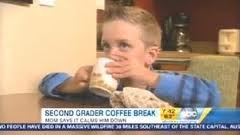
Mum Gives Her Son Coffee to Treat His ADHD

September 8, 2011

Whilst I don’t for a second advocate giving coffee to a child, I applaud Christie Haskel for trying to find an alternative to the drugs doctors prescribe.  As I was watching the abc report on this mother I felt like the reporter was trying to manipulate me into thinking that this woman acted irresponsibly and recklessly by treating her child without consulting a doctor.

But I didn’t fall for the manipulation.  Good on her for resisting Ritalin.  She has every right to find an alternative to a drug many parents are weary of.  Below are some issues I had with the reporting of this story.

1.  The story quotes that “experts say there is no proof it works.”

Well actually I am of the opinion that if it works for some people, as it has worked for this mother it “can” work.  No more proof required.

2.  The piece lists the “potentially dangerous side-effects of caffeine.”

What about the potential side-effects of Ritalin?

  • Abdominal pain
  • Akathisia
  • Alopecia
  • Angina
  • Appetite loss
  • Anxiety
  • Blood pressure and pulse changes (both up and down)
  • Cardiac arrhythmia
  • Diaphoresis (sweating)
  • Dizziness
  • Dyskinesia
  • Dysphoria or Euphoria
  • Formication
  • Headaches
  • Hypersensitivity (including skin rash, urticaria, fever, arthralgia, exfoliative dermatitis, erythema multiforme, necrotizing vasculitis, and thrombocytopenic purpura)
  • Lethargy
  • Libido increased or decreased
  • Nausea
  • Palpitations
  • Pupil dilation[45]
  • Psychosis
  • Short-term weight loss
  • Somnolence
  • Stunted growth
  • Tachycardia
  • Xerostomia (dry mouth aka cotton mouth)

3.  A Psychiatrist is presented warning parents not to become deluded into thinking coffee can cure ADHD:

Can drugs cure ADHD?

A meta analysis of the literature concluded that methylphenidate quickly and effectively reduces the signs and symptoms of ADHD in children under the age of 18 in the short term but found that this conclusion may be biased due to the high number of low quality clinical trials in the literature. There have been no placebo controlled trials investigating the long term effectiveness of methylphenidate beyond 4 weeks thus the long term effectiveness of methylphenidate has not been scientifically demonstrated. Serious concerns of publication bias regarding the use of methylphenidate for ADHD has also been noted. A diagnosis of ADHD must be confirmed and the benefits and risks and proper use of stimulants as well as alternative treatments should be discussed with the parent before stimulants are prescribed.

4.  The question is asked how does the mother know that by solving this one problem she isn’t creating several new ones:

I ask the same question about traditianal ADHD medication:

It was documented in 2000, by Zito “that at least 1.5% of children between the ages of two and four are medicated with stimulants, anti-depressants and anti-psychotic drugs, despite the paucity of controlled scientific trials confirming safety and long-term effects with preschool children.”

It is ludicrous to attack a mother for trying to find alternatives to a drug that comes with known side-effects, has stark similarities to cocaine and amphetamines and hasn’t convincingly proven the case against dependency or long-term side-effects.

Coffee isn’t something you’d want to be giving a child but neither is Ritalin.  I know which one I would rather give my child.


Love of Learning Not Considered a Priority

September 8, 2011

There are too many realities of education that are accepted without being properly challenged.  One such reality is that pre-school kids generally love learning whilst older kids don’t.  Pre-schoolers like to ask questions, think creatively, learn new things and take risks with their learning.  Preschool teachers seldom experience the negativity we Primary school teachers see on a daily basis.

A few years later that same Pre-school class will become a Middle-Years Primary class.  Invariably things will be very different.  Academic and social pressures start to show, the kids become self-conscious about getting answers wrong,  are less likely to put their hands up and don’t enjoy their learning as much, if at all.  What has happened in such a short time period?  How did such enthusiastic learners become so dispirited and negative so quickly?  What is the system doing wrong?

In my opinion, part of the blame falls on the endless obsession of benchmarks and accountability.  Whilst it is important to make schools accountable for the quality of their teaching and as important as it is to provide parents with current data about their childs’ progress, look at the price the students have had to pay for this to happen.

The child is subjected to frequent rigorous standardised testing where they are pressured to perform not only to preserve their own self-esteem but also to bolster their school’s reputation.  Innovative, fun and creative lessons are being replaced by pre-tests, practise tests and formal tests.  Trial and error and experimentation is being replaced by methods, short cuts and rote learning.  Curriculums are overloaded, dead boring and politically charged.

And so severe is the pressure from schools to comply with these rigid expectations, that naturally, some are going to unethical lengths to restore their reputations:

Some teachers feel pressurised into altering pupils’ marks to imply they are making good progress in class, research suggests.

Three separate studies suggest teachers are changing assessments after pressure from senior school staff worried about making the school look good.

The government said it trusted schools to make correct judgements when grading pupils.

And all three, being presented to the British Educational Research Association on Wednesday, suggest that some teachers feel pressure from school management to show that their pupils are steadily hitting targets.

Teachers typically have to provide information at least once a term on which level of the national curriculum a child has reached as they move through the school.

The author of one of the studies, Professor Martin Fautley of Birmingham City University, said assessment was being used for an entirely different purpose than was intended.

“Assessment has become a measure of school effectiveness rather than simply a measure of how pupils are performing.

“Management are telling teachers that pupils should be achieving at a certain level, and some teachers are then feeling forced into saying that they have achieved it, whether or not this is appropriate.”

What this article and many ones like it don’t tell you is what implications all this pressure has on the students and on the way teachers teach.

The sad reality of all this is the creative child that buzzes about their experiences on the way back from pre-school later becomes the child that refuses to talk about their day only a few years later.