I hope we don’t get child psychologists and new age self-help authors spring to the defense of these kids. When a group of school kids turns the 9/11 memorial into their own personal dumping ground, it is not a case of ‘kids being kids’. These kids knew what they were doing, realised how insensitive it was and yet, decided to do it anyway.
But like the bullying of a bus monitor (as I have covered in a number of posts), this isn’t about kids on a bus or kids at the 9/11 memorial site, this is about kids in general.
There is a lack of self-respect and respect for others in this generation of kids that is quite frightening. The kamikaze approach that is apparent in both recent stories is a problem that is faced in households and classrooms all over the world.
In this case, the target for their angst is going to make a lot of people extremely upset:
A group of Brooklyn students on a school trip to the National September 11 Memorial & Museum were booted from the hallowed site after they callously hurled trash into its fountains.
The vile vandals from Junior High School 292 in East New York treated the solemn memorial — its reflecting pools honoring the nearly 3,000 people killed in the terror attacks — like a garbage dump.
“They kicked us out because of littering in the water. Kids were throwing baseballs in the pond thing,” said eighth-grader Anthony Price, 14, of East New York, who insisted he wasn’t one of the troublemakers.
In addition to the baseballs, witnesses reported seeing empty plastic soda bottles and other refuse in the water on Thursday.
“They were making jokes and throwing stuff in the fountain. It didn’t seem like a big deal,” added another student on the trip who refused to give his name.
Department of Education officials have launched an investigation into the students’ shenanigans.
Tourists visiting the site Saturday said they were disgusted by the students’ filthy acts.
“That is an absolute disgrace,” said Sharon Hooks, 55, a school teacher from Hartford, Conn. “I don’t care if these children were too young to remember the events of that day. They need to be taught to be respectful.”
I can’t believe the rhetoric I have read about the money Karen Klein is earning from donations. So what? Generous people were so outraged by what they witnessed on that clip that they donated money. Get over it!
This story was never really about a bus monitor anyway. The. Klein case merely exemplified some very big bullying related issues – namely, the lack of respect many children have for adults, the lack of empathy for a person who is clearly being hurt, the influence of a group in regards to peer pressure and the passive behaviour from bystanders.
An elderly bus monitor who was taunted, picked on and threatened by a quartet of ruthless seventh-graders is likely going to retire on the $586,000 she has so far received in donations from concerned strangers who were outraged after viewing a video that captured her torment.
‘She is definitely surprised and overwhelmed and certainly thankful for everyone’s support, and it is nice knowing she is not alone,’ Karen Huff Klein’s daughter, Amanda Romig, told RadarOnline.com on Friday.
‘We never thought it was going to be that much, she didn’t think that much – then wow!’ Romig added, saying that her 68-year-old mother is not likely to return to work.
Click here on my post which discussed the need to punish the middle school children involved.
I hope the generous people who helped secure this donation together with the many other people who were shocked and angered by the clip, now focus their energies on ensuring that their children never treat people like those middle school children treated Ms. Klein.
The problem with being a credible hulk is no matter how credible the story, he’s still a hulk.
Such is the hard truth for an obese Ottawa dad deemed too fat to keep his kids.
We’ll call him Dad because he can’t be named or identified.
Dad, 38, claims there’s no adequate oversight of Children’s Aid judgements in this province.
His two sons – age 5 and 6 – have been put up for adoption. He’s not been granted custody because – among other things – he’s 360 lbs and has been as much as 525 lbs.
It appears the judge used Dad’s obesity as a major reason as to why he can’t have custody of his kids. That’s created a lot of chatter and created a debate about whether obese people make good parents.
The judge may have some good reasons for not allowing this man to be with his children but his obesity should not be a factor.
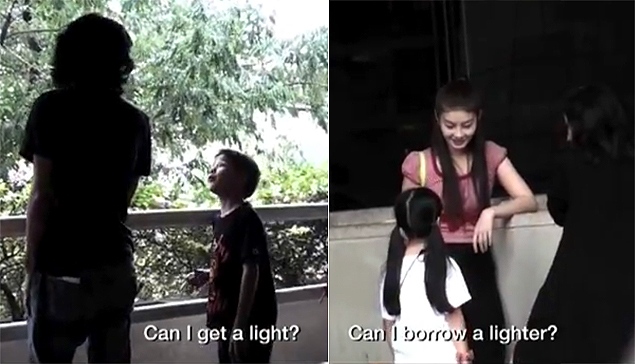
It has been labelled “heartbreaking” and one of the most effective anti-smoking advertisements ever.
The new public service announcement from Thailand shows two small children approaching adults who are smoking and asking them for a light.
Not one of the adults shown in the ad gives the children what they ask for.
Instead the adults — who have no idea they are being set up — begin giving the children earnest lectures on why smoking is so bad for them.
“If you smoke you die faster,” one man tells a little boy.
“Don’t you want to live and play?”
“When you smoke you suffer from lung cancer, emphysema and strokes,” another says.
The children then reveal their trump card, a brochure they hand the adults which reads: “You worry about me. But why not about yourself?”
The video, produced by the agency Ogilvy Thailand on behalf of the Thai Health Promotion Foundation, was uploaded to YouTube a week ago and has since gone viral, attracting more than 350,000 views.
The foundation has reported a 40 percent increase in the number of calls it has received about how to stop smoking.
Big Bird, Elmo and Oscar the Grouch could be returning to cinemas after studio 20th Century Fox bought the film rights to the show from production company Sesame Workshop.
A new film would be the third big-screen outing in the 43-year history of the iconic US TV series, whose previous guests have included Johnny Cash, David Beckham and Michelle Obama.
The announcement comes off the back of a successful film featuring Jim Henson’s other troupe of puppets, the Muppets, which took over £100 million at the box office earlier this year, and picked up an Academy Award for best song.
It is also reported that Fox have secured Sesame Street writer Joey Mazzarino to pen the script, as well as Shawn Levy, director of Night at the Museum and Reel Steel, to produce.
The movie will be the first from Sesame Street, which was originally launched as an educative tool by the US government, since the 1999 film The Adventures of Elmo in Grouchland. That came 14 years after 1985’s Follow That Bird, starring Chevy Chase.
As of 2008, the show, which is shown in some form across 140 countries, was estimated to have been watched by over 77 million children during its run of 4,300 episodes. The Cookie Monster and friends can boast a collective 8 Grammies, and 118 Emmys between them.
Catering for gifted students is a significant challenge for a teacher. Teachers can go dizzy trying to find time with students at both ends of the spectrum, whilst also working to help the rest of the class progress.
SCHOOLS are failing the state’s best and brightest students, a damning parliamentary report has found.
A 15-month inquiry has found the education provided to gifted students is often inadequate – sometimes with severe and devastating consequences.
The report, tabled in Parliament today, said up to 85,000 Victorian students fit the category of gifted.
“These students are frequently frustrated and disengaged,” the education and training committee report said.
“And rightfully so: they are being let down by the education system. These neglected students represent our state’s future visionaries and innovators.”
All teachers should be capable of recognising and teaching the gifted, the report said.
Education Minister Martin Dixon welcomed the report and said he “looked forward to responding to it in detail”.
“Our job in education is to engage, excite and extend students,” he said.
This problem is very real, but let’s not forget the difficulties teachers face with an ever-increasing workload and an overcrowded curriculum.
It seems that we have given up on promoting healthy lifestyles and educating our students about nutrition. It’s now all about avoiding obesity:
The American Medical Association on Wednesday put its weight behind requiring yearly instruction aimed at preventing obesity for public schoolchildren and teens.
The nation’s largest physicians group agreed to support legislation that would require classes in causes, consequences and prevention of obesity for first through 12th graders. Doctors will be encouraged to volunteer their time to help with that under the new policy adopted on the final day of the AMA’s annual policymaking meeting.
Whilst I am sympathetic to the 13 year-old boy that wishes to play netball, I don’t think it’s appropriate for a teenage boy to play in an all-girls team. Not only will boys ruin the enjoyment that girls have for the sport but girls are entitled to raise concerns about the body contact that exists within the game.
MEMBERS of a junior netball club have slammed a VCAT decision to allow a 185-centimetre tall, 13-year-old boy interim permission to play in an all-girls’ competition.
Despite Netball Victoria discouraging teams from speaking out, the coach, parents and players from one of the boy’s rival teams, St Therese’s of Essendon, say it would be a disaster if VCAT made the ruling permanent that boys can play in the 15 and under matches.
They fear it would smash girls’ confidence on court, and spell an end to girls having the choice to play in a team of their own gender. St Therese’s head coach Dianne McCormack wrote to The Age saying it was not a personal comment on the boy, who plays for Banyule in the Parkville Netball association’s 15 and under C Grade.
A St Therese’s C-Grade player, Ally, 12, has written to the sports minister and Netball Victoria saying that when she played against the boy in the 13 and under competition, ”no one wanted to play a strong defence because it meant you had to put your body up against his”.Ally said when she got older she might want to play mixed, ”but now I just want to play against other girls”. ”Most boys I know are already bigger and stronger than me.
”Please stick up for me and all girls who play in girls’ competitions. I don’t think it’s fair for any boy to take away my right and any girl’s right to play in an all-girls’ competition.”
Wake up America! Your preparedness to prescribe powerful stimulants to children for reasons as slight as a lack of concentration is lamentable. It is a trend that threatens to effect a whole generation. Teachers have got to take a far more passive approach on this issue. Instead of recommending that students take these drugs they should instead concentrate on their own performance. Too many teachers take the selfish choice of trying to restrain a wayward or naughty child rather than focus on their own weaknesses as a teacher. Instead of picking on a childs’ lack of focus, they should be concerned about how engaging their lessons are.
The new report also found an uptick in the use of some drugs in children, with stimulants for attention deficit hyperactivity disorder, or ADHD, leading the pack.
From 2002 to 2010, the use of ADHD drugs grew by 46 percent — or some 800,000 prescriptions a year. The top drug dispensed to adolescents was the stimulant methylphenidate, also known as Ritalin, with more than four million prescriptions filled in 2010.
“What the article is suggesting is that the number of children that we are treating for attention deficit disorder has gone up,” said Dr. Scott Benson, a child and adolescent psychiatrist and a spokesperson for the American Psychiatric Association.
“For the most part I think the overall increase reflects a reduction in the stigma,” he told Reuters Health. “It used to be, ‘You’re a bad parent if you can’t get your child to behave, and you’re a doubly bad parent if you put them on medicine.'”
Dr. Lawrence Diller, a behavioral pediatrician who has written extensively about ADHD, was more critical of the rise in stimulant prescriptions, noting that the U.S. is far ahead of other countries in its use of the drugs.
“You have to look at how our society handles school children’s problems. It’s clear that we rely much, much more on a pharmacological answer than other societies do,” Diller said. “The medicine is overprescribed primarily, but under-prescribed for certain inner-city groups of children.”
A report in the New York Times last Sunday said stimulant use is becoming a commonly used study drug even among high schoolers, with healthy students easily fooling their doctors into prescribing the coveted drugs.
“There is no objective test, so obtaining the medications is relatively easy,” said Diller.
When I was a child there was no punishment more feared than a suspension from school. The idea that the Principal could at any moment call your parents to pick you up and take you home was enough to make any child think before breaking a rule. But times have changed and suspensions have lost their effectiveness. This is partly due to it being metered out for minor offenses such as answering back and rudeness and partly due to a change in parenting styles.
If my parents were given the call to pick me up early they would have been furious. They would have immediately sided with the school and grounded me at home. Nowadays, parents take their children’s side and embrace them rather than berate them. When the child returns to school after their suspension, it is common to hear them boast about being taken out for a coffee and spending the afternoon playing video games.
SUSPENDING students from school for bad behaviour is counterproductive, with students who have been suspended twice as likely to be excluded again in the next 12 months.
Research by Australian Catholic University professor Sheryl Hemphill found about 6 per cent of students in Years 6-8 have been suspended, rising to 12 per cent of Year 10 students.
“Kids who are suspended just keep getting suspended. It doesn’t stop the behaviour that resulted in the suspension, it almost sets them on a pathway more likely to lead to suspension,” she said. “The risk for students who are having trouble maintaining engagement and staying at school is that suspension starts to help them move out of school.”
As part of a series of reports on problems in our nation’s schools, The Australian has found that suspended students were 50 per cent more likely to engage in antisocial behaviour and 70 per cent more likely to commit a violent act in the next 12 months.
Professor Hemphill said the policy of excluding students from school as punishment for bad behaviour sent a mixed message: every child must attend school, except on some occasions.
“It’s so contradictory to everything else we’re trying to do,” she said. “We’re trying to keep kids in school longer, we know the positive benefits of keeping them connected to further study and training for employment.
“Suspension doesn’t fit with the current policy environment, a lot of which promotes connection with education, because suspension is potentially a way of cutting off students.”
The problem with scrapping suspensions is that it leaves teachers with fewer options in dealing with class discipline issues.








 Topical Teaching
