Posts Tagged ‘National Testing’

Another Day, Another Standardised Test

July 5, 2011

UK teachers are told to add mandatory phonics tests to the ever-expanding list.  Remember when teaching was about engaging the students not test practise?

This time next year, every year 1 pupil in England is likely to encounter a new national test assessing a central aspect of their ability to read.

The children, aged five and six, will be presented with 40 individual words on paper, and asked to sound them out to their teachers or to another adult. Some words will be familiar to most, while others will be made-up or “non” words such as “mip” or “glimp”, designed only to assess the child’s ability to follow the pronunciation rules, such as they exist, of written English.

The results of this test, or “screening check”, will then be collected, given to the child’s parents and also used to produce statistics on national and local performance and to inform Ofsted inspection judgments on schools.

One leading literacy figure has described the new test as potentially “disastrous”, while another told this newspaper it was an “abomination” and likely to be a major waste of taxpayers’ money. A petition with more than 1,000 signatures against it has been collected.

The debate surrounds the principle of teaching phonics, another boring, routine and old-fashioned way of teaching content that could be conveyed in a far more exciting and engaging way.

Beyond this debate, I feel there is another issue at stake.  The rise of obsessive testing inevitably leads to the curriculum being hijacked by test practise as well as pressure needlessly put on Primary aged students.  These students deserve to have their crucial first years of schooling without the stresses they will confront later on down the track.
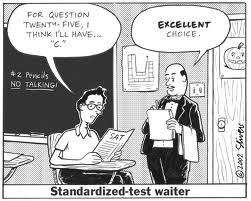
 

National Testing Leads to Bad Teaching

May 10, 2011

Today school students all around Australia are going to be sitting the dreaded NAPLAN tests – a National test covering language, literacy and numeracy.  A test many children don’t take all that seriously, leaving their teachers to explain disappointing results and unmet expectations.  The students will often sit for the test without ever finding out how they went afterwards.  Why should they?  For all they know, this test is nothing more than a hurdle requirement that seems to stress the teacher out far more than themselves.

And that’s where these tests fail.  The pressure placed on the teacher forces them to teach to the test.  Weeks out from the NAPLAN date, teachers forgo their best laid plans, and instead force their students to undergo countless practice tests and mindboggingly boring skills sessions.  The students don’t know what hit them!  All of a sudden, they are bombarded with these tedious, non-interactive lessons, where the teacher often loses his/her temper in a state of panic and utter desperation.

“Guys, if you don’t listen, you wont know what to do come NAPLAN time.”

This argument is futile.  They know that if they don’t understand how to answer a question, all they have to do is leave it out, or better yet, guess.  No need to lose sleep over it!

For teachers, these tests are becoming even more important, now that test results are connected with teacher bonuses:

TEACHERS are continuing to “teach to” national literacy and numeracy tests, despite warnings from education authorities.

The first of three days of NAPLAN testing begins for year 3, 5, 7 and 9 students across the country today.

But educators warned the pressure being put on schools to perform well was having unintended consequences.

And the weight placed on NAPLAN results will increase today when the Government links them to financial bonuses for the country’s best teachers.

Today’s Budget is expected to commit $425 million to provide bonuses of up to $8100 to the top 10 per cent of teachers.

Victorian Association of State Secondary Principals president Frank Sal said that some schools were already under pressure to post high NAPLAN scores, even before they were linked to teacher bonuses.

While many schools have been doing practice exams to prepare for this week’s tests, parents have been told they can do nothing to boost their children’s performance.

Australian Curriculum, Assessment and Reporting Authority chair Prof Barry McGaw said regular learning was the best preparation for students: “NAPLAN is not a test students can prepare for, because it is not a test of content.”

Gone are the days where good teaching meant innovative and engaging lessons.  Gone are the days when teachers were valued for new, fresh approaches to developing skills and nurturing the collective sel-esteem of the class.  No, nowadays teaching is about meticulously preparing for a test that comes every 2 years in a student’s life and ultimately doesn’t truly capture what they know and what they are truly capable of.

These lessons can be monotonous, lack opportunities for critical discussion and go against the grain of authentic teaching, but as long as you persist, there may be a bonus in it for you.

Teaching to The Blasted Test!

March 29, 2011


It sickens me to see the Government so smug about the upcoming round of National Testing.  In Australia it’s called the NAPLAN (I refer to it as “NAPALM”), and like other National tests around the world it compares student data against the average.  The Government uses the National tests as an easy way out of doing something constructive about Education.

Before I slam these pathetic tests, in the spirit of goodwill, I will acknowledge some advantages of National Testing:

  • It uses these tests as a vehicle for pressurising schools and teachers to lift their game and secure good results for their students.
  • It forces teachers not strictly following the curriculum to adhere to the syllabus
  • It gives parents some real data to consider, rather than the deliberately vague school reporting, which essentially tells parents nothing.
  • It gives parents an opportunity to become more involved in their child’s education.

Now for the disadvantages:

  • It forces teachers to stop what they are doing, and spend weeks if not months practicing for the test.  Everything gets put on hold while the sample test papers get wheeled out.
  • It fills students as young as 8 years-old with anxiety, pressure and insecurity.
  • It causes schools to “encourage” the parents of special needs students to keep their kids at home during the testing week.  This is to ensure that their child doesn’t affect the school’s results.  It also achieves in further marginalising these children who, in many cases, already feel disconnected from their peers.
  • It puts enormous stress on teachers.  This stress has an effect on their quality of teaching.
  • It turns education into an extreme negative at a time when kids still show an interest in learning.

I am currently teaching Grade 5 for the first time.  I am preparing my students for the rigours of NAPLAN (they sat for them 2 year ago).  It means that my emphasis has had to change.  Instead of teaching in an engaging and creative way, I’ve been forced to teach to the tests.  The result has been a succession of comparatively boring and turgid lessons on strategies for answering multiple choice questions, “debugging” sample tests and revising basic skills.  My students are not enjoying these lessons at all!  I fear that when they sit these tests they will sabotage the process by rushing through it as revenge for what its done to their enjoyment of school.

What makes these tests even worse is that they are testing the children at Grade 5 level even though they have just started Grade 5.  Because of that, my students haven’t covered some of the concepts being tested.  Surely, if they wanted to test a Grade 5 class against the Grade 5 benchmarks they should have done it at the end of the school year, not at the beginning!

When are Governments going to stop being so lazy and start taking on a fresh and innovative approach to learning?  Why must my students be subjected to sample tests and other turgid preparatorylessons, instead of conventional, authentic lessons?

Parents have the right to know how  their child is progressing.  At the same time though, their children deserve the right to have a pressure reduced primary education, where the teachers are able to harness their natural curiosities, instead of burden them with weeks of test prepa
ration!