
Posts Tagged ‘Education’

Now Schools Are Spying on Their Students

August 14, 2011

I am in favour of schools playing a far more proactive role in dealing with cyberbullying and advocating privacy settings to protect against cyber stalkers, but spying on their students’ Facebook pages is not appropriate.

SCHOOLS are using internet monitoring companies to read what students are saying on social networking sites.

The typical service used by schools such as Ascham looks at any publicly available material posted on sites such as Facebook, Formspring and Tumblr to monitor the sometimes ferocious use of the media by young people.


Whilst schools often go into their shells when it comes to cyberbullying, spying on their students is an invasion of privacy.  Instead of concerning themselves with publicly available material they should work harder to ensure their students have their privacy settings on.
This measure will do precious little to stop bullying.  Bullies are much smarter than we give them credit for.  They find ways to harass away from the watchful eyes of anyone that might punish them for their crimes.
Yet whilst this will do little to prevent bullying it will make the students even more negative about school and authority in general.


School Toilet Trial is a Terrible Idea

August 12, 2011

Teachers should stop being so precious about time wasted due to toilet breaks.  Of course it’s not ideal to have children come in and out of the classroom from the toilet whilst you are teaching a skill or conducting a classroom discussion.  I don’t doubt that students have the option in going at break times but choose not to, and they must learn to take those opportunities.  I also know that some students use it as an excuse to leave the classroom whilst not needing to go to the toilet.

But ultimately, so what?

The frustrations listed above should never lead to an imposed trial which could result in children wetting themselves.  I would rather have lessons impaired on a constant basis that have even one child wetting themself on account of a harsh rule I have introduced.

I never want to involve myself at any time with a trial like the one at Kew Primary School:

PARENTS are alarmed that children at a primary school in Melbourne’s east began wetting themselves after the school tested an approach that discouraged them from going to the toilet in class time.

In the Kew Primary School trial, which parents said was conducted without their knowledge, the entire class would go to the toilet if one child needed to go during a lesson.

One mother, who asked not to be named, said she first became aware of the trial when her child wet herself at the front door. ”I said, ‘What happened? She said, ‘I’m holding on, I didn’t want the whole class to have to come with me to the toilet.’ At first when she told me the rule I disbelieved her.”

Another mother took her high-achieving child to the doctor after she wet herself twice at home.

”She hasn’t done this since she was three,” the mother said. ”There was a kind of ripple effect where parents slowly became aware of changes in their children. Children were complaining of headaches, they were constipated, they weren’t drinking water and were coming home with full drink bottles.”

A group of parents wrote to Kew Primary principal Kim Dray, expressing their concern about the trial and citing medical research about the impact of constipation on children.

In an email, obtained by The Age, Dr Dray said the ”whole class” method of toilet break supervision was ”used successfully by some other schools” and was being tested by some classes.

”Team leaders met at the end of last week to discuss the trialled approaches, and although you may find this surprising, some commented on a decrease in disruption to class lessons, especially in senior and specialist classes,” she wrote.

Meet the Classroom Management Guru

August 11, 2011

Below are two clips from a film made by Australia’s behaviour management guru, Bill Rogers.  I think all teacher’s will find this useful regardless of experience.

Clip 1

Clip 2

Please share these clips with your colleagues.  I’ve attended a Bill Rogers seminar and found it very useful.

The Educational Implications of the London Riots

August 10, 2011

I couldn’t help but be struck by this excerpt from an article about the London Riots:

“… what I am saying is that for all of those who live and work in the poorer areas of London this disaster has been totally unsurprising. The fact of the matter is that we have manufactured within our society a sub-culture of sociopaths who care nothing for anyone or anything but themselves and are wholly unable to empathise with the suffering of others. The people most responsible for creating this social plague are the very same politicians, journalists and social commentators who are now asking “How did this happen?”

I believe that to a lesser extent the Educational system has bought into the plague too.  So consumed by its bottom line, so obsessed with the meaningless private vs public school debate and so content to take creative children and force them to conform with a robotic set of rules and regulations, that children get lost in the crowd.

I had a discussion with someone recently about the role of schools.  He felt that schools were nothing more than institutions with the responsibility of imparting knowledge.  According to him, as long as the school could point to the lessons that were taught and the curriculum that was followed, their job was done.

I believe schools have a far greater responsibility.  They must do a lot more than concentrate on prime numbers and single-celled organisms.  They must try to ensure that every child has a sense of self and an understanding of how they can use their unique skills and qualities to contribute to society.

It sounds fanciful and “airy fairy” but children today are more obsessed than ever before by wealth, gadgets, appearance and all things materialistic.  They spend so much time trying to outlook and outdo others simply because they are not happy with who they are and what they have.  The question has to be asked, besides close family members, who helps them to understand and appreciate who they are and what they can achieve?

The media is charged with unsettling them and making them fearful.  The advertising industry is charged with making them feel that without products and gadgets they cannot be happy. Where are our kids receiving the positive message they desperately need to hear?

Children often say, “Why should I be good to them if they aren’t to me.”  Those participating in the riots seem to be making that statement.  Whilst it is absolutely no excuse to do what they have done, one has to wonder who does look after the best interests of our children.  Shouldn’t the school system who has our kids throughout their crucial developmental years do more to help them find acceptance in who they are?  Shouldn’t the school system encourage them better to be themselves rather than conform?

There is no excuse for people who riot and willfully and violently break laws, but when reflecting on incidents lessons must be learnt.  Children that are supported and nurtured don’t riot.  Children who are in touch with their unique qualities and have been encouraged and accepted by others don’t riot.

We can go on preparing our students for calculus tests and chemistry assignments, but in a time of need and doubt, our students probably wont turn to calculus or tests tubes for salvation.


Cyberstalking the Worst Type of Bullying

August 9, 2011

Another reminder of the severity of falling victim to cyber bullying:

The inability to escape from the 24 hour online world and the public nature of threats posted on the internet make being bullied electronically more intense, it was claimed.

Addressing the American Psychological Association’s Annual Convention, Elizabeth Carll said: “Increasingly, stalkers use modern technology to monitor and torment their victims, and one in four victims report some form of cyberstalking, such as threatening emails or instant messaging.”

Victims may feel stress, anxiety, fear and nightmares, as well as enduring eating and sleeping difficulties, she said.

Dr Carll, of the APA Media Psychology Division, “It is my observation that the symptoms related to cyberstalking and e-harassment may be more intense than in-person harassment, as the impact is more devastating due to the 24/7 nature of online communication, inability to escape to a safe place, and global access of the information.”

A Teacher’s Worst Nightmare

August 7, 2011


Could there be anything worse for a teacher than to be falsely accused of pedophilia?  To frame someone as a pedophile purely out of spite goes beyond all reason.

Police are hunting the creator of a fake Facebook profile that was used to impersonate a Sydney primary school teacher and frame him as a paedophile by targeting kids at his school.

The teacher, who cannot be named, is a long-time campaigner against racism online and with others he runs a blog that names and shames racists by publishing their hate-filled Facebook postings.

In a phone interview, he said he believed this is why he was targeted. He said he and his family had been harassed over the phone, received death threats and had threatening notes left in his mail box after his personal details – including his address, phone number, photos and work details – were posted on a white supremacist website.

“This Facebook profile opened up a couple of days ago with a picture of me and a friend with shirts off holding a beer … they were writing things on the wall such as ‘i’m gay and I like little boys’ and all sorts of things like that,” the teacher said in a phone interview.

“They were engaging with students – kids were commenting and they were writing back pretending to be me.”

I hope they catch the people responsible and give them prison time to reflect on their awful behaviour.

Teaching Perfectionists

August 5, 2011

I recall a lesson when I was fresh out of University, when I was  substitute teaching in school in Newcastle.  I was to give out colouring-in sheets to a Grade 1 class.  The teacher had supplied me with only 2 or 3 spare sheets for those that made an error.  Colouring-in sheets, whilst not of any obvious educational value, is a great babysitting device.  Most kids love them because they do not involve any thinking or grading and most teachers appreciate the fact that students can do them both quietly and independently.

On this occasion one of the girls came up to me and asked me for a replacement sheet.

“What’s the matter?” I asked.

“Can I have another sheet?  I messed up this one.”

She presented the sheet to me and I was immediately struck by how beautiful it looked.  Her worked showed striking attention to detail and great care for staying within the lines.

“But what’s wrong with this picture? It looks fabulous to me.”

“It’s terrible.  I made a big mistake.  Look, I went out on the lines.”

Even with her pointing to the spot where she trespassed the line I had to squint to see the infringement.

“You don’t need another sheet.  This is fine.  I wouldn’t even call that a mistake.”

“But I never go out of the lines.  Mum told me never to colour out of the lines.”

I don’t know what got into me, but I instinctively gave her a new sheet and asked her to go out of the lines multiple times – this time on purpose.

You should have seen the horror in her eyes.

Then I turned to the class and announced that the class do the same thing.  I said I was looking for work that featured colouring out of the lines. The class just stared out in confusion.

“C’mon it’ll be fun.  Let’s colour out of the lines!

And all of a sudden they started doing as I suggested.  And they loved it!  They laughed, coloured with energy and abandon and enjoyed comparing their imperfect work with others.

The girl in question saw her classmates having so much fun making mistakes, she too went back to her desk and revelled in this weird but cathartic exercise.  We even sang a colouring out of the lines song.

I don’t know whether I did something constructive or destructive, but I can report that the class looked so much more relaxed and happier when mistakes were acceptable and perfection was bypassed.

Teachers tend to allow the perfectionist to continue their habits.  This is because perfectionists are a pleasure to have in the classroom.  They take their studies seriously, try their best at all times and listen attentively to instructions.

But the problem is perfectionism is extremely unhealthy.  Parents often laugh it off and say, “She get’s that from me.  I’m a bit like that too.”  But is it really a joke?  Perfectionists are on a hiding to nothing because the goal they aim for is impossible to reach.  The inevitable consequences of perfectionism is that they never get the satisfaction of their efforts or accept people’s praise because all they can see is what they didn’t get right.

I am all for studious, hardworking students, but not at the expense of their right to enjoy the fruits of their hard work and the joy of basking in their achievements.

What Facebook Age Restrictions?

August 4, 2011

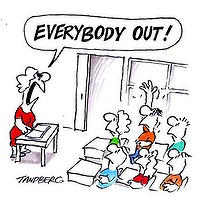
There is age rstrictions on Facebook for a reason.  The potential outcomes when a pre-teen uses Facebook are severe enough to warrant it a 13+ age requirement.

But does that stop under age kids opening their own account?  Of course not.

Washington: Some 7.5 million of the 20 million minors who used Facebook in the past year were younger than 13, and a million of them were bullied, harassed or threatened on the site, says a study released Tuesday. Even more troubling, more than five million Facebook users were 10 years old or younger, and they were allowed to use Facebook largely without parental supervision leaving them vulnerable to threats ranging from malware to sexual predators, the State of the Net survey by Consumer Reports found.” Read the rest, here.

And this is a trend we are seeing all over the world.  As important as it is to have this age requirement, it seems too easy to sidestep it.

I believe that if Facebook really wanted to ban under 13’s from setting up accounts, they could.

But do they really want to?

Don’t Expect an Influx of Male Teachers Sometime Soon

August 3, 2011


In an incredibly pointed and honest comment, reader Eric succinctly sums up the difficulties of being a male primary teacher.

As long as society remains in a state of collective hysteria regarding children, more and more adults (especially men) will rightly fear situations where they are in close proximity to children other than their own. Personally, I go out of my way to avoid certain parks, playgrounds and other areas where children congregate, because an unaccompanied adult male seen walking near such areas will arouse suspicion. I don’t mind this situation; I’d much rather be far away and unseen than fall prey to the lynch mob.

Any efforts to “recruit” more men into teaching will only ensnare some naive, unwary men into situations that could land them in prison in the blink of an eye, their lives ruined forever. Men, you have been warned!

These sentiments are almost never expressed but is not a minority view.  Eric is clearly a responsible and ethical person who is all too aware of the constant news reports about sick, deranged and evil male teachers.  Eric and the average parent have every right to feel this way.  The safety and security of children is much more important than the welfare of the male teaching fraternity.

The warning expressed above may not be verbalised very often but it is not lost on men who fleetingly consider teaching before thinking better of it.

Personally, I enjoy my job immensely, pride myself on my professional approach and can cope with the fact that male and female teachers are judged differently in the eyes of some parents.

But for those that desperately want more males in the system – don’t expect an influx too soon.

Putting Your Kids First

August 2, 2011

A recent survey seems to show that many parents prefer rest and a quiet drink than spending time with their kids:

A new survey has revealed that stressed adults prefer to kick back with a bottle of wine, rather than spending time with their partners or children.

Six in ten adults said drinking was their top choice after a stressful day, reports the Daily Mail.

While 28 per cent said spending time with their children helped them relax only 26 per cent opted for talking to their partner, according to the poll of 825 adults conducted by industry-funded charity Drinkaware.

It found people battle stress with up to four drinks on a typical evening at home.

Family dynamics have changed over the years.  Something like the family dinner is quite different now to what it was in the 60’s and 70’s.  Whilst a few drinks is clearly more relaxing than getting the kids ready for bed, it is still important that they receive the love and attention they need.

Ultimately, they need to feel as though they are more important than a drink at the end of a taxing and stressful day.