Posts Tagged ‘Children’

Things Middle School Students Wish We Knew

December 15, 2014

middle

Courtesy of weareteachers.com via  :


1. I was not trying to get attention by falling off the chair. I am approximately infinity inches bigger than I was yesterday and I just lost track of how to balance. I felt like an idiot so I made falling into a joke. Crying was the other choice. And I’d rather cut off my arm than cry in school.

2. I did that homework. I am almost positive I did it. Getting it from done to folder to backpack to school to you is like seven extra homeworks. That is too many. It’s also possible I forgot to do the homework. I honestly have no idea where my planner is. Or maybe the homework was completely confusing and if I asked for help people might think I am stupid now when that used to be my best subject.

3. That time I called you Mom was the most humiliating moment of my life. It’s one thing in second grade but middle school? Ugh. How does this stuff still happen to me?

4. When you force us to get up—do stuff, act it out, test our ideas—it wakes us up and makes the lesson so much more fun and easy to remember.

5. Sometimes I just can’t focus. I’m buzzy, jumpy, pumped with electricity. Somebody suddenly looks distractingly attractive, across the room, which is fully that other person’s fault, not mine. Or I don’t get what we’re discussing and the pain of not understanding is so excruciating I just have to take a break from paying attention.

6. It feels awesome when you notice something special about me. When you value a skill or interest of mine, you give me a route in to subjects I didn’t think I’d like—and make me feel like I have something worth sharing.

7. What you tell me about myself matters way more than I hope you know. When you tell me I am something—smart, brave, kind, stupid, a trouble-maker, creative, a writer, a mathematician, funny, hard-working—I believe you.

8. I like it when you’re sarcastic but not when you’re harsh. When you say something ironically and I get it, I feel smart and mature. But when you’re mocking in a sharper way, it feels mean and a little scary.

9. Respect me. There are lots of things I already know about myself. Some I want to talk about, A LOT, and it means so much to me when you find time to include me (and it) in class. But lots of other things about me, I’m not ready to discuss, and especially not in class.

10. If you call on me and I am flat-out wrong, please don’t humiliate me. I’m already praying for a hole to open up in the floor and swallow me. It’s hard for me to believe that not knowing isn’t shameful but is instead a good starting point for learning. Help me.

And one bonus extra thing: You are suddenly one of the most important adults in my whole world. How you respond to me affects everything. Please be tough. Please be gentle. Especially when I am neither.


Click on the link to read Watch a Classic Argument in Action (Video)

Click on the link to read 7 Things a Quiet Student Wishes Their Teacher Knew

Click on the link to read Skills That Aren’t Taught But Should Be: #1 People Skills

Click on the link to read Top 10 Most Unusual School Bans

Click on the link to read Rules that Restrict the Teacher and Enslave the Student
Tips for Tackling the Mental Health Stigma in Your Classroom

December 3, 2014

depression

I must admit that I have never been formally trained on how to teach a child suffering from mental health issues or even how to bring the topic up in the classroom.

Whilst these tips by Martin Williams are all within the realms of common sense, it is good to get the reassurance that you can deal with something effectively even if you were never trained to do so:


Talk about mental health

“Mental health was never mentioned at school at all,” says Charlotte Walker, who now writes a blog on mental health issues. “I found out I had depression aged 12 from a teenage health guide.”

Now a mother, Walker is acutely aware that there is still a worrying lack of discussion about mental health in schools. It’s a problem that can not only lead to stigmatisation, but also cause health issues to go undiagnosed. “My son’s experience is that schools focus on the ‘safer’ feeling topics, such as insomnia and exam stress, but don’t dare go into the realms of bipolar or schizophrenia.”

Walker suggests that teachers should tackle the problem by simply trying to be more candid about mental health when chatting to children. “We’ve seen that sex and relationship education doesn’t always work because it’s in dedicated sessions,” she explains. “I think it’s important to have a general spirit of openness.”

It’s also important to talk openly about what support is in place for children who are experiencing difficulties, she says. “It tends to be that you only find out what’s on offer once you’ve declared your child is having problems,” Walker says. “If the information is given out to everyone, no one is singled out for stigma or discrimination.”

But tackle derogatory language

While it’s important to encourage discussion of mental health, research has shown that the use of pejorative terms about mental health problems are common in many children’s everyday language. While this is reflective of a wider societal problem, teachers can do their bit by cracking down on language when it is used in a derogatory or abusive way.

“Discriminatory language needs to be challenged,” says Walker. “Schools have come a long way with this on homophobia, but we need challenge the use derogatory words like ‘psycho’ or ‘schizo’ and the devaluing of clinical terms.”

Consultant psychiatrist Arun Chopra has said previously that misuse of terminology leads to misunderstandings about mental health. “You would never hear it used in relation to a physical condition,” he says. “You wouldn’t hear someone being described as a bit diabetic.”

Importantly, however – as has been pointed out before – language is just the visible surface of a deeper discrimination, so tacking language alone can never be the full solution.

Be aware

Unlike physical problems, some mental illnesses aren’t so obvious. “Only a couple of teachers and a handful of friends knew I was anything other than totally fine because I hid it,” says Lorraine Davies, who suffered from anxiety and depression at school. “If I’d been schizophrenic or suicidal maybe it would have been more noticeable, so, weirdly, I might have found more support and less whispering from friends behind my back as they tried to work out why I was being ‘weird’.”

For teachers, the key is to be on the look out for warning signs, according to Dr Raphael Kelvin, the clinical lead for Minded, a website designed to help pupils and teachers understand mental health issues. He suggests that teachers brush up on their knowledge of symptoms and never ignore a child whose behaviour fluctuates.

“If teachers understand that depression can strike not just when someone is saying they’re depressed, but also with someone who’s concentration and motivation has changed, they might be able to help them.”

Kelvin says teachers need to be alert, but do not need to become psychiatrists to help. If in doubt, he says, share your concerns with parents and other teachers to get to the root of the problem.

Help children tell their story to friends

“It’s very important to have a narrative about these things,” says Dr Kelvin, “people need a story to explain how things are. When kids come to the clinic after a period of difficulty, I often try to encourage them to have a story about their experience to explain what they’ve been through to their peers and friends.

“Often they either want to tell everybody or nobody, and the responses vary. The kid who tells everybody can become the butt of insensitive remarks; but the ones who tell nobody end up feeling very isolated. So how do they talk about it to their friends and how much do they want to say? What words do they need to tell their story in a way that’s not too painful? I think those are the kind of things that teachers can support pupils with. If you hear the story of why someone is behaving in a certain way you get a depth of understanding.”

Don’t alienate them further

A child who is experiencing mental health discrimination is such a delicate issue that approaching it clumsily or ignoring it all together can intensify the problem.

Davies says that a lack of understanding among certain teachers pushed her further outside the protection school should provide. “I was asked never to attend one teacher’s classes ever again as I was often late to his 9am because my anxiety was too high for me to get the school bus. Another went out of his way to provoke me – I think he thought I was a drama queen who needed a firm hand.”

Even teachers who are trying to help need to be careful, says Wilson. They should listen closely to pupils’ social concerns and approach issues with huge sensitivity.

“For instance, there are an awful lot of children who will have nothing to do with their classroom assistant because their friends laugh at them,” he says. “You’ve got to take that on board because their self-esteem is often at such a low ebb that anything will set them off. It’s all very finely balanced.”


Click on the link to read A Lack of Proper Sleep Does a World of Damage to a Child’s Attention Span

Click on the link to read What an ISIS School Looks Like

Click on the link to read Using Children as Bait is Abhorrent

Click on the link to read The Outrageous Pro-Gun Picture Book for Kids

Click on the link to read Sousa’s Techniques to Build Self-Esteem


Suicide is a Problem Schools Shouldn’t Walk Away From

November 30, 2014

jayden arnold

Since a child spends a majority of his or her waking hours at school, it bothers me that many schools are so reactive when it comes to helping a child at risk. To wait for obvious signs of distress is a policy that flirts with disaster. I have long called for schools to help students who have difficulties making friends or who are undergoing challenges such as radical change, seperation of their parents or those going through a breakup of a friendship or relationship. Instead of waiting for the students to ask for help, is there anything wrong with offering it?

Suicide often occurs when the victim feels that nobody cares or understands. What  better way to show you “get it” than to initiate contact with a student that might need it?

Suicide is not a problem that schools can afford to blame on home issues. It is very much an issue that needs to be tackled through a partnership between school and home:


A SUICIDE prevention policy should be developed in every school in Australia to counter the scourge that affects so many young people, the Black Dog Institute says.

The policy should include plans to execute prevention programs, goals for positive mental health and guidelines for managing suicidal behaviour in schools.

Institute director Professor Helen Christensen said the action plan should be distributed to all school staff.

Teachers and parents also could be trained as “gatekeepers” to improve the identification of suicidal youth by better recognising warning signs and referring students on to further care.

“Gatekeeper training can be delivered universally such as to all school staff or selectively to parents of at risk students,” Prof Christensen said.

Under peer helper programs young people, too, could be equipped with knowledge and skills to help fellow students they believe to be at risk.

Experts believe young people are more likely to confide in one of their peers than in an adult when they are having serious problems.

Prof Christensen has made a series of recommendations on suicide prevention in the specialist publication of the Australian Council for Educational Research, Teacher.

“There is increasing recognition that a coordinated approach to suicide prevention must involve the participation of key community organisations,” she said.

“Among them schools are particularly well placed to deliver interventions that will enhance resilience, improve mental health and reduce risk of suicide.”

Schools at the centre of a mental health crisis among young people report that students are self-harming or threatening to injure themselves at a rate of more than two per week.

Child psychologists also say increasing numbers of children are presenting with mental disorders such as severe anxiety and, in the most extreme cases, have suicided.

Principals campaigning for more counsellors to handle disturbed children in schools report more problems are emerging in younger students — some exhibiting violent and challenging behaviours and a lack of remorse.

Cyber bullying, increasingly linked to incidents of self harm and suicide, now affects an estimated 463,000 a year with around 365,000 of them in the 10-15 age group.

Research by the UNSW’s social policy research centre has found increasing evidence of the lasting effects of cyber-bullying with links to low self-esteem, mental health issues, depression and anxiety.

A number of schools have responded to the Sunday Telegraph’s coverage of the suicide issue affecting young Australians.

Figures show suicide is the leading non-medical cause of death in children aged 10 to 14.

Writing in the newsletter of Rosebank College in Sydney’s inner west, acting assistant principal Paul Hardwick told the school community: “It was with great sadness reading the Sunday papers that the fragility of life hit me.

“Over the last couple of months families, friends and school communities have been left to ponder ‘why?’ and ‘what should I have done differently?’

“The College’s deepest sympathies go out to the families and schools trying to work through the heartache and sadness as they come together to grieve the loss of those so young.

“While adolescent mental health issues are on the rise, we as a community need to be able to arm our children with the tools to seek assistance when they need it and certainly when they are vulnerable.

“Just asking if someone is OK is not always enough.”

Rosebank College republished in its newsletter points of advice given by the headmaster of The King’s School, Parramatta Dr Tim Hawkes, which ran in The Sunday Telegraph.

Southern Cross School at Ballina on the state’s north coast said it, too, was touched by the tragic stories published in The Sunday Telegraph.

The school this week held a Wellbeing Expo “to bring the subject of youth mental health into the public arena and open channels for young people to know where and how to contact the right people” for help.


Click on the link to read Teacher Runs Suicide Note Writing Workshop

Click on the link to read Don’t Wait For Signs a Child is Contemplating Suicide

Click on the link to read Teachers Can’t Afford to Make Light of Suicide

Click on the link to read Schools Have an Even Bigger Responsibility than Educating

Do We Learn Enough From Children?

November 5, 2014


Sometimes our children show us up as ignorant. In the video above, one simple question is asked: If you could change one thing about your body, what would it be?

Watch the difference between the way children interpret the question to the way the adults do.

It’s society that encourages us to be critical of our own bodies – it is not a natural construction.


Click on the link to read Kids as Young as 7 Diagnosed with Anorexia

Click on the link to read The Destructive Impact of the “Fashion Police” Brigade

Click on the link to read The Plus Sized Barbie Debate Misses the Point

Click on the link to read Study Claims that Being Attractive can give you Better Grades

Click on the link to read The Unique Challenges that Body Image Represents for Females

The Inconvenient Truth Kids Style

October 14, 2014


You spend your life trying to teach your kids the importance of telling the truth and then this happens:


truth

Courtesy of Nickmom


Click on the link to read The Quality Most Parents Want to Teach Their Children

Click on the link to read Are Our Expectations for Children Too High?

Click on the link to read 25 Ways to Approach the Dreaded ‘How was School Today?’ Question

Click on the link to read Learning to Let Go

Click on the link to read Things Teachers Wish Parents Knew Before the School Year Begins

Click on the link to read The Worst Parent in the World May be an Australian

Shaming Students is Never the Answer

October 7, 2014

eggbuckland


If you really cared about the welfare of your students you would never shame them, even in order to make a point. If I became aware that a student’s profile picture was inappropriate I would deal with it thoughtfully and discreetly.

Not like this:


A 15-year-old says she was humiliated by a teacher who showed an enlarged picture of her in a bikini to more than 100 other students during a school assembly.

Children at Eggbuckland Community College in Plymouth, Devon, were shown the photograph taken from her Facebook profile to illustrate the pitfalls of posting private images online.

Unknown to the schoolgirl, who has not been named, staff had taken her swimwear photo off the internet.

It was blown up and added to a portfolio of other pictures then shown during a packed school assembly.

The shock tactic at the 1327-pupil specialist arts school left the girl distraught.

Her mother, who has now made an official complaint to Ofsted, said: ‘They took the photo from her Facebook profile – she put it on there last year.

‘They used other photos of kids from the neck up but for some reason they thought it was OK to use a picture of my daughter in her bikini.

‘Why did they have to use an image like that to make their point. Then they pointed her out in the assembly. She was really upset.

The teachers should have shown the students this instead.

Watch a Classic Argument in Action (Video)

September 29, 2014

https://www.youtube.com/watch?v=3sKdDyyanGk


One child claims it’s sprinkling another that’s it’s raining. Both refuse to concede. My favourite is the girl in the middle that does her best to stay impartial and act as peacemaker.


Click on the link to read 7 Things a Quiet Student Wishes Their Teacher Knew

Click on the link to read Skills That Aren’t Taught But Should Be: #1 People Skills

Click on the link to read Top 10 Most Unusual School Bans

Click on the link to read Rules that Restrict the Teacher and Enslave the Student

Click on the link to read This is What I Think of the No Hugging Rule at Schools

What is Your Position on the Homework Debate?

September 28, 2014

hwork

I used to be very much against homework, but have softened my stance insomuch as I believe that homework is preferable to hours watching television or playing on a game console. It is interesting that experts are still divided on this matter:


DESPERATE parents are hiring private tutors to turbo-charge their children’s education because they are unhappy with the amount and quality of homework set by schools.

Education experts are so divided about the merits of homework that growing numbers of families are signing up their children for outside coaching to supplement classwork.

Education insiders have told The Saturday Telegraph that homework policies vary enormously between schools and often between teachers at the same school.

The homework row has been fuelled by a parliamentary inquiry in Victoria that found it had almost no academic benefits for primary school students.

And in France a plan by President Francois Hollande to abolish homework in French schools reignited a long-running debate.

The Australian Tutoring Association said many parents enrolled their children in private coaching to ensure they received “structured support” outside of school.

Chief executive Mohan Dhall said homework was often given to primary school children without explaining why it was set and without an obvious reason and purpose.

“There does not seem to be a sense of order or purpose about school homework — just an ad-hoc program that does not always meet the needs of kids,” Mr Dhall said. “A lot of parents think it is unstructured — additional work for children needs to be meaningful and engage them in higher-order thinking.”

Teachers argue there is no one-size-fits-all policy for homework.

Some experts claim children should spend their time after school playing and letting their brains wind down so they can get a good night’s sleep to absorb the day’s learning.

Newly released data reveals Australian children have the fifth greatest homework load globally, with 15-year-olds receiving about six hours’ a week compared to the OECD average of 4.9 hours.

The research shows private school students do about two hours of homework more than their peers in public schools.

Schools are also facing a groundswell of opposition to homework as doctors advise it is bad for children’s sleep and educators and academics claim it is of little benefit.


Click on the link to read The Adult Version of the Dog that Ate my Homework

Click on the link to read Fourth Graders Quizzed about Infidelity in Homework Assignment

Click on the link to read Young Child Shows Dissatisfaction with his Homework (Photo)

Click on the link to read Why I Changed My Mind About Homework

Click on the link to read Leave Parents Alone When it Comes to Homework

The Quality Most Parents Want to Teach Their Children

September 21, 2014

quality

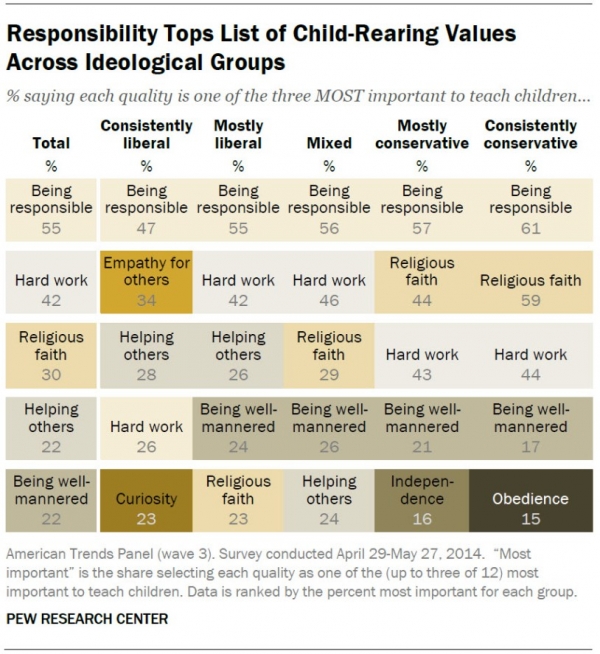
A very interesting survey asks, What is the quality most parents want to teach their children?


The Pew Research Center study on parenting attitudes sampled more than 3000 adults who were asked to evaluate which of a list of 12 values are the most important they feel children need to learn.

The adults ranked the importance of teaching children the following values from most to least popular: responsibility, hard work, helping others, good manners, independence, creativity, empathy for others, tolerance, persistence, curiosity, obedience and religious faith.

Researchers found that while “being well-mannered” was rated high on the list among all groups, it wasn’t as strong as a desired quality among the most liberal participants. Instead, liberals selected “empathy for others” and “hard work” higher on the list. Pew suggests that children are starting to be taught increasingly different values as political and cultural differences continue to evolve.

Religious faith was found to be one of the most important things parents wanted their children to develop, but it was not rated as important as the other qualities. “Obedience” ranked much higher in the list for consistently conservative parents more than any other quality, following responsibility.

Another difference in the types of qualities parents want to teach their children lies within their level of education. Less than half of college graduates chose religious faith or obedience. The study found that the college graduates selected tolerance, persistence and curiosity more than parents of a lower education. Parents with only high school education valued their children helping others more than those with some college or a college degree.

The study shows that even though political beliefs, race, religion and education vary between American parents, most parents want their children to learn similar qualities.


Click on the link to read Are Our Expectations for Children Too High?

Click on the link to read 25 Ways to Approach the Dreaded ‘How was School Today?’ Question

Click on the link to read Learning to Let Go

Click on the link to read Things Teachers Wish Parents Knew Before the School Year Begins

Click on the link to read The Worst Parent in the World May be an Australian

Click on the link to read 10-Year-Old’s Marriage Advice to His Teacher

We Are Too Soft on Teachers Who Have Sex With Their Students

September 18, 2014


awful

Every day there are new reports of teachers caught engaging in sexual affairs with their students. And these are only the ones the have been caught!

I want a message sent loud and clear to the teaching fraternity that this kind of behaviour is extremely serious and wont be tolerated. I want mandatory minimum sentences for teachers that are found to be engaging in sexual relationships with their students. Even if they are consensual and even if they are no longer considered a minor. It is abhorrent and should be dealt with accordingly.

But it was love!

It was consensual!

It was just an innocent fling!

No excuses! Teachers have a responsibility to act with dignity and common sense.


Click on the link to read Why Teaching and Politics Should not Mix

Click on the link to read Abusing the Privillege of Teaching Children

Click on the link to read Teacher Allegedly Has Cocaine Delivered to School

Click on the link to read Dealing Softly with Bad Teachers Sends the Wrong Message to Students

Click on the link to read Up to 1 in 10 US Students Have an Inappropriate Relationship With Their Teacher