Our Students Show us Up All the Time!

November 7, 2015

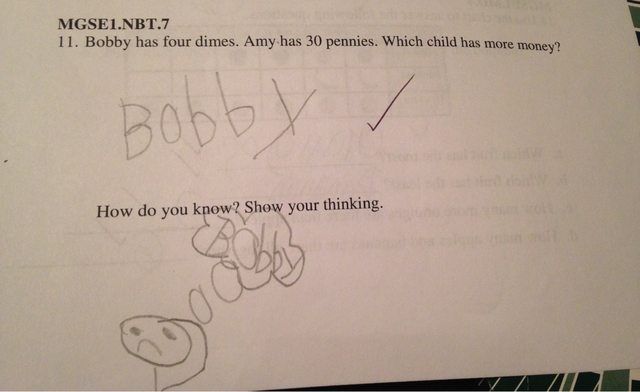
bobby


You just know when there’s a badly worded question that our students will pick up on it. Take the worksheet above for example.


Click on the link to read Hilarious Video of Children Eating Candy

Click on the link to read Helping Kids Learn from Failure

Click on the link to read How Babies Learn (Video)

Click on the link to read Celebrating Our Mistakes

The Destructive Powers of Social Media in the Classroom

November 4, 2015

social-media-sleep

Social media can be a welcome addition to every teacher’s toolkit, but as long as it keeps your students awake at night, it can also be a concentration killer:


You’ve probably seen it – a teenager rocking to music blasting from headphones while also texting, checking out Facebook and watching TV.

And, supposedly, doing homework.

For those people who date back to pre-handheld-device days and who found it hard enough to concentrate on homework even without digital distractions, the sight of multitasking teens is mind-boggling.

It’s also more prevalent than you might think.

A new report by Common Sense Media, a San Francisco-based non-profit that tracks children and their technology use, finds that teens age 13 to 18 spend almost nine hours a day – that’s longer than they usually sleep – on “entertainment media,” which includes things like checking out social media, music, gaming or online videos.

And that’s not including time spent using media for school or homework.

Meanwhile, tweens – those aged 10 to 12 – are not far behind, consuming about six hours of similar content, according to the report released Tuesday.

The study also found that half of teens say they often or sometimes watch TV (51%), use social networking (50%), text (60%) and listen to music (76%) while doing homework. You can bet that those figures include some who do all four at the same time.


Click on the link to read Teacher Busted for Lying Thanks to Her Facebook Updates

Click on the link to read Up to 1 in 10 US Students Have an Inappropriate Relationship With Their Teacher

Click on the link to read Facebook Exposes Yet Another Bad Teacher

Click on the link to read Why I Won’t Be Celebrating Facebook’s 10th Anniversary

Hilarious Video of Children Eating Candy

November 3, 2015


https://www.youtube.com/watch?v=MQOP9i-u5zIhttps://www.youtube.com/watch?v=MQOP9i-u5zI


Trick rather than treat for these kids.


Click on the link to read Helping Kids Learn from Failure

Click on the link to read How Babies Learn (Video)

Click on the link to read Celebrating Our Mistakes

Click on the link to read Is Guilt a Motivator of Children?

Is it Appropriate to Bribe Your Students?

November 2, 2015

money-for-grades

I’m not entirely critical of a school that has the money to incentivise academic improvement among their student population. After all, at least they’re trying.

But it really does seem rather desperate:


Brandon Allen is determined to make sure senioritis doesn’t hit during his last year at John Glenn High School in Westland. So he has signed a contract that will pay him $200 per semester if he substantially improves his grades.

“I heard that senioritis is a real thing. I figured that if I signed up for this program, it would keep me on track,” said Brandon of Westland.

About 400 students at the nearly 1,800-student school have signed such contracts, modeled after a smaller program at nearby Wayne Memorial High School. Both schools are in the Wayne-Westland Community Schools district.

The new program, called Champions of John Glenn, is funded primarily by a $50,000 donation from local businessman Glenn Shaw and his family. Shaw, who graduated from Wayne Memorial in 1961, lives in Canton, but Westland is still in his heart.

“I just love this community. … We just know kids are going to do so much better,” he said.

In addition to being able to earn $400 in a school year, the student with the highest percentage increase in his or her grade-point average will receive a one-year scholarship to the Wayne County Community College District or Schoolcraft College. Students already having a top grade of 4.0 can earn the money by setting different goals: organizing an event, taking a college entrance exam, reading a book or writing a paper.

Nearly all of the teachers at the school  — as well as other staff members such as custodians and the police liaison officer —  have signed on to become mentors. So has the district superintendent.

Some teachers have taken on entire classes of students.


Click on the link to read Keep Politics Out of the Classroom

Click on the link to read Tips for Teachers Preparing for the First Day of School

Click on the link to read Would You Ever Want to Visit Your Old High School?

Click on the link to read Middle School Student Bought Teacher Thong Underwear as a Gift by Accident

Helping Kids Learn from Failure

November 1, 2015


groundhog-day

The Groundhog theory, that all mistakes are repeated until learned from is apt and extremely relevant to children of all ages. That’s why it is very important to give our students tips for helping to identify mistakes and failures and learn from them.

The following is a list written by Angela Stockman:


6 Questions that Help Kids Learn from Failure

  1. In what ways did this experience help you become more courageous?
  2. What did you learn about yourself from this experience, and how has this knowledge inspired you to make positive changes?
  3. How did this experience make you wiser?
  4. If you were disappointed by your behavior, how might you consider its more positive aspects? In what ways might you use the same behavior to be of service to others in the future?
  5. If your beliefs, actions, or work wasn’t valued by a particular person or group, what are you discovering about the kinds of people and groups that you should be seeking out? Where you can find them? Who are they?
  6. What is this negative experience inspiring you to learn, create, or do?


Click on the link to read How Babies Learn (Video)

Click on the link to read Celebrating Our Mistakes

Click on the link to read Is Guilt a Motivator of Children?

Click on the link to read What Kids Think About Love (Video)

Teacher Draws Penis on Student’s Assignment

October 31, 2015


penis-student-work

If you can’t be a good example to your students, perhaps you shouldn’t be in the job:


THERE are calls for a female teacher to be sacked after she drew a massive penis on a child’s work because he hadn’t worked hard enough.

The student’s mother, Sandra Green, claims the teacher from Texas, Kim Juzdowski, eventually owned up to the rude artwork.

Although Juzdowski apologised, Green believes the school needs to take further action and lodged a formal complaint.


Imagine if the teacher was a male? Apologies wouldn’t have been nearly enough.


Tips For Less Talking and Better Teaching

October 30, 2015

angela-watson

A brilliant list written by Angela Watson:


1. Don’t steal the struggle.

It can be uncomfortable to watch kids struggle to figure out an answer, but they need time and silence to work through it. Resist the urge to talk students through every step of a problem and instead just observe. Similarly, learn to love think time. I often worry about keeping the momentum of a lesson going, and it’s uncomfortable for me to allow several moments of silent “wait time”or “think time” before calling on students. However, I try to push against the feeling that I will lose students’ attention because I know providing wait time can actually increase the length and quality of their responses. Letting kids think instead of rushing in to narrate or question builds anticipation around what’s going to be said next and increases participation as more kids are prepared to move into the conversation.

2. Move from the front of the classroom.

It’s easy to get in an instructional rut when you stand at the same place near the board all day long. Try occasionally sitting on the side of the classroom or in an absent student’s desk and say, “I need someone to go up and demonstrate ___ for us.” Because students are used to the person at the board facilitating the lesson, they are likely to talk for much longer than if you stay at the front and they’re in their seats answering you. You can even remain sitting among the class once the student is done demonstrating and ask follow up questions from other students instead of commenting on the students’ demo yourself (“What do all think? Is that an effective method–how do you know? Does anyone use a different strategy?”)

3. Teach students signals for your often-repeated phrases and for transitions.

Cut down on conversations about bathroom/water/pencil sharpening/etc by teaching kids to use sign language to request permission: use sign language to indicate your answer back: yes, no, or wait. I also like to teach kids sign language for please, thank you, and you’re welcome so that I can reinforce their good choices and acknowledge kids without constantly talking. Use music, a chime, or other auditory signal to indicate when it’s time to start an activity, pause, and clean up. The idea here is to give kids a break from hearing your voice: they are far more likely to tune in to a unique sound than to a 20 word direction.

4. Use non-verbal reinforcement for behavior whenever possible.

A lot of the talking most of us do throughout the day is related to student behavior, and most of the time, we’re wasting our breath. Resist the urge to lecture students every time someone forgets their materials, interrupts your lesson, or makes an inappropriate noise. It’s far more effective (not to mention easier and less disruptive) to give students “the teacher look” and keep the lesson moving. If you need to have a conversation about the behavior with a student or issue a consequence, try to wait for a break in your instruction rather than stop the whole class from learning while you discipline one kid.

5. Turn your statements into questions and prompts.

Instead of saying to a group, “Nice work over here, I like the strategy you used for ___”, ask the kids to reflect on their own work: “Tell me how your group has chosen to solve ___.” Instead of telling a child, “Take a look at #3, that answer is incorrect” say, “Would you tell me how you got the answer for #3?” Not only will these questions get kids talking instead of you, kids will also have the chance to reflect on and articulate their learning.

6. Instead of asking, “Does that make sense?” say, “Can you put that in your own words?”

If you’ve ever asked kids “Are you getting this?”, you’ve probably noticed you rarely get an insightful response. So, you either move on without kids understanding or you repeat something you’ve already said. Try inviting kids to put what you’ve explained into their own words, either repeating it back to you (if you were helping the child in a one-on-one conversation) or by turning and talking to a partner/doing a quick think/pair/share.

7. Stop repeating yourself.

It’s tempting to say important points and instructions a couple of different ways to make sure every child understands, but that strategy can backfire when it’s overused. Kids learn that it’s okay to tune you out because you’ll repeat everything you say. Instead, experiment with different strategies for getting kids to follow directions the first time you give them and use call-and-response routines to get kids’ attention right away.

8. Notice moments when you summarize/review for students and instead get their input.

If you hear yourself saying once again, remember, as I said, as always, so to sum this up, or don’t forget, that probably means you’re about to drive home an important point for the second or third (or tenth) time. Practice making those moments a chance for kids to share: What’s the rule about this? Who can sum this section up for us? Who remembers the way to determine ___? Some teachers even turn these moments into interactive activities, where the whole class does a hand motion, body movement, sound, or chant to indicate that they’re summarizing an idea or reviewing directions before getting started.


Click on the link to read What Type of Teacher Are You?

Click on the link to read The Making of a Great Teacher

Click on the link to read The Perfect Teacher According to Students

Click on the link to read How to Praise Students Properly
Tips for Making Co-Teaching Work

October 27, 2015

team-teaching

I don’t enjoy co-teaching. Perhaps it’s because my style is different, perhaps it’s because I’ve never found the right partner, but my preference is to go it alone.

However, if I was to go down that path, I could do a lot worse than follow these steps courtesy of educator Natalie Marston:


1. Establish rapport.

The first step that you (the regular classroom teacher and the special education teacher) need to take is to establish a relationship — even before the students enter the building. Get to know each other on a personal level. After all you will be together the entire year. What things do you have in common? Are you married? Children? Hobbies? Where did you grow up?

When the two of you have a comfortable relationship and rapport with each other, the children feel more comfortable in the classroom. Students can sense tension as well as harmony within the learning environment. A positive relationship will help minimize misunderstandings and motivate you to resolve problems before they escalate.

2. Identify your teaching styles and use them to create a cohesive classroom.

Are you a hands-on teacher who loves doing experiments and using manipulatives, never to open a textbook? While your co-teacher needs to use the textbooks first and then supplement with experiments and manipulatives?

How do you manage behaviors? What are your discipline styles?

Instructional and discipline styles are just two factors you need to examine so that you can combine the best of both of your styles to create a cohesive classroom. You need to find a balance that makes everyone comfortable.

When you plan lessons together, you can use your two styles to complement one another and thus enhance the lessons and the delivery of instruction. You create a cohesive classroom with consistent expectations when both of you are on the same page with instruction and discipline styles.

3. Discuss strengths and weaknesses.

How can you utilize each instructor’s strengths and weaknesses? A good way to do this is to have each of you make a list of strengths, weaknesses, likes, and dislikes. Then take the lists and compare them and highlight the strengths that are dominant for one teacher and allow that person to be the lead teacher in those areas. By using these strengths, you can differentiate your instruction to meet the needs of a larger group more frequently within the classroom as well as allowing for individualized instruction.

4. Discuss Individualized Education Plans and regular education goals.

To create Individualized Education Plans (IEPs), the special educator needs to involve the regular educator in the special education process. Students in special education belong to both educators, so the general educator must be informed about the IEP for each child. Otherwise, the two of you cannot effectively execute the plans. It’s difficult to educate a child if you are unaware of his or her special needs. It is important to discuss the modifications and accommodations as well as the goals and objectives to ensure student success in the classroom. The special and regular education teacher can then work together in meeting the student’s goals and ensuring adequate progress.

In the same way, the regular education teacher should discuss with the special education teacher his or her goals for the regular students, as the regular education students belong to the special education teacher as well. Both educators should be addressing the goals, objectives, and mandatory curriculum for that grade level.

5. Formulate a plan of action and act as a unified team.

You have to make decisions constantly throughout the year, so if you formulate a plan of action in the beginning of the year, disruptions will be minimal.

Consider the following items in your plan of action:

  • Scheduling
  • Expected classroom behaviors
  • Classroom procedures, such as class work and homework policies, turning in work
  • Consequences of not following rules and procedures
  • Grading
  • Communication between home and school

Talk about what you will tolerate as well as how you will respond to actions that are not acceptable. Be consistent when dealing with parents, and meet as a team for conferences with them. Determine your roles in advance so that you do not contradict each other or foster misunderstandings during the meeting.

6. Take risks and grow.

A wonderful aspect of co-teaching is that it allows you to take risks, learn from each other, and grow as professionals.

Co-teaching provides a safety net when you take risks in your instruction. When you try something new and it doesn’t work, you have another teacher in the room who can step in with another technique or lesson that works, or point out the area of difficulty, or assist in redirecting the lesson. When you are the only teacher in the room and a lesson bombs, you often have to stop and move on and then analyze later why the lesson fell apart — without the assistance of someone else in the room observing the lesson.


Click on the link to read What Type of Teacher Are You?

Click on the link to read The Making of a Great Teacher

Click on the link to read The Perfect Teacher According to Students

Click on the link to read How to Praise Students Properly

Don’t Blame Teachers for National Anthem Furor

October 26, 2015

national-anthem-muslim


The outrage based on a school’s decision to let Muslim children leave the room during a rendition of the national anthem is grossly unfair.

Teachers have a very difficult job and the last thing we need is to to get ourselves embroiled in a cultural episode where we get accused of being racist or insensitive.

If my school Principal allowed students to leave the room during the national anthem, I wouldn’t even think about questioning the ruling. There are far bigger fish to fry:


A Victorian school that invited Muslim children to walk out of assembly before the national anthem was played has been criticised by parents and maverick Senator Jacqui Lambie.

Cranbourne Carlisle Primary School said Shia Muslim students were allowed to skip the anthem because during the month of Muharram taking part in joyous events such as singing and listening to music is frowned upon as it is a time of mourning, the Herald Sun reports.

Lorraine McCurdy, who has two grandchildren at Cranbourne, told radio station 3AW she “saw red” when children were invited to leave before singing ‘Advance Australia Fair’.

“Two children got up and said ‘welcome to our assembly’ with that a teacher came forward and said all those who feel it’s against their culture may leave the room,” Ms McCurdy said.

“With that about 30 or 40 children got up and left the room.

“We sang the national anthem and they all came back in.

“I saw red, I’m Australian and I felt ‘you don’t walk out on my national anthem, that’s showing respect to my country.”

Independent Tasmanian Senator Jacqui Lambie said she found the whole situation “disgusting”.

“I find that absolutely devastating, we should all be singing the Australian national anthem and we should be doing that with pride,” the senator said.

“I find these schools that are allowing this to happen disgusting.

“I don’t think religion needs to be brought into the national anthem. We should all be proud to be Australians and proud to sing the national anthem.”

Cranbourne principal Cheryl Irving said the school, whose motto is “Many Cultures, one community”, allowed students to opt out of the anthem for religious reasons.

“Muharram is a Shia cultural observation marking the death of Imam Hussein. This year it falls between Tuesday October 13 and Thursday November 12,” Ms Irving said.

“Prior to last week’s Years 2-6 assembly, in respect of this religious observance, students were given the opportunity to leave the hall before music was played.

“The students then re-joined the assembly at the conclusion of the music.”

The Department of Education has backed the decision saying it supports schools “to be inclusive for all students”.


Click on the link to read Stay Away From You Students’ Facebook Pages

Click on the link to read Teacher Claims he Didn’t Think Sex Abuse Was a Crime

Click on the link to read The Classroom Incident that Isn’t Seen as Child Abuse but Actually Is

Click on the link to read A Cautionary Tale for Frustrated Teacher

What Type of Teacher Are You?

October 25, 2015

teacher

The Guardian put teachers in 4 categories. Which one best fits your teaching approach?


The idealist

This type really cares about making a difference, not just to their students but to society in general. They see improving social justice as a key part of their role, and when looking for a job they think about where they can have the greatest impact.

These teachers are also attracted to the job because they love their subject and have a desire to work with young people. Their motivation does not waver either; 29% said they strongly disagreed that they had considered leaving the profession in the past six months, compared with 25% of teachers overall.


The practitioner

This type is not so much interested in contributing to society as in contributing to the development of their own students. They are in the profession because they want to be teachers, they enjoy their craft and they are committed to the job. Practitioners are also strong believers in the importance of continued professional development. When deciding where to teach, they consider the character of a school – including aspects such as student behaviour and attainment.


The rationalist

This type of teacher joined the profession for practical reasons. They believe they can make a difference but are also pragmatic, realising that they need a job with good pay and holidays. These factors play an important role in keeping them in the profession, as does their enjoyment of school culture. They work in places that enable them to have an impact but also offer a good quality of life. Rationalists, however, can tend towards negativity, with 50% having considered leaving the profession in the last six months . They are also less likely than other teacher types to say that they would recommend the job to their younger selves.


The moderate

The type of teacher isn’t likely to raise strong opinions in the staffroom – it’s Mr or Mrs Middle of the Road. There is no one factor that brings them into the profession. In fact, they are motivated by many things (from a love of their subject to the need for a job) and they stay for a range of reasons. Half of this group is open-minded about where they work in terms of location, while the other half makes the decision after considering personal and school-specific factors. They are, however, more likely to move because of their family or partner.

When it comes to recommending the job to students and their younger selves, this type is less enthusiastic – only half would do so, compared with three-quarters of “practitioners”. They are also more likely to have considered leaving the profession in the last six months than “idealists” and “practitioners”.


Click on the link to read The Making of a Great Teacher

Click on the link to read The Perfect Teacher According to Students

Click on the link to read How to Praise Students Properly

Click on the link to read Tips for Teachers of ESL Students