Homeschooling is Not the Enemy

February 25, 2011

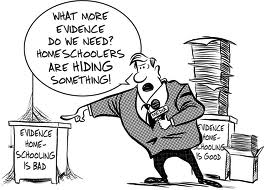
Whilst I am not a proponent of homeschooling and I see the virtues of the traditional school system, I am very frustrated by the lack of tolerance given to parents who decide that homeschooling is their prefered option.  To knock homeschooling is to ignore the many serious flaws inherent in the traditional school system.  Even though I think these flaws can be corrected and better practice can be implemented, until that is the case, parents will always look at their options.

That’s why I was particularly disappointed to read a recent article regarding the 12,000 children, aged 16 or under who are classed as “missing” from school in England.

The figures prompted warnings about the safety of those allowed to slip through the net. Children allowed to drop out of school could be at “serious risk” of physical, sexual or mental harm, charities said.

A Commons Education Select Committee inquiry in October reported that thousands of children as young as 11 who were “lost” to the education system may be turning to lives of crime, drugs and prostitution.

At this pont of the article I was naturally concerned about these kids who are so young, yet are not receiving education.  Then I read the following sentence:

Children may go “missing” due to being forced to wait for a school place or being kept at home by their parents…

How are those scenarios considered “missing?”  What if a child is being homeschooled?  Are they missing then?  Surely children waiting for a school place and being kept home by their parents aren’t necessarily “missing”.

Luckily I read another article which focussed on ending home-school stereotypes:

Despite successes with the ACT, spelling bees and math contests, home-schooled children battle a stereotype that they’re social misfits leading sheltered lives that fail to prepare them for the real world. Or worse yet, home schooling is depicted as brainwashing by parents pursuing a narrow political or religious agenda.

Nebraska law is friendly to home-schoolers, requiring basically that parents submit a form affirming their intent to home-school and provide a copy of their curriculum. The state doesn’t require state testing or home visits by state personnel.

Several parents interviewed said they cope with public misconceptions about home schooling even as the Internet and creative teaching arrangements give parents new ways to broaden their children’s education and further challenge the stereotypes.

Home-schooled students play on Little League teams, join Boy Scouts, perform in public school bands, participate in cooperative academic classes and, when necessary, take classes at local high schools and colleges, parents say. Students participate live in classes via the Internet.

Mike and Tricia Croushorn of Omaha home-schooled their children, Abi, 22, Tyler, 20, and Sam, 16, to give them a well-rounded education that included a religious component.

The Croushorns got interested after getting to know parents who home-schooled.

“We would meet these other children and they were always polite and respectful, and they could carry on a conversation with adults,” Tricia Croushorn said.

Homeschooling is not the enemy of education.  Bad teaching and poorly run schools are the enemy of education.  Until traditional schools really do offer the kind of support, care and safety that they claim to, then loving parents will always explore their options.  Because ultimately it’s not about tradition, it’s about the best needs of our children.  The only people who should be making that call are the parents.

I love being a school teacher and I see great value and potential in traditional school education, but I admire the selflessness and sacrifice that homeschooling parents make and the intentions behind their decision.  Instead of picking on the unconventional, make the conventional much better than it currently is.
Losing the Control of Your Class and Sanity

February 25, 2011

One of the most important qualities of a good teacher is patience.  Teachers, no matter how experienced or adept they may be, struggle at times with behaviour management issues in the classroom.  The loss of control at the hands of cheeky and disobedient students happens to the best of us.  It’s just a matter of how well we deal with it.

The trick is to keep your emotions settled, think calmly and find an appropriate way to address the issue as well as administer a consequence that fits the infringement.  Unfortunately, for some, all clarity and common sense goes out the window when faced with classroom management stresses.  Take this unfortunate case for example:

A TEACHER at a primary school was sacked after ordering pupils to wear a picture of a child with a noose around its neck as a punishment.

Ama Bankah, 31, had been working as a supply teacher in class of children – many with special educational needs – at Shaw Primary School, South Ockendon, Essex, England, when the practice came to light.

The General Teaching Council‘s professional conduct committee heard Ms Bankah claimed the placard was used as a “behaviour management technique”.

Every time she rang a bell, all the children had to sit quietly and those who didn’t would be “caught” by the “hangman” which was the name of the picture on the placard.

The GTC heard the image on the placard was of a child dressed in the colours of the school uniform. When Ms Bankah did this to one of the boys on February 1, 2008 he burst into tears and the matter was brought to the attention of the headteacher Linzi Roberts-Egan.

She then quizzed Ms Bankah, who had been in the post for three months, before asking her leave the school.

“Ms Bankah’s behaviour on 21 February 2008 was demeaning to the pupil concerned, caused him some harm, and had the potential to harm other pupils,” GTC committee chair Sashi Sivaloganathan said.

The committee also heard that some parents were so concerned about what had happened that they considered taking their children out of the school.

Whilst a story like this illustrates a teacher using terribly bad judgement, I can’t help but consider the difficulties she must have been facing to come up with such a desperate and inappropriate response.  Teaching is a difficult profession, and no formal training prepares you for unruly and disrespectful students.

Structures need to be put in place to support the teacher well and truly before they lose their mind and make terrible judgement calls like this one.

Bizarre Ideas in Education

February 24, 2011

I’ve written about this before, but I still can’t believe that this insane idea is gaining momentum.  Yes, it’s true that teachers often get frustrated by what they believe is negligent parenting of their students.  Does that give them the right to formally assess their perceived incompetence?

The idea of giving teachers the responsibility to write report cards about their students’ parents is ridiculous.  Yet, the idea is not going away:

Legislation from a Florida lawmaker has parents pondering how they’d be graded on their involvement in their child’s education: satisfactory, unsatisfactory or needs improvement?

Public school teachers in Florida would be required to grade the parents of students in kindergarten through the third grade, under a bill introduced by Rep. Kelli Stargel, R-Lakeland.

The bill has gotten the married mother of five national attention because there’s been so much emphasis on tying teacher salaries and advancement to student performance.

“We have student accountability, we have teacher accountability, and we have administration accountability,” CNN.com quotes Stargel as saying, “This was the missing link, which was, look at the parent and making sure the parents are held accountable.”

The grading system is based on three criteria that Stargel wrote in the legislation:

• A child should be at school on time, prepared to learn after a good night’s sleep, and have eaten a meal.
• A child should have the homework done and prepared for examinations.
• There should be regular communication between the parent and teacher.

Unbelievable!  Is it not the child’s responsibility to take ownership over their own homework? Did I just read that a child should have eaten a meal?  If a teacher is aware that their student isn’t being fed, the teacher has a responsibility to notify child protection authorities, not mess around with assessment forms!

Sure there are bad parents out there, but what is a report card going to achieve anyway?  How is a report going to change the error of their ways?

“Thanks teacher.  I needed that. I had no idea I was a bad parent.  I feel so much better now!”

I suppose, teachers needn’t worry.  A policy as silly as this will never be seriously contemplated.  Well, at least I hope not ….

Treating Teachers Like Livestock

February 23, 2011

Someone needs to explain to this ignorant Australian how New York could be in this situation.  How can New York be in a situation where they feel they are better off letting go of more than 4.650 teachers?  How is this possible?  Is New York so content with their education system that they think they can make their cutbacks by ridding themselves of talented teachers?  Isn’t there other areas of government waste they can focus on instead of this massive cull?  That’s what this amounts to – a massive cull.  Teachers as expendable livestock!

And what’s worse is they are bound by a law that requires that teachers hired last are the first ones to be laid off, regardless of their effectiveness.

“I’m sorry, you’re doing a brilliant job and have been a source of inspiration to your students, but because we only hired you recently, we have to let you go.”

Teacher morale has always been an oxymoron, but this would be doing so much damage to teachers, their families, students and schools.  Take this case for example:

This is Stany Leblanc’s second year as a New York City teacher. It may also be his last.

When Mr. Leblanc’s sixth-grade students arrived in September for their first day of school in the South Bronx, they were on average two years behind in writing skills and more than a year behind in reading.

To inspire his poor, black and Hispanic charges to read, Mr. Leblanc has found books that are relevant to many of their lives. Students whose homes are too chaotic for studying find in his classroom a quiet place to work long before school in the mornings and well after the school day is done. He pushes students to write essays every week and groups them into teams named after colleges, so they remember every day what they are working toward.

Five months later, his sixth-graders are reading and writing at the sixth-grade level. “I’ve already caught them up and now I’m moving them beyond,” he said.

More than 4,650 teachers are expected to be laid off at the end of this school year, according to Mayor Michael Bloomberg‘s preliminary budget. State law requires that teachers hired last are the first ones to be laid off, regardless of their effectiveness.

That would make Mr. Leblanc, who began teaching in 2009 and earns $45,000 a year, vulnerable to being among the first to go among a citywide teaching corps of nearly 80,000.

His school is vulnerable, too. More than 200 new schools have been created in New York City in recent years to replace large, dysfunctional schools where too many children were failing. These new schools tend to have teachers with less experience.

The location of Mr. Leblanc’s school in a poor neighborhood is a factor as well. Schools in poor districts tend to have newer teachers, as teachers with greater seniority tend not to want to work there. The Department of Education has said low-income communities will be among the hardest hit by teacher layoffs, places where children can least afford to lose their teachers.

“It’s going to be devastating to the culture” of the school, said Mr. Leblanc’s boss, Patrick Awosogba, the principal and founder of Science & Technology Academy: A Mott Hall School. Dr. Awosogba carefully picked each of his 25 teachers, building a team of educators who work well together and often pitch in at each other’s classrooms to offer help and advice.

Am I misreading the situation?  Is Mr.  Bloomberg’s initiative necessary?  Why is a profession with relative job security worldwide suffering from such insecurity in New York?  How do you get a situation where 4,650 teachers required one year are no longer required the next?

Sounds like another case of treating teachers like livestock!

The Cost of Sedating Our Boys

February 20, 2011

I recently came across an interesting opinion piece by Elizabeth Farrelly in the Sydney Morning Herald.  Whilst I wouldn’t go as far as to connect the lack of representation of male teachers to the number of boys on Ritalin, some of her points do resonate.  There is no doubt that Ritalin does have a place, but with the numbers of children (boys in particular) taking the drug climbing markedly from year to year, it is more than fair to raise some strong concerns.  Ms. Farrelly certainly does just that:

The Ritalin wars are usually treated as just another tussle between the pharmaceutical companies and the rest, but is there something else going on here as well? Is it part of a more generalised, covert war on boyhood? //

Thirty years ago Australian primary schools employed five male teachers for every four females. By 2006 there was one male teacher for every four females. This overwhelming feminisation of primary education, and of culture generally, has made boy-type behaviour stuff to frown upon. Are we in danger of seeing boyhood itself as a disorder?

When Christopher Lane, author of Shyness: How Normal Behaviour Became a Sickness, quoted a psychoanalyst saying “We used to have a word for sufferers of ADHD; we called them boys”, he probably did not expect it to become the most famous line of his book.

What was once introversion is now “avoidant personality disorder”, nervousness is “social anxiety disorder” (SAD) or dating anxiety disorder (DAD) and so on. It’s not that these disorders don’t exist, says Lane, a Guggenheim fellow studying the ethics of psychopharmacology, but that our definitions are so broad that the entire mysterious subconscious is reduced to chemical balance, and any deviation looks like disease.

Why, he asks, is ADHD so commonly diagnosed in boys? Is it new behaviour? Or just a new attitude to that behaviour?

But why the gender imbalance, and why now? We know that boys tend to be late maturers anyway, but Scott concedes there are also social and perceptual factors at play. Teachers with “less structured” teaching style and “more distracting” classroom environments, he says, yield many more of his clients than their more disciplined (my word) colleagues.

Whereas ADHD girls “sit quietly in a corner”, the boys are more disruptive and more noticed, more referred, more medicated. And although much the same is true of ”normal” boys and girls, the upshot is that ”girl” is a norm to which boys are expected to strive. Scott sees it as “an unintended consequence of how society operates”.

But consequences this important should be either clearly intentional, if girlifying boys is really what we want, or remedied. Personally, I reckon the crazily creative are types we’ll need more of, rather than fewer of, in the future, even if they are male.

The above are just some snippets from this very thought-provoking opinion piece.  It has never sat well with me that such a large proportion of children taking Ritalin are boys.  Whilst I wouldn’t go as far as to blame it on few male teachers, it does make you wonder whether we are getting it right.

It seems like society may be letting boys down very badly.

Natalie Munroe is No Hero!

February 18, 2011

I can’t believe the amount of support blogger Natalie Munroe is receiving after she was caught complaining about her students on a public blog.

Sure, she may not have named them when she called them “… rude, disengaged, lazy whiners. They curse, discuss drugs, talk back, argue for grades, complain about everything, fancy themselves entitled to whatever they desire, and are just generally annoying.”

She didn’t even use her full name.  So what did she do wrong?

When you write a blog that complains about the people you work with or for, be very careful that the secret doesn’t come out.  When a school board is presented with complaints from parents who were angry that their children were insulted online, they have no choice but to issue a suspension.  It’s a really bad look – especially from a teacher.

Ms. Munroe’s defenders say she was just telling the truth.  Firstly, she wasn’t telling the truth.  Truth applies to fact, this is opinion.  The old adage that one’s opinions is best left to one’s self certainly applies here.  The school would look ridiculous if they allowed Ms. Monroe to write what she likes and they certainly couldn’t have defended it on the basis of truth.

But many disagree with me
:

However, it is high time for teachers to speak up even at the loss of their jobs. United in this effort, they could turn the tables and help students achieve better educations. And they could have a better, safer, environment.

It might be noted here that she did not direct her statements to any specific student. There has been a Facebook group organized to support her.

Every classroom in America is filled with students like this, and sometimes it must be like working in a zoo. It might be an easier job than trying to reach and teach kids who could care less about school, respecting those in authority, and those who hold back other students who really want to learn.

This is not the forum for teachers to have a go at their own students.  If they disguise their comments in general statements about the nature of kids in modern society that is acceptable, but when they make judgements about the personalities and behaviours of their own students, they must accept the consequences of these revelations should they reach the parents.

My own take on this is that she made a mistake.  She is not a bad person or necessarily a bad teacher.  Whilst it’s not a good look for a teacher to be caught out venting their frustration, it happens all the time, and given the time, place and circumstance it won’t lead to suspension.  But seriously, Natalie Munroe is no hero!

The Drug Companies Are Winning at Our Children’s Expense

February 17, 2011

I have a confession to make.  I hate drug companies.  No, worse, I despise drug companies.

I may not be a doctor, pharmacist or  expert, so you can discount my views as just ramblings from an ignorant blogger if you like, but that isn’t going to change my position.

It is my belief that the drug companies have a vision.  That vision is to see children being given medication as if it were candy.  Last month I wrote about the fact that more than a quarter of kids in the US are on medication, with almost 7% on two or more prescription drugs.  The drug companies probably see that figure as merely a good start, with plenty of room for improvement.

And as much as I wish we could see through what they are doing, I’m afraid, they continue to prevail.

I was really disappointed to hear that a lice drug called Natroba,  has been approved by the U.S. Food and Drug Administration for use on children ages 4 and older.

A lice drug?  So let me get this straight.  You give your child a drug that goes into the bloodstream to fight a problem which is external to the body.  How on earth does that work?

The product — which is applied to dry scalp and hair, then left on for 10 minutes — contains spinosad, a compound that excites the central nervous system of head lice. The bugs, which are most common in children ages 3 to 12, become paralyzed and die.

And what about the “known” side-effects?

Common side effects of Natroba include redness or irritation of the eyes and skin.Because it contains benzyl alcohol, which can be harmful to newborns and low-birth-weight infants, the drug should not be used on children younger than 6 months.

6 months?  Why would you give a prescription drug to a baby suffering from lice?

The sad part of this is that we live in the age of the quick fix.  The solution to every problem must come at the click of a finger.  No matter how many of these drugs get released, there will always be doctors happy to endorse and prescribe them and parents only too happy to avoid the time and energy used to treat their children in the traditional way.

If this keeps up, soon it will be rare to find a child not on medication.  What a tragedy!

Why Students Misbehave

February 16, 2011

There are many reasons given for poorly behaved students:

  • The teacher doesn’t enforce discipline
  • The students are spoilt
  • The students are not parented properly
  • Kids are rude nowadays, and haven’t been properly taught manners.

All these reasons are decent explanations for an unruly child or class.  But there is one glaring omission from this list, which doesn’t get nearly the amount of coverage as other reasons – the students are bored!

My experience with unruly behaviour, is that it is more prevalent in a classroom that is taught in a bland style.  I have observed some brilliantly dedicated and hard-working teachers, who spend countless hours planning their lessons using the latest graphic organisers and programs, only to watch their hard work fizzle before their very eyes.  The most thorough preparation can go out the window when it results in a unsipiring lesson.

So much of today’s educational resources concentrates on breaking skills down, organising thoughts and following scientific trends.  What they fail to do is assist teachers in delivering fun, enjoyable lessons.

The latest trend in Australian education is direct instruction.  Direct instruction involves reading from a script.  In Australia this is how many schools teach their maths and spelling.  The class teacher is presented with a manual and asked to read from a script (the script even tells you when to pint at the board and when to pause!).  The students job is to listen, repeat after the teacher, and answer questions in their workbooks.  No hands are answered, no discussion takes place.  It’s just the teacher talking and the students responding.

The strengths of this style of teaching are worth noting.  The program is comprehensive, it fixes gaps in student learning, it helps improve the student’s listening skills, it makes for a quiet classroom and cuts planning time.  But among the weaknesses for such a program is the fact that it is so boring, firstly for the teacher, and also for the student.

Boring classes often leads to disruptive behaviour.

Have you ever watched the behaviour of teachers during a boring PD or staff room meeting?  And that’s adults!  We can control our behaviour far better than our students.  It’s just that when you are bored, it’s not so easy to maintain focus and avoid distraction.

In my own teaching, I find that my most difficult classes come as a result of an inability to properly engage my students.  Because I am not a strict or authoritative teacher, I rely very much on the strength of my lessons to maintain decorum in the classroom.

Among the many questions we teachers must ask ourselves when we reflect on behavior management in our classrooms is, what are my lessons like?  Could they be more relevant to the interests and life experiences of my students?


How is Hitting Students Still Legal?

February 15, 2011

I don’t know if it was naivety on my part or just the fact that I’m from Australia, but I had no idea that corporal punishment was still legal in 20 US states.  A third-world country maybe – but the US?  In Australia it is absolutely illegal to strike a student, and so it should be.  I just assumed that the America had the same protocols.  Turns out I was wrong.

In response to the dreadful story of the elementary teacher charged with assault for allegedly choking and punching 8 first grade students, the Washington Post recently wrote an expose on the issue of legalised corporal punishment:

In June, Rep. Carolyn McCarthy (D-N.Y.) introduced the Ending Corporal Punishment in Schools Act, which would ban corporal punishment as a form of punishment or way to modify undesirable behavior at all public and private schools with students that receive federal services.

Congress apparently had other things to do. The bill was sent to a committee but never made it further in the legislative process.

Last year a congressional committee had a hearing on the issue. The panel learned that:

  • School officials, including teachers, administered corporal punishment to 223,190 schoolchildren across the nation during the 2006-07 school year (according to conservative government estimates, the latest year for which national statistics were available).
  • As a result of that punishment, 10,000 to 20,000 students requested medical treatment.
  • Students are typically hit on their buttocks with a wooden paddle, about 15 inches long, two to four inches wide and a half-inch thick, with a six-inch handle at one end.
  • Most students are paddled for minor infractions, such as violating a dress code, being late for school, talking in class or in the hallway, or being “disrespectful.”
  • Almost 40 percent of all the cases of corporal punishment occur in Texas and Mississippi.
  • Current studies indicate that physical punishment is most common in kindergarten through eighth grade, in rural schools, in boys, and in disadvantaged and nonwhite children.
  • African American students are 17 percent of all public school students in the United States but are 36 percent of those who are victims of corporal punishment, more than twice the rate of white students.

Supporters of corporal punishment will defend the method as being effective in dealing with unruly behaviour.  In my opinion, it is a lazy option that should never be allowed.  As much as I wish it weren’t the case, not all teachers care deeply about their students.  Many get disenchanted, flustered and resentful.  While a vast majority of teachers want nothing more than to see their students thrive, others will surely exploit any means possible to shut them up.

Australia and the United States have a close relationship and share many of the same values and ideals.  But corporal punishment isn’t one of them.  How can 20 States continue to allow such an extreme form of punishment in today’s age?  Please don’t wait for more horrible stories about unprofessional and violent teachers before doing something about this.

No matter how badly behaved they may be, kids deserve better than this!

Be Careful How Much Power You Give Schools

February 14, 2011

Multiple choice time:

You have a 6-year old boy suffering from separation anxiety because his father, an Army commander, is leaving for Iraq.  The boy is found drawing zombies and writes underneath the drawings that he wants to die.

As a school administrator, do you:

a. Take the child aside and offer help, sympathy and a listening ear.

b. Call his mother to set up a plan for how to join forces and help the child during this tough period of his life.

c. Refer the situation to a counsellor or recommend that the mother take the child to a psychologist to get expert help.

d. Call an ambulance and get that child to a psychiatric ward, so he can be committed to a 72-hour psychiatric hold.

If you answered “d” you are probably from Los Angeles, the home of mystifying school decisions.

A mother has criticised school authorities for committing her six-year-old son to a psychiatric ward against her wishes because of a picture he drew in class.

Jack Dorman was pulled out of his elementary school classroom after he sketched a drawing of zombies and stick figures and wrote that he wanted to die.

But the boy’s furious mother, Syndi, said her son was simply upset that his soldier father was being deployed to Iraq.

She said the way Los Angeles school officials treated her son ’was right up there with my worst nightmare.’

Mrs Dorman added: ‘They said they were concerned about a picture he drew. I said he plays video games and it’s a picture from a video game.’

She claims Jack suffers from separation anxiety and was particularly upset on the day he drew the disturbing picture after learning his father, an Army commander, was leaving for Iraq on Thursday.

‘I explained to them what was happening, that my husband was being deployed to Iraq, that he was upset when he came to school today, that he wanted to be at home,’ she said.

‘I’m saying, “I will deal with it, that we have a therapist and that we’ll make sure he’s seen today”.’

‘They said it was out of my hands. They said they were in control and they could do this and had already called an ambulance.

‘I said, “Can you do this?” and they’re like, “Yeah”, Mrs Dorman said in an interview with NBC. ‘I’m just like, “What? Can I get a lawyer? How is this happening?”.’

Mrs Dorman said the ambulance ride was terrifying for her son, who was already seeing a therapist because he became anxious when he was separated from his family.

‘I was trying to reassure him that it would be okay and he asked if I’d come back for him and I said of course I am going to come back for you,’ added Mrs Dorman.

Jack was released after 48 hours, but his mother fears the ordeal has traumatised her son.

‘My son doesn’t want to go back to school. He’s afraid they are going to take him away again,’ she said.

In a statement, Los Angeles Unified School District Superintendent Ramon Cortines insisted his staff took the appropriate action.

‘We did the right thing here,’ he said. ‘I can unequivocally state that correct procedures and protocols were followed, including contacting the parents and accessing community resources such as the Los Angeles County Psychiatric Mobile Response Team.

‘When any student indicates a desire to take his or her own life, the LAUSD is required to follow strict protocols to ensure the safety of the student. The safety of LAUSD students is paramount,’ he added.

Where is the common sense in this story?  The boy is 6-years old!  A 6-year old boy with a father being sent off to war who threatens his life on the back of a drawing needs care and support from his school.  He needs the school to be sensitive and compassionate.  So what do they do to this poor kid?  They send him off to a psychiatric ward!  The person that was responsible for calling the ambulance is a more suitable candidate for the ward!  What were they thinking?

The unfortunate modern reality of living in a litigious world, in my opinion,  is that school’s care more about being sued than for the rights of the children.  It is for this reason, we need to be mindful that in all kinds of sensitive circumstances, school’s are likely to put their interests ahead of the child’s.  We must be careful how much power we give them.  This includes teacher’s being given authority to greatly influence the decision of a doctor in prescribing powerful medications to a child.

And it isn’t just the school that is to blame.  It’s the regulations which were instituted with one massive, gaping hole in it – the common sense clause. Even with the best of intentions, a law that ignores common sense, is a terrible law!

And notice the lack of apology.  No, they are still defending their decision!  Shame on you!

Time to change the law folks