Banning Home-Made Lunches is a Dreadful Policy

April 15, 2011

Of all the things to ban at school, who was responsible for this terrible idea? How can you ban children from bringing a home-made lunch to school? How can you force parents into spending money for their child’s lunch when they could provide their own for less cost?  This is another case of we don’t trust parents and their children, so we’ll intervene.  Whilst this philosophy is often generated from good intentions, it seldom leads to good results.

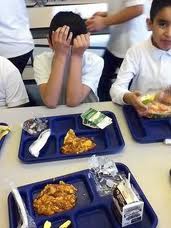
The days of brown bagging it are over for students in a Chicago school. In an effort to encourage healthy eating, their principal banned lunches brought from home.

Elsa Carmona, principal of Little Village Academy on Chicago’s West Side, forbade students from bringing food from home (except those students with a medical excuse) after she noticed kids eating “flaming hot” chips and drinking soda at lunchtime. “It’s milk versus Coke,” she said.

While the goal of healthy eating is a positive one, parents are understandably upset about the Carmona dictating what their kids can and cannot eat for lunch. Not to mention the fact that some parents may be able to send their kids to lunch with a meal that costs less (and one that could be even healthier) than the school’s offerings.

The kids are upset, too. When the Tribune reporter visited the school, one seventh grader led students in a chant of “We should bring our own lunch! We should bring our own lunch!” Students say the school’s food tastes bad. Bad-tasting food, parents say, often means that kids throw away the school lunch and go hungry.

It’s also worth noting, as reported by the Tribune, that the school district receives money from the federal government for each free or reduced-price lunch it serves, meaning that in banning homemade lunches could potentially put more money in the pockets of both the district and the school district’s food provider.

But Carmona maintains her school’s policy is simply about helping students make healthy choices. “Nutrition-wise,” she told the Tribune, “it’s better for the children to eat at the school. It’s about nutrition and the excellent quality food that they are able to serve (in the lunchroom).”

Is anyone surprised that this scheme looks very much like a money-making venture disguised as a realistic attempt in tackling childhood obesity?  What happens to a child who is caught bringing in a lunch from home that is more healthy and nutritious than what the school offers?  Does that child get punished?  What happens if the students hate the menu?  Why should they be forced to eat what they don’t like?

I am all for reducing the amount of junk that students have in their lunch boxes. But at the end of the day, I urge school’s to stop mirroring prisons.  Yes discipline is important, as is routine.  And yes, at times intervention is required.  But why do those involved in forming school policy show a lack of regard for making their students’ time at school a happy, comfortable or at the very least bearable experience?

How about forcing those involved in making stupid rules like this one to eat from the school cafeteria?  How about making them lead my example and banning them from eating a home-made lunch?

And you wonder why there is such a lack of respect from students nowadays?



Cyber Bullying Takes Bullying to a New Level

April 13, 2011

It would be taking bullying too lightly to say it was important or a priority.  It is much more serious than that.  Bullying is a huge area of concern worldwide and is the issue most in need of consideration and due diligence in our schools.  I am happy to hear that in my home state of Victoria, legislation has been passed making it a crime to bully, with workplace bullies jailed for up to 10 years.

It is reassuring to see that cyber bullying is included in this piece of legislation:

The legislation would also cover cyber bullying. It’s happening in other places too.

With the internet covering every part of our lives, cyber bullying has become more prevalent now than ever before. Access to mobile phones, the Facebook phenomenon and YouTube have made it a real problem. Cyber bullying is now so bad that it’s being looked at by a parliamentary committee. Facebook says its removing 20,000 under age users globally each day, but the problem continues. Cyber bullying is perpetrated not just by young people. Take for example the revelations of a gay hate campaign on Facebook in the Australian Defence Force. //

Cyber bullying can take many forms. It can include being teased or made fun of online, being sent threatening emails,  having rumours spread about you online, having unpleasant comments, pictures or videos about you sent or posted on websites like Facebook or MySpace,  being sent unwanted messages, being deliberately ignored or left out of things on the internet or even having someone use your screen name or password and pretending to be you to hurt someone else.

One of the worst examples recently popped up when Blake Rice, who lost his mother and brother in Queensland’s floods, was bashed by six youths because of all the attention he was getting. After leaving him with a broken collar bone, they set up a Facebook page titled We bashed Blake Rice.

The effect of cyber bullying can not be underestimated.  When a child is bullied in the schoolyard, they may find sanctuary in the comfort and safety of their home and family.  This basic right is not afforded to victims of cyber bullying.  They are bullied from the very place they go to for safety and certainty.  With cyber bullying, there is nowhere to hide.

Another unique aspect of cyber bullying, is that when students are bullied at school there is a clear expectation that the Principal and staff will work together to protect these students.  Who are our children to turn to when they are being bullied online?  Their teachers?  Their parents?

This frustrating aspect is highlighted quite clearly through this heartbreaking letter to the Editor from a mother in the UK.

I WAS so pleased to read the article from a concerned father on Facebook Bullying.

I am the parent of a 13 year old girl attending a West Norfolk High School.

We have experienced the horror of Facebook Bullying, which follows on from a day of hell for my daughter in school.

I have had to complain to the school, visit the school, etc, on many occasions since my daughter started three years ago, only to be told the same thing time and time again – the bullies have been spoken too, the bullies have been dealt with; only to find that same evening it starts again at home in the form of Facebook.

The horrible taunts, the name calling, and then more join in and back up the bully’s comments. My daughter puts a far braver face on it than I ever could, but as a mother I feel her pain – and I am disgusted that the parents of these children are not checking what their delightful children are saying and the manner in which they are saying it.

I log on to my daughter’s Facebook with her permission every day now. On occasions as I have been doing this I have had vile messages sent to me via chat – and they get a nasty shock when they realise they have not actually sent it to my daughter.

I have threatened them with Police, with their parents and for cyber bullying, but most times you just get verbal abuse back.

What is happening to our children and our schools?

I have thought about taking my daughter off Facebook altogether to protect her, but why should she be the one who feels punished; why should she miss out on what the majority of her peers are enjoying responsibly?

Also it helps me as a parent to see just what the poor child is enduring and a least, on an upside, I can be there for her and support her through this the best I can – and I have the names of the bullies.

Perhaps Facebook should have been thought through before its launch – 18 years minimum age for access maybe.

There may just be a chance then that these awful bullying children may have reached maturity, and know right from wrong.

ANOTHER CONCERNED PARENT (MOTHER)

The Perfect Example of Courage and Self-Respect

April 12, 2011

The following is a clip I watched today that literally blew me away.  It is of a Pakistani actress by the name of Veena Malik, who in the face of harsh criticism by cleric, Mufti Abdul Qavi, stands up for herself in a profoundly courageous and inspirational way.  I don’t want to comment on the substance of their heated conversation (I’ll leave that to others).  Instead, I want to focus on the courage, integrity and strength of character displayed by Ms. Malik.

This is not something I can show in the classroom because of cultural sensitivities, but I strongly urge parents to watch this video.  The message that this clip sends to young girls in particular is potentially very powerful.  Here is a woman who refuses to be degraded, dictated to and walked over.  That is exactly the message we should be sending to our youth – be honest, courageous, proud and compassionate, and never let others manipulate, bully or belittle you.

Again I want to stipulate that I am not commenting on the substance of the disagreement between Ms. Malik and the cleric because that is not the purpose of this blog.  This blog is about education, and I can think of no better education for a young impressionable child than to see a model of self-respect, courage and integrity first hand.

Thank you Ms. Malik for standing up not only for yourself but for all people who feel downtrodden and unappreciated!

Should Teachers Have Students as Facebook Friends?

April 12, 2011

My answer to this question is a categorical no.  Whilst my own teachers were generous with their time, even giving out their phone numbers (when I was in 12th grade) to offer help after hours, this sort of generosity is now just plain unprofessional.  Teachers should not accept invitations to be Facebook friends with their students, nor should they be giving out their phone numbers.

It seems that this issue is a concern around the world.  A study was recently conducted in Ontario, which featured the following recommendations:

A report, to be released Monday, recommends teachers neither accept — nor send out — Facebook friend requests involving students. They should avoid texting, and never communicate by email using a personal account, says the advisory from the Ontario College of Teachers, the body that oversees the profession.

Online communications should be via “established education platforms” such as web pages set up for a school project or class, says the report, obtained by the Toronto Star.

Teachers should also only contact students electronically during the same times they’d feel comfortable calling home.

“When we are communicating with students, face-to-face or in more traditional ways, we are trying to replicate that in other media,” said Michael Salvatori, the college’s registrar.

“The informal language of texting is not the kind of interaction a teacher and student would have … there are lots of ways teachers can be available for students without texting.”

The report comes as school boards try to figure out how to create rules around the use of social media, without hampering efforts by educators to engage students by using it.

And, increasingly, just as in their real life, teachers’ conduct online is also coming under scrutiny. Recently, in the U.S., teachers have been suspended for posting inappropriate comments on their personal Facebook pages, on their own time; one said he hated his job and students, another compared herself to a “warden” supervising “future criminals.”

This is only the third advisory the college has ever issued, and it will follow up with information sessions around the province this month and next.

Few school boards have a social media policy as yet, trusting to general guidelines around teacher and online conduct to cover it for now.

That’s because social media has exploded in the past few years, said Paul Elliott, vice-president of the Ontario Secondary School Teachers’ Federation, which put out a pamphlet for teachers on the issue a while ago.

It’s the newly graduated teachers who tend to have a tough time at the start, he added.

They’ve been active on Facebook, and they are moving into a profession where behaviour that wasn’t considered objectionable before is now inappropriate — such as posting a picture enjoying a beer with friends, he said.

As for texting, it can sometimes prove “a useful tool of communication in the classroom, with the curriculum — but that’s the only time it should be in use,” he said.

The college has also warned teachers that anything they post online can be altered, and that “innocent actions” can be “easily misconstrued or manipulated.” The report cites several disciplinary cases, albeit extreme ones, where emails or other online communications were involved.

There is no good reason for a teacher to be communicating with students through Facebook or any other forms of social media.  While I respect and appreciate my teachers for giving me the opportunity to call on them after hours with queries or concerns, I don’t think the current day teacher should be allowed to do the same today.  Teachers must be responsible and careful in their dealing with their students.  There is nothing responsible about being a Facebook friend with your student.

Are Kids Addicted to Technology?

April 11, 2011

Technology is a wonderful thing when it doesn’t take over your life.  In context, technological innovations such as mobile phones and the internet connect you to others and make day-to-day operations easier to carry out and more time effective.  But technology addiction, like all other addictions, is something to be concerned about.

Children need a range of different experiences and stimuli.  They need exercise, real human interaction and routine.  When an addiction, such as internet addiction occurs, it tends to become quite a negative and destructive situation.

But are kids really addicted to technology?

Researchers found nearly four in five students had significant mental and physical distress, panic, confusion and extreme isolation when forced to unplug from technology for an entire day.

They found college students at campuses across the globe admitted being “addicted” to modern technology such as mobile phones, laptops and television as well as social networking such as Facebook and Twitter.

A “clear majority” of almost 1,000 university students, interviewed at 12 campuses in 10 countries, including Britain, America and China, were unable to voluntarily avoid their gadgets for one full day, they concluded.

The University of Maryland research described students’ thoughts in vivid detail, in which they admit to cravings, anxiety attacks and depression when forced to abstain from using media.

One unnamed American college student told of their overwhelming cravings, which they confessed was similar to “itching like a crackhead (crack cocaine addict)”.

The study, published by the university’s International Centre for Media & the Public Agenda (ICMPA) and the Salzburg Academy on Media & Global Change, concluded that “most students… failed to go the full 24 hours without media”.

The research, titled The world Unplugged, also found students’ used “virtually the same words to describe their reactions”.

These included emotions such as fretful, confused, anxious, irritable, insecure, nervous, restless, crazy, addicted, panicked, jealous, angry, lonely, dependent, depressed, jittery and paranoid.

Prof Susan Moeller, who led the research, said technology had changed the students’ relationships.

“Students talked about how scary it was, how addicted they were,” she said.

“They expected the frustration. But they didn’t expect to have the psychological effects, to be lonely, to be panicked, the anxiety, literally heart palpitations.

“Technology provides the social network for young people today and they have spent their entire lives being ‘plugged in’.”

The study interviewed young people, aged between 17 and 23, including about 150 students from Bournemouth University, who were asked to keep a diary of their thoughts.

They were told to give up their mobile phones, the internet, social networking sites such as Facebook and Twitter, and they were not allowed to watch television.

They were, however, permitted to use landline telephones and read books.

The study found that one in five reported feelings of withdrawal akin to addiction while more than one in 10 admitted being left confused and feeling like a failure.

Just 21 per cent said they could feel the benefits of being unplugged.

One British participant reported: “I am an addict. I don’t need alcohol, cocaine or any other derailing form of social depravity… Media is my drug; without it I was lost.2

Another wrote: ‘I literally didn’t know what to do with myself. Going down to the kitchen to pointlessly look in the cupboards became regular routine, as did getting a drink.’

A third said: ‘I became bulimic with my media; I starved myself for a full 15 hours and then had a full-on binge.’

While a fourth student added: “I felt like a helpless man on a lonely deserted island in the big ocean”.

Prof Moeller added: “Some said they wanted to go without technology for a while but they could not as they could be ostracised by their friends.’

“When the students did not have their mobile phones and other gadgets, they did report that they did get into more in-depth conversations.

“Quite a number reported quite a difference in conversation in terms of quality and depth as a result.”

I realise that it is absolutely vital for teachers to embrace technology and ensure that they are well-trained and up to date with the latest in technological advances.  There is no doubt that introducing technology in the classroom has real benefits.  But in the primary level, I am careful to encourage a balanced approach where my students get a broad range of experiences and use different mediums.
As great as technology is, you can have too much of a good thing.

Bullying is Always Vulgar But Rarely This Bad

April 8, 2011

My country Australia and neighboring New Zealand has had it hard over the past few months, with floods, cyclones and earthquakes causing loss of life and enormous damage to homes, roads and towns.

In a time of tragedy, one of the few positives that can be reflected on, is the way wider communities come together in friendship and solidarity.

That is why it is so upsetting to hear of the bullying inflicted on the brother of Queensland’s flood hero.

First let’s reflect on the story of Jordan Rice’s courage and self-sacrifice:

To then bully Blake Rice, the poor younger brother, is just disgusting!

Blake Rice, 10, has been unable to return to school since he was set upon by the gang, who reportedly recognised him from media reports. The teenagers later set up a Facebook page called “We Bashed Jordan Rice” to boast about the assault.

The incident comes after a series of verbal assaults and threats on the Rice family following the January floods that have forced John Tyson, Blake’s father, to consider moving the family away from their home town of Toowoomba.

Mr Tyson and Blake became well known across the world after Jordan, 13, died in a flash flood in January after telling rescue crews to take his younger brother to safety first. The boys’ mother Donna Rice also died after the family car was swamped in the flood.

The family believe that coverage of Jordan’s heroics have stirred up resentment in the town.

Debbie Anderson, a family friend, told the Toowoomba Chronicle, that they were sick of the way they had been treated by some parts of the community.

She said many members of the Rice family had been bullied, abused and picked on because of what occurred in January.

“They’ve laughed in our face about Jordan’s death,” she said.

The attacks have shocked and appalled the wider community, with Julia Gillard, the prime minister, describing them as “a low act” and Anna Bligh, the Queensland premier, saying the behaviour was “disgusting”.

The local authorities have promised to prosecute the teenagers responsible with “the full force of the law.”

Toowoomba, one hour’s drive west of Brisbane, and the Lockyer Valley were hit by a deadly flash flood on Jan 11 that killed more than 25 people. Communities in the region are still trying to recover.

Bullying of all kinds is vulgar.  It is a reflection of the worst society has to offer.  At a time when Blake needs the support and care of his wider community, he is being harassed, beaten and forced to flee.

Unacceptable and downright awful!

Anaphylaxis: The New Form of Discrimination

April 8, 2011

As a father of a beautiful child who suffers from anaphylaxis, I couldn’t be more disappointed in the parents of Edgewater Elementary School for their repeated calls for a young girl with a peanut allergy to be removed from their school. Their reaction is alarmism at its best and warrants a strong and decisive response by the school board.  Unfortunately, the best they could do is blame Federal law for not being able to remove the child.

Some public school parents in Edgewater, Florida, want a first-grade girl with life-threatening peanut allergies removed from the classroom and home-schooled, rather than deal with special rules to protect her health, a school official said.

“That was one of the suggestions that kept coming forward from parents, to have her home-schooled. But we’re required by federal law to provide accommodations. That’s just not even an option for us,” said Nancy Wait, spokeswoman for the Volusia County School District.

Wait said the 6-year-old’s peanut allergy is so severe it is considered a disability under the Americans with Disabilities Act.

To protect the girl, students in her class at Edgewater Elementary School are required to wash their hands before entering the classroom in the morning and after lunch, and rinse out their mouths, Wait said, and a peanut-sniffing dog checked out the school during last week’s spring break.

Wait said school leaders will meet this week with parents to address concerns and try to halt inaccurate rumors that children’s mouths were being wiped with disinfectant.

Chris Burr, a father of two older students at the school whose wife has protested at the campus, said a lot of small accommodations have added up to frustration for many parents.

“If I had a daughter who had a problem, I would not ask everyone else to change their lives to fit my life,” said Burr.

Am I missing something here?  Are we not in the year 2011?  So what if children are slightly inconvenienced my having to wash their hands and rinse their mouths?  How can the inconvenience of added personal hygiene measures compare to the possibility of an anaphylactic attack?

How dare the school for not taking a much more calm and rational approach.  Talk about pandering to parents!  Why couldn’t they just say that nut allergies are common, and with sensible but thorough measures, we can deliver great educational outcomes for all students with allergies?

My daughter has egg and sesame allergies.  Otherwise, she is a normal, sweet-natured and delightful person.  I would be horrified if there was a campaign to have her removed and homeschooled.

There is enough descrimination already in this world, let’s not add to it!

Stop Banning Our Kids From Being Kids

April 7, 2011

Society pretends it isn’t so, but let’s face it – school is not a natural environment for the growing child. Kids have to sit in an often uncomfortable seat for hours on end, have no say who they can sit next to, can not talk unless spoken to, can not go to the toilet without permission and often cannot choose for themselves what they would like to wear.

As a teacher, I devote so much of my time to help maximise my students’ enjoyment for learning and appreciation for the positive aspects of school such as positive social interactions and self growth.  I am drawn to this profession because I can see that it is possible to create joy from the school experience. That kids who have only seen school as a negative can be turned around quite quickly.

That is why I get frustrated with the constant barrage of regulations and bans that lessen the students’ opportunity for enjoyment of school.

Take this unfortunate case for example:

Children at Pope Paul Catholic Primary School, in Baker Street, have been barred from playing the national sport over concerns there could be accidents.

An angry parent of a year five child contacted the Potters Bar Edition to say he thought “the world has gone mad” over the 
ball game ban.

The whistleblower did not wish to be named as he feared the school would “bear grudges” against his child.

He said: “I’m just rather fed up of the health and safety coming out of the school.

“Break times are time to let off some energy and relate with other kids.”

He also pointed to football’s ability to teach valuable life lessons like winning and losing and the importance of teamwork.

And speaking about the injury fears, he added: “Boys might fall over and hurt their leg, but you just get up, wipe it off and carry on.”

Headteacher Helen Lines said: “The children aren’t allowed to play football on the playground during the winter months because there isn’t enough room.”

She added: “Many of the children want their own game and there’s no room to do anything else.

“In the summer there are plenty of ball games on the field, but it’s too muddy in the winter.”

Despite the weather picking up as spring has sprung, Mrs Lines said pupils were still banned from playing football.

She said: “We’ve tried a rota system but it’s too tempting for others not to join in.

“We’ve got lots of people trying to play a very active sport like football, there are going to be accidents.

“There are lots of children who don’t want to play football.”

She added playing the sport in the confines of the playground was too “dangerous”.

Ms. Lines rationale makes no sense at all.  On the one hand she says there isn’t enough room because of the great demand for multiple soccer games and on the other hand she claims that there are children who don’t want to play, thereby intimating that their stance wont affect too many.

There’s a reason why kids like to play active sports during recess – they are kids!  Not only that, they are sitting down for hours on end.  Let them run!  Let them enjoy their recess!  Don’t even bother investigating why boys aren’t thriving at school when you want to ban the very activity that gives them an outlet for their restlessness and something to look forward to.

Ultimately, it’s not entirely the fault of schools.  They are entitled to cover their backs in the fear of being sued.

Here is an idea:  How about Governments passing legislation that makes it much harder for parents to sue schools for run of the mill accidents?

And how far will this go?  If you ban soccer, you have to ban monkey bars, slides, basketballs, cartwheels, running, bunsen burners, scissors and sharp pencils etc.

School is already a less than perfect place for our children.  Why make it so much worse?

Why Teachers Want Out of the Profession

April 6, 2011

It’s such a tragedy to read that nearly two-thirds of teachers want to quit. I love the profession, and recommend it to anyone that has an interest in teaching, but it is clear that no matter how wonderful this vocation is, the support and welfare of teachers is, more often than not, missing from the equation.

Unlike what some may think, teachers aren’t leaving because of the money (even though we clearly don’t make very much).  A recent survey spell it out:

Centre for Marketing Schools director Dr Linda Vining said the survey confirmed the “deeper issues” of concern to teachers.

They included a lack of communication between staff and principals, and feeling undervalued and not being consulted.

“Teachers are feeling steamrollered . . . they are feeling that things are happening too quickly,” Dr Vining said.

“Through my research comes a sense they feel they are not valued members of the team – they are simply there to work and for many of them that’s not fulfilling.”

The findings are a sad indication of why so many teachers are unhappy:

  • SIXTY per cent of teachers said the school’s direction was not clearly communicated.
  • FIFTY-ONE per cent did not feel part of a close-knit school community.
  • FIFTY-FOUR per cent said communication between staff and management was poor.
  • TWENTY-SEVEN per cent said the school principal was not approachable.

The tragedy of this situation is that teachers are leaving for reasons which should be easily rectifiable. They are not leaving because they don’t enjoy teaching, aren’t happy in a classroom or find that they are not up to the day-to-day demands of the profession. They are leaving because they are feeling unappreciated, ignored, not properly consulted and have difficulties with colleagues.

These issues should be able to be addressed and corrected, so that teachers can enjoy the same kinds of working conditions as I do. The fact that they aren’t is a strong condemnation on the way schools and administrators operate. They are often inflexible, unaccommodating and cold.

And this is supposed to be the warm, friendly and caring environment for our children?

Why Be Flexible When You Can Be Politically Correct?

April 5, 2011

There used to be a time when educators were self-directed.  They could decide how to teach, when to discipline and were given the opportunity to do their job according to their own unique style.

Not any more.

Everything is dictated and imposed, so little is left up to the educators.  There is such a lack of trust in the gut instincts and methodology of teachers and school communities, that Governments feel they must intervene.  What we are left with is political correctness gone mad!

Take this story for example:

CHILDCARE workers who send tantrum-throwing toddlers to “time out” risk hefty fines under national childcare laws to come into force next year.

New regulations will expose childcare centres to penalties if children are required to take part in religious or cultural activities, such as Christmas tree decoration or Easter egg hunts.

Childcare supervisors risk personal fines for the first time, under the national legislation being adopted by state and territory governments.

Centres could be fined as much as $50,000, and supervisors $10,000, for failing to ensure children are adequately supervised, or for using “inappropriate discipline” to keep order.

Centres will be banned from using …  “any discipline that is unreasonable in the circumstances”.

The Education and Care Services National Act, which has been passed by Victoria as the “host jurisdiction” and will be replicated by other states and territories, does not define “unreasonable” discipline.

But draft regulations with the legislation show childcare supervisors risk $2000 fines for “separating” children.

Supervisors must “ensure that a child being educated and cared for by the service is not separated from other children for any reason other than illness or an accident”, the regulations state.

Herein lies the problem.  Governments know precious little about education.  Here is just a few examples of how they’ve got it wrong:

  1. “Separating children” is often an essential method of conflict resolution and discipline.  If a child is threatening another child/children, they must be separated.  You can’t allow a child (regardless of age) who is in an irrational or heated frame of mind to be among other children. It is simply a safety imperative.
  2. Similarly, separation can be quite effective for teaching students that every action has a consequence.  When a child misbehaves and is forced to sit out of a game or activity for a period of time, it teaches the child that privileges come with responsible behaviour.
  3. To not define “unreasonable” discipline is just ridiculous.  How can you pass a law about something that isn’t even defined?  How can you have already thought up the fine before you have properly defined the offence?
  4. What is wrong with giving childcare centres the opportunity to decide for themselves whether or not to conduct Easter egg hunts?  They are not stupid.  If they have a large non-Christian demographic, there is no way they would ever consider such an activity.  But what if they were entirely Christian in make-up?  What if the parents were uniformly comfortable with their children taking part in Easter Egg Hunts?  No,  the Government says they will fine you  regardless.

Political correctness stifles those in the know from doing their job properly.  It stops teachers from injecting their own personal style and prevents innovators from providing our educational system with much-needed positive change.  It says that all childcare centres and schools must be run in the same way, with the same harsh and uncompromising rules without any thought given to the makeup or cultural uniqueness of the institution.

Political correctness is useless and counter productive.  Instead of these harsh and illogical rules, teachers and childcare workers need to be encouraged to be flexible, sensible and sensitive to the welfare of their students and their families.