When teaching maths, I put a large emphasis in imparting the skills through game play. It is amazing what you can teach with a dice, some counters and a pencil and paper! Kids love games. They love the competitiveness of them and the opportunity to socialise while the game is going on.
That’s why I am not surprised that video games have become more popular as a teaching tool. Up until now, video games have been seen as a distraction. It seems as thoug educators have had a change of heart and decided that if you can’t beat them, then join them.
VIDEO games could replace blackboards as parents and teachers increasingly turn to gaming to teach kids.
Seven of 10 Aussie parents see games as an educational tool, a Digital Australia report says.
The number of parents playing games with their children has risen to more than 78 per cent.
Schools and teachers are embracing games in the classroom, as well.
At Fitzroy North primary, gaming has been built into its curriculum in the past four years, from teaching maths with apps on a tablet to learning about ethics and governance with simulator games such as SimCity 4 and Civilization.
Teacher Kynan Robinson, who heads the school’s computer program and admits his son became interested in reading through Club Penguin, says children even get a chance to develop their own games.
“Gaming is engaging and it’s relevant to what kids are into,” Mr Robinson said.
“It’s much more stimulating than a blackboard and chalk.”
In the next three years the value of Australia’s video games industry is expected to top $2 billion.
As a classroom teacher, I see new parents taking guided tours of our school all the time. Nowadays parents find it particularly important to sign up to a school while their child is still a newborn. This means that schools are becoming inundated with requests from new parents for guided tours.
During these tours parents openly show an appreciation for the Smartboards that adorn the classrooms.
“So there’s a Smartboard in every single classroom?” they ask in amazement.
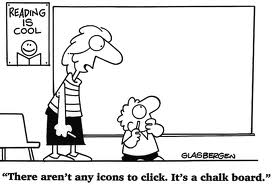
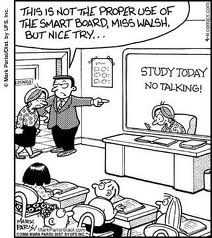
As impressive as Smartboards look, in itself they haven’t revolutionised teaching. The challengef or us is to get the technology to compliment our teaching rather than become the focus. Similarly, it is also essential that this technology doesn’t become a mere piece of decoration that manages to impress parents without actually being used for any real educational benefit:
A disruptive technology is one that radically alters an existing market – the iPod displacing the Walkman, for example, or tablets eating into sales of PCs. In the same way, new technologies have the potential to disrupt the education system, bringing about major changes in the way pupils learn and challenging the way schools and colleges are run.
… everyone seems to agree that, as exciting as new technologies are, they should not be seen as a panacea for all ills, or a short cut to more effective teaching. “We’ve seen a lot of whiteboards go into schools, and that’s good because you can have more interactive things on the screen,” says Mills. “But it doesn’t necessarily shift the paradigm of a teacher talking to kids. If done badly, all that investment can just reinforce a model of teaching that isn’t putting the tools in the hands of children.”
Teachers will need more support and resources to embrace the digital classroom idea. “When people spend so much money on the hardware and software, the advice would be you need to spend at least the same amount of money on staff training and development,” says Doug Belshaw, a researcher at JISC infoNet, which provides resources promoting good practice and innovation within the education sector, and co-kickstarter of the Purpos/ed Community Interest Company. “Otherwise you’re never going to get any effectiveness from it.”
Of course, many teachers already know the obvious: that new technologies have the potential to be a disruptive force of the good kind, breaking down barriers between schools and the wider world, the timetable and more flexible forms of learning, pupil ability and the requirements of the curriculum. They can empower children and better prepare them for life in our fast-paced online world. But we are yet to make the leap from pockets of innovation to a mainstream embrace of the digital classroom within our schools.
I’ve inherited a class that does not have a whiteboard. Well actually it does, but it is covered up by a Smart Board. It seems that my school was so excited to install brand new Smart Boards (interactive whiteboards) that they set it up directly on the existing board. They were so keen to set up the Smart Boards it didn’t even occur to them to take down the whiteboards first!
As much as I love my Smart Board, I find it much easier to write and present maths problems on a traditional whiteboard.
So I got my school to order one for me. Last December ….
And it only arrived today!
Meanwhile, my Smart Board died two weeks ago. The projector just decided it couldn’t facilitate any longer (I hope it didn’t have anything to do with my ghastly interactive whiteboard handwriting). A teacher without a whiteboard is like a carpenter without a drill. It is a huge challenge to teach without a board. A challenge that has proved frustrating and in a sense, quite revealing.
It has taught me that no matter how incredible modern technology has become. No matter how much education has been transformed because of touch screens, blogs, the internet, YouTube, Wikipedia etc. Nothing can replace the simple whiteboard!
The problem with the wonderfully diverse technologies available to teachers is that it can sometimes breed lazy teaching. A SmartBoard doesn’t make a teacher. The challenge for teachers is not to rely on the technologies at hand, but to simply use them in conjunction with a well-developed lesson.
Kids love using computers and gadgets in the classroom but the technology has not made them better learners, suggests a new report.
The non-profit Media Awareness Network interviewed a small sample of plugged-in elementary and high school teachers from across Canada and found there’s work to be done to better incorporate technology into schools.
The report suggests many students aren’t really as good at using the Internet as it may seem. While it’s assumed today’s kids are quick to learn how to use computers, the authors found many students are great at social media or finding something to watch on YouTube but their digital skills end there.
Teachers reported that some of their kids had a hard time effectively using search engines like Google and weren’t able to consistently sort out valuable sources from the clutter on the web.
“Digital literacy is not about technical proficiency but about developing the critical thinking skills that are central to lifelong learning and citizenship,” the report states.
The finding wasn’t particularly surprising, said Matthew Johnson, director of education for the Media Awareness Network.
“It’s something we’ve seen before but this really underlined it. I always like to draw a distinction between literacy and fluency,” he explained.
“When we watch a young person sit down on the computer and open a dozen different screens and do a dozen different things at once, we’re really seeing (digital) fluency — the same fluency that lets a 10-year-old talk a mile a minute. But it doesn’t necessarily show genuine literacy, it doesn’t show they understand what they’re doing, it doesn’t even show necessarily that they’re skilled at what they’re doing.”
There is a current obsession with technology in the classroom. Even so, I would have thought that it was only sensible to bring as much technology as possible into the classroom. After all, we are trying to help children develop life skills. In today’s world technology is all around us. It is integral that our students have a familiarity if not competency with the latest in technology.
Something sounded familiar last week when I heard U.S. Education Secretary Arne Duncan and FCC Chairman Julius Genachowski make a huge pitch for infusing digital technology into America’s classrooms.
Every schoolchild should have a laptop, they said. Because in the near future, textbooks will be a thing of the past.
Where had I heard that before? So I did a bit of research, and found it. The quote I recalled was, “Books will soon be obsolete in the schools…. Our school system will be completely changed in 10 years.”
the nirvana sketched out by Duncan and Genachowski at last week’s Digital Learning Day town hall was erected upon a sizable foundation of commercially processed claptrap. Not only did Genachowski in his prepared remarks give a special shout out to Apple and the iPad, but the event’s roster of co-sponsors included Google, Comcast, AT&T, Inteland other companies hoping to see their investments in Internet or educational technologies pay off.
How much genuine value is there in fancy educational electronics? Listen to what the experts say.
“The media you use make no difference at all to learning,” says Richard E. Clark, director of the Center for Cognitive Technology at USC. “Not one dang bit. And the evidence has been around for more than 50 years.”
Almost every generation has been subjected in its formative years to some “groundbreaking” pedagogical technology. In the ’60s and ’70s, “instructional TV was going to revolutionize everything,” recalls Thomas C. Reeves, an instructional technology expert at the University of Georgia. “But the notion that a good teacher would be just as effective on videotape is not the case.”
Many would-be educational innovators treat technology as an end-all and be-all, making no effort to figure out how to integrate it into the classroom. “Computers, in and of themselves, do very little to aid learning,” Gavriel Salomon of the University of Haifa and David Perkins of Harvard observed in 1996. Placing them in the classroom “does not automatically inspire teachers to rethink their teaching or students to adopt new modes of learning.”
I am a bit in the middle on this issue. I am in favour of all types of technology in the classroom, just not as a replacement for standard teaching. Those schools that are dominated by devises, lose out from the benefits of teacher/student interaction. But that is not to say that i-Pads in the classroom wont make any difference. It just means that those i-Pads are not more important to education than a quality teacher.
1. Apps are an important and growing medium for providing educational content to children, both in terms of their availability and popularity.
Over 80% of the top selling paid apps in the Education category of the iTunes Store target children.
In 2009, almost half (47%) of the top selling apps targeted preschool or elementary aged children. That number has increased to almost three-‐quarters (72%).
The percentage of apps for children has risen in every age category, accompanied by a decrease in apps for adults.
2. Early learning apps for toddler/preschool are particularly prominent. Developers should consider potential saturation of this market.
Apps for toddlers/preschoolers are the most popular age category (58%), and experienced the greatest growth (23%).
General early learning is the most popular subject (47%), and there are significantly more general early learning apps than the second most popular subject (math, 13%).
For those interested in a more comprehensive summary of the report please follow this link. If you would like to read the entire report please click on this link.
I completely disagree with James Kendrick’s reasoning for his stance on the iPad for Education scheme. He is of the belief that the program may unravel due to the kids’ rough treatment of the equipment.
Apple wants to make a difference in areas that matter, and education certainly qualifies. Today’s announcement of a new textbook publishing scheme, that provides rich textbook content for grade schoolers using iPads, is a good step toward bringing the education system into the digital age. There is one thing that may get in the way of the Apple goal: kids.
As part of my interest in covering mobile technology, I made friends with several administrators handling these programs at the schools, which included both middle schools and high schools. Listening to the people behind the laptops in grade schools was certainly eye-opening, and lead me to wonder how feasible Apple’s iPads in schools initiative can really be.
What these program administrators discovered was how destructive school kids can be on a regular basis. The stories they told about how thoroughly destroyed many of these laptops were over the course of a school year, in what would be considered top schools, were mind-boggling. Several years of data found that few, if any, laptops survived the entire school year without extensive physical damage through poor handling by the kids. It was so bad that after the first couple of years the budget had to be changed to reflect the inability to use a single laptop in more than one school year.
The fact that the laptops were damaged in “top schools” doesn’t surprise. Students in top schools often take for granted the value of equipment. They assume that broken items are quickly replaceable with little hassle involved. It is my belief that children from poorer families actually take better care of equipment.
And this leads to my second point. One of the major benefits of iPads in the classroom is the expense of text books will be markedly reduced. Whilst the tablets will be quite costly, so too are conventional text books. This program allows schools to offer students from poorer families access to the best online textbooks at a much cheaper rate.
Sure, there will be damage to some i-Pads. That’s to be expected. But it isn’t reason to desist from embracing this program. Children are not unnecessarily destructive. If they are made to realise the expense and significance of what the school is offering they are most likely going to ensure that they look after the equipment.
If you trust kids to do the right thing they will not let you down.
People who draw attention the benefits of teacher/student Facebook communication miss the point. There is no doubt that there are some fantastic innovations through social media that would allow teachers to respond to the educational needs of their students. But all benefits go out the window when one considers the dangers.
High school teacher Jennifer Kennedy has a prepared response for students who send her “friend” requests on Facebook.
No. Or, at least not until they graduate.
It’s a rule she said she shares with fellow teachers at Sacramento New Technology High School.
Increasingly, school district officials across the region and throughout the country are coming up with their own guidelines for what kind of online and electronic communication is acceptable between teachers and students.
“We have a generation of kids who communicate this way,” said Kennedy, who teaches sophomores and seniors. “If you say absolutely no Facebook or texting, you are cutting off an important relationship with students.”
In districts with policies against such behavior, officials have said social media sites blur the line between the professional and private lives of teachers. And then there are the rare but widely reported allegations of abuse initiated or intensified through social media.
These allegations of abuse spoil any chance teachers and students have of communicating via social media sites. Perhaps this if for the best.
Two weeks I wrote about one of the most underrated learning tools in modern education. I call YouTube underrated because not only is it not given enough credit for being a valuable resource but it is blocked in many schools.
I wrote:
YouTube is the modern-day instructive tool. It clearly and carefully teaches people practical skills in language they can understand. It plays the part of teacher.
At the moment I am teaching my 5th Graders about finding the lowest common denominator before adding and subtracting fractions. As a test, before writing this blog post, I typed some key words into a YouTube search and came up with many fine online tutorials on this very skill that kids can readily access. It shouldn’t replace the teacher, but it can certainly help a child pick up a concept.
In the space of 2 weeks YouTube has announced that it will introduce its YouTube for Schools, allowing students to access the site without being exposed to inappropriate material:
After making some changes on its home page UI, Youtube now plans to foray into education. To help the cause of spreading education, Youtube plans to unveil a new tool for teachers as well as students.
Youtube for schools is a new idea to introduce collaborative education as head of Youtube Angela Lin says,” This is a technical solution to allow schools that normally restrict access to YouTube to gain access to it.”
Youtube’s official blog post also suggested that teachers have been looking up to leveraging the Youtube platform to access a huge database of knowledge in form of educational videos. But the bone in the throat was those other videos related to entertainment would distract students. This was the main reason behind schools restricting Youtube videos. However, the educational value of Youtube videos in visually interactive learning was much wider in horizon. Thus, Youtube introduced a new platform for learning.
This is a great coup for students and teachers. Well done YouTube!
YouTube, in my opinion, is the hidden gem of education. It’s hidden, not because people don’t know it exists or what it can do. On the contrary, everyone and their dog is aware of the diverse clips that YouTube contains. It’s hidden because many schools, including until recently my own, have chosen to block it. The reason for this is fairly understandable – YouTube contains clips which are clearly unsuitable for children.
Whilst this is true, there is too much to be gained by exposing children to the wealth of educational opportunities that exist on YouTube to justify blocking it.
The other day I wanted to buy a phone. I had a few in mind, but didn’t posses the technological nous to help me find something that would best give me value for money and fulfill my practical needs. So I did what many do when they can’t make their mind up about something – I asked YouTube. On YouTube I watched clips on the various phones, was given a run through of their features, advantages, design and reliability issues etc.
This helped me settle on a phone. But my education didn’t stop there. As I am a visual learner, I require more than just a booklet to follow. To set up my phone and navigate my way through the different functions I turned to my dear friend, YouTube, who again, didn’t let me down.
YouTube is the modern-day instructive tool. It clearly and carefully teaches people practical skills in language they can understand. It plays the part of teacher.
At the moment I am teaching my 5th Graders about finding the lowest common denominator before adding and subtracting fractions. As a test, before writing this blog post, I typed some key words into a YouTube search and came up with many fine online tutorials on this very skill that kids can readily access. It shouldn’t replace the teacher, but it can certainly help a child pick up a concept.
And it’s not just academic skills that can be developed through YouTube. If my school hadn’t relaxed its position on YouTube, I wouldn’t have had the chance to show my students the best anti-bullying film going around. I have come across so many lame and unconvincing films about bullying in my time. So to first find Mike Feurstein’s masterful film, and then get the chance to show the movie to my appreciative class, was a major coup for my ongoing efforts in trying to keep my classroom bully free. The film, posted below is as good a reason as any to allow teachers to use YouTube in the classroom.
Sure teachers have to be on the lookout for students who may exploit this privilege, but ultimately that is our job. If we banned everything that has possible risks or negative outcomes, we wouldn’t have much to work with at all.









 Topical Teaching