Archive for the ‘Education Matters’ Category

The School Kids Evicted From 9/11 Memorial are Symptomatic of a Broader Problem

June 25, 2012

I hope we don’t get child psychologists and new age self-help authors spring to the defense of these kids. When a group of school kids turns the 9/11 memorial into their own personal dumping ground, it is not a case of ‘kids being kids’. These kids knew what they were doing, realised how insensitive it was and yet, decided to do it anyway.

But like the bullying of a bus monitor (as I have covered in a number of posts), this isn’t about kids on a bus or kids at the 9/11 memorial site, this is about kids in general.

There is a lack of self-respect and respect for others in this generation of kids that is quite frightening. The kamikaze approach that is apparent in both recent stories is a problem that is faced in households and classrooms all over the world.

In this case, the target for their angst is going to make a lot of people extremely upset:

A group of Brooklyn students on a school trip to the National September 11 Memorial & Museum were booted from the hallowed site after they callously hurled trash into its fountains.

The vile vandals from Junior High School 292 in East New York treated the solemn memorial — its reflecting pools honoring the nearly 3,000 people killed in the terror attacks — like a garbage dump.

“They kicked us out because of littering in the water. Kids were throwing baseballs in the pond thing,” said eighth-grader Anthony Price, 14, of East New York, who insisted he wasn’t one of the troublemakers.

In addition to the baseballs, witnesses reported seeing empty plastic soda bottles and other refuse in the water on Thursday.

“They were making jokes and throwing stuff in the fountain. It didn’t seem like a big deal,” added another student on the trip who refused to give his name.

Department of Education officials have launched an investigation into the students’ shenanigans.

Tourists visiting the site Saturday said they were disgusted by the students’ filthy acts.

“That is an absolute disgrace,” said Sharon Hooks, 55, a school teacher from Hartford, Conn. “I don’t care if these children were too young to remember the events of that day. They need to be taught to be respectful.”


New Sesame Street Movie Announced

June 21, 2012

From the people who taught us that reading and writing can be fun comes a new venture that should please young children worldwide:

Big Bird, Elmo and Oscar the Grouch could be returning to cinemas after studio 20th Century Fox bought the film rights to the show from production company Sesame Workshop.

A new film would be the third big-screen outing in the 43-year history of the iconic US TV series, whose previous guests have included Johnny Cash, David Beckham and Michelle Obama.

The announcement comes off the back of a successful film featuring Jim Henson’s other troupe of puppets, the Muppets, which took over £100 million at the box office earlier this year, and picked up an Academy Award for best song.

It is also reported that Fox have secured Sesame Street writer Joey Mazzarino to pen the script, as well as Shawn Levy, director of Night at the Museum and Reel Steel, to produce.

The movie will be the first from Sesame Street, which was originally launched as an educative tool by the US government, since the 1999 film The Adventures of Elmo in Grouchland. That came 14 years after 1985’s Follow That Bird, starring Chevy Chase.

As of 2008, the show, which is shown in some form across 140 countries, was estimated to have been watched by over 77 million children during its run of 4,300 episodes. The Cookie Monster and friends can boast a collective 8 Grammies, and 118 Emmys between them.

UK Kids Don’t Know Where Milk or Bacon Comes From!

June 17, 2012

What is the point of filling curriculums with the latest in nonsensical new-age methodology and a raft of programs that are time-consuming but utterly ineffective when our children don’t even know the basics? It seems that we are allowing our kids to become selfish and insular, far more concerned about themselves than the world around them. It is essential that our children become more aware of the world around them.

More than a third of 16 to 23-year-olds (36%) do not know bacon comes from pigs and four in 10 (40%) failed to link milk with an image of a dairy cow, with 7% linking it to wheat, the poll of 2,000 people for charity Leaf (Linking Environment and Farming) found.

Some 41% correctly linked butter to a dairy cow, with 8% linking it to beef cattle, while 67% were able to link eggs to an image of a hen but 11% thought they came from wheat or maize.

A total of 6% of those questioned knew that salad dressing could come from rapeseed oil, compared with the national average among all age groups of 24%.

Although four in 10 young adults (43%) considered themselves knowledgeable about where their food comes from, the results revealed a “shocking” lack of knowledge about how the most basic food is produced, the charity said.

Leaf chief executive Caroline Drummond said: “We often hear reports that our food knowledge may be declining but this new research shows how bad the situation is becoming.

“Despite what they think, young adults are clearly becoming removed from where their food comes from.

“Three in 10 adults born in the 1990s haven’t visited a farm in more than 10 years, if at all, which is a real shame as our farmers not only play an important role in food production but are passionate about engaging and reconnecting consumers too.”

The charity, which is organising an Open Farm Sunday event this weekend, also found almost two-thirds of young adults (64%) did not know that new potatoes would be available from British farms in June, and one in 10 (10%) thought they took less than a month to grow.

OnePoll surveyed 2,000 C adults online between May 11 and 14.

Innovative Way to Stop Exam Cheating

June 16, 2012

Do you ever get the feeling nobody trusts you?

neupete's avatarwe(often)learnhere

View original post

Student Sues School for Failing to Get into Preferred Law Course

May 17, 2012

Does anybody want to take personal responsibility for anything anymore? We are become a society of ‘blamers’. Fancy a student in an exclusive Private school suing for a lack of assistance! Those schools give so much more support than Private school. Did it ever occur to her that getting into a course relies on ones own aptitude over anything else? Did it ever occur to her that there were students studying night and day to get into that course? Meanwhile, it is claimed, she was serving suspensions for coming to class late and failing to complete set work tasks.

A former student of one of Australia’s most prestigious private schools is suing the academic institution after she failed to get into the law course of her choice.

Rose Ashton-Weir, 18, claims that the elite Geelong Grammar School, where Britain’s Prince Charles spent two terms as a student in 1966, did not provide her with adequate support, The Age reported Thursday.

As a result, the teenager’s final high school score was insufficiently high enough to gain admittance to law at the University of Sydney, the Victorian Civil and Administrative Tribunal heard Wednesday.

Ashton-Weir is currently pursuing an arts and sciences degree at the University of Sydney.

She had attended Geelong Grammar, 48 miles (77km) south of Victoria’s capital city Melbourne, in 2008 and 2009, but left to continue her high school education in Sydney.

Ashton-Weir told the Geelong Advertiser that the school had failed her.

‘It was incredibly detrimental to my academic skill and development,’ she said.

Ashton-Weir, who was a boarder at the school, reportedly struggled with mathematics, and scored eight out of 68 in one test. Despite this, she was placed in a regular class. The school’s representative, Darren Ferrari, said every effort had been made to help the teen.

Ashton-Weir’s mother, Elizabeth Weir, is also suing Geelong Grammar, The Age reported.

Weir wants AU$39,000 (US$38,740) compensation for rent she paid when they moved to a new home after her daughter relocated from Geelong to Sydney.

Weir also claims that Ashton-Weir’s move resulted in her giving up her cookie business which would have raked in AU$450,000 over a three-year period.

Ferrari told the tribunal that Ashton-Weir had been suspended several times at Geelong Grammer, was absent from classes often and had failed to complete required school work.

I suppose if she wins this case, it would be ironic. Trust a future lawyer to endorse dodgy lawsuits that puts the ‘blame game’ over personal responsibility.

One of the Most Overrated Skills in the Classroom

March 28, 2012

Whilst I can obviously see the value of teaching spelling skills, I don’t think it is anywhere near as important as schools make out.

The emphasis that spelling gets when it comes to teaching allotments, testing and reporting is astounding. Surely there are more vital skills such as maths, writing and reading that can profit from taking some of the ‘treasured’ spelling time.

Many skills now have specialised spelling programs complete with up to 5 weekly periods per class from the Second Grade upwards. Talk about overkill! My daughter recently brought home a form requesting our written consent to take her out of her classes in order to strengthen her spelling skills. What makes this request even more bizarre is that she is only in the first grade! I can understand taking her out for maths or English, but spelling?

What upsets me most about the obsession with children and spelling is what it does to our students. Our children know whether they are good spellers or not. They have been tested countless times and their work is often given a ‘dose of red’ where every misspelled word corrected. What then tends to happen, is that students become self-conscious about their spelling capabilities and try to avoid the dreaded red ink corrections. Instead of using the most appropriate word for their written work, they choose words they know how to spell. This has a severe negative impact on the quality of their writing.

I am a big fan of minimising the emphasis of spelling. I want my students to write freely, to choose words that best fits their work and have a fearless approach to spelling difficult words. To me, a free and unhampered piece of writing replete with spelling errors far outweighs a dreary, disjointed piece of work with correct spelling.

I’m not against the teaching of spelling and I certainly believe that spelling rules and the understanding of morphographs have a place in the classroom. I just don’t think these skills are anywhere near as important as many would have you believe.

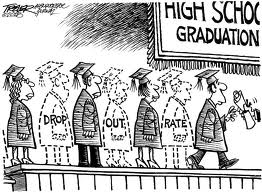
The Stigma of the School Dropout is Sometimes Unfair

November 28, 2011

For some reason, society seems to have an issue with “dropouts” who choose a trade over completing high school.  Whilst I am not in favour of someone chosing to drop out without a legitimate Plan B, I highly respect people who make the choice to become plumbers, builders and electricians, even when it’s at the expense of finishing high school.

Australia’s Opposition Leader, Tony Abbott, is right to push for the opening of trade schools in preference to virtually paying students off for completing school. School and University is not for everyone. There are teenagers much more adept at taking on a practical trade than writing essays, working through trigonometry problems and making sense of chemistry.

Paying students just to finish school (it’s the parents that get the money) achieves a lot less than it sounds. Often it doesn’t translate into higher education training and it doesn’t guarantee that there will be marked differences in the takeup of the dole.

Mr Abbott wants to investigate a return to the former Coalition Government’s scheme for technical high schools and school-based apprenticeships.

Mr Abbott declined to endorse a Labor Government election promise to pay families $4000 to help keep teenagers in school longer, saying the spending would have to be appropriately targeted.

“The other point I want to make is that it’s all very well keeping kids at school past year 10 but they’ve got to be the right kids being kept at school past year 10,” Mr Abbott told Sydney radio 2UE.

“A lot of kids would probably be better off in the long run leaving school at year 10 and getting an apprenticeship rather than staying on doing an academic or quasi-academic time at school when in the end it’s the practical trades that we need.

“I mean, one of the great initiatives of the Howard Government was to try to foster these school based apprenticeships to try to get back to a considerable extent towards, if you like, technical high schools.

“And I guess I’d want to carefully study this and make sure that the right kids are getting the money and that we really were keeping the right kids at school because if you’ve got the wrong kids at school it can end up like a glorified occupational therapy basically.”

He told reporters later: “It’s important that some kids stay at school and go on to university, it’s also important that other kids get a good technical education.”

I don’t like the “pigeonhole” mentality society seems to employ. Such thinking makes it hard for people to take different routes and make changes that are right for them. The popular opinion isn’t always the right one for the individual. All countries need active and educated members of society, but they also need good tradespeople.
School is not for everyone. If you have a passion for a trade, don’t hesitate, go for it!

Teacher Blunder Causes Nightmare for Students

November 16, 2011

Can you imagine the distress that the students must have felt when they discovered the novel they prepared for wasn’t actually covered in the exam?  What do they do?  Try and write about novels they haven’t read?  Can you imagine the teacher’s embarrassment when he/she was informed of the huge error?

SHOCKED students from a private school in Melbourne’s southeast were unable to complete a VCE exam because they had been taught the wrong text.

Authorities have launched an investigation after eight pupils from Lighthouse Christian College in Keysborough spent a year studying a novel not on the prescribed reading list.

The error was discovered last Thursday afternoon – when the year 12 students could not find Julia Leigh’s The Hunter on their literature exam paper.

The VCE English exam is a 3-hr exam.  Unlike all other subjects, it is not an elective. Every Year 12 student in the State sits for it. To study a text, night and day, only to find out during the exam that it wasn’t on the prescribed reading list would have been an earth shattering revelation for the students involved.  If it was me, I would have panicked.  It would have ruined the whole exam for me.

Mistakes happen, but this was a big one!

Wikipedia Becoming Accepted in Educational Circles

November 6, 2011

I read a very interesting article about Wikipedia and its newfound legitimacy in education.

Below are some excerpts from the article:

The Toronto District School Board, for instance, lists Wikipedia as a primary source in a research guide it hands out to students, while Wikipedia will expand its college program to a high school in Virginia next year.

Reliable is not a word that traditionally has been associated with Wikipedia, but that’s changing.

The change began in 2005 when the prestigious science journal Nature compared Wikipedia to Encyclopaedia Britannica and found Wikipedia to be almost as accurate as Britannica, a finding that set off a war of words between the two institutions.

The evidence mounted this year, when Brigham Young University in Utah found that Wikipedia was a reliable place to learn about U.S. politicians. The school’s study found few inaccuracies in the biographical and voting details of gubernatorial candidates.

And, in September this year, a study published in the Journal of Oncology Practice found that cancer information on Wikipedia was as accurate as information on peer-reviewed, patient-oriented websites.

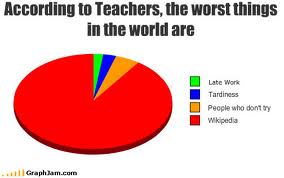
As a teacher, my issue isn’t so much with the accuracy of Wikipedia so much as the laziness it inspires.  I want my students to research using a number of different mediums and publications.  Wikipedia tends to be a ‘one-stop shop’ for students looking for information on the run.
I am really happy to read that Wikipedia have improved their reputation.  I only wish students would extend their repertoire a bit in the name of authentic research skills.

One-in-Five High School Students ‘Learn Nothing’

September 20, 2011

There is a 1983 film entitled Teachers, which while universally panned by critics and eventually bombed at the box office, stands as one of the most accurate portrayals of schools caught on celluloid.  Starring Nick Nolte, the film is a satire of American Government High Schools.  Those not familiar with the way a school runs found it over-the-top, unfunny and irritating.  Whilst the film is badly made, it contains some insights and observations that are perceptive, extremely funny and just as relevant today.

There is no better example of this than the fact that the school in the film is being sued by a former student that was allowed to graduate without being able to read or write.


Now contrast that scene with these findings:

The UK is falling behind international rivals because one-in-five children “learn nothing” throughout their secondary education, according to the head of Britain’s top private schools’ group.

Figures show that almost one-in-five pupils left primary school this summer without reaching the standard expected of the average 11-year-old in reading. Some one-in-10 boys had the reading skills of a seven-year-old or worse.

Perhaps what worked most against the success of the movie Teachers was that it was too clever and too accurate for its own good.