Archive for the ‘Education Matters’ Category

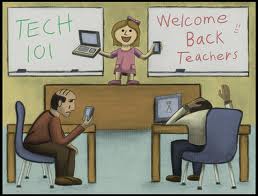
25 Amusing Signs You Might Be a 21st Century Teacher

January 9, 2013

modern

Courtesy of teachthought.com:

  1. You think of clouds as good things.
  2. You check twitter for news. And only twitter.
  3. The blogosphere is more relevant a term than the stratosphere.
  4. You spent more this year on iPad peripherals than you have pencils and pens.
  5. You giggle when you recall how you used to simply give tests at the end of a unit.
  6. You hate Wikipedia.
  7. You begged your school accountant for an iTunes card instead of your annual classroom fund.
  8. Have actually used the phrase “digital citizenship” in a sentence with a straight face.
  9. You’re screwed if the internet goes down during a lesson.
  10. You love YouTube.
  11. You forgot what chalk does to your skin.
  12. Flipping the classroom is an instructional strategy rather than a method of classroom management.
  13. Your students facebook friend request you, and won’t take the hint.
  14. Your district has a more transparent facebook policy than they do on assessment or curriculum mapping.
  15. You text other teachers during meetings.
  16. You think school should be out on Steve Jobs’ birthday.
  17. You trade rooms with another teacher for a better Wi-Fi signal—and don’t tell them why.
  18. You’ve texted during class, but have taken a student’s phone for doing the same.
  19. You plan lessons assuming that every student has Wi-Fi broadband access 24 hours a day, 7 days a week.
  20. Students blame passwords and log-in issues rather than the dog for eating their homework.
  21. Your students have to explain certain technologies to you, but you pretend you already knew.
  22. Your computer clock replaced the clock on the wall.
  23. You seriously consider that if it’s not being talked about on twitter, it may not have happened.
  24. You’ve spoken more recently with the tech leader in Mumbai than the new 10th grade Math teacher down the hall.
  25. You always truly believe there’s an app for that.


Click on the link to read  20 Questions Teachers Should Be Asking Themselves

Click on the link to read School Official Allegedly told a Teacher to Train her Breasts to not Make Milk at Work

Click on the link to read 12 Tips for Managing Time in the Classroom

Click on the link to read If Teachers Were Paid More I Wouldn’t Have Become One

Click on the link to read Different Professions, Same Experiences

Click on the link to read Our Pay Isn’t the Problem

20 Questions Teachers Should Be Asking Themselves

December 10, 2012

teaching

Courtesy of minds-in-bloom.com:

    1. What are some things you accomplished this year that you are proud of?
    2. What is something you tried in your classroom this year for the first time? How did it go?
    3. What is something you found particularly frustrating this year?
    4. Which student in your class do you think showed the most improvement? Why do you think this student did so well?
    5. What is something you would change about this year if you could?
    6. What is one way that you grew professionally this year?
    7. Who amongst your colleagues was the most helpful to you?
    8. What has caused you the most stress this year?
    9. When was a time this year when you felt joyful and/or inspired about the work that you do?
    10. What do you hope your students remember most about you as a teacher?
    11. In what ways were you helpful to your colleagues this year?
    12. What was the most valuable thing you learned this year?
    13. What was the biggest mistake you made this year? How can you avoid making the same mistake in the future?
    14. What is something you did this year that went better than you thought it would?
    15. What part of the school day is your favorite? Why?
    16. What were your biggest organizational challenges this year?
    17. Who was your most challenging student? Why?
    18. In what ways did you change the lives of your students this year?
    19. Pretend that you get to set your own salary for this past year based on the job that you did. How much do you feel that you earned (the number you come up with should be in no way based on your current salary – rather, come up with a number that truly reflects how you should be compensated for your work this year)?
    20. Knowing what you know now, would you still choose to be a teacher if you could go back in time and make the choice again? If the answer is “no,”  is there a way for you to choose a different path now?

Click on the link to read School Official Allegedly told a Teacher to Train her Breasts to not Make Milk at Work

Click on the link to read 12 Tips for Managing Time in the Classroom

Click on the link to read If Teachers Were Paid More I Wouldn’t Have Become One

Click on the link to read Different Professions, Same Experiences

Click on the link to read Our Pay Isn’t the Problem

Teaching about Felix Baumgartner’s Jump in the Classroom

October 17, 2012


The following ideas for teachers in incorporating Felix Baumgartner’s Jump into the high school classroom comes courtesy of teq.com (Primary resources provided below):

1. Use Fluid Math to teach acceleration due to gravity.  The video below shows how FluidMath’s Animation feature allows you to write a function (such as ax= – 9.8t2) that describes an object’s motion, and then run a simulation of the movement along a path.

2. Use Algodoo to simulate the ascent and the descent. Algodoo is the fun 2D physics simulator which allows you to plot the speed of an object (Baumgartner) over time.  The video below shows how to plot a free falling object’s speed over time, and how to change Gravity and Air Resistance.  A trial version of Algodoo for education can be downloaded here.

3. Share Video of the Jump with your class. The videos are easy to find.  If you’re blocked from YouTube at your school, check out Convert.Files.  If you like the meme below, just drag it into SMART Notebook!

4. Simulations of Physical Phenomena related to Felix Baumgartner’s jump.  PhET, from the University of Colorado, has great interactive learning objects.  Here are some of the best (related to the jump):  gas properties, frictiongravity calculator.

5. Follow Bobak Ferdowski on TwiterFerdowski is a Systems Engineer at NASA. He’s brought a new level of cool to federal social media.  Follow him for the latest on NASA events, comments on space news, or if you want to know what to major in (Physics or Engineering) in college.

For related resources at primary level please follow this link.


Click on the link to read Teaching Children about the Curiosity Mars Landing

Click on the link to read Teaching Fractions: The Musical

Click on the link to read Six Tips For a Happy Classroom

Click on the link to read  Proposal to Adopt Shooting as Part of the Curriculum

Portraits of Classrooms From Around the World

October 3, 2012

Courtesy of the brilliant photographer Julian Germain and brainpickings.org:

Brazil, Belo Horizonte, Series 6, Mathematics

Taiwan, Ruei Fang Township, Kindergarten, Art

St. Petersburg, Russia. Year 2, Russian

Tokyo, Japan, Grade 5, Classical Japanese

Lagos, Nigeria. Basic 7 / Junior Secondary Level 1, Mathematics

Qatar, Grade 8, English

Bahrain, Saar, Grade 11, Islamic

Peru, Cusco, Primary Grade 4, Mathematics

More portraits can be found by following the link above.

Click on the link to read Top Ten Funny Excuses For Being Late To School

Click on the link to read 7 Tips for Transforming Your Classroom

Click on the link to read 2 Kids Outsmart 3 Robbers

Click on the link to read the 100 Skills Parents Should Teach Their Children

7 Tips for Transforming Your Classroom

October 1, 2012

Courtesy of esteemed educator and blogger David Truss:


Inquiry based learning is a key tenet of the Inquiry Hub. When students get to choose their own topics, with guidance and support from their teachers, peers and community members, these learners will produce thoughtful, rich and compelling answers.

By helping students connect, create and learn together, we will encourage them to look outside of their box and seek a world of potential.

* Transforming Classrooms with Inquiry: It starts with educators asking really good questions. There are a lot of resources on Inquiry Learning, here is a great list of resources to get teachers started. The Calgary Science School’s Exemplary Learning and Teaching posters are excellent examples of the resources shared in the list. Which of these resources will help you develop more inquiry based lessons?


Neon Mic' by fensterbme on flickr

When students explore their interests in-depth, they will often discover insights worth sharing with others. At the Inquiry Hub, we believe that an integral part of learning is the ability to share what you’ve learned with others in meaningful ways.

* Transforming Classrooms with Voice: Be it a presentation to a small group, the entire school, the local community or online (with the world), work with students to craft their message in thoughtful, well represented ways. How can you use recording devices, now available on almost every phone and on every computer, to get students prepared for presentations or to get students to share their work publicly?


An important skill to learn is how to ‘write to a specific audience’, and there is no better way to promote this than to give learners a legitimate audience for their work.

* Transforming Classrooms with Audience: Through the use of blogs, wikis, digital portfolios and social media tools, you can invite the world to be a participatory audience in the work that our students do. An Authentic Audience Matters! What can you do to increase the audience of your students’ work beyond the class or just you, their teacher?


Collaboration is a learned skill that is essential in today’s world. Our goal will be to have students collaborate on projects that matter, in many different communities.

* Transforming Classrooms with Community: Provide opportunities for projects to extend beyond age-group peers to include younger and/or older students, parents and teachers, community members, subject area experts, and students from around the globe. Who do you know in your community (or your online network) that can share their expertise with your students?


“In a learning organization, leaders are designers, stewards, and teachers.” ~Peter Senge
At the Inquiry Hub, students will be provided with many opportunities to be designers, stewards and teachers. We believe that every student has the potential to lead!

* Transforming Classrooms with Leadership: Buddy up with students in younger classes. Create activities and events which truly allow students to ‘run the show’. Here is a resource I developed for teaching leadership and developing a school-wide leadership program. How can you create more authentic leadership opportunities for your students in your class?


We can learn a lot from (and within) play. Play promotes discovery and invites the idea that we can have fun learning, even from our mistakes. From the MIT Media Lab’s advocation of ‘Lifelong Kindergarten‘ to Google’s promotion of employees getting 20% of their work week dedicated to personal-interest projects, it is quickly becoming apparent that ingenuity and creativity are both sparked from an environment that incorporates play into learning.

* Transforming Classrooms with Play: There is a lot of pedagogy in play (at all ages). Do we provide “gaps” in our teaching? Time and spaces where students can be creative beyond the scope of the content we are teaching? Watch this interesting slide show, think about how ‘Game design’ invites creative play, and question how you can embed some of these ideas into your lessons?


A key principle in the new learning theory, Connectivism,  considers networks to be a central metaphor for learning. The theory suggests that ‘learning and knowledge rests in diversity of opinions’. The COL Inquiry Hub will use a hybrid model that blends classroom, community and online experiences, and so students will be exposed to a multitude of learning networks.

* Transforming Classrooms with Networks: Skype is a great tool to bring classes from across the country or across the globe together. Who can you connect your class with, and what tools can you use, beyond Skype, to connect the learning that’s happening in other physical and digital learning spaces?

For more wonderful material and advice from David Truss please follow this link.

Click on the link to read Top Ten Funny Excuses For Being Late To School

Click on the link to read Why Spelling is Important

Click on the link to read 2 Kids Outsmart 3 Robbers

Click on the link to read the 100 Skills Parents Should Teach Their Children
The Cost of Living in a ‘Dropout Nation’

September 26, 2012

US network PBS filmed a story for their Frontline series entitled ‘Dropout Nation‘. It looked at the impact of rising school dropouts. They revealed the following findings:

$20,241

The average dropout can expect to earn an annual income of $20,241, according to the U.S. Census Bureau (PDF). That’s a full $10,386 less than the typical high school graduate, and $36,424 less than someone with a bachelor’s degree.

12

Of course, simply finding a job is also much more of a challenge for dropouts. While the national unemployment rate stood at 8.1 percent in August, joblessness among those without a high school degree measured 12 percent. Among college graduates, it was 4.1 percent.

30.8

The challenges hardly end there, particularly among young dropouts. Among those between the ages of 18 and 24, dropouts were more than twice as likely as college graduates to live in poverty according to the Department of Education. Dropouts experienced a poverty rate of 30.8 percent, while those with at least a bachelor’s degree had a poverty rate of 13.5 percent.

63

Among dropouts between the ages of 16 and 24, incarceration rates were a whopping 63 times higher than among college graduates, according to a study (PDF) by researchers at Northeastern University. To be sure, there is no direct link between prison and the decision to leave high school early. Rather, the data is further evidence that dropouts are exposed to many of the same socioeconomic forces that are often gateways to crime.

$292,000

The same study (PDF) found that as a result — when compared to the typical high school graduate — a dropout will end up costing taxpayers an average of $292,000 over a lifetime due to the price tag associated with incarceration and other factors such as how much less they pay in taxes.

Click on the link to read Top Ten Funny Excuses For Being Late To School

Click on the link to read Why Spelling is Important

Click on the link to read 2 Kids Outsmart 3 Robbers

Click on the link to read the 100 Skills Parents Should Teach Their Children

Top Ten Funny Excuses For Being Late To School

August 30, 2012

Courtesy of funny.com:

1. They’re always ringing the bell before I get there.

2. I saw a sign that read “School Ahead. Go Slow.”, so I did.

3. My watch was set to Tokyo time.4. I had to feed my pet piranha.

5. My alarm clock kept going off while I was asleep.

6. Sorry–usually my punctuation skills are excellent.

7. I was dreaming about a basketball ball game, and it went into overtime.

8. I’m on time–everyone else is early.

9. I told you if I wasn’t here, you should go ahead and start without me.

10. What? I thought this place was open until three thirty!


Click on the link to read Who Said Grammar Isn’t Important?

Click on the link to read Why Spelling is Important

Click on the link to read 2 Kids Outsmart 3 Robbers

Click on the link to read the 100 Skills Parents Should Teach Their Children

Teaching About the Olympics: A Teacher’s Resource

July 29, 2012

The Guardian compiled a useless list of Olympics resources and websites for teachers:

The Olympic Games: a short animated history – video
It’s a bit cheeky in parts, but this witty and sweetly animated potted history of the Olympic games takes us from Ancient Greece’s nude athletes and the first Paralympic gold medalist to present day.

London Olympics in charts: from medals to competitors, how do the 1908, 1948 and 2012 games compare?
A bit more sport history here. What kind of Olympics were London’s events in 1908 and 1948 – and how have they changed since? In the first of our series of articles based on a unique collection of parliamentary data, we show how London’s third Olympics compares.

London 2012: Olympic bodies – interactive
This is a fascinating insight into what it takes to build an Olympic body. From what they eat to how they train, athletes including Andy Murray, Jessica Ennis, Mo Farah and Victoria Pendleton reveal the physical and mental challenges of Olympic sport.

Could you be a medallist? Find out with our brilliant retro interactive
Here, our interactive team has used race times data to bring athletic achievement to life. In this game-style interactive (inspired by the beloved 8-bit games of my childhood) students can see how their personal best in the 100m, 10km, 100m freestyle swim and bicycle road race compares against the all-time greats – and whether their time would have earned a place on the podium. Could be fun follow up for sports day? For the ICT teachers among you, here’s some info on how it was built too.

Poetry Parnassus interactive map: verse from each Olympic nation
A wonderful English resource inspired by the Poetry Parnassus, and tied into the Cultural Olympiad, this interactive map takes you on a tour of the world’s finest poetry with works from competing Olympic nations. We particularly enjoyed the Marshall Islands’ Kathy Jetnil-Kijiner’s moving piece history project.

Click on this link to see more Olympic lesson ideas.

Click on the link to read Slacklining – The Latest Teen Craze

Click on the link to read The School Kids Evicted From 9/11 Memorial are Symptomatic of a Broader Problem

Click on the link to read UK Kids Don’t Know Where Milk or Bacon Comes From!

Uni Student Pretends to be Kidnapped to Get Out of Exam

July 6, 2012

Some people will try anything to avoid doing exams:

Brazilian police have revealed a university student faked her own kidnapping to get out of an end of year assessment.

Susan Paola Fadel Correia, 22, claimed she had been abducted by three men who tied her up and held her captive for 24 hours, Para state’s civil police said, Gawker reports.

On Wednesday police said the student admitted she had made the story up and was with a friend during the time she had claimed to be held against her will.

Fadel has been charged with making a false report.

Slacklining – The Latest Teen Craze

July 6, 2012

I know I’m supposed to be too responsible to promote crazy teen risk-taking activities, but I actually found myself enjoying this video.

TEENAGERS have been slacking off over the holidays, but for once their parents are not complaining.

The latest craze to hit Newcastle is an acrobatic activity called slacklining.

Th e Hunter Sports Centre at Glendale is offering slacklining classes for teens during the school holidays.

Slacklining is tightrope walking with a twist.

Individuals walk across the nylon tightrope, which is not held taut and is similar to a narrow trampoline.

The activity has become increasingly popular in Australia and is commonly performed outdoors between two palm trees.