Posts Tagged ‘Training’

Private School Teachers Are Not Necessarily Better Teachers

September 21, 2011

Whilst I like the idea of experienced and outstanding teachers helping to mentor student teachers, I am very bewildered by a proposal to have private school teachers mentor public school teachers.

Who thought of this crazy plan?

It is such a simplistic generalisation that private school teachers are superior to their public counterparts.  So what if private school kids get better academic results.  We all know that the credit doesn’t solely fall on the classroom teachers.  Private school students are given higher expectations by their parents and often have tutors to help them when they are behind.

That is why it was refreshing to read an article by lecturer, James Williams:

The results that private schools achieve may be impressive – but results are one thing, raising aspirations in a cohort of disaffected youths, when your experience is of children with Cath Kidston pencil cases who holiday in the Bahamas is quite another.

The problem with such debates is that they miss an important point.

Not all teachers, regardless of how they have been trained, can teach in all schools.

The reality of teacher training is that there is no ‘one method’ of training that instantly produces excellent teachers who can turn their hand to any school, any challenge and any system.

An important skill for those who are teacher trainers, like me, is recognising your trainee’s strengths and weaknesses and guiding them to teach in the right school for them.

It is very good to hear that teacher training is under the microscope.  For too long the problems to do with teacher training was swept under the carpet.  Teachers spend years of their lives slaving away for a degree that ultimately does precious little for preparing them for the realities of the classroom.

I like the idea of a mentor system, I just don’t like this one.


The Trouble With Professional Development

July 2, 2011

I am so tired of going to long and diabolically boring PD’s that do nothing to advance my skills and leave me deeply frustrated.  I just read a brilliant article about the ineffectiveness of some professional development and how it misses an important opportunity.

The way we provide professional learning experiences and support our nation’s teachers is a running source of debate and, unfortunately, disappointment. Policymakers grumble at the costs. Teachers complain they don’t get what they need while parents and the public wait for our schools to get it right for our students.

…  Another federally funded report found that even after two years of targeting more than 100 7th grade math teachers in 12 districts with professional development, there was no measurable impact on teacher knowledge or student achievement. Even the researchers sounded a bit surprised, noting that the programs did everything the existing research says is effective.

Though I’m not familiar with the specifics of these professional development approaches, I’m not too surprised that they didn’t lead to improved student achievement. It is far too easy for professional development to miss the mark – even if it follows the research.

As the former director of professional development in New York City schools and someone who has devoted most of my professional life to leading teacher professional development, I can tell you that what teachers need to improve their craft is rarely what they receive from professional development.

This is not a slam on professional development per se, though teachers typically do not have enough input in determining what professional development they need, who delivers it and when they get it. And the stakes are about to get higher as states phase in higher common core standards that will ask more of teachers and students.

Much of the professional development teachers are required to attend is attached to textbook adoptions, mandates, or scripted programs that promise results that are rarely delivered.

To read the full article, please follow this link.


Why Our Young Teachers Leave

March 7, 2011

This is a topic I feel very strongly about and it goes to the heart of the future of our educational system.  Our system is not being fair to our young teachers.  The way they are trained and geared towards teaching is horrendous.  The lack of support they receive upon commencing their first job is even worse.  If the Government really cared about teacher shortages and low retention rates they would do something about it.  But the truth is that they are too clueless to think up a decent policy and too inert to care.

As schools grapple with Australia’s teacher shortage, the race to lure more people into the profession has begun. Governments are scrambling to offer scholarships and other incentives to get more students, mature-age graduates and workers in other professions to consider a career in the classroom. The strategy seems to be working, with education authorities reporting a rise in teacher graduate numbers.

In Victoria, more than 4200 people graduated as teachers last year, an extra 400 compared with the previous year. But what if the focus on stimulating teacher supply is the policy version of pouring water into a bucket riddled with holes?

A team of education researchers who have spent the past nine years interviewing teachers think this is the case. They argue that chronic teacher shortages won’t be solved as long as governments keep failing to confront the reasons why large numbers of teachers desert their jobs early.

“Poor pay is not the reason they’re giving for leaving the profession: it’s the workplace issues of highly stressful, poor working conditions,” says Dr Paul Richardson, who has been working with Monash University colleague Dr Helen Watt since 2002 on Australia’s first longitudinal study tracking the experiences of 1650 teachers from the time they started a university education course through their years in the profession. Twenty-seven per cent of those surveyed planned to quit teaching within their first five years of teaching. Dr Richardson says the finding has big implications for governments trying to entice other professionals to switch to teaching. Many of the teacher recruits planning to quit were people who had experience in other professions.

“These were people who had been in business commenting on conditions in their schools by saying, ‘There’s no support, you can’t get any photocopying done, you’ve got to do it all yourself!’

“One guy said: ‘I’ve been a solicitor and now I’ve got a one-metre desk in a staffroom where you can’t think.’ They were totally shocked by the working conditions and the lack of administrative support.”

Between 25 and 40 per cent of teachers leave the profession within five years of starting, according to estimates in numerous surveys by teacher unions and education academics. An accurate national figure is not publicly available because exit statistics are kept and collated differently by individual education authorities in each state and territory.

Of course teachers aren’t leaving because of the pay.  Our future teachers know that the pay isn’t great, and still sign up to join the profession.  Why?  Because they have a devotion to education, to helping our next generations achieve, to making a difference.  But what they don’t bank on is the lack of sufficient training and support they will get along the way.

I went to one of the elite Australian universities, with a highly distinguished Education faculty.  Only problem is, my university, like so many around the world failed to give me the practical insights and methods necessary for doing my job properly.  They were brilliant at filling us up with the theoretical, terrible at preparing us for the day-today issues that face classroom teachers.  Accountants are prepared for their job straight out of Uni, as are doctors, lawyers and architects.  Why can’t teachers go into their profession with the same amount of confidence and practical nous?  And it’s not just the best universities in Australia.  This applies to abroad as well.

As a first year teacher I was on a one-year contract. I had to show competency straight away or risk losing my job and reputation even before my actual degree arrived in the mail.  I couldn’t ask my colleagues too many questions, for I didn’t want to lose confidence in the people who would help decide whether or not I should be retained at the end of the year.

Teaching is a wonderful profession.  And I’m glad that I had the determination and passion to stick through the uncertain times and develop the skills on my own.  But that isn’t going to cut it for all young teachers.  They deserve better practical training and a true support system that watches over them – not to judge them, but to honestly help them.  Teachers wont leave like they are if they feel adequately supported and nurtured.

Governments are dumb when they respond to the problem by making more places for teaching training at University.  The more places they make available, the more teachers scurry away before making any lasting impact in the profession.  Why should anyone be surprised?  How can you sell the profession to our youth, when in reality they face such an uphill battle for acceptance, confidence and job security?

Wouldn’t it be worth investing in support systems and greater practical experience for our young teachers?  Nurture them, assist them, give them the tools and then watch them thrive.
My Solution to a Major Problem in Education

February 11, 2011

THE PROBLEM

There are two different categories of teacher that are affected by this problem.

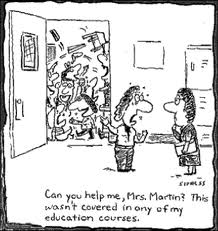
Category 1: In my opinion teacher training is ineffective. New teachers don’t get enough practical exposure to the workings of a classroom and do not come fully prepared to deal with the issues that arises when teaching their own class. Because they are new, and yet to earn their stripes they are less comfortable than most to ask for help or seek guidance. They also often begin on trial 1 year contracts, thus pressurising them into showing their worth and instilling confidence in their colleagues. Such a teacher will not want to seem incapable or lacking in proficiency.

Category 2: Many teachers are being roundly criticised at the moment for not performing up to standard. It seems to be in vogue to blame teachers, when in truth there is a lot wrong with education – it isn’t just about the quality of teachers. These teachers do exist and require much more support rather than the threat of being cut and left unemployed.

THE SOLUTION

The solution that I propose is two tiered:

1. Experienced teachers who are deemed to be excelling at a certain standard are offered a mentoring role for higher wages. If accepted to take on that role, these teachers would offer new teachers the chance to spend a few days in their classroom, let them observe their lessons, give them access to the their planning material and be someone out of that teacher’s school environment who can deliver advice and guidance via email and phone. This challenges the mentor teacher to strive in their new position as well as their underling.

2. For the second category of teacher, I recommend that newly retired teachers, who have left the profession with a wealth of knowledge and an eagerness to maintain links with the profession, be paid to mentor and assist teachers who have not been performing at the required benchmarks. Instead of firing teachers in the first instance, I propose that these teachers get the opportunity to improve with a greater deal of support and collaboration.

WHAT THIS SOLUTION ACHIEVES

• Provides the opportunity for excellent teachers to be better paid;

• Allows retired teachers to maintain links with their profession and share their wealth of experience;

• Gives new teachers greater confidence and a non-judgemental mentor who they can approach; and

• Allows teachers currently not working at their premium a second chance that may reinvigorate and refresh them.

You Don’t Get Elite Teachers with Elitism

February 4, 2011

In my opinion, one of the biggest factors concerning the current failures of our educational system is the inadequate and substandard teacher training programs offered by our Universities.  Not just the minnow Universities but also the elite ones.

The idea proposed by Lord Adonis that every secondary school should have teachers who attended elite universities is not only unworkable but costly and simplistic.

Addressing the Independent Academies Association (IAA) conference in central London, Lord Adonis said: “You need a good mix of teachers, of course, at any successful school, but you cannot be a successful school unless you at least have a certain proportion of your teachers who have themselves come from leading universities in to which you intend to send your best students.”

Lord Adonis warned delegates it would not be possible to transform admissions to top universities “unless you can develop a cadre of teachers in your own schools that have that background themselves.”

I attended one of Australia’s elite Universities and I can tell you without a shadow of a doubt that there was precious little that I was taught that was of value to me in the classroom.  From my experience the training of teachers needs an overhaul.  Teaching theory is all well and good but it needs to be complemented with proper practical instruction.  I’ve seen teachers who are more academic  and have sharper intellects than I do, who floundered in the classroom because sometimes all the knowledge in the world on the right and left brain and metacognition can’t help you get through to a hostile or challenging class.

My lecturers were mostly former teachers who left the classroom because they couldn’t manage anymore.  They were a fountain of knowledge when it came to theory, but clearly relieved to be out of the classroom.  Their pearls of wisdom included “Use them or lose them”, concerning the number of paid sick days available to teachers.  Sure, it can be seen as good advice to cash in on your paid sick leave, but it isn’t the positive and responsible message to be sending to future teachers.

Lord Adonis may be right.  Perhaps it is easier to get pupils, particularly those from poorer areas, into top universities when their teachers have studied at those institutions too.  But for my daughter, I am satisfied with a teacher that is caring, dedicated, and prepared to challenge educational norms by experimenting and taking responsible risks.

You don’t need an elite University to educate, prepare and nature an elite teacher.