There will be many supporters of the concept of online classrooms. People will see it as cheap, engaging and an opportunity for children who haven’t been able to acclimatise to the classroom to find a workable alternative.
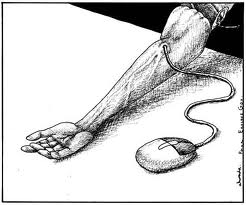
But do we really want our children living through their computers? Is real human interaction being permanently dismantled in favour of communication via the computer screen?
In a radical rethinking of what it means to go to school, states and districts nationwide are launching online public schools that let students from kindergarten to 12th grade take some—or all—of their classes from their bedrooms, living rooms and kitchens. Other states and districts are bringing students into brick-and-mortar schools for instruction that is largely computer-based and self-directed.
In just the past few months, Virginia has authorized 13 new online schools. Florida began requiring all public-high-school students to take at least one class online, partly to prepare them for college cybercourses. Idaho soon will require two. In Georgia, a new app lets high-school students take full course loads on their iPhones and BlackBerrys. Thirty states now let students take all of their courses online.
Nationwide, an estimated 250,000 students are enrolled in full-time virtual schools, up 40% in the last three years, according to Evergreen Education Group, a consulting firm that works with online schools. More than two million pupils take at least one class online, according to the International Association for K-12 Online Learning, a trade group.
It’s all part of a burst of experimentation in public education, fueled in part by mounting budgetary pressures, by parental dissatisfaction with their kids’ schools and by the failure of even top-performing students to keep up with their peers in other industrialized countries. In the nation’s largest cities, half of all high-school students will never graduate.
Advocates say that online schooling can save states money, offer curricula customized to each student and give parents more choice in education.
In my opinion, some of the biggest advantages of the conventional school system is that it provides children with the exposure to help, guidance, leadership opportunities, social interactions and a taste of the challenges that they will meet in the real world.
None of these advantages are addressed by a i-Pad.
Teacher burnout is a significant problem that strike even the very best of teachers. Even the most passionate and dedicated of teachers struggle to see out a term out without getting sick or feeling extremely fatigued.
Research shows the teaching profession has the highest burnout rate of any public service job. What can we do to keep the best and the brightest teachers in the classroom?
In April, the American Federation of Teachers (AFT) and the American Institutes for Research (AIR) released the report, “Workplaces That Support High-Performing Teaching and Learning: Insights From Generation Y Teachers.”Gen Y teachers—that is, those under 30 years of age—account for at least one in five teachers in US classrooms today. They start out intending to make teaching a lifelong profession. However, according to the report, young teachers leave the profession at a rate 51 percent higher than older teachers and transfer to a different school at a rate 91 percent higher than their older colleagues. Studies also show that the national teacher-turnover rate costs school districts approximately $7 billion annually.
In the AFT/AIR report, young teachers say they want:
Feedback on their performance and to be evaluated in a fair way
Time to collaborate with their colleagues
Differentiated pay for high performance
Technology to provide engaging and effective lessons, as well as to support collaboration with other teachers through, for instance, videos and conferencing technology.
I agree with every point, but have a problem with the third one. Whilst I believe Governments should look into a differentiated model of pay for high performers, I don’t believe such an initiative would have any bearing on cases of teacher burnout.
The list of proposed changes by young teachers above is most fair and reasonable. If responded to, the outcomes could be quite positive all around. It’s certainly time to better address teacher burnout. It’s an issue that cannot be dismissed and will not go away.
Even the best parents and teachers struggle to get kids doing menial tasks on a consistent basis. From making their beds to putting their lunchboxs back in their bag, it’s amazing how difficult it is to get children to be responsible for small yet important tasks.
That is, until an app was designed to assist desperate and exhausted parents:
You may find this shocking, but getting my 11- and 9-year-olds to do household chores is like pulling teeth. Rotten kids!
That may change now that I’ve got You Rules Chores on my iPhone. This clever new app turns household chores into a game, rewarding each kid a designated number of coins for each completed job. Whoever finishes the week’s chores first is the winner. (Of course, we all know who the real winners are: mom and dad.)
The app features cute graphics and music, and after a parent gets set up as the “referee,” each kid gets to choose an avatar (from only six available, alas).
We all love our internet connections and mobile phones and would find it extremely difficult to live without them. However, addictions are still addictions, and there is no doubt that our children have grown a deep addiction to the internet. So bad is the problem, that children have become more addicted to the internet than to TV:
Just 18% of children would miss TV most, compared to mobile (28%) and Internet (25%), finds Ofcom research
A new research by communications watchdog Ofcom has revealed that more young British teenagers can do without TV but not without mobile and the Internet.
Ofcom research found that just 18% of children aged 12 to 15 would miss TV most, compared to mobile (28%) and the Internet (25%). However, the research suggests that the teenagers are also watching more TV than ever before, with viewing figures increasing by 2 hours since 2007.
In 2010, children aged 4-15 watched an average of 17 hours and 34 minutes of TV per week, compared with 15 hours and 37 minutes in 2007. Nearly one third (31%) of children aged 5-15 who use the Internet are watching TV via an online catch-up service such as the BBC iPlayer or ITV Player, said Ofcom.
Ofcom’s research said that 95% of 12-15 year olds now have Internet access at home through a PC or laptop, up from 89% in 2010 and 77% in 2007.
Social networking is still one of the most popular uses of the Internet amongst 12-15s. Ofcom said that children are visiting social network sites more often on their mobiles. Half (50%) of 12-15s with a smartphone visit them weekly compared with 33% in 2010.
Children aged between 8-11 are more likely to use Internet for gaming, with 51% saying they play games online on a weekly basis, up from 44% in 2010. 8-11s are also spending more time playing on games players/ consoles compared with 2010 (9 hours 48 minutes – an increase of nearly 2 hours), said Ofcom.
In my school days television addiction was a problem. Now we have another addiction which comes with the same side-effects. It creates tired students who have been up so late they can’t concentrate. It has compromised our children’s capacity to have healthy social interaction. Playing with a friend has now become messaging a friend. It’s just not the same.
As soon as people go from the moderate to the obsessive, they lose control of themselves. Children today are certainly showing the signs of a lack of control, to the point where they are smuggling mobiles in their bags so they can reply to Facebook messages as soon as they receive them.
Kids require rules for their internet usage. Rules that outline when, how and where they can use it.
Condolences to the Jobs family on the untimely death of a good, decent person who made a telling contribution to innovation and society. Amongst his crowning achievements, it must be noted, that Jobs leaves a distinct legacy in the education sector:
The death of Apple founder Steve Jobs is an education story as well as a business story.
Among the Jobs tributes flooding the Internet Wednesday night was this from the parent of an autistic child. Although the son does not talk, the parent wrote, he uses Apple’s iPad to communicate.
“Thank you Steve Jobs for helping my son,” the parent wrote on CNN’s iReport site. “You have given us hope we thought we would never have.”
The parent summed up Jobs’ impact on the son very simply: “Steve Jobs saved my son.”
Jobs’ influence on education is likely to increase after his death. School districts in Florida and elsewhere are turning to the iPad to both engage students and replace textbooks — keeping them more up-to-date at a lower cost.
State Rep. Jeff Brandes, a Pinellas County Republican, believes the devices have the potential to significantly reduce the cost of educating children as less money is available in the state budget.
My daughter has been enriched and engaged by the great variety of educational apps. I would have loved to learn to read with the tools she has at her disposal.
I used to be philosophically opposed to homework in all forms. That was, until I witnessed how my students used their after-school time. It was then, that I realised that ten to fifteen minutes a night would constitute the only meaningful activity some of these students would take part in on a given night.
The radio presenter Alan Jones doesn’t believe in homework because children should have time to play outside and learn skills that only time after school with your family can teach. Normally, I would agree. But do children today have these types of experiences after school?
Families are so busy working that when children come home, they often sit in front of the TV for hours or play computer games. Children spend hours every day networking on Facebook. Exhausted parents do not realise just how dangerous these modern technological tools can be.
Technology can open a world of excitement to children. Yet it can also glorify gangster lifestyles through MTV, and encourage the use of bad language and ”text speak” in social networking.
An hour of homework a night distracts children from such activities and enables them to practise what they were taught at school. Excellent learning requires constant revisiting, and homework is the perfect tool to reinforce facts and skills. Teachers often find that children forget what they learnt the day before. At high school, you may not see your history or geography teacher for a few days until the next lesson. Without any homework in between to bridge the gap, often teachers take two steps forward, then one step back in the following lesson.
It is the school’s responsibility to inform parents that homework has been set – easily done through a diary system. The school should also ensure the homework set is of quality and not some assignment that can essentially be downloaded from the internet. Equally, it is the parents’ responsibility to ensure homework gets done.
I object to her call for an hour of homework per day, but I do currently favour 10-15 minutes of revision work, to consolidate on skills and concepts currently being covered in class.
Well, I have taught math in the past. My thoughts on homework was that if students had homework, they didn’t get finished in class. I never assigned homework. Homework was there if they didn’t get finished in class, but most times students did.
Now that I teach Science, it’s the same way. A lot of what we do is in class, hands-on activities. Homework are the questions they didn’t get to because they were goofing off or not focused in class.
In my opinion, teachers who teach the entire period and allow no work time are not good teachers. Students need to know they are being successful and have confidence. They can’t have a teacher telling them they are correct when they are at home.
This topic remains a very contentious one. I look forward to reading your opinions on this much discussed issue.
If kids are addicted to internet, Facebook and Twitter, it’s not as if their parents have no options. Reading about how fearful parents are about theeffects of their children’s addictions, I couldn’t help but wonder why they felt so powerless.
A third of all UK parents believe that their children are in danger from the internet and 80 per cent think it is possible to become addicted to social networking sites such as Twitter and Facebook, a new study suggests. It also found that a third of parents even believe that the web can “rewire” a person’s brain.
Internet charity the Nominet Trust, who commissioned the research, say there is no evidence that social networks are harmful in themselves, and that there is no neurological evidence of the web changing brains.
Facebook and Twitter, they suggested, usually in fact reinforce existing friendships, while even playing video games has been show to improve coordination and ‘visual processing skills’.
Parents can take control over their children’s internet access. Some recommendations include:
Capping time on the internet
No internet access in their bedrooms
Ensuring that they do not have a Facebook page if they are under 13.
Imposing strict bedtimes.
If you do not hinder access to the web and have no rules or involvement in how it is used, you have something to worry about. This addiction is very real and requires a proactive response.
SEVEN in 10 Australian households have access to the internet at home, one in five of us want to work less and the most popular physical activity is walking, the latest data on social trends shows.
Four out of every five children aged 5-14 use the internet, making them the digital generation, and 86 per cent of households with children aged under 15 have access to the internet at home, the latest Australian social trends study from the Australian Bureau of Statistics shows.
Eighty five per cent of children used the internet for educational activities, 69 per cent played online games, 47 per cent used the internet to download music and 22 per cent used it for social networking.
Only two out of three households without children had access to the internet at home, the study found.
At a time when parents are often criticised for being over-protective and not exposing their kids to taking on challenges, it is amazing to see how quickly young children adapt to new technologies. The apprehension and indecision that adults have is non-existent. These kids often make the remarkable transition from inhibited and anxious to confident risk takers as soon as the i-Pad comes out.
Take this revealing clip as a two-and-a-half year old is presented with an i-Pad for the very first time. Watch how confidently she navigates the product and how quickly she learns to use its programs and features.
This shows us what kids are capable of, not only when it comes to technology, but in other spheres at all. When engaged and stimulated, when they enjoy what they are doing, their behaviour becomes more positive and more inclined to take responsible risks.
The challenge of educators is to spend less time protecting students from making mistakes and disappointment, and more time investigating ways to educate through fun and engaging activities. Confidence does not come about from someone protecting you or holding your hand through a challenge.
Confidence comes about when the challenge is enticing and the outcome is genuinely fulfilling.
Last week I discussed how technology can be a good thing when the balance is right. Unfortunately, technology addiction is very common among young children. The trick is to have firm guidelines for how much time can be dedicated to technology use. I certainly wouldn’t ban it altogether.
Pupils at primary schools who use educational apps on smart-phones and tablets are performing better in their lessons, a new report showed has revealed.
The study reveals that forty per cent of parents who download educational apps say their child’s academic performance has improved as a result.
But the research shows that not only are they helping to raise academic attainment, educational apps are also helping children aged between 5 and 11 every day, inside the classroom.
The study, commissioned by Encyclopaedia Britannica, shows the vast majority of parents who have downloaded an app claim they have helped their child with school work and projects, while more than half of parents with smart devices actively encourage their child to download apps for exam revision, homework and learning about new topics.
The report also reveals that families with access to mobile devices are fully engaged with educational apps as learning aids, with the average smartphone-owning family downloading more than four since purchasing their device.
The findings comes as two thirds of parents with smart devices are calling for more educational apps to be developed, saying they encourage independent learning and that children prefer to use them compared to other learning aids.
Ian Grant, Managing Director of Encyclopaedia Britannica UK, said: ‘It’s great that families are fully embracing new technologies when it comes to their childrens education and that they’re starting to see tangible benefits to academic attainment, both in and out of the classroom.’
Sue Atkins, Author of Raising Happy Children for Dummies and parenting blogger, said: ‘In a busy, hectic, stress-filled world of trying to get children interested in learning and being curious about the world, we need to engage them in new ways, and what better way than to download smartphone apps.
‘As a parent myself, I welcome this brilliant new way to help my daughter with her revision.’
Research was carried out online by PCP among 510 UK parents of children aged 5 – 11 with access to at least one smart device, in March 2011.
Exposing children to technology is good when properly supervised. Like with everything in Education, and therefore in life – balance is integral.









 Topical Teaching