Posts Tagged ‘Teachers’

Why Aren’t Kids Held Back Anymore?

February 11, 2011

“It is our policy not to hold kids back unless there are exceptional circumstances.”

This is the standard line that Principals use nowadays when a teacher raises the topic of kids repeating grades.

Why isn’t it school policy?  What is stopping schools from having the courage to recommend it?

EXCUSE 1: “There is a stigma about kids that are forced to repeat a year.”

Well, that stigma is partly generated by an educational system that refuses to think logically about this issue.  When policy makers decide that some students would greatly benefit from redoing the year, they are assisting in breaking that stigma.  When they decide that they would prefer letting thE child flounder in a year level they aren’t equipped for they are helping to maintain the stigma at the cost of progress.

EXCUSE 2: “A child’s confidence could be tarnished by making them repeat.”

Since when is a school content in letting students fail, looking out for their self-esteem?  How is being miles apart from the rest of the class a confidence boost?  On the contrary, a child can get a new lease on life when they repeat a year.  They are given extra time to fill in the gaps and improve their basic skills.

EXCUSE 3:“But the parents would be devastated if we even raised it.  They may even remove the child from the school. “

A school that makes its decisions based on whether or not the parents will remove their child, is deeply compromised and lacks integrity.  The reason why parents may be devastated is because such an occurrence is rare.  The reason why it is rare to recommend that a child repeat a year is because schools don’t do it enough.  You have to break the cycle before such a measure gains wider acceptance.

Ultimately, a school should do what is right for the child, not what is popular or easy.  That is why I congratulate the Indianapolis school system for its brave new policy:

A new statewide third grade reading test will be a new test developed by the same company that produces the ISTEP statewide exams. About a third of third grade students fail the English and language arts ISTEP test each year, but the new exam will be designed with the expectation that all students who can read will pass the test.

“This is so fundamental to a child’s success, I think we absolutely must draw a line in the sand,” said board member Jim Edwards.

Under provisions adopted by the board Tuesday, students who do not pass the test on the first try could attempt the test again during locally-offered summer school, and could move to fourth grade if they pass on that attempt. All students would have to pass the exam to advance unless they qualified for one of the plans’ three exemptions: one for special education students, one for English language learners and one for students that have been retained twice prior to fourth grade.

I realise that repeating a year has implications, and that sometimes the result of doing so will end up being negative.  I simply feel that schools should be caring and supportive enough to do the right thing by the child and help replace stigmas with good decisions.
Teachers Can Now Be Fired For Being Human!

February 10, 2011

Reality check: Teachers are REAL people!  They are not robots, and yes, they make mistakes.  Sure, teachers are role-models with a responsibility to act with dignity and professionalism at all times.  But that doesn’t mean that they can’t enjoy the same privileges and opportunities as other people.

To fire a teacher over an innocuous Facebook photo is absolutely disgraceful!

A US teacher was fired for posting a picture of herself holding a glass of wine and mug of beer on Facebook, a report has said.

The happy holiday snap cost Ashley Payne her job after a parent spotted it on Facebook – and complained, the Daily Mail reports.

The picture was reportedly taken while travelling around Europe in the summer of 2009.

According to the Daily Mail, Payne, 24, was shocked when she was summoned to the head teacher’s office at Apalachee High School, in Winder, Georgia, and offered an ultimatum.

She reportedly told CBS News: “He just asked me, ‘Do you have a Facebook page?’

“And you know, I’m confused as to why I am being asked this, but I said, ‘Yes’, and he said, ‘Do you have any pictures of yourself up there with alcohol?’”

He then offered her an option: resign or be suspended.

She chose to resign.

Readers of my blog would be aware that I have previously written about the challenges that Facebook and other forms of social media has on educators and education as a whole.  I have been critical of teachers who post inappropriate material, as well as advised teachers to ensure that their privacy settings are on.  What makes this case different is that this teacher wasn’t doing anything illegal or unprofessional, especially since her settings were switched to private:

The English teacher reportedly later found out it was one anonymous emailer who turned her into the school board after seeing the picture on the social networking site.

But she is baffled how a parent could gain access to her page when she has all her privacy settings on “high””, meaning only her closest friends have permission to see her pictures.

According to the Daily Mail, she admits putting the “offensive” photos on Facebook but says she now feels as if she had stashed them in a shoebox at home for them to be stolen and showed to the head teacher.

Let our teachers have a life!  Let’s not fire every teacher who has holiday photos!

Payne added: “I just want to be back in the classroom, if not that classroom, a classroom. I want to get back doing what I went to school for, my passion in life.”

All those resposible for this teacher’s resignation – shame on you!

The Obstacle Course that is Teaching Maths

February 9, 2011

Below is the second maths lesson in a series of original maths lessons I have devised over the years:


Maths Obstacle Course

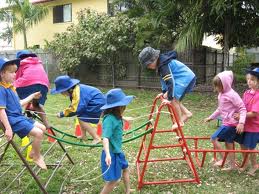
I devise a simple obstacle course using whatever playground equipment the school has.  Slides, monkey bars, polls, ladders and bridges are all useful.  The obstacle course doesn’t need to be intricate, long or complex.  Students should be able to finish it within half a minute maximum.

I take the students out to the playground.  They have no idea what we are doing.  They may ask me, but my reply is “You’ll see.”  The reason why I don’t tell them it’s a maths lesson is because maths has a stigma, and just the mention of it will deflate some students’ expectations.

Usually outdoor lessons require pencils, worksheets and clipboards.  The students are relieved when they find out that none of these implements are required.

With the students congregating around the playground equipment, I tell them that they are going to be doing an obstacle course.  I show them the route they need to take and tell them that each individual will be timed while doing the course.  Each student gets one attempt only, with their personal time written down.  On completion, I order the times privately while the students get a drink of water.

Only the 5 quickest times are read out, so as not to upset or demoralise any of the slower performing students.  Of course, if other students request to know their time, I tell them.  At this point we walk back to the classroom.

On arrival, I write the times in random order on the board.  Using the times, students will take part in some of the activities below, depending on their age and maths proficiency:

Activity 1:  Order the times from quickest to slowest;

Activity 2:   Round the times to the nearest second, tenth of a second etc;

Activity 3:  Work out the total time taken cumulatively over the entire class;

Activity 4:  Work out the average time for the entire class;

Activity 5: Chart the times using Excel and create a chart such as a column graph which presents the data in graphical form; and

Activity 5: Students estimate what time they think they would get should they be given a second attempt.  They will also be asked to give reasons for their answer (e.g. it could be faster the second time around due to a greater awareness of the route, or an improved strategy, yet it could be slower due to fatigue or the pressure to perform).

Even though the main chunk of the lesson is spent doing something that can hardly be called maths, it serves as a basis for engaging the students.  The skills covered in the lesson include measuring time, adding decimals, ordering number, rounding, IT, graphing, averaging and predicting.

It’s a great feeling watching the students get a shock when they find out that the PE lesson they thought they were taking part in, ends up being referred to as a maths lesson.

And ultimately, that’s the point.  Maths is in everything – even the things that give the students pleasure.

Parents, Don’t Do Your Kids’ Homework!

February 7, 2011

The other day I took my daughter to the museum to see an exhibit on Africa.  We sat down to do an African inspired craft activity where I witnessed a loving mother helping her daughter design and decorate her artwork.  I use the word “help” very loosely, because in fact she was basically doing the whole thing for her.  Soon the child’s father joined them.  What ensued was a disagreement between the child’s father and mother over what design strategy to use and what colours worked best.  What was supposed to be an activity for the child, became a chance for the parents to let their child sit aimlessly while her parents took over.

This is a common syndrome when it comes to homework.  Parents often end up doing their child’s homework.  Whilst I understand that they do this out of love as well as to diffuse some of their child’s anxiety over the complexity of the set task, I strongly urge parents to desist from this practice.  Even though in the short-term the child is grateful that the homework can now be submitted without too much heartache, in the long-term they have neither demonstrated capability in successfully mastering the task nor have they managed to calmly work through a challenge.  I accept that parents use homework as a chance to spend some quality time with their kids on a weeknight (where time with the kids is often at a premium), but there are better ways to show your children that you love them and support them.

Whilst there are some strong arguments for abolishing homework (which I will cover at a later date), I’d instead like to focus on what homework should be and how parents can help without feeling a need to take over:

  1. Homework should be revision.  It should not introduce a new concept or skill.  It should simply be a vehicle for students to demonstrate how well they understood what was covered in class that week.  If the child is bringing home work that was not introduced in class, I advise you to see the teacher.
  2. Most teachers give a few days to complete the homework.  I strongly urge my students to use night one to read over the homework and circle any question that they don’t understand.  Then, instead of approaching their parents, come see me the next day.  Of course, I am not restricting the parents from helping their kids, I am merely offering my help as the first option.  In my opinion, parents have already spent most of their youth completing homework, they have paid their debt to education and should now be allowed to enjoy a homework-free life.
  3. When the student approaches the teacher early on about difficulties in the homework, they are showing a great deal of responsibility and assertiveness.  This isn’t lost on the teacher.  So if the students maintains this sort of dialogue with their teacher, extensions are likely to be given should they struggle to meet the deadline.
  4. The best help you can give your children, when assisting them through a homework task is patience and perspective.  Offer your services by all means, but ensure that unlike the girl at the craft table, they end up having ownership of their work.  Kids are not proud of their parents homework, they are proud of their own achievements.  Whilst instilling independence and confidence in children may sometimes feel like an overwhelming proposition, the payoff is huge.  I would rather my students hand in a piece of homework that they took ownership of that was full of mistakes than a brilliant piece ultimately done by mum or dad.

We can easily look at parents who are doing their children’s homework in a judgmental light, whilst calling them enablers and accusing them of spoiling their children.  This is not the right approach.  These parents are often loving parents that don’t know how best to act in a complex situation.

Hopefully the above tips are of some assistance.

You Don’t Get Elite Teachers with Elitism

February 4, 2011

In my opinion, one of the biggest factors concerning the current failures of our educational system is the inadequate and substandard teacher training programs offered by our Universities.  Not just the minnow Universities but also the elite ones.

The idea proposed by Lord Adonis that every secondary school should have teachers who attended elite universities is not only unworkable but costly and simplistic.

Addressing the Independent Academies Association (IAA) conference in central London, Lord Adonis said: “You need a good mix of teachers, of course, at any successful school, but you cannot be a successful school unless you at least have a certain proportion of your teachers who have themselves come from leading universities in to which you intend to send your best students.”

Lord Adonis warned delegates it would not be possible to transform admissions to top universities “unless you can develop a cadre of teachers in your own schools that have that background themselves.”

I attended one of Australia’s elite Universities and I can tell you without a shadow of a doubt that there was precious little that I was taught that was of value to me in the classroom.  From my experience the training of teachers needs an overhaul.  Teaching theory is all well and good but it needs to be complemented with proper practical instruction.  I’ve seen teachers who are more academic  and have sharper intellects than I do, who floundered in the classroom because sometimes all the knowledge in the world on the right and left brain and metacognition can’t help you get through to a hostile or challenging class.

My lecturers were mostly former teachers who left the classroom because they couldn’t manage anymore.  They were a fountain of knowledge when it came to theory, but clearly relieved to be out of the classroom.  Their pearls of wisdom included “Use them or lose them”, concerning the number of paid sick days available to teachers.  Sure, it can be seen as good advice to cash in on your paid sick leave, but it isn’t the positive and responsible message to be sending to future teachers.

Lord Adonis may be right.  Perhaps it is easier to get pupils, particularly those from poorer areas, into top universities when their teachers have studied at those institutions too.  But for my daughter, I am satisfied with a teacher that is caring, dedicated, and prepared to challenge educational norms by experimenting and taking responsible risks.

You don’t need an elite University to educate, prepare and nature an elite teacher.

I’m Drowning in Paperwork: Please Pass the Snorkel

February 3, 2011

I admit it.  The allegations are true.  I am a tree-killer!

It’s not my fault, of course.  In the short time I have been teaching, the paperwork demands on a teacher have grown from taxing, to barely manageable, to excessive, and now – out of control!

Why?  Why, at a time when teachers are being criticised for their students’ low performance data and failure to deliver on outcomes, is the paperwork demands of a teacher so high?  Surely time would be better spent developing engaging lessons.

The answer is simple.  The rules applying to all teachers are in place to cover the lesser achieving teachers.  The assumption is that if a lazy teacher wasn’t told what to do, how to think, what to cover, how to plan and who to cater for, they wouldn’t achieve anything.  By forcing teachers to complete crazy amounts of paperwork, they are treating all teachers as if they were inert, fraudulent, apathetic stooges.

Take the planning requirements, for example.

Is planning important?  Absolutely!  Planning is important for three main reasons:

1.  It shows what you are teaching your students in a week, term and year.

2. It helps you organise thoughts and properly sequence the concept or skill you are teaching.

3.  It provides a comprehensive guide for a casual relief teacher, should you not be able to teach your class.

As important as planning may be, it can still go overboard.  In the summer holidays alone I had to complete first term planners for literacy and numeracy, yearly planners for literacy and numeracy, a 10 page integrated planner for my topic of inquiry (Federation) and weekly planners for both numeracy and literacy.  The amount of hours I spend on those darn things doesn’t correlate with how useful they turn out to be.

The rationale that by spending hours upon hours on these planners,  an average teacher will become transformed miraculously into a more focussed and effective educator is just plain wrong.  On the contrary, it forces some teachers to cut corners by mindlessly copying dull, lifeless units from textbooks.  With all that paperwork, teachers often become too concerned with deadlines and time restrictions to go to the trouble of conceiving original and fresh lesson ideas.

And it’s not just planning.  There’s professional learning contracts which chart the goals, reflections and progress of the teacher, class newsletters, letter to parents, school policy feedback forms, incident report documentation, worksheets, homework, curriculum night summaries, parent teacher interview folios and I’m sure there’s more, because … there’s always more!

I’m not trying to play the victim here.  I love my job and understand the value of the above requirements.  It’s just that the sheer amount of  paperwork clearly gets in the way of a teacher’s natural desire to spend less time meeting arcane professional standards and more time excelling in delivering fun, vibrant and engaging lessons.

I’d love to write more on this topic, but unfortunately, I’ve got more paperwork to finish.


Do You Suffer From Classroom Envy?

February 1, 2011


There have been a few realities that have caught me off guard since I signed up to being a teacher. The expectation of a meticulously presented classroom is certainly one of them. I’m not an artistic person. My creativity comes from writing and thinking innovatively, but I am inept at decorating. Design school’s nationwide are not flocking to mimic my inimitable low-key style.

I knew that a classroom should look bright, contain student work and be aesthetically pleasing. What I didn’t know, that I have seen learned, was that teachers are inherently obsessive with the look and feel of their classroom. From the table layout to the perfectly hand-crafted posters and signs. Teachers are constantly shopping for material, furniture and accessories to beautify their classroom.

Often it’s a competition. The other day I complemented a colleague about her majestic looking classroom in the presence of another colleague. Only later was I told that by praising that colleague I had potentially upset the other who was already anxious about her classroom not matching up to others aesthetically.

It reminds me of the Christmas lights battle that takes place in some neighbourhoods. What starts out as an expression of good will and festivity, can sometimes turn in to a competitive slugfest. I am not a competitive person at the best of times. In this context, my classroom isn’t simply inferior, compared to the others it looks like a jungle.

My bosses past and present have continually made insensitive comments about the look of my classroom. It’s not as if I don’t try. Sure, it doesn’t size up to the others, but I still maintain it possesses a quaint charm (well that’s my spin on it anyway).

I once apologised to a parent about the look of my classroom during a meeting. The parent responded by pointing out that she doesn’t care what the classroom looks like, just as long as her child is happy and learning well.

Is that representative of other parents? Is it a case of style vs substance? Or, perhaps I am depriving my students of a classroom they can be more proud of. Perhaps like my students I have to improve at skills that don’t come naturally to me. I have to get better at cutting big, beautiful, cardboard letters for my brightly coloured welcome sign.

Is this just my experience? Are there other teachers who have an insecurity over the look of their classrooms? Are any of you envious of the classroom next door?

Teacher Myth #4

January 28, 2011

Teacher Myth: 4

Teachers should not become emotionally involved with their students


There is a prevailing philosophy in educational circles that teachers are best served by not involving themselves emotionally in the lives of their students.  According to this principle, a teacher must follow procedures without caught up in the difficulties and hardships of their students.

The rationale given for this is as follows:

  1. Teachers are not friends.  Any emotional connection between a teacher and student is unprofessional and breaks the much needed divide between the teacher and student;
  2. Teachers lose their ability to make objective decisions regarding their students when they are emotionally involved; and
  3. If teachers worried about every little thing that concerned their students they would be so overwhelmed and overburdened they would cease to have the energy to work effectively.

So strong are the proponents of this philosophy that some go as far as to say that teachers shouldn’t smile until Easter (Christmas in the US and Europe).  The logic being that is a teacher who smiles loses the authority required to teach effectively.

I personally despise this philosophy.  I find it to be negative, destructive and absolutely outrageous.  If I was forced to teach in such a manner, I would be handing my resignation in before you could say the words, “No smiling!”

When a teacher decides not to become emotionally available to their students, they automatically become emotionally distant.  They become cold, unapproachable, lose their empathy, and lose the respect they thought they could only achieve by acting this way.  Sure they may preside over a quiet and orderly class, but it ultimately would be doing their students more harm than good.

Teachers are the most crucial of role-models.  An integral part of a teacher’s job is to model healthy behaviours.  One of the most humane and important qualities a person can have is empathy.  Without empathy, a person finds it hard to relate and connect with others.  They can become insular, cold and selfish.  These are not the ideal characteristics of a teacher.

Yes, teachers are not friends, and they never should be.  But you don’t have to present yourself as a friend to connect, worry, defend or care about your students.  Sure teachers must be aware that they can’t interact with their students as they would with their friends, but it doesn’t mean that they can’t share a joke or feel bad for a student going through a tough time.

The notion that a teacher loses their objectivity just because they care about their students is utterly false.  Teachers can certainly can maintain objectivity whilst providing care and support for their students.

Whilst I have lost sleep on the account of students’ hardships, it did not overburden me one bit.  In actual fact, I would be far more overtaxed by forcing myself to keep an emotional distance.

This terrible philosophy cost me a number of times during my teaching rounds.  On one occasion it almost caused me to fail.  I had a University inspector sit in on one of my lessons.  Her job was to grade me on my performance.  If I received anything less than a 4 out of 7, I would not only have to repeat the rounds, I would probably have to repeat the entire year.  The lesson went very well.  I prepared my class beforehand for the likelihood that there would be a visitor inspecting me, just so they weren’t freaked out by having a strange adult sitting in the back of their classroom.

I was really happy with how the lesson transpired.  The kids were incredibly well behaved, seemed to enjoy the activity and produced very pleasing work.  After the session, the inspector let me know that she graded me a 4 out of 7.  She said that the class was too well behaved and that she had to mark me down accordingly.  I asked her how teaching a well behaved class could possibly earn me a deduction.  She said that the students were clearly behaving, not because I was a good teacher, but because they liked me and wanted me to succeed.  She said that it is not viable for a teacher to teach in such a friendly manner as opposed to a firm and authorative manner and maintain control of a class.

I absolutely detest this argument.  I had cold, emotionally distant teachers when I was at school, and there’s no chance I am going to become that sort of teacher.  My experience since that episode has shown me that I was right.  Whilst my students are not the best behaved students in the world, and I clearly don’t control a classroom nearly as well as some, my students are happy, respectful, engaged and a pleasure to teach.  They respect me not because I am overly firm, but because they don’t want to disappoint me.  They know I care about them and in turn they want to please me and make me proud of them

Students deserve a teacher who cares about them.  There are plenty of other career options for people who pride themselves on emotional distance such as parking inspectors and tax auditors.


Maths and Primary Teachers Don’t Always Go Together

January 25, 2011

A school principal once said something to me which really stuck.  He said that if you look at a primary teacher’s academic background, you see a clear trend.  Most teachers come from a humanities background.  They studied Arts, Literature, Politics, History etc.  He said, only rarely do you find a primary school teacher with a maths background.  The unfortunate truth of the matter, he concluded, is that many primary school teachers are uncomfortable with teaching maths.  Many have limited skills and are simply not adept at effectively explaining maths concepts to their students.

I think there is a lot in what he said.  Whilst spending a year as a substitute teacher, I witnessed many schools and observed many teachers.  It is very rare to find a primary teacher that doesn’t possess an interest in literature and social studies.  It isn’t rare however, to find a teacher who groans at the prospect of teaching fractions or who becomes impatient when a student doesn’t seem to be taking in the method for solving an equation.

Early last year an article was printed in The Australian about the deficiencies of Australia’s education system to deliver acceptable maths outcomes. Even though it was written about Australia, I think it may well apply to many other countries as well.

A groundbreaking review of the mathematics and statistics disciplines at school and university by the Go8 found “the state of the mathematical sciences and related quantitative disciplines in Australia has deteriorated to a dangerous level, and continues to deteriorate.”

The review was compiled by a committee of the nation’s senior mathematicians headed by former University of Sydney vice-chancellor Gavin Brown.

It found that in 2003 the percentage of Australian students graduating with a major in mathematics or statistics was 0.4 per cent, compared with an OECD average of 1 per cent.

Between 2001-2007 the number of mathematics major enrolments in Australian universities fell by approximately 15 per cent.

I also came from a humanities background.  Before completing my degree in teaching, I studies Arts, majoring in English Literature and History.  I, like other teachers was terrible at maths during school.  Our school used to give high pressured maths tests all throughout the year.  I studied for them long and hard, yet managed to fail just about every single one of them.  One day I was so distraught at not being able to work out the answers, I secretly threw my test in the rubbish bin.  A week later my teacher approached me apologetically to tell me she somehow misplaced my test.

The interesting part of it was I actually liked maths.  Whilst it never came easy to me and was taught in a pressurised and negative way, I still managed to enjoy the subject.  In Year 12, I decided I wanted to do maths as one of my final year subjects.  The teacher, Principal and Vice-Principal thought I was crazy and tried to talk me out of it.  They were worried that my inevitably poor results on the three major assessment tasks would drag the class’ score down and tried to persuade me to take up economics instead.  I stubbornly refused.

As it turns out, I did quite well in the end, including earning an A on one of the assessments.  The same Maths teacher that didn’t want me in her class later told me I was her favourite student.  Not because I was the best behaved or the smartest, but because I was determined.  She was impressed that I chose to fight my maths demons rather than take the better grades on offer from doing economics.

Now as a maths teacher (I teach all general subjects), I can relate to the student that doesn’t get it.  I enjoy teaching maths in a style that I would have profited from as a child.  The creative scope for teaching elementary maths is almost limitless.  I like to set up maths role-plays in my class.  In teaching place value I set up a situation where the students are spies trying to break codes in order to thwart an evil plan.  For measurement I get the students to build towers and design tracksuits for Australia’s National sporting teams.

It’s always going to be hard for primary teachers to excel in teaching something they may have never excelled at when they were students.  But that can be a blessing in disguise.  Sometimes a rustiness in the subject helps you relate to the struggles of some of your students and encourages you to be more creative in the way you teach.

Don’t Dismiss the Effect of Divorce on a Child

January 24, 2011

Unfortunately, divorce is a fact of life. Teachers often have multiple students from broken homes in their classrooms.  It is absolutely imperative that these students get the support they need.

Because it’s so common it may be easy to overlook a child whose parents just became separated or divorced.  The teacher may be of the opinion that the child in today’s age should adjust, and with time, move on from the initial shock and uncertainty.  They may rationalise that since others in the class have been through the same situation, there is a peer support system there for the child, and no further intervention is required.

Whilst I understand that rationale, I do not agree with it.

Firstly, I need to make 2 things clear:

1.  It is not a teachers place to pry, make judgements and involve themselves in the personal decisions of their students’ parents.

2.  The support that I am talking about is one of keeping the child in a positive frame of mind, not asking personal questions or initiating dialogue about sensitive issues.

It is my opinion that while divorce is a fact of life and that in most cases there is nobody to blame, it is quite distressful for the child.  The fact that it is common and has also effected other classmates provides next to no comfort for the child.  I believe that when a child’s parents separate the teacher must refer the matter to the school councillor (if the school has one), and spend more time with child building their confidence and displaying patience when the child plays up or has difficulty completing a task.  It is not sufficient to wait until the child shows signs of anxiety or rebellion.  The time to initiate support is straight away.

There are a number of school-related changes that the child may undergo that is worth considering.  Below are just a few:

  • The child will have 2 homes.  Meaning he/she may have to bring an overnight bag to school.  It is best to have a discreet place to put the bag.  The bag, I have found becomes a sort of symbol of the separation, and the child is often bashful about it.  A special spot for the bag often reduces some of the anxiety of bringing it.
  • The child often receives 2 newsletters, notices and reports.  For the first few months (if not indefinitely), discretely handing out these notices is the best policy.
  • It is best to have both parents at the Parent/Teacher meeting, if possible, at the same time.  This can be a tense session and involve the former partners engaging in point scoring and blaming. It is in these sessions however, that the teacher has an opportunity to address the importance of co-operation and inclusion when it comes to matters concerning the child.
  • Homework, books and uniforms are often left at mum’s or dad’s.
  • When the child fails to bring money for school photos, camps or excursions it is often because one parent refuses to pay half the cost and the other refuses to pay for the entire cost.  In this event, for the child’s sake, I have paid the cost out of my own pocket (without telling anyone) and have on occasion approached my boss in a bid to get the school to wave the cost.

I read an article which discussed the link with children of divorce to higher levels of suicidal thoughts. I suppose this is not surprising at all, but it does back up what I have been discussing.  Some interesting findings from the Canadian survey that inspired the article include:

Researchers from the University of Toronto said Wednesday that they had studied 6,647 adults, including almost 700 who had been under the age of 18 when their parents divorced and found men from divorced families were three times more likely to have seriously considered suicide than adult males whose parents had not divorced.

Women whose parents had divorced were twice as likely to have thought about taking their own lives, according to the research published in the journal Psychiatry Research.

I recently completed a children’s novel about a boy struggling with the separation of his parents.  As a guide to see if the manuscript was good enough to engage an audience, I used to read it to my students (without mentioning that I wrote it).  I was always worried that the passages describing the separation may be too confronting for children who have experienced separation and divorce in real life.  I was staggered to find that the opposite was true.  They were the ones that connected most strongly to the story.

It provided them with a voice.  A voice that is buried somewhere beneath the surface.  A voice that shouldn’t be dismissed, ignored or taken for granted.