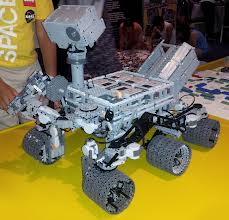
Courtesy of The Guardian is a list of teacher resources for teaching children about the Curiosity landing on Mars:
Landing on the Curiosity rover on Mars
This brilliant interactive tells us what’s going to happen on Monday (everything crossed for that landing) and beyond if all goes well. An innovative “sky crane” will lower the Curiosity Mars rover on the surface of the red planet. Explore the exact stages of the landing sequence and the what’s next when the Curiosity reaches its destination at the foot of a mountain inside Gale Crater. One of the hypothesis Curiosity is due to investigate is how a bunch of light-toned rock in this area could have got this colour – was it by interacting with flowing water perhaps billions of years ago? If all goes well Curiosity will be able to give us some answers.
Essential guide to Mars rover Curiosity
More information on the timings and the project as a whole, which is part of the Mars Science Laboratory mission.
Curiosity rover’s seven minutes of terror
Oooh this stuff is exciting… the Nasa ship carrying the space agency’s Curiosity will bear down on the red planet at more than 8,000 miles per hour (Wiggo eat your heart out) and attempt to land the rover. This article explains how the manoeuvres the spacecraft must execute are so complex that the slightest mistake could notch up just another grim statistic in the history of failed missions to Mars. Mission scientists are instead hoping Curiosity will follow in the footsteps of Spirit and Opportunity which touched down in 2004 (Opportunity is still operational eight years later!).
Animated preview of the landing
You can also check out this computer-animated preview of the planned landing.
Free downloadable game from Nasa
More info on Nasa’ s free game to simulate the descent of Curiosity through the red planet’s atmosphere on the journey that has been dubbed the “seven minutes of terror”.
Nasa’s Curiosity Mars rover the stakes couldn’t be higher
If this summer’s landing fails America’s and possibly the whole world’s exploration of the surface of Mars could stop for a decade or more.
Alien life on Enceladus?
If you and your students need an alternative to fantasizing about a trip to Mars, why not find out a bit more about Enceladus? It’s an icy moon of Saturn, which many scientists believe is a much better bet for finding alien lifeforms in our solar system
A “Goldilocks” planet
Another potential target for life is Kepler 22-b, a newly discovered new planet in the “Goldilocks zone” of its own solar system. It’s about 2.4 times the size of Earth with a temperature of a comfy 22C (72F). Only downside is it’s a bit of a trek at 600 light years away from Earth and experts aren’t sure if it is made mostly of rock, gas or liquid!
Habitable alien worlds
The Habitable Exoplanets Catalogue ranks alien worlds suitable for life. So far they’ve found only 15 planets and 30 moons that are potentially habitable.
Space images
This month’s pick of the best space-related images includes the likeness on a distant planet of Disney’s most famous creations.
Women hold up half the sky
China’s first female astronaut Liu Yang – part of the Shenzhou 9 crew taking China one step closer towards building a space station.
Gagarin and the space race
A Powerpoint aimed at key stage two illustrating Gagarin’s incredible voyage and other major milestones in the stages of space exploration and an associated lesson plan to go with it.
The Earth is space
An online science lesson on the position of the planets in the solar system and the concept of gravitational pull.
Human adaptation to extreme environments
How would our bodies cope with an extreme environment change? This lesson investigates
The solar system
An online lesson for key stage three.
Planets
Some lovely graphics for primary aged children exploring the position of the planets in our solar system, the phases of the moon and how the moon orbits the Earth.
Nasa’s Mars Science Laboratory Mission
Everything you need to know about Curiosity and Nasa’s mission to Mars. The site explains how determining past habitability on Mars gives scientists a better understanding on whether life could have existed on the red planet and, if it could have existed, as idea of where to look for it in the future.
Spirit and Opportunity
Nasa’s Mars rovers Spirit and Opportunity were a huge success, let’s hope Curiosity can build on that! Opportunity is still sending in info and Spirit only gave up the ghost in 2010.
Online catalogue of habitable exoplanets
A cosmic directory listing the planets and moons most likely to harbour alien life pulled together by the Planetary Habitability Lab at the University of Puerto Rico at Arecibo – so far 15 planets and 30 moons have been labelled potentially ripe for life.
Science Museum space galleries
The next best thing to going to space is a visit to London’s Science museum.
Kepler
Nasa’s Kepler space telescope is working to spot more exoplanets.
Enceladus images
Awesome pictures of the Enceladus flumes captured by Cassini during its close flyby in November 2009 posted up with commentary by Emily Lakdawalla, planetary geologist from the Planetary Society.
Solar Dynamics Observatory
Stunning pictures from Nasa.
Hubble
Hubble is constantly sending us fascinating images and news – just last month astronomers using the NASA/ESA telescope found a fifth moon found orbiting icy dwarf planet Pluto. Here’s some guidance on using the Hubble images specifically in schools and also a series of astronomical exercises for secondary school aged students.
ARGOS
If we are going to go to Mars – or anywhere else in space – we are going to need some serious training, so check out ARGOS, no not that Argos, we’re talking about the Active Response Gravity Offload System designed to simulate gravity reduced environments such as Lunar, Martian or microgravity.
Click on the link to read Teaching Fractions: The Musical
Click on the link to read Six Tips For a Happy Classroom
Click on the link to read Proposal to Adopt Shooting as Part of the Curriculum




 Topical Teaching