Posts Tagged ‘Schools’

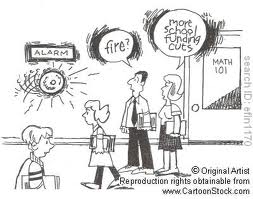
Treating Teachers Like Livestock

February 23, 2011

Someone needs to explain to this ignorant Australian how New York could be in this situation.  How can New York be in a situation where they feel they are better off letting go of more than 4.650 teachers?  How is this possible?  Is New York so content with their education system that they think they can make their cutbacks by ridding themselves of talented teachers?  Isn’t there other areas of government waste they can focus on instead of this massive cull?  That’s what this amounts to – a massive cull.  Teachers as expendable livestock!

And what’s worse is they are bound by a law that requires that teachers hired last are the first ones to be laid off, regardless of their effectiveness.

“I’m sorry, you’re doing a brilliant job and have been a source of inspiration to your students, but because we only hired you recently, we have to let you go.”

Teacher morale has always been an oxymoron, but this would be doing so much damage to teachers, their families, students and schools.  Take this case for example:

This is Stany Leblanc’s second year as a New York City teacher. It may also be his last.

When Mr. Leblanc’s sixth-grade students arrived in September for their first day of school in the South Bronx, they were on average two years behind in writing skills and more than a year behind in reading.

To inspire his poor, black and Hispanic charges to read, Mr. Leblanc has found books that are relevant to many of their lives. Students whose homes are too chaotic for studying find in his classroom a quiet place to work long before school in the mornings and well after the school day is done. He pushes students to write essays every week and groups them into teams named after colleges, so they remember every day what they are working toward.

Five months later, his sixth-graders are reading and writing at the sixth-grade level. “I’ve already caught them up and now I’m moving them beyond,” he said.

More than 4,650 teachers are expected to be laid off at the end of this school year, according to Mayor Michael Bloomberg‘s preliminary budget. State law requires that teachers hired last are the first ones to be laid off, regardless of their effectiveness.

That would make Mr. Leblanc, who began teaching in 2009 and earns $45,000 a year, vulnerable to being among the first to go among a citywide teaching corps of nearly 80,000.

His school is vulnerable, too. More than 200 new schools have been created in New York City in recent years to replace large, dysfunctional schools where too many children were failing. These new schools tend to have teachers with less experience.

The location of Mr. Leblanc’s school in a poor neighborhood is a factor as well. Schools in poor districts tend to have newer teachers, as teachers with greater seniority tend not to want to work there. The Department of Education has said low-income communities will be among the hardest hit by teacher layoffs, places where children can least afford to lose their teachers.

“It’s going to be devastating to the culture” of the school, said Mr. Leblanc’s boss, Patrick Awosogba, the principal and founder of Science & Technology Academy: A Mott Hall School. Dr. Awosogba carefully picked each of his 25 teachers, building a team of educators who work well together and often pitch in at each other’s classrooms to offer help and advice.

Am I misreading the situation?  Is Mr.  Bloomberg’s initiative necessary?  Why is a profession with relative job security worldwide suffering from such insecurity in New York?  How do you get a situation where 4,650 teachers required one year are no longer required the next?

Sounds like another case of treating teachers like livestock!

Why Students Misbehave

February 16, 2011

There are many reasons given for poorly behaved students:

  • The teacher doesn’t enforce discipline
  • The students are spoilt
  • The students are not parented properly
  • Kids are rude nowadays, and haven’t been properly taught manners.

All these reasons are decent explanations for an unruly child or class.  But there is one glaring omission from this list, which doesn’t get nearly the amount of coverage as other reasons – the students are bored!

My experience with unruly behaviour, is that it is more prevalent in a classroom that is taught in a bland style.  I have observed some brilliantly dedicated and hard-working teachers, who spend countless hours planning their lessons using the latest graphic organisers and programs, only to watch their hard work fizzle before their very eyes.  The most thorough preparation can go out the window when it results in a unsipiring lesson.

So much of today’s educational resources concentrates on breaking skills down, organising thoughts and following scientific trends.  What they fail to do is assist teachers in delivering fun, enjoyable lessons.

The latest trend in Australian education is direct instruction.  Direct instruction involves reading from a script.  In Australia this is how many schools teach their maths and spelling.  The class teacher is presented with a manual and asked to read from a script (the script even tells you when to pint at the board and when to pause!).  The students job is to listen, repeat after the teacher, and answer questions in their workbooks.  No hands are answered, no discussion takes place.  It’s just the teacher talking and the students responding.

The strengths of this style of teaching are worth noting.  The program is comprehensive, it fixes gaps in student learning, it helps improve the student’s listening skills, it makes for a quiet classroom and cuts planning time.  But among the weaknesses for such a program is the fact that it is so boring, firstly for the teacher, and also for the student.

Boring classes often leads to disruptive behaviour.

Have you ever watched the behaviour of teachers during a boring PD or staff room meeting?  And that’s adults!  We can control our behaviour far better than our students.  It’s just that when you are bored, it’s not so easy to maintain focus and avoid distraction.

In my own teaching, I find that my most difficult classes come as a result of an inability to properly engage my students.  Because I am not a strict or authoritative teacher, I rely very much on the strength of my lessons to maintain decorum in the classroom.

Among the many questions we teachers must ask ourselves when we reflect on behavior management in our classrooms is, what are my lessons like?  Could they be more relevant to the interests and life experiences of my students?


Why Aren’t Kids Held Back Anymore?

February 11, 2011

“It is our policy not to hold kids back unless there are exceptional circumstances.”

This is the standard line that Principals use nowadays when a teacher raises the topic of kids repeating grades.

Why isn’t it school policy?  What is stopping schools from having the courage to recommend it?

EXCUSE 1: “There is a stigma about kids that are forced to repeat a year.”

Well, that stigma is partly generated by an educational system that refuses to think logically about this issue.  When policy makers decide that some students would greatly benefit from redoing the year, they are assisting in breaking that stigma.  When they decide that they would prefer letting thE child flounder in a year level they aren’t equipped for they are helping to maintain the stigma at the cost of progress.

EXCUSE 2: “A child’s confidence could be tarnished by making them repeat.”

Since when is a school content in letting students fail, looking out for their self-esteem?  How is being miles apart from the rest of the class a confidence boost?  On the contrary, a child can get a new lease on life when they repeat a year.  They are given extra time to fill in the gaps and improve their basic skills.

EXCUSE 3:“But the parents would be devastated if we even raised it.  They may even remove the child from the school. “

A school that makes its decisions based on whether or not the parents will remove their child, is deeply compromised and lacks integrity.  The reason why parents may be devastated is because such an occurrence is rare.  The reason why it is rare to recommend that a child repeat a year is because schools don’t do it enough.  You have to break the cycle before such a measure gains wider acceptance.

Ultimately, a school should do what is right for the child, not what is popular or easy.  That is why I congratulate the Indianapolis school system for its brave new policy:

A new statewide third grade reading test will be a new test developed by the same company that produces the ISTEP statewide exams. About a third of third grade students fail the English and language arts ISTEP test each year, but the new exam will be designed with the expectation that all students who can read will pass the test.

“This is so fundamental to a child’s success, I think we absolutely must draw a line in the sand,” said board member Jim Edwards.

Under provisions adopted by the board Tuesday, students who do not pass the test on the first try could attempt the test again during locally-offered summer school, and could move to fourth grade if they pass on that attempt. All students would have to pass the exam to advance unless they qualified for one of the plans’ three exemptions: one for special education students, one for English language learners and one for students that have been retained twice prior to fourth grade.

I realise that repeating a year has implications, and that sometimes the result of doing so will end up being negative.  I simply feel that schools should be caring and supportive enough to do the right thing by the child and help replace stigmas with good decisions.

Teachers Can Now Be Fired For Being Human!

February 10, 2011

Reality check: Teachers are REAL people!  They are not robots, and yes, they make mistakes.  Sure, teachers are role-models with a responsibility to act with dignity and professionalism at all times.  But that doesn’t mean that they can’t enjoy the same privileges and opportunities as other people.

To fire a teacher over an innocuous Facebook photo is absolutely disgraceful!

A US teacher was fired for posting a picture of herself holding a glass of wine and mug of beer on Facebook, a report has said.

The happy holiday snap cost Ashley Payne her job after a parent spotted it on Facebook – and complained, the Daily Mail reports.

The picture was reportedly taken while travelling around Europe in the summer of 2009.

According to the Daily Mail, Payne, 24, was shocked when she was summoned to the head teacher’s office at Apalachee High School, in Winder, Georgia, and offered an ultimatum.

She reportedly told CBS News: “He just asked me, ‘Do you have a Facebook page?’

“And you know, I’m confused as to why I am being asked this, but I said, ‘Yes’, and he said, ‘Do you have any pictures of yourself up there with alcohol?’”

He then offered her an option: resign or be suspended.

She chose to resign.

Readers of my blog would be aware that I have previously written about the challenges that Facebook and other forms of social media has on educators and education as a whole.  I have been critical of teachers who post inappropriate material, as well as advised teachers to ensure that their privacy settings are on.  What makes this case different is that this teacher wasn’t doing anything illegal or unprofessional, especially since her settings were switched to private:

The English teacher reportedly later found out it was one anonymous emailer who turned her into the school board after seeing the picture on the social networking site.

But she is baffled how a parent could gain access to her page when she has all her privacy settings on “high””, meaning only her closest friends have permission to see her pictures.

According to the Daily Mail, she admits putting the “offensive” photos on Facebook but says she now feels as if she had stashed them in a shoebox at home for them to be stolen and showed to the head teacher.

Let our teachers have a life!  Let’s not fire every teacher who has holiday photos!

Payne added: “I just want to be back in the classroom, if not that classroom, a classroom. I want to get back doing what I went to school for, my passion in life.”

All those resposible for this teacher’s resignation – shame on you!

Parents, Don’t Do Your Kids’ Homework!

February 7, 2011

The other day I took my daughter to the museum to see an exhibit on Africa.  We sat down to do an African inspired craft activity where I witnessed a loving mother helping her daughter design and decorate her artwork.  I use the word “help” very loosely, because in fact she was basically doing the whole thing for her.  Soon the child’s father joined them.  What ensued was a disagreement between the child’s father and mother over what design strategy to use and what colours worked best.  What was supposed to be an activity for the child, became a chance for the parents to let their child sit aimlessly while her parents took over.

This is a common syndrome when it comes to homework.  Parents often end up doing their child’s homework.  Whilst I understand that they do this out of love as well as to diffuse some of their child’s anxiety over the complexity of the set task, I strongly urge parents to desist from this practice.  Even though in the short-term the child is grateful that the homework can now be submitted without too much heartache, in the long-term they have neither demonstrated capability in successfully mastering the task nor have they managed to calmly work through a challenge.  I accept that parents use homework as a chance to spend some quality time with their kids on a weeknight (where time with the kids is often at a premium), but there are better ways to show your children that you love them and support them.

Whilst there are some strong arguments for abolishing homework (which I will cover at a later date), I’d instead like to focus on what homework should be and how parents can help without feeling a need to take over:

  1. Homework should be revision.  It should not introduce a new concept or skill.  It should simply be a vehicle for students to demonstrate how well they understood what was covered in class that week.  If the child is bringing home work that was not introduced in class, I advise you to see the teacher.
  2. Most teachers give a few days to complete the homework.  I strongly urge my students to use night one to read over the homework and circle any question that they don’t understand.  Then, instead of approaching their parents, come see me the next day.  Of course, I am not restricting the parents from helping their kids, I am merely offering my help as the first option.  In my opinion, parents have already spent most of their youth completing homework, they have paid their debt to education and should now be allowed to enjoy a homework-free life.
  3. When the student approaches the teacher early on about difficulties in the homework, they are showing a great deal of responsibility and assertiveness.  This isn’t lost on the teacher.  So if the students maintains this sort of dialogue with their teacher, extensions are likely to be given should they struggle to meet the deadline.
  4. The best help you can give your children, when assisting them through a homework task is patience and perspective.  Offer your services by all means, but ensure that unlike the girl at the craft table, they end up having ownership of their work.  Kids are not proud of their parents homework, they are proud of their own achievements.  Whilst instilling independence and confidence in children may sometimes feel like an overwhelming proposition, the payoff is huge.  I would rather my students hand in a piece of homework that they took ownership of that was full of mistakes than a brilliant piece ultimately done by mum or dad.

We can easily look at parents who are doing their children’s homework in a judgmental light, whilst calling them enablers and accusing them of spoiling their children.  This is not the right approach.  These parents are often loving parents that don’t know how best to act in a complex situation.

Hopefully the above tips are of some assistance.

You Don’t Get Elite Teachers with Elitism

February 4, 2011

In my opinion, one of the biggest factors concerning the current failures of our educational system is the inadequate and substandard teacher training programs offered by our Universities.  Not just the minnow Universities but also the elite ones.

The idea proposed by Lord Adonis that every secondary school should have teachers who attended elite universities is not only unworkable but costly and simplistic.

Addressing the Independent Academies Association (IAA) conference in central London, Lord Adonis said: “You need a good mix of teachers, of course, at any successful school, but you cannot be a successful school unless you at least have a certain proportion of your teachers who have themselves come from leading universities in to which you intend to send your best students.”

Lord Adonis warned delegates it would not be possible to transform admissions to top universities “unless you can develop a cadre of teachers in your own schools that have that background themselves.”

I attended one of Australia’s elite Universities and I can tell you without a shadow of a doubt that there was precious little that I was taught that was of value to me in the classroom.  From my experience the training of teachers needs an overhaul.  Teaching theory is all well and good but it needs to be complemented with proper practical instruction.  I’ve seen teachers who are more academic  and have sharper intellects than I do, who floundered in the classroom because sometimes all the knowledge in the world on the right and left brain and metacognition can’t help you get through to a hostile or challenging class.

My lecturers were mostly former teachers who left the classroom because they couldn’t manage anymore.  They were a fountain of knowledge when it came to theory, but clearly relieved to be out of the classroom.  Their pearls of wisdom included “Use them or lose them”, concerning the number of paid sick days available to teachers.  Sure, it can be seen as good advice to cash in on your paid sick leave, but it isn’t the positive and responsible message to be sending to future teachers.

Lord Adonis may be right.  Perhaps it is easier to get pupils, particularly those from poorer areas, into top universities when their teachers have studied at those institutions too.  But for my daughter, I am satisfied with a teacher that is caring, dedicated, and prepared to challenge educational norms by experimenting and taking responsible risks.

You don’t need an elite University to educate, prepare and nature an elite teacher.

I’m Drowning in Paperwork: Please Pass the Snorkel

February 3, 2011

I admit it.  The allegations are true.  I am a tree-killer!

It’s not my fault, of course.  In the short time I have been teaching, the paperwork demands on a teacher have grown from taxing, to barely manageable, to excessive, and now – out of control!

Why?  Why, at a time when teachers are being criticised for their students’ low performance data and failure to deliver on outcomes, is the paperwork demands of a teacher so high?  Surely time would be better spent developing engaging lessons.

The answer is simple.  The rules applying to all teachers are in place to cover the lesser achieving teachers.  The assumption is that if a lazy teacher wasn’t told what to do, how to think, what to cover, how to plan and who to cater for, they wouldn’t achieve anything.  By forcing teachers to complete crazy amounts of paperwork, they are treating all teachers as if they were inert, fraudulent, apathetic stooges.

Take the planning requirements, for example.

Is planning important?  Absolutely!  Planning is important for three main reasons:

1.  It shows what you are teaching your students in a week, term and year.

2. It helps you organise thoughts and properly sequence the concept or skill you are teaching.

3.  It provides a comprehensive guide for a casual relief teacher, should you not be able to teach your class.

As important as planning may be, it can still go overboard.  In the summer holidays alone I had to complete first term planners for literacy and numeracy, yearly planners for literacy and numeracy, a 10 page integrated planner for my topic of inquiry (Federation) and weekly planners for both numeracy and literacy.  The amount of hours I spend on those darn things doesn’t correlate with how useful they turn out to be.

The rationale that by spending hours upon hours on these planners,  an average teacher will become transformed miraculously into a more focussed and effective educator is just plain wrong.  On the contrary, it forces some teachers to cut corners by mindlessly copying dull, lifeless units from textbooks.  With all that paperwork, teachers often become too concerned with deadlines and time restrictions to go to the trouble of conceiving original and fresh lesson ideas.

And it’s not just planning.  There’s professional learning contracts which chart the goals, reflections and progress of the teacher, class newsletters, letter to parents, school policy feedback forms, incident report documentation, worksheets, homework, curriculum night summaries, parent teacher interview folios and I’m sure there’s more, because … there’s always more!

I’m not trying to play the victim here.  I love my job and understand the value of the above requirements.  It’s just that the sheer amount of  paperwork clearly gets in the way of a teacher’s natural desire to spend less time meeting arcane professional standards and more time excelling in delivering fun, vibrant and engaging lessons.

I’d love to write more on this topic, but unfortunately, I’ve got more paperwork to finish.


Making Maths Fun is Not Mission Impossible

February 2, 2011


I’m no teaching guru – just an ordinary teacher that loves his job. I am a primary level generalist teacher, which means I teach all major subjects such as Maths, English, Social Studies and Science. As much as I love teaching all subjects, I find Maths most exciting.

Is it because I have a background in Maths? Absolutely not. I have an Arts degree.

Is it because I am good at Maths? On the contrary. As a student I would frustrate my teachers no end. As a kid, I had as much chance of passing a maths test as Homer Simpson has of suffering from dandruff!

The reason I love teaching maths is that I find it an untapped and underrated subject for injecting creativity and role-play. Last week I wrote about how primary teachers often struggle to teach maths, as they mostly come from a humanities background.

Commenting on that post, loyal reader and frequent contributor Margaret Reyes Dempsey, wrote, “I’d love to read a post about some of the ways you approach math in the classroom.”

Every week I will endeavour to describe an innovative Maths lesson I have concocted.


Lesson 1: Mission Impossible Maths (Place Value)

I get the students to bring a pair of sunglasses to school for homework. The students invariably ask me what the glasses are for. I tell them it’s a surprise. They automatically think science, perhaps an activity out in the sun. The truth is, the sunglasses are nearly irrelevant, only there to raise curiosity and engagement.

On the day of the lesson I take the kids to our small but homely hall. I carry a briefcase and have on my own pair of “spy” glasses. The kids have no idea what is in the briefcase, and have no clue what is happening. I sit them down on the floor and tell them that there is a problem. There is a mansion close by. In that mansion there is a suitcase. In the suitcase there is a key. The key, in the hands of evil would change the world as we know it. It would give them the power to ban all music except for the golden oldies and make sure that nothing but news is on TV. The kids groan at the prospect. Lucky you are here, I tell them. You are the best spies in the world, and your mission is to break in to the mansion and get the key before they do. I call their names out, adding their secret spy name e.g. Sammy “The Drummer” Smith. The spy name is just another opportunity for me to connect with the interests and skills of my students. I split them into groups based on ability, as the lesson will involve maths problems ranging from basic to more complex.
I take them outside and show what they have to do to break into the mansion. I show them the slide which I call “The Tunnel of Terror.” Getting through the tunnel will be tricky, as a wrong turn would send out the crocodiles. To get through the tunnel without being eaten, group 1 has to work together to order a sheet of 5 digit numbers from lowest to highest number.

I then take the class to the school door, or “Dynamite Door”. To gain access to the mansion, Group 2 has to order a sheet of 5-digit numbers, this time from highest to lowest, otherwise the door will explode.

I show the class the door that leads to the hall, or as I call it “The DNA door.” To gain access to the room in which the suitcase is kept, Group 3 has to bypass the special DNA sensitive handle. To do that, they are given 6-digit numbers to order.

Group 4 has to get past the infra red sensors to get to the suitcase. This involves making as many 4-digit numbers from, for example, 4, 3, 1, 8. Once they have gotten past all 4 obstacles they will face one more test (to be revealed at the time) before being able to open the briefcase. They are told they have 45 minutes and the time starts now …
I distribute the sheets to each group, watching them feverishly try to solve the problems without making a mistake. Each group appoints a checker, to check for a careless error that would complicate this dangerous mission. If a group finishes early, they are quiet, because they rely on the proficiency of the other groups. When all groups are done we go back to the slide. The clock is still running.

The first member of group 1 reads the first part of the answer and when I confirm that it’s right goes down the slide. The other members do the same until they have all slid down the slide. Members of group 2 read out their answers. On getting the right answer each member is allowed access through the door until they are all inside the building. The same for Group 3 with their door and Group 4 with the sensors.

The final challenge involves a representative from each group stepping forward to help break the suitcase code. I tell the 4 representatives that the code number is between 3,500 and 3,600, and they have to guess it right. All I can tell them is whether their guess is higher, lower or spot on.

Once the final code has been broken, the person that correctly broke it gets to open the case and take out the key. They usually get the key with only a few minutes left to spare. You should see the cheers and hugs that come about from unearthing the key. It is such a great bonding experience.

I do this lesson in the second week of the school year. At that stage my students almost uniformly claim they hate maths with a passion. It is only after the lesson that I spill the beans that they had just taken part in a maths activity. In reality, it was nothing more than a set of dry worksheets with a bit of imagination and wackiness added on.

If you feel that this lesson would be suitable for your kids, I’d love to know how it goes.

Do You Suffer From Classroom Envy?

February 1, 2011


There have been a few realities that have caught me off guard since I signed up to being a teacher. The expectation of a meticulously presented classroom is certainly one of them. I’m not an artistic person. My creativity comes from writing and thinking innovatively, but I am inept at decorating. Design school’s nationwide are not flocking to mimic my inimitable low-key style.

I knew that a classroom should look bright, contain student work and be aesthetically pleasing. What I didn’t know, that I have seen learned, was that teachers are inherently obsessive with the look and feel of their classroom. From the table layout to the perfectly hand-crafted posters and signs. Teachers are constantly shopping for material, furniture and accessories to beautify their classroom.

Often it’s a competition. The other day I complemented a colleague about her majestic looking classroom in the presence of another colleague. Only later was I told that by praising that colleague I had potentially upset the other who was already anxious about her classroom not matching up to others aesthetically.

It reminds me of the Christmas lights battle that takes place in some neighbourhoods. What starts out as an expression of good will and festivity, can sometimes turn in to a competitive slugfest. I am not a competitive person at the best of times. In this context, my classroom isn’t simply inferior, compared to the others it looks like a jungle.

My bosses past and present have continually made insensitive comments about the look of my classroom. It’s not as if I don’t try. Sure, it doesn’t size up to the others, but I still maintain it possesses a quaint charm (well that’s my spin on it anyway).

I once apologised to a parent about the look of my classroom during a meeting. The parent responded by pointing out that she doesn’t care what the classroom looks like, just as long as her child is happy and learning well.

Is that representative of other parents? Is it a case of style vs substance? Or, perhaps I am depriving my students of a classroom they can be more proud of. Perhaps like my students I have to improve at skills that don’t come naturally to me. I have to get better at cutting big, beautiful, cardboard letters for my brightly coloured welcome sign.

Is this just my experience? Are there other teachers who have an insecurity over the look of their classrooms? Are any of you envious of the classroom next door?

The Latest Sport: Degrading Our Teachers

January 27, 2011

Don’t get me wrong, I am extremely positive about President Obama’s passion for education.  It is great to hear him talk of the virtues of this great profession:

“Let’s also remember that after parents, the biggest impact on a child’s success comes from the man or woman at the front of the classroom. In South Korea, teachers are known as “nation builders.” Here in America, it’s time we treated the people who educate our children with the same level of respect. (Applause.) We want to reward good teachers and stop making excuses for bad ones. (Applause.) And over the next 10 years, with so many baby boomers retiring from our classrooms, we want to prepare 100,000 new teachers in the fields of science and technology and engineering and math.” (Applause.)

“In fact, to every young person listening tonight who’s contemplating their career choice: If you want to make a difference in the life of our nation; if you want to make a difference in the life of a child — become a teacher. Your country needs you.” (Applause.)

But if the US really needed good teachers, why does it treat its current ones so badly?  Why does it constantly refer to disposing of bad teachers instead of offering support to improve teacher performance?  It may be “time we treated the people who educate our children with respect,” but until you do, I’ll take it as words rather than substance.

I am referring to three examples which highlight the lack of respect of American teachers.

1. The recent decision by a New York State Judge to release the performance ratings of thousands of New York teachers to the media:

The judge, Cynthia Kern of the Supreme Court of the state of New York, wrote in a nine-page decision that the UFT’s argument “is without merit,” adding that the court of appeals “has clearly held that there is no requirement that data be reliable for it to be disclosed.”

The data attempt to measure the progress made by students in fourth through eighth grades under specific teachers by comparing their state test scores in math and English in a given year with the previous year.

The Department of Education has such data applying to 12,000 teachers; overall, there are nearly 80,000 teachers in New York City.

2. The  “Last In, First Out” (LIFO) sham of a policy:

This policy dictates that when there are layoffs, the most recently hired teachers in the system are the first to be fired. These decisions are based solely on seniority, without regard for teacher effectiveness.  The policy has three major negative impacts: first, it removes many high-performing tenured and non-tenured teachers from the   classroom, while retaining those that are less effective but have more years in the system; second, it causes a higher number of layoffs, since junior teachers are paid the least; and finally, it disproportionately impacts the lowest performing schools, which have the largest number of new teachers.

3. The Teacher Bashing Website, RateMyTeachers.com:

This website invites parents and teachers to rate and comment on their teachers.  The comments are public and often extremely slanderous.  Whilst being a US website, teachers from all around the world, including my country, Australia, can be rated and commented on.  Each teacher’s comments and rating can then be shared through Facebook by clicking a button on the site.  This is absolutely disgraceful, and while the authorities know about it, they have decided not to intervene.

President Obama, I absolutely love your passion for education.  You most certainly have a vision and an expectation that things improve.  But for your words to ring true and your wishes to come to fruition there is a lot more you and your Government can do for teachers.

Let’s start by offering support to your current teachers instead of giving up on them in favour of new blood.  Let’s give good teachers the opportunity to feel secure in their job.  And finally, let’s consider the impact websites like RateMyTeachers.com have on teacher morale.

If you really want teachers to get the respect they deserve, the respect needs to come from your administration first and foremost.