If I wasn’t a teacher I think I would have supported Michael Gove’s push for reduced summer vacation and longer school days. Non-teachers are quick to remind us teachers that our vacation time is too long and our contact hours are just as generous. These same people wouldn’t teach if their life depended on it!
Firstly, while it is true that are holidays are long, we teachers get burnt out by the demands of our job. As much as I love teaching, towards the end of a given term, I am crawling towards the finishing line. Teaching is such a physically and emotionally charged career, it is simply impossible to envisage a 4 week annual holiday like other professions experience.
Secondly, our working hours do not stop at the end of day bell. Unlike many other professions, teachers are expected to take their work with them. From planning and marking to writing reports, teachers are forever working. This includes night, weekends and yes, holidays!
Michael Gove seems to think that quality will come with quantity. I am not so sure:
The school day could be extended and summer holidays reduced, Michael Gove, the Education Secretary, said yesterday.
Under the proposals for the extended day, pupils could remain in school between 7.30am and 5.30pm and attend on Saturdays, with an extra two weeks potentially being added to school terms.
Over a five-year period, the extended hours would mean pupils gained as much as a year’s worth of extra education, allowing them to take vocational subjects in addition to their exam material.
Asked how this would affect teachers, he said: “If you love your job then there is, I think, absolutely nothing to complain about in making sure you have more of a chance to do it well.”
Mr Gove said the move would benefit “poorer children from poorer homes”, who “lose learning over the long summer holidays”.
Mr. Gove’s assertion that if teachers loved their jobs they would have nothing to complain about is quite insensitive and offensive. I love my job and do the best that I can. But I have limitations. I feel that if I was teaching in England, this proposal would burn me out earlier and more severely. I find it very sad that the Education secretary is so out of touch with teaching and the demands of a modern-day teacher.
Excessive video game use and high rates of video game addiction lead to much anguish from concerned parents. Many parents never saw the addictive pull of video games as an issue when they bought consoles for their kids or allowed them to have a computer in their bedrooms. I read a very interesting piece by writer, Scott Steinberg, on the major issues relating to children and video games.
– Amount of Play Time
– Age Appropriateness
– Health and Obesity
– Addiction
– Safety Concerns
– Violence, Aggression and Misbehavior
The issue of particular interest to me was the video game addiction section. Video game addiction is not a term we hear very often, but I’m afraid it will be widely familiar in the next few years.
Addiction– For some kids, there is a real danger of becoming too involved in playing games, or even in living too much of their lives in the virtual world of the Internet. In rare cases, true symptoms of addiction can develop, and such kids can require direct help from their parents, peers, and professionals to have a healthy, balanced life. While a change of environment and routine can sometimes be enough to break kids out of an addictive mindset, the reality is that it’s hard to prohibit kids from using technology on a regular basis, since it’s such an integral part of daily life. Many experts encourage parents to become more engaged in the addictive activity in an effort to better understand the problem and prospective solutions. They also encourage families to seek out professional help should children exhibit warning signs of addiction. Several of these warning signs, according to the Search Institute, an independent non-profit organization dedicated to creating healthy communities, and other sources, include:
Playing for increasing amounts of time
Lying to family and friends about video game usage
Thinking about gaming during other activities
Using video games to escape from real-life problems or bad feelings, as well as anxiety or depression
Becoming restless or irritable when attempting to stop playing video games
Skipping homework in order to play video games
Doing poorly on a school assignment or test because of time spent playing video games
I urge parents to spot the signs before the addiction gets completely out of hand. It may even be worth reading Mr. Steinberg’s book, “The Modern Parent’s Guide to Kids and Video Games,” which will be free to download at www.ParentsGuideBooks.com in February 2012.
I understand that teachers in a religious school cannot be “seen” to have radically opposed views to the school they are teaching at. For instance, I am not opposed to a religious school requesting their science teachers to subsist from proferring a personal view about creation which isn’t consistent with their religious beliefs.
But as long as a teacher doesn’t broadcast their differing views or lifestyle choices what is the problem? How can a teacher undergoing artificial insemination lose her job because of it in today’s age? Worse still, the reason for her dismissal was that she had done a “grave immoral act.”
There was nothing immaculate about a Catholic school teacher’s conception.
Christa Dias, a former teacher at Holy Family and St. Lawrence Catholic schools in Cincinnati, Ohio, claims she was fired for becoming pregnant using artificial insemination.
Ms Dias was fired in October 2010 when, at five and a half months pregnant, she approached her employer about maternity leave options.
The schools initially fired Ms Dias, 32, for being single and pregnant, Cincinnati.com reports.
When the schools discovered that violated several federal and state anti-discrimination laws, they said she was fired because she became pregnant using artificial insemination.
That, the school said, was in direct violation of her contract.
‘She has a right to her opinion, but she doesn’t have a right to violate her (employment) contract,’ Archdiocese of Cincinnati spokesman Dan Andriacco told the website.
The contract Ms Dias signed called for employees to adhere to Catholic social teachings, including the avowal that having a child without a husband and out of wedlock is a ‘grave immoral’ act.
Many will argue that a contract is a contract and if you break a contract you should suffer the consequences. Well, I think the contract is unconstitutional. It is time to ban religious school from imposing these restrictive and highly inappropriate contracts. Sure, if she had personally advocated artificial insemination to her students, I would understand if the school would react by releasing her from her contract.
But she didn’t flaunt her personal choice. She kept it a secret. Firing her may be legal at the moment, but something should be done to stop religious school from imposing such restrictions in the future.
Some teachers must live under a rock. The only thing worse than calling your students names is calling your students names on Facebook. Any teacher found to be insulting their students on Facebook deserve what is coming to them.
Two teachers have quit after staff allegedly called pupils “thick” on Facebook.
Teacher Stuart Clark sparked the tirade after he declared he was “fed up of bumping into pupils in town”.
Nyanza Roberts replies: “By town, do you mean top end of holderness road? That’s bout as far anyone goes. No wonder everyone is thick..
“Inbreeding must damage brain development.”
Head Debbie Johnson jumps in and says: “You’re really on one today mrs… !! Xx.”
Colleague Jane Johnson posted: “Massive queue of year 5/6 kids in poundland! x”
Parents found out about the conversation by staff at Westcott Primary School in east Hull when copies were attached to fences in the streets surrounding the building.
Mary Wallace, chairwoman of governors at Westcott Primary School in Hull, said the two had “decided to relinquish their posts”.
Hull city council added: “We’re supporting the school and will focus on ensuring children get the best possible standards of education.”
There are thick people in this incident, but they are not the students.
The continued debate between private and public school funding tires me out. I am a big believer of a well-funded (i.e. wisely funded) public school sector as well as a thriving private school sector. There is no reason why parents can’t be given choice and why supporting private schools must come at the expense of quality public education.
This is where the “Moneyball” analogy fits in.
Moneyball is the true story of Oakland A’s GM Billy Beane. Oakland is severly restricted due to the lowest salary constraints in baseball. Winning means beating teams with much better infrastructure and player payment capacities. Billy is presented with the unenviable task of finding a winning team with the miniscule budget offered. Together with a Harvard economics major, a system is devised that uses statistical data to analyse and value players they pick for the team.
Public schools need to take the same approach. Just like the big baseball teams of the time, plenty of money is spent on public schools, but much of it is wasted money. I look at education in a very traditional way. Whilst it is ideal to have the best sporting fields, technologies and building designs, none of these ingredients has been proven to be essential for teaching and learning the curriculum. The school across the road may be able to give each child their own i-Pad, but that shouldn’t explain a marked difference in maths, science or english results. A teacher should be able to deliver on the curriculum with or without such devices.
Whilst many get worked up when Governments subsidise private schools, there is a good reason why they do it.
1. It takes billions off the budget bottom line. This saves Governments money, resulting in reduced taxes and smaller class sizes in public schools.
2. It allows private schools to lower their fees. This is crucial for parents who are by no means wealthy, but are prepared to scrimp and save (and sometimes take on multiple jobs and a second mortgage) to get their children into private schools. These people should be commended. They work long hours, weekends, give up overseas travel and big screen TV’s, just to give their kids the best education possible. Government subsidies allow that to happen.
In Australia, the Government gives $13,000 to every public school per student. Private schools get $5,000. Factor in to the equation that many private schools are not elite schools with truck loads of money and resources (I work in such a private school, where I earn considerably less than a public school teacher), and you realise that the subsidy shouldn’t detract from a thriving public education system.
By constantly drawing attention to private schools, we risk bringing the private school system down to the public level. What we should be doing instead is trying to get the public school system improved to the level where it gives its private school equivalent a run for its money. That way, you have a private school that sets the bar for top quality education and a public school system that is structured to be able to go toe-to-toe with them based on prudent spending, good decision-making and a workforce of supported and fairly paid teachers.
Teachers find the last weeks of a school year absolutely exhausting. Many of us crawl towards the finishing line amazed that the deadlines have been reached and the seemingly insurmountable boxes have somehow been ticked.
Now that I am both a teacher and a parent of a school aged child, I can see that the end of year poses challenges for parents too.
1.) You’re Broke. Between the gift for the classroom teacher, the teacher’s aides, the piano teacher, the math tutor, the babysitter graduating high school who wasn’t much for cleanup but at least she could walk home, and the niece graduating college after the five year plan, you are clean out of $20 dollar bills. (Apologies if you are more of $100 dollar bill gifter, I didn’t mean to insult you. Can I please be your babysitter?) It gets so bad that you could almost use a second job. But you can’t do that, because…
2.) Your Productive Workday Has Been Shot to Hell. You have to be up at school to see the end-of-year talent show, of course, and your child would never forgive you for missing out on the end-of-year class picnic. Then the school districts get in on the act, fulfilling some budgetary or union contract obligation by cutting a bunch of June school days in half. Your to-do list becomes an archive, saved in its non-checked-off state for future generations to admire. It’s enough to make you run for comfort to the cookie jar which is full because…
3.) You Have Baker’s Elbow. Brownies for the ballet recital, pound cake for the Little League team party, chocolate chip cookies for the celebration of a completed Social Studies group project; you’re churning them out like your middle name is Poppin’ Fresh. You would like to buy stock in King Arthur Flour and Betty Crocker, but can’t get out of the kitchen long enough to log onto E*trade. And if you’re going anywhere past the stove it’s going to be to the laundry room because….
4.) The Lunch Bags Look Like They’ve Been Beaten. Bruised, torn, bearing tiny flecks of unidentifiable foreign substances that may or may not be mold, the insulated lunchboxes that started off the year in bright primary colors have been reduced, through constant improvised use as seats, soccer balls, and weapons, to an indistinguishable grayish brown. You weigh running them through the washer one last time. But would it be the cycle that finally separates the strap from the rest of the bag? That would probably make you cry, because…
5.) You Burst Out Crying At Inopportune Times. It’s the inevitable result of being handed concrete evidence, in the form of a graduation certificate or a class council election, that Your Children Are Growing Up. The ultimate example was when the Kindergarten teacher rewrote Eric Carle’s “A Very Hungry Caterpillar” to describe all the knowledge that our children had hungrily gobbled up throughout the year. Then she had them hold up wobbly, colorful pictures they’d drawn of butterflies and said, “And now you are beautiful butterflies who will fly off to First Grade!” Twenty-three moms, 15 dads, and one kindergarten teacher hit the deck sobbing, delaying the children’s American Sign Language performance of “Somewhere Over the Rainbow” until we’d (temporarily) recovered our composure.
There is a simple reason why the video confessional of a bully victim goes viral overnight. The amount of children bullied around the world is horrifying. Clips like the one made by Jonah Mowry certainly cuts at a raw nerve.
A bullied 14-year-old has stood up for himself in an online video – and has become a national icon.
Jonah Mowry’s heart wrenching video was made at 4 a.m. It starts out simply as a teenage boy telling us his name, but it quickly turns into an emotional confession.
With tears in his eyes, Mowry tells people watching that he’s been bullied since the first grade because he is gay.
The video was made in August before Jonah started school and in the video he says he’s not ready to go back because he’s scared the bullying will continue.
The video might have remained buried on YouTube, but last week, Perez Hilton blogged about it and then it went viral.
The video has now been viewed more than 7.4 million times.
Jonah got tweets of support from celebrities like Nick Jonas, Rosie O’Donnell, Jane Lynch and anti-bullying crusader Lady Gaga.
On Friday, Jonah appeared on ABC’s “Good Morning America”. He told those watching that if you’re being bullied, don’t be afraid to tell someone.
“You need to tell your parents, even if it will make it worse maybe. You need to tell someone because keeping it in just makes it a lot harder. If you tell someone, it’s a big weight lifted off your shoulders,” said Mowry.
Jonah says once his story became a viral sensation, he was called into the principal’s office.
“He told me if anything happens, that he’ll do his best to make sure it doesn’t happen again. So, when I came back to school, everyone was very supportive and very welcoming and nice,” Mowry said.
His final message to other kids being bullied is that it will get better. You can be happy. You just have to try.
The positive ending to his message will prove extremely heartening to victims of bullying who can see no end to the constant persecution in sight.
It is my belief that cyber-bullying is often based on “dominance” and “popularity” rather than “hate”. I don’t think most cyberbullies hate their victims. Instead, I think they see them as stepping-stones to wider acceptance from their peer group. Often the victims are minorities or outcasts. The pressure to be in the “in group” has always been high. For an “in group” to exist there needs to be a clearly defined “out group”. It is often seen as a sort of right of passage for someone seeking popularity to kick the easy target.
A new study commissioned by CNN’s “Anderson Cooper 360°” found that the stereotype of the schoolyard bully preying on the weak doesn’t reflect reality in schools.
Instead, the research shows that many students are involved in “social combat” — a constant verbal, physical and cyber fight to the top of the school social hierarchy.
“Kids are caught up in patterns of cruelty and aggression that have to do with jockeying for status,” explains Robert Faris, a sociologist whom “Anderson Cooper 360°” partnered with for the pilot study. “It’s really not the kids that are psychologically troubled, who are on the margins or the fringes of the school’s social life. It’s the kids right in the middle, at the heart of things … often, typically highly, well-liked popular kids who are engaging in these behaviors.”
Faris, along with the co-author of the study, Diane Felmlee, also found that bullies, whom they call aggressors, and victims are not defined roles, but in many cases, they can be the same person. The higher students rise on the social ladder, the more they bully other students, and the more other students bully them.
“When kids increase in their status, on average, they tend to have a higher risk of victimization as well as a higher risk of becoming aggressive,” Faris says.
The study was conducted this spring at The Wheatley School, a nationally top-ranked high school on Long Island, New York. More than 700 students at the school were given a survey with 28 questions on aggressive behavior four separate times throughout the semester. They were also given a roster of the entire school in which every student had an identification number and kids were asked to write down specifically who did what.
This is part of the reason why I am so critical of the way bullies are handled at some schools. So often the emphasis is on the actions of the bully and not on the social environment that encourages bullying behaviour in the first place. That is why so much of my energy is devoted to changing the social fabric of my class.
After all, bullying isn’t a priority – it is THE PRIORITY. As a teacher, I am entrusted not with people’s money or belongings but with the most important and precious things they have – their children. It is my responsibility to ensure that they are safe and secure. Sure, I have to teach them and help them grow academically, but even more so, I have to do my best to make sure that the child they dropped off at my classroom is going to come back in as good if not better emotional shape than when they arrived.
When I speak to my class at the beginning of the year, I tell them there is a sure-fire way for them to have to repeat the year a second time. It’s not if they find the work difficult or are struggling to pass assessments – it’s if they are not treating their classmates with respect. Because if they are not ready to treat others with respect, they are not emotionally ready to go up a year level.
I’m not joking. I really do mean it.
There is a lot of talk about ‘child centered learning’ vs ‘teacher centered learning’. I prescribe to neither. Instead, I believe in what I call “class centred learning”. The main focus of my teaching is that everyone in the class must respect each other. It is the fundamental rule for assessing my own performance. They don’t have to be best of friends, but they absolutely must respect each other. And ultimately, it is my duty to empower the class and create an environment of closeness and mutual respect.
Does it mean that there is no bullying in my classroom? Absolutely not. I wish. I’m only an ordinary teacher. What it means is, I take more interest in the welfare of my class than any other consideration.
On the topic of bullying, I again strongly recommend (not for the last time) this most brilliant anti-bullying film developed by young students in their own free time. It is the best of its kind by a long, long way!
I remember how frustrating it was to have to raise my hand before I could speak in class. The teacher took what felt like an eternity to pick me.
First I would go for the conventional right arm raised high, complete with perfect posture and enthusiastic eye contact. But then my arm grew tired.
Plan B was to swap arms, this time using the left, but with the same steely determination to get chosen. But after a while, my arm would again become tired.
Finally I would go for the two arm job. My right arm would be raised with my left used as support behind the elbow, propping it up in the hope that I could last until my name would eventually get the call.
And then, after all that, I would remain overlooked and reluctantly gave up the fight and threw in the towel.
And that was just to ask permission to go to the bathroom …
As you may have guessed I’m not a fan of raised hands. It amazed me at Uni during tutorials how civil a lesson can be when raising hands was replaced by two simple unspoken rules – wait your turn and don’t interject.
That’s why I’m dumbfounded that a simple change like replacing hand raising with the far less strenuous “thumbs-up” motion, could me met with so much criticism:
Pupils at Burlington Junior School in Bridlington, East Yorks, have been asked to adopt the new hand signal to create a more relaxed classroom.
The children – aged eight and nine – have now been told to get the teachers attention by giving a thumbs up while cupping their hand.
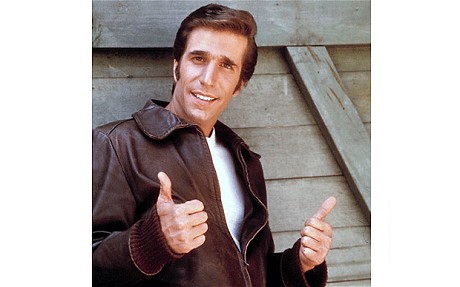
But parents at the 360-pupil school have blasted the decision as “daft” after it was introduced at the beginning of this school year and say the clidren look like The Fonz, from the television comedy Happy Days.
Dad-of-three Dave Campleman, 44, who has two children at the school, said: “I thought it was a joke at first. It’s daft. I can’t see the logic in it.
“Fair enough if it was across the board, but I’ve not heard of any other schools doing it.
The driving instructor added: “I think it’s a bit pointless, it’s not benefiting their education – they could focus on other things.
“Kids are used to putting their hands up, it is natural for them. Being told to do something different just confuses them.
“I am just bemused by it. I think they should go back to the old way of putting your hand up in class.”
And teachers at the pupil school have even taken to putting up signs to discourage kids from raising their hand.
In one poster campaign plastered on the walls of classrooms, a thick red cross can be seen through an image of a raised arm to discourage children from using the old method.
Next to it is an image of a pupil doing a thumbs up aimed at helping pupils get to grips with the change.
Another parent, who has a son in the class but didn’t want to be named, said: “It is going to make the class look like they are all imitating the Fonz from Happy Days.
“On a serious note when these kids go up to secondary school next year they could be a laughing stock because all the other children will be putting up their hands.
“I think there should have been more consultation from the school with the parents over this and perhaps a trial first before an outright ban.
“I can’t really see it making the classroom more relaxed – they are young, excitable kids and putting up your thumb instead of your arm isn’t going to change that.”
It’s amazing how a simple change can create such angst. I think the signs are a light-hearted send up of the stereotypical rigid school rule. It’s not as if children are going to be punished for accidentally raising their hands.
As for the kids becoming a laughing-stock in High School, one might be surprised to know that children aren’t stupid. Treat them like mature young adults and you may be in for a pleasant surprise.
There is a 1983 film entitled Teachers, which while universally panned by critics and eventually bombed at the box office, stands as one of the most accurate portrayals of schools caught on celluloid. Starring Nick Nolte, the film is a satire of American Government High Schools. Those not familiar with the way a school runs found it over-the-top, unfunny and irritating. Whilst the film is badly made, it contains some insights and observations that are perceptive, extremely funny and just as relevant today.
There is no better example of this than the fact that the school in the film is being sued by a former student that was allowed to graduate without being able to read or write.
The UK is falling behind international rivals because one-in-five children “learn nothing” throughout their secondary education, according to the head of Britain’s top private schools’ group.
Figures show that almost one-in-five pupils left primary school this summer without reaching the standard expected of the average 11-year-old in reading. Some one-in-10 boys had the reading skills of a seven-year-old or worse.
Perhaps what worked most against the success of the movie Teachers was that it was too clever and too accurate for its own good.








 Topical Teaching
