Posts Tagged ‘Parenting’

The Insanity of Modern Educational Thinking

July 27, 2011

Below is an article that exemplified the absolute lack of balance and common sense in our Education system.  To have three separate school uniforms in the one school grounds, with each uniform representing a different learning ability, is just plain insane!  It is demeaning, offensive, inexcusable and achieves the exact opposite of what a school is supposed to achieve.

A school isn’t just a place where information is disseminated.  Schools serve as  a microcosm for society as a whole.  They prepare students for the challenges faced in the real world.  They are supposed to help children realise the importance of responsibility, empathy, teamwork, leadership, perseverance and acceptance.

But do they really?

Children from aged 11 are being segregated, taught in colour-coordinated buildings, playing in separate fenced-off areas and eat lunch at different times.

The move has caused concern that it is stigmatising children who are placed in lower quality sets.

Pupils are ranked as they leave primary school and placed into one of three mini schools at Crown Woods College, Greenwich.

The brightest go to Delamere and wear purple ties and purple badges. The rest go to Ashwood, which wears blue, or Sherwood, which wears red.

The two latter schools are made up of pupils with mixed abilities but are still streamed into three tiers.

Critics have warned that the move is demoralising for pupils and encourages resentment and animosity amongst those in different sets.

Michael Murphy, the head teacher at the comprehensive, said: “I felt if we made explicit the provision for high-ability children we would be able to attract those children and their parents who would rather not put them in to a grammar.”

“Mrs Thatcher said you can’t ignore the market, you have to respond to it.”

Kevin Courtney, deputy secretary of the National Union of Teachers has condemned the practice.

He said: ‘The idea of taking a large school and turning it into three mini schools is likely to be good for [the school’s] relationships, but streaming is a step backwards. It leads to competition for children rather than improvement in teaching.”

Labelling a student based on their current learning level is extremely damaging.  Schools should be doing all they can to eliminating labels and focussing not on what makes us different, but rather, on the things which unite us.  We all want to feel respected and cared about.  We want to be appreciated for the skills we have and supported in obtaining skills that don’t come easy to us.

Instead of drawing attention to discrepancies in ability, we should be drawing attention to the fact that each and every child has unique qualities which make them important.  Just like a vibrant society requires people from all walks of life, political perspectives and skills, a schoolyard does too.

How would teachers like it if they were colour coded according to their teaching ability?
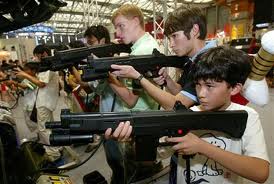
Should Violent Video Games Be Banned?

July 26, 2011

I am glad to see that the recent events in Norway isn’t prompting any knee-jerk reactions in banning violent video games.  Although I dislike violent video games and would not want them in my house, I am not an advocate for banning them from the public.  As much as I despise violence of any kind, I don’t believe that violent games causes violent outbursts.

Proper censorship classifications is a much better approach:

THE Australian government will not back away from new classifications for violent video games despite suggestions they might have played a part in the Norwegian horror, says Home Affairs Minister Brendan O’Connor.

State and federal attorneys-general last week ended years of debate and agreed to support an R18+ classification for video games, with the exception of NSW’s Greg Smith, who abstained.

Mr O’Connor has rejected calls for governments to reconsider their position after revelations that the man accused of carrying out the bomb and shooting attacks in Norway, Anders Breivik, was obsessed with violent video games.

“Because there’s a madman who has done just such atrocities in Norway, I don’t think means that we are going to close down film or the engagement with games,” he told ABC TV yesterday.

Mr O’Connor said that under the new R18+ classification, the 50 most popular adult games could no longer be played by 15-year-olds.

One of the Saddest Stories of the Year

July 24, 2011

After reading an article about how students hijacked a website in memory of a girl who committed suicide, I felt angry and deflated.  What makes the story worse is she killed herself as a result of cyberbullying:

PRINCIPALS have condemned “heartless” school bullies who hijacked website pages set up in honour of a Sydney teen who committed suicide last week.

Dannii Sanders, from Castle Hill, took her life on Tuesday after she was allegedly tormented on Facebook.

But when Dannii’s devastated friends created a Facebook tribute page, the bullying continued as users flooded the page with derogatory remarks.

“Guys I can’t take all this internet bullying. I think I’ma kill myself,” mocked a user.

“Deserved it. I (laughed out loud) hard,” another wrote.

When Dannii’s friends spoke up against the bullies, posting “Let her be in peace”, one tormentor replied: “What is she gonna do though?

Read the comments and kill herself again?”

During the week at least three Facebook groups set up in Dannii’s honour were removed after pranksters posted abuse.

One group’s page called “Stop bullying NOW: In memory of Danni Sanders” was defaced with a disturbing image of the 14-year-old’s head in a noose containing the caption, “place head here”.

Sheree Vertigan, the Australian Secondary Principals Association Head, said the online onslaught was some of the most vicious she had encountered and “an example of 21st century bullying at its worst”.

She said those making inappropriate comments should face legal action as it was defamation.

Ms. Vertifan is absolutely right.  Those responsible should be charged for their defamatory words.  But we should demand that cyberbullies of all types are banned from all social media.  Cyberbullies should not have Facebook and Twitter accounts.

I’ve got a message for cyberbullies:

Look at the consequences of being bullied!  Don’t expect to get away without consequences of your own!

It’s Not Career Advice that 10 Year-Olds Need

July 21, 2011

Whilst Simon Hughes’ call for Primary schools to offer career advice has some basic merit, it deviates from the most important needs of a primary student.

Youngsters will be urged to start thinking about their careers from the age of ten under plans unveiled today by the Coalition’s education access czar.

Simon Hughes, the Liberal Democrats’ deputy leader, wants primary schools to start giving career counselling to pupils.

Mr Hughes said: ‘It is never too early for people to start thinking about future careers and educational opportunities.

‘Children in their last year of primary school can be inspired, and can form their first clear impressions of the world of work and further study.’

Primary schools will have to host career advice sessions with industry experts  and parents to discuss what qualifications are needed.

He hopes the move will make youngsters start thinking about university before they even start secondary school. Mr Hughes said: ‘The message I have heard from young people around the country is clear.

‘We need better careers advice, starting early, and with parents as well as students given better information about going to university.

If you give students the encouragement and support to help them see where their qualities lie, what they are good at and how they can use those skills to contribute to a classroom, school and society you never need to worry about career advice.  The reason why so many students seem aimless and unsure of their future is because not enough time and energy has been put into their strengths and too much time tends to be focussed on their weaknesses.
By Grade 6 students seem to be aware of where they are academically, what they struggle to do well and how they are regarded by teachers and fellow students.  What they might not be aware of is that there is so much more than academics in the makeup of a person.  There is their personality, creativity, street smarts and leadership skills.  Teachers must understand the strengths of all their students and praise them accordingly.
A student who is aware of what they love to do, where their talents lie and how they can use those skills and traits to contribute to society never need worry about career advice.  Not at 10 years old anyway.

Bubble Wrapping Our Kids is Not a Solution

July 20, 2011

When we were young climbing was a great adrenaline rush.  I remember the enjoyment I had climbing trees with my friends.  Nowadays, climbing trees have been deemed too unsafe and even the basic play equipment has been watered down to avoid accidents, and in turn, fun.

Current safety standards veer public playgrounds towards the benign realm of soft and cushy: sharp edges are covered, jungle gyms and monkey bars are miniaturized to reduce the height children can climb and the whole things are placed on shock-absorbent wood chips or rubber mats to cushion the blow when children inevitably fall.

But are we really doing our children any favors by taking all the risk out of playtime? Some pediatric experts are saying no — in the pursuit of protection for our children, we have stunted their ability to fend for themselves.

In a recent paper published in the journal Evolutionary Psychology, Norwegian psychologists Ellen Sandseter of Queen Maud University in Norway and Leif Kennair of the Norwegian University for Science and Technology write that “risky play” among young children is a necessary experience that helps children learn to master their environments. Protecting children from any risks in their playtime could breed children that are more likely to be anxious and afraid of danger.

“An exaggerated safety focus of children’s play is problematic because while on the one hand children should avoid injuries, on the other hand they might need challenges and varied stimulation to develop normally, both physically and mentally,” the authors write. “Paradoxically, we posit that our fear of children being harmed by mostly harmless injuries may result in more fearful children and increased levels of psychopathology,” they add. “We might need to provide more stimulating environments for children, rather than hamper their development.”

Dr. Gary Smith, director of the Center for Injury Research and Policy at Nationwide Children’s Hospital, says the slow disappearance of more traditional “risky” playground toys has more to do with litigation than with proven safety issues.

Let kids be kids.  Grazes and bruises use to be worth it for the sheer enjoyment of the great outdoors.

Blaming the Teacher for an Unruly Class

July 20, 2011

I read an unfortunate review of a BBC documentary entitled “Classroom Secrets” (yet to be televised in my country). The BBC website describes the documentary as a TV first:

In the first experiment of its kind on TV, parents in a primary school in Leicester are given a unique opportunity to see how their children really behave behind the classroom door.The film shows the challenges teachers face and the effect, on all pupils, of low-level disruption – estimated to cost schools across Britain three weeks of teaching every year. The usually secret life of a Year 4 class is filmed by fixed cameras over the course of one week, after which some of the parents are invited to see what their child has got up to. The film shows surprising – sometimes shocking – results for both teachers and parents and asks – who’s really responsible for how our children behave in class?

Sandra Parsons from the Daily Mail puts all the blame for this unruly class on the teacher.  First, there’s the crass and highly simplistic headline:

It’s teachers who need a lesson in discipline to control these unruly students

Her simplistic and naive statements continue with this observation:

When the teacher watched the footage of her class, she said what she’d learned was that ‘where she placed herself in the classroom’ was of vital importance. At which point, I practically wept.

Sadly, she was utterly oblivious to the fact that one of the fundamental causes of her pupils’ bad behaviour was not where she sat, but where her pupils sat.

Instead of having individual desks, they were grouped around tables scattered about the room. Most of the children faced each other, not the teacher. There was no structure and no discipline. Unsurprisingly, they were bored and disruptive.

Seating arrangements, whilst relevant to student participation and conduct is certainly not the most important ingredient in classroom management.  The poor teacher is likely to have used it as an excuse for her shortcomings, not because it would have solved the problem entirely.

Parsons goes on to write:

Witness, by way of contrast to the Leicester school, the traditional teaching methods that have been espoused by headmaster Sir Michael Wilshaw at Mossbourne Community Academy in Hackney, East London.

At Mossbourne, pupils are sent home even for wearing the wrong colour shoes. If they arrive late or without their school planner, they have to stay in at break or lunch.

Mobile phones are banned, substantial homework is set, and any pupils who disrupt a lesson or are rude to staff have to stay behind until 6pm.

Teachers work 15-hour days because they recognise that many pupils are unlikely to be returning to a home where they’re encouraged to do their homework, so stay after hours to help them do it at school.

And when the children do go home, teachers and a few ‘heavies’ line the route to the bus-stop so no one gets beaten up for wearing a smart uniform.

Why do people always point to these types of schools as the answer to all our education problems?  I would hate to teach in a school like this?  I would never want a child of mine to have to suffer a system that keeps them in to 6pm for the slightest infringement.

Why can’t schools impose boundaries and high expectations without being a dictatorial, prison-like institution?  Is the aim that students have some enjoyment of school so offensive?  Why can’t we trust that children can adhere to basic rules and display respect without beating it into them with a raft of unpleasant and highly suffocating regulations?

And Ms. Parsons is being unfair to teachers by accusing those who are not maintaining order in their class as lacking dedication.  Has she ever taught a class?  It’s not that easy.

Below are other reasons why teachers can’t be fully blamed for an unruly class:

– The standard of teacher training is very poor.  Often student-teachers are not given the tools to be able to overcome these challenges;

– An out-of-control class is often a symptom of poor leadership and an unhealthy school culture;

– Where is the support for a teacher when they need it?

– Some classes are just plain difficult to teach regardless of the experience, passion or dedication of the teacher.

It is not fait to be so simplistic and narrow-minded when judging a teacher’s performance.  There is often many factors and reasons for a teacher’s inability to maintain oder.  It’s not always solely the teacher’s fault.

(Please note that my above comments were not refering to the Mossbourne Community Academy in Hackney.  I am not familiar with that school so I can’t comment on them directly).

Does Obesity Equate to Child Abuse?

July 17, 2011

Last week Harvard obesity specialist David Ludwig advocated putting children in temporary foster care when the child is found to be obese.   The obvious conclusion being, that in his opinion, allowing your child to get to the stage of obesity equates to a form of child abuse.

I don’t agree with this statement or the measures advocated by Mr. Ludwig.  And more importantly I think the debate will distract rather than positively influence what is a very important issue.  I appreciate the words of Dr. Arthur Caplan, the director of the Center for Bioethics at the University of Pennsylvania who wrote:

“I am not letting parents off the hook,” he wrote in response to the article, “but putting the blame for childhood obesity on the home and then arguing that moving kids out of homes where obesity reigns is the answer is short-sighted and doomed to fail. We need the nation to go on a diet together and the most important places to start are the grocery store, schools and media.”

My only query on the above quote is why he omitted “home”.  Surely “home” is the most important place to start a change of habits.  Not just in what is eaten, but how food is eaten.  It is sad to hear of the demise of family dinners.  Surely the television and computers can be switched off for half-an-hour every evening.

Woman Tries to Sell Her Kids on eBay

July 17, 2011

Whether it was a legitimate attempt or just a joke, it is a very sad and sorry look at the inherent selfishness in some parts of our society.

A VICTORIAN woman is being investigated after offering her two young children for sale to the highest bidder on internet auction site eBay.

The woman, in her early 30s, lives near Geelong. She wrote a “lengthy sales pitch” that included photographs of her son and daughter, both aged under 10.

Several people placed bids on the sickening auction, which has alarmed authorities.

Detectives from the Sexual Offences and Child Abuse unit were alerted to the internet page by a horrified member of the public.

The page has been taken down and the woman’s children could be taken into permanent care.

Victoria Police has decided not to press charges against the mum, who claims the act was a joke.

However, police sources told the Sunday Herald Sun they were disturbed by the incident and in particular the genuine bidders who tried to obtain the children.

Officers continue to probe the people who bid on the children and the Department of Human Services is continuing its investigation into the family.


Father Goes to Great Lengths To Ensure Daughter is Cyber-Safe

July 15, 2011

Father and computer expert, Bill Ramsey sets a good example for other parents concerned about what their children get up to online:

“The internet has really changed the way that children interact with the world and not always for good,” said Bill Ramsey.  He’s owns The Bill Guy Technology Solutions and is a dad.  He says you have to know who your kids are chatting with on places like Facebook.  “There are so many parents that say I don’t care that they put that stuff up there and I tell them they should.  You should care,” he said.

He cares so much, he requires his 15-year-old step daughter provide her passwords so he can access everything, including text messages.  He says she doesn’t like it but knows if she breaks the rules she’ll lose her computer privileges.  By checking her email recently, he found emails from a guy who asked she send pictures of herself.  She didn’t do it, but he says she also didn’t understand why it was a big deal.  “So what this is a person I’ll never see.  But you don’t know this.  You don’t know who this is,” he said.

Ramsey was able to find the boy who lived in Arkansas and called his parents.  He says that also shows how easy it is to track people down with information posted on-line.  The National Center for Exploited and Missing Children say one in seven youth between the ages of 10 and 17 have received a sexual solicitation on the internet.  Ramsey says that’s enough to know what your kids are up to.  “It’s not an invasion of their privacy,” he said.

Obviously Ramsey is good with computers and has an easier time keeping track on his child’s on-line activity.  But he says it’s not difficult if you put in some effort.  He says having passwords is the most helpful but it’s also good just to visit their Facebook page.  If getting a password won’t work, he says there are several software programs that offer various amounts of protection and some at a cost. 

He recommends checking out, http://www.webwatchernow.com, http://www.netnanny.com and http://www.cyberpatrol.com

Parents Join Facebook to Spy on Their Kids

July 15, 2011

Parents are clearly concerned about what their kids do on Facebook:

A survey has revealed that fully 30 per cent of British parents’ Facebook “friend” requests to their children get rejected, and that many then resort to using other people’s login details in order to keep track of their offspring’s Web-2.0 activities.

This sad commentary on the number of parents who feel able to speak to their kids as opposed to interacting with them primarily online – it would seem normal to know in advance whether a friend request to one’s nipper would be rejected, for instance – came among the results of a survey of 2,000 online Brits.

The survey revealed that among today’s digital British some 5 per cent of parents would like to monitor their kids on Facebook but don’t know how, and 55 per cent do stalk their kids online. No less than 11 per cent reported that the only reason they had a Facebook account was to keep an eye on their nippers, suggesting that in some age groups, up to a fifth of Facebook users have no real interest in the service’s putative benefits and are only there because they worry about its effects on their kids.

Indeed in many cases a Facebook user who signed up for positive reasons is not actually that person – it is a friend of theirs borrowing their login to keep tabs on their kids. Some 13 per cent of digital parents reported having done this, presumably because they couldn’t be bothered creating an account just for this purpose.

Altogether then, it would appear that 24 per cent of online Brit parents consider that the only reason to use Facebook is worry about their children. Perhaps it’s just as well that the company’s founder Mark Zuckerberg says he no longer cares about new signups.

“These figures are initially quite surprising, but since certain malicious third parties have been known to prey on unsuspecting or over trusting individuals online, it does seem as though many could have legitimate concerns,” commented Claus Villumsen of security firm Bullguard, which commissioned the survey.

I wonder if Mark Zukerberg and his Facebook team can do more to help concerned parents.