Posts Tagged ‘Opinion’

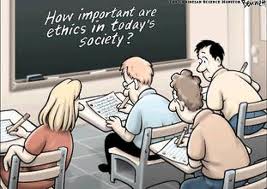
The Ethics Debate

November 22, 2010

For the past few years there has been much debate about the place Ethics classes have in Primary school education.  There has been resistance from religious groups on the basis that it is competing with formal RE (Religious Education lessons) for numbers and government funding.  Proponents of having ethics instruction in our government schools claim that people have a right to choose what is the best for their children, and that non-religious students are better off having an alternative program rather than just sitting out of RE and taking part in an unstructured lesson (basically consisting of free time or watching a movie) instead.

In a new law about to be passed in NSW, parents will have the right to ethics classes as an alternative to scripture in their child’s school even if the principal and the majority of the school community opposes them.

A Baulkham Hills parent, whose child participated in the trial, said: ”The majority of parents, ethics teachers and children at our school found the ethics classes an enriching complement to the many good SRE [Special Religious Education] classes on offer”.

However, many of those opposed were concerned about ethics competing with scripture classes.

”Ethics is already taught in other forums in state primary education and should not be allowed to attract students away from meaningful faith-based studies,” wrote one.

Whilst I am not opposed to have Ethics lessons taught at our schools, I would like to make the following points:

1.  I would like to see RE and Ethics material being submitted to a curriculum board for approval.  Everything taught at school must be rich, stimulating, engaging and subject to curriculum style scrutiny.

2.  Every teacher should, and most do, invest time in their day-to-day teaching, imparting ethics by teaching their students right from wrong, helping them to make healthy choices and showing them how to maximise their potential.  The idea that students without an Ethics program at their school are is some ways missing out on ethics instruction is just wrong and disrespectful to hardworking, caring teachers.

Is the RE vs Ethics debate prevalent in countries other than Australia?  What is your opinion regarding the validity of ethics instruction?
What is the Perfect Class Size?

November 15, 2010

A report came out recently by the Grattan Institute which claims that reducing class sizes does not necessarily improve schooling.

The study’s author, Dr Ben Jensen, says that while the drive to reduce class sizes is well intentioned, his research suggests that it has little impact on the quality of education for children. He says that more effective teachers would produce a better result.

But the Teachers Federation disagrees with his report, which is based on research carried out in the US state of Florida.

“Any parent given a choice between a large class or a smaller class will choose the smaller class because they know their child will get more teacher time and support,” federation vice president Joan Lemaire said in a statement.

Just because good teachers are a better indicator of success, doesn’t mean that our classrooms aren’t too crowded.  Whilst I appreciate that there is a big cost in cutting class sizes, you can not tell me for a second that a teacher is just as capable of teaching 27 as she/he is of teaching 17.  A good teacher will flourish in most environments and will rise to most pressures, but imagine how much more influential they would be in a smaller class.

I have 17 in class which would probably be the envy of many teachers.  I feel that 17 is a good number, and I wouldn’t ideally want to teach a class of 25 or more.

How many students do you have in your class and what do you think is the ideal (being realistic of course) amount?

Lessons to be Learnt from the Sticky Tape Incident

November 14, 2010

I was disturbed to read of the alleged incident involving a teacher accused of sticky taping students’ mouths shut in dealing with unruly students.  Whilst I am horrified at the alleged incident, and the teacher involved, if found guilty, will get a justifiably serious penalty for her actions, I think there are other issues worth considering in relation to the case:

The report says that, “the school has been aware of previous occasions where the teacher has struggled to manage her students.” If that is the case, what was done to support this teacher?  If a teacher is struggling to deal with the management of their class, it is up to the school community to support the teacher.  When a teacher struggles to manage their class, it can have a very negative effect on their self-esteem and can make them impatient and irrational.  Whilst that in no way excuses unprofessional behaviour, it is a sign that the teacher requires some assistance and support.

Teachers, more often than not, join the profession to make a difference to the lives of their students.  They often have the best of intentions and a selfless approach to their job.  However, they soon realise that it can be a very difficult and under-valued profession.

Studies often show that teaching is among the most stressful of occupations, with difficult parents, students, school boards and staff members all factors in pushing teachers to the limit.  While I again stipulate that there is no excuse for acts of aggression against students, it is important to have structures in place that help teachers that are suffering from some of the difficulties that come with the job.


Single Sex vs Co-Ed

November 6, 2010

According to a Courier Mail report, there is an increasing preference towards single sex classrooms. Education experts say the trend of single-sex classrooms for young students is gaining momentum and works, but the State Government has left the matter up to principals as the debate heats up in primary schools. Personally, whilst I realise that the data shows that single sex classrooms are more inclined to deliver favourable academic outcomes, I think that the classroom is supposed to be a microcosm for the outside world. A co-ed class gives students much-needed experience in  repect and appreciation for different cultures, genders and nationalities. Besides, I prefer teaching co-ed classes because I like a diverse and multi-faceted classroom.

The Inconvenient Truth About the National Curriculum

October 27, 2010

So the Australian Curriculum Assessment and Reporting Authority reportedly has said An Inconvenient Truth has a place in modern history studies and English.

In my opinion the new Australian Curriculum is a very flawed document and needs to be fixed from its current draft state.  My biggest problem with it is that it doesn’t just tell us what topics to cover, but also what angle to use.

An example of this is climate change.  The word ‘consensus’ which has been bandied around lately does not belong in the classroom.  The classroom is best served by looking at all sides of an issue and letting the students come to their own conclusions.  Instead, the National Curriculum wants teachers to teach climate science with a clear and unambiguous position.

In a recent unit on Weather, I played an excerpt of ‘An Inconvenient Truth’.  I think it’s an interesting movie and has a place in the classroom. However, the curriculum should encourage teachers to present opposing views.

Perhaps the film could be shown together with the recent documentary Cool It to present both sides of the argument.

Provide the tools, and let the kids decide.