Posts Tagged ‘Mobile Phones’

Kids Need Meaningful Relationships More than Mobile Phones

March 12, 2012

No matter how advanced technology becomes, nothing will stop us from needing human contact and real interaction. You might be able to stockpile Facebook friends, but nothing can replace the loyalty and support offered by a real friend.

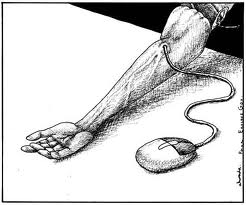
Sometimes I feel that we have allowed ourselves to live in glass cubicles, shielded from real people, real conversations and real experiences. The same technology which was devised to bring us closer together has been misused and ultimately, has kept people out.

Teachers have been instructed to keep emotional distance from their students, the local small business operator who cared about his/her community as much as their bank balance, has been replaced by people not interested in the place where they work or the people who frequent their establishment. People are much less likely to say things like, “I just met someone on the train. We got talking and she told me all about her interesting life.” The only talking on trains is via mobile phone.

Is this really a natural way to live? Is this how we want our children to grow up? Are we really surprised to read that children don’t play with other children like they used to?

A new study that found almost 50 per cent of kids don’t play every day has prompted an expert’s warning about a generation of depressed and anxious youngsters.

The study, hailed as the first of its kind in Australia, carried out a total of 1397 interviews, including 344 with children aged between eight to 12.

About 40 per cent of them said they don’t have anyone to play with while 55 per cent say they’d like to spend more time playing with their parents.

Forty-five per cent said they were not playing every day.

The MILO State of Play study, which also interviewed 733 parents and 330 grandparents, found that more than 94 per cent of them believed play was essential for child development.

But it is still rapidly falling off the list of priorities, said child psychologist Paula Barrett.

“The longer we de-prioritise it, the more likely we are to have unhappy and inactive Australian kids which are more likely to be anxious and depressed, resulting in a raft of social problems in adulthood,” she said.

Dr Barrett said unstructured, active play was essential to help children learn important life skills, develop imagination and creativity.

“This finding highlights a concerning yet common misperception that many parents share – they dont think that kids need to play regularly after the age of eight,” she said.

Many will criticise me for drawing a parallel with the state of society and the development of new technologies. Of course technology isn’t solely to blame for a lack of real and personal interactions. But let’s face it, they have made the issue more serious. Just look at the advertisement above. Do we really want life’s pleasures to be about how nifty our touch screens can become?

In 2005 a landmark movie was released entitled, Crash. It depicted New York as a place where people are too insecure and selfish to interact with others. The only way a person can have any dialogue with a stranger is if they, quite literally, crash into each other.

Our children need real friends, not Facebook friends, they need play dates not peer-to-peer gaming sessions and they need the adults in their lives (including teachers) to scrap any notions of emotional distance and become engaged.

Let’s tear down the barriers and bypass the touch screens and actually … talk with each another!

Keeping Kids Safe Online

February 5, 2012

I agree with Adam Turner. Cybersafety is something parents need to address. They have the primary duty to ensure that their children are following safe online practices.

As far as I’m concerned cybersafety is primarily a parent’s responsibility, just like teaching about stranger danger or how to cross the road safely. The fundamentals of cybersafety are no different to the real world; don’t wander off, don’t talk to strangers, don’t reveal too much about yourself and call a parent if you’re unsure of something.

Some parents might complain that it’s all too complicated, but it’s not if you take an interest in your children’s activities and take the time to learn the basics. Talk to them about computers and the internet. Ask them what they’re learning at school and what they’re doing at home. Take an interest, just as you should in their other activities. 

Turner suggests ways in which parents can better supervise their children:

A common cybersafety rule is that the computer stays in the living area, positioned in such a way that anyone who walks into the room can see what’s on the screen. If notebooks are permitted in the bedrooms for studying, perhaps it’s on the condition that they recharge on the kitchen bench at night. The same rule can apply for mobile phones, which can also help combat cyberbullying.

You can split cybersafety into two key areas. The first is protecting young children from accidentally stumbling across inappropriate content. This isn’t hard if you can set up a list of appropriate bookmarks and trust your kids not to wander. Installing an ad and pop-up blocker offers an extra layer of protection. If children can’t be trusted not to wander, even by accident, you might consider a whitelist plug-in for your browser, which lets you limit access to a specific list of sites.

The second area of cybersafety is hindering older children who are deliberately seeking inappropriate content. This area is much harder to deal with, as smart and determined kids will find a workaround to just about any security measure (remember, help is only a Google search away).

There’s a big market for desktop filtering software, but don’t walk away and trust it to do a parent’s job. In my experience it tends to cripple your computer, but your mileage may vary. If you do want to restrict internet access, look at services that are independent of your end device – particularly useful if your house contains a variety of internet-enabled gadgets.

It’s worth investigating the filtering options built into wireless routers. Some let you create blacklist and whitelists, or switch off the internet at specific times. You could even run a separate wireless network for the children, making it easier to control their access without affecting your own. Another filtering option is DNS-level services such as OpenDNS. 

Whilst teachers should also take an interest in cybersafety issues, it’s up to the parents to take the lead.

Internet Addiction and our Children

October 26, 2011

We all love our internet connections and mobile phones and would find it extremely difficult to live without them.  However, addictions are still addictions, and there is no doubt that our children have grown a deep addiction to the internet.  So bad is the problem, that children have become more addicted to the internet than to TV:

Just 18% of children would miss TV most, compared to mobile (28%) and Internet (25%), finds Ofcom research

A new research by communications watchdog Ofcom has revealed that more young British teenagers can do without TV but not without mobile and the Internet.

Ofcom research found that just 18% of children aged 12 to 15 would miss TV most, compared to mobile (28%) and the Internet (25%). However, the research suggests that the teenagers are also watching more TV than ever before, with viewing figures increasing by 2 hours since 2007.

In 2010, children aged 4-15 watched an average of 17 hours and 34 minutes of TV per week, compared with 15 hours and 37 minutes in 2007. Nearly one third (31%) of children aged 5-15 who use the Internet are watching TV via an online catch-up service such as the BBC iPlayer or ITV Player, said Ofcom.

Ofcom’s research said that 95% of 12-15 year olds now have Internet access at home through a PC or laptop, up from 89% in 2010 and 77% in 2007.

Social networking is still one of the most popular uses of the Internet amongst 12-15s. Ofcom said that children are visiting social network sites more often on their mobiles. Half (50%) of 12-15s with a smartphone visit them weekly compared with 33% in 2010.

Children aged between 8-11 are more likely to use Internet for gaming, with 51% saying they play games online on a weekly basis, up from 44% in 2010. 8-11s are also spending more time playing on games players/ consoles compared with 2010 (9 hours 48 minutes – an increase of nearly 2 hours), said Ofcom.

In my school days television addiction was a problem.  Now we have another addiction which comes with the same side-effects.  It creates tired students who have been up so late they can’t concentrate.  It has compromised our children’s capacity to have healthy social interaction.  Playing with a friend has now become messaging a friend.  It’s just not the same.

As soon as people go from the moderate to the obsessive, they lose control of themselves.  Children today are certainly showing the signs of a lack of control, to the point where they are smuggling mobiles in their bags so they can reply to Facebook messages as soon as they receive them.

Kids require rules for their internet usage.  Rules that outline when, how and where they can use it.


The Benefits of Educational Apps

April 22, 2011

Last week I discussed how technology can be a good thing when the balance is right.  Unfortunately, technology addiction is very common among young children.  The trick is to have firm guidelines for how much time can be dedicated to technology use.  I certainly wouldn’t ban it altogether.

Technology has such a legitimate upside which cannot be dismissed:

Pupils at primary schools who use educational apps on smart-phones and tablets are performing better in their lessons, a new report showed has revealed.

The study reveals that forty per cent of parents who download educational apps say their child’s academic performance has improved as a result.

But the research shows that not only are they helping to raise academic attainment, educational apps are also helping children aged between 5 and 11 every day, inside the classroom. 

The study, commissioned by Encyclopaedia Britannica, shows the vast majority of parents who have downloaded an app claim they have helped their child with school work and projects, while more than half of parents with smart devices actively encourage their child to download apps for exam revision, homework and learning about new topics.

The report also reveals that families with access to mobile devices are fully engaged with educational apps as learning aids, with the average smartphone-owning family downloading more than four since purchasing their device.

The findings comes as two thirds of parents with smart devices are calling for more educational apps to be developed, saying they encourage independent learning and that children prefer to use them compared to other learning aids.

Ian Grant, Managing Director of Encyclopaedia Britannica UK, said: ‘It’s great that families are fully embracing new technologies when it comes to their childrens education and that they’re starting to see tangible benefits to academic attainment, both in and out of the classroom.’

Sue Atkins, Author of Raising Happy Children for Dummies and parenting blogger, said: ‘In a busy, hectic, stress-filled world of trying to get children interested in learning and being curious about the world, we need to engage them in new ways, and what better way than to download smartphone apps.

‘As a parent myself, I welcome this brilliant new way to help my daughter with her revision.’

Research was carried out online by PCP among 510 UK parents of children aged 5 – 11 with access to at least one smart device, in March 2011.

Exposing children to technology is good when properly supervised. Like with everything in Education, and therefore in life – balance is integral.

Schools Must Share the Blame With Parents

April 18, 2011

Teachers are great at blaming poor parenting for the bad habits of their students. Often it is completely justified. However, sometimes parents are not the only one that deserves the criticism. Sometimes when students present poorly at school, it is just as much the failure of the school to engage and enforce standards as it is the parents.

Take this case for example:

Teachers are warning that pupils are failing to pack their schoolbags with basic classroom equipment and instead are bringing mobile phones, iPods, hand-held computer game devices and even the latest iPads to school.

Some schools have even begun to introduce new agreements which require parents to ensure their children are equipped with textbooks and pens at the beginning of each day.

“They often don’t come to school with their books, or without their homework and sometimes they are lacking something so basic as a pencil to write with,” said Chris Keates, the general secretary of the NASUWT union.

“They come with all this electronic equipment, it would be nice if they just brought a pen.

“My message to parents is that you can send a very powerful message to your child about the importance of their schooling by making sure that they are ready to work when they get to class each morning.”

The problem will be discussed at the union’s annual conference later this week, which will also hear from schools which have drawn up “learning contracts” with parents to encourage them to take a keener interest in their child’s day-to-day progress.

Frustrated by pupils forgetting the basics but arriving with hundreds of pounds worth of electronics in their blazer pocket or schoolbag, one Sheffield teacher was instrumental in introducing a learning contract at his school.

The English and drama teacher, who declined to be named, said: “I teach children from some of the wealthiest backgrounds in the city but it was getting to be an absolute pain in terms of the day-to-day basics.

“It’s amazing how many devices kids carry around with them these days. Young people aspire to have these Macbooks and other expensive equipment but it seems to me that the priorities are skewed.

“They automatically reach for their MP3 players and so on, but not for the writing equipment.

“I believe they should be able to pick up a pen and construct a sentence, which is correct in terms of grammar and spelling, without resorting to an electronic spellchecking device which will probably give them an incorrect, American version.”

He added: “Our policy sees any forgotten equipment being marked in children’s daily log books for parents to see and I urge all parents in the country to check their child has the basic equipment for the school day.”

The Education Bill published in January proposed new powers for teachers to confiscate prohibited items, including electronic gadgets, and to also enable staff to examine data such as video clips for evidence of bullying or other bad behaviour.

A survey in 2006 found that 91 per cent of children owned a mobile telephone by the age of 12.

This article is a great example of teachers blaming parents for a problem they have a share in. The following points need to be made:

  1. If you have a child at your school for 5-15 years and they still haven’t grasped the concept of bringing pens and text books to class, you are not running a very good school. Where are your rules? Where are your expectations? Don’t blame parents for not overseeing their kids’ schoolbag – surely you can do more to enforce standards of organisation.
  2. What has mobile phones and i-Pods got to do with not bringing books and pens to school? If you have a problem with electronic gadgets, ban them or at least set some guidelines. Kids will always be drawn to modern gadgets. Don’t blame mobile phones for the lack of student organisation. There is no reason why kids can’t be taught the importance of balancing educational and extra-curricular activities.
  3. If you’ve got something to say to parents don’t do it through the media. Teachers and parents must work together. Articles that have teachers preaching to parents often create a divide which helps no one.
  4. Finally, and perhaps most importantly, a likely reason for our students being so disinterested in their studies as to come to class unprepared, is due to the lack of engagement on the part of teacher. One of the most important skills a teacher must have is the ability to stimulate and interest their class. If their class seems bored, it is probably because they have a boring teacher. It’s so easy to blame parents and i-Pods, when the real issue is there are too many teachers who offer little and expect a lot in return.

You might accuse me of being disloyal to my profession. The truth is, I am a parent as well as a teacher, and I empathise and relate to both sides of this debate. Sure there is far too many parents out there that don’t get involved with their child’s educational needs. I hear horror stories all the time. But let’s not forget that teachers choose to enter this profession because they want to make a difference to their students. To do this, they must be prepared to work through all obstacles and challenges.

Apportioning blame is fine – just as long as all parties accept some responsibility.

Are Kids Addicted to Technology?

April 11, 2011

Technology is a wonderful thing when it doesn’t take over your life.  In context, technological innovations such as mobile phones and the internet connect you to others and make day-to-day operations easier to carry out and more time effective.  But technology addiction, like all other addictions, is something to be concerned about.

Children need a range of different experiences and stimuli.  They need exercise, real human interaction and routine.  When an addiction, such as internet addiction occurs, it tends to become quite a negative and destructive situation.

But are kids really addicted to technology?

Researchers found nearly four in five students had significant mental and physical distress, panic, confusion and extreme isolation when forced to unplug from technology for an entire day.

They found college students at campuses across the globe admitted being “addicted” to modern technology such as mobile phones, laptops and television as well as social networking such as Facebook and Twitter.

A “clear majority” of almost 1,000 university students, interviewed at 12 campuses in 10 countries, including Britain, America and China, were unable to voluntarily avoid their gadgets for one full day, they concluded.

The University of Maryland research described students’ thoughts in vivid detail, in which they admit to cravings, anxiety attacks and depression when forced to abstain from using media.

One unnamed American college student told of their overwhelming cravings, which they confessed was similar to “itching like a crackhead (crack cocaine addict)”.

The study, published by the university’s International Centre for Media & the Public Agenda (ICMPA) and the Salzburg Academy on Media & Global Change, concluded that “most students… failed to go the full 24 hours without media”.

The research, titled The world Unplugged, also found students’ used “virtually the same words to describe their reactions”.

These included emotions such as fretful, confused, anxious, irritable, insecure, nervous, restless, crazy, addicted, panicked, jealous, angry, lonely, dependent, depressed, jittery and paranoid.

Prof Susan Moeller, who led the research, said technology had changed the students’ relationships.

“Students talked about how scary it was, how addicted they were,” she said.

“They expected the frustration. But they didn’t expect to have the psychological effects, to be lonely, to be panicked, the anxiety, literally heart palpitations.

“Technology provides the social network for young people today and they have spent their entire lives being ‘plugged in’.”

The study interviewed young people, aged between 17 and 23, including about 150 students from Bournemouth University, who were asked to keep a diary of their thoughts.

They were told to give up their mobile phones, the internet, social networking sites such as Facebook and Twitter, and they were not allowed to watch television.

They were, however, permitted to use landline telephones and read books.

The study found that one in five reported feelings of withdrawal akin to addiction while more than one in 10 admitted being left confused and feeling like a failure.

Just 21 per cent said they could feel the benefits of being unplugged.

One British participant reported: “I am an addict. I don’t need alcohol, cocaine or any other derailing form of social depravity… Media is my drug; without it I was lost.2

Another wrote: ‘I literally didn’t know what to do with myself. Going down to the kitchen to pointlessly look in the cupboards became regular routine, as did getting a drink.’

A third said: ‘I became bulimic with my media; I starved myself for a full 15 hours and then had a full-on binge.’

While a fourth student added: “I felt like a helpless man on a lonely deserted island in the big ocean”.

Prof Moeller added: “Some said they wanted to go without technology for a while but they could not as they could be ostracised by their friends.’

“When the students did not have their mobile phones and other gadgets, they did report that they did get into more in-depth conversations.

“Quite a number reported quite a difference in conversation in terms of quality and depth as a result.”

I realise that it is absolutely vital for teachers to embrace technology and ensure that they are well-trained and up to date with the latest in technological advances.  There is no doubt that introducing technology in the classroom has real benefits.  But in the primary level, I am careful to encourage a balanced approach where my students get a broad range of experiences and use different mediums.
As great as technology is, you can have too much of a good thing.