Posts Tagged ‘kids’

Parents Overdosing Their Kids on Paracetamol

June 7, 2011

It’s crucial for preserving the health of your child’s liver that you take care when administering painkillers with paracetamol:

Regulators are updating the information displayed on the labels of the medicines in order to make them clearer and better tailored to babies and young children.

The new guidance follows research published last month that showed one in four young patients is given too much of the pain reliever, putting them at risk of liver damage.

The study also found that parents often give their children Calpol or similar medicines containing paracetamol at home before going to the GP who then prescribes yet another painkiller.

At the moment, there is one age band for those aged six to 12 years-old, but this will now be split into three bands.

The guidance currently says children aged six to 12 should have 5ml to 10ml of medicine, up to four times in 24 hours.

The Role of Teacher in Helping Students Deal With Divorce

June 5, 2011


In a previous post I observed that:

It is my opinion that while divorce is a fact of life and that in most cases there is nobody to blame, it is quite distressful for the child.  The fact that it is common and has also effected other classmates provides next to no comfort for the child.  I believe that when a child’s parents separate the teacher must refer the matter to the school councillor (if the school has one), and spend more time with child building their confidence and displaying patience when the child plays up or has difficulty completing a task.  It is not sufficient to wait until the child shows signs of anxiety or rebellion.  The time to initiate support is straight away.

Now we find just how difficult it is for kids academically:

Young children of divorce are not only more likely to suffer from anxiety, loneliness, low self-esteem and sadness, they experience long-lasting setbacks in interpersonal skills and math test scores, new research suggests.

Children do not fall behind their peers in these areas during the potentially disruptive period before their parents divorce, the study revealed. Instead, it’s after the split that kids seem to have the most trouble coping.

“Somewhat surprisingly, children of divorce do not experience detrimental setbacks in the pre-divorce period,” noted study author Hyun Sik Kim, a doctoral candidate in the department of sociology at the University of Wisconsin-Madison. “From the divorce stage onward, however, children of divorce lag behind in math test scores and interpersonal social skills.”

“Children of divorce also show enhanced risk of internalizing problem behaviors characterized by anxiety, loneliness, low self-esteem and sadness,” Kim said.

While the negative impacts do not continue to worsen several years after the divorce, “there is no sign that children of divorce catch up with their counterparts, either,” he added.

The study is published in the June issue of the American Sociological Review.

In the study, Kim discussed how the fallout from divorce might harm childhood development.

Children may be stressed by an ongoing parental blame game or child custody conflicts. This stress could be compounded by the loss of stability when a child is shuttled between separate households or has to move to another region altogether, thus losing contact with his or her original network of friends.

In fact, Kim observed a dramatic change in family locations, suggesting that children of divorce were more likely to change schools.

Parents’ divorce-related depression might also play a role, as could economic strains when family income suddenly drops, he said.

In his research, Kim analyzed data from the Early Childhood Longitudinal Study on 3,600 children who entered kindergarten in 2008.

The children were tracked through fifth grade. Over that time, Kim compared children whose parents had gotten divorced while the child was in the first, second or third grade with the children of intact marriages.

While divorce is an unfortunate fact of life for many adults and their kids, it is crucial that teachers play a supportive role, offering appropriate care and displaying patience and sensitivity at all times.  Just because it happens frequently, doesn’t make it any easier for those involved to adjust to and overcome.


The Result of Sleep Deprivation for Kids

May 29, 2011

A new study suggests that there is a clear correlation between kids with limited sleep time and weight gain:

Preschoolers who do not get enough sleep are at higher risk of becoming overweight, researchers in New Zealand have concluded.

Getting less sleep seems to be related to increased body weight in children but doctors aren’t sure how.

Prof. Rachael Taylor of the human nutrition department at the University of Otago in Dunedin and her colleagues followed 244 children between the ages of three and seven. Young children who don’t get enough sleep risk becoming overweight. 

The children had their weight, height, body mass index and body composition measured every six months. Parents filled in questionnaires about the sleep and diet habits of their sons and daughters at three, four and five years of age. At those ages, the children also wore accelerometers to monitor their movements.

The boys and girls averaged 11 hours of sleep per day at all three ages.


Each extra hour of sleep per night at age three to five was associated with a reduction in BMI of 0.49 times and a 0.61 times reduction in the risk of being overweight or obese at age seven, the team found.

The researchers said the differences in BMI were from fat mass, which points to how poor sleep harms body composition in children.

The link remained after taking factors such as gender and physical activity into account.

As for why, the researchers proposed that having more time to eat and changes in hormones in the brain could affect appetite.

“The study is a valuable contribution to the understanding of the causal pathway whereby reduced sleep duration may directly contribute to overweight and obesity in children,” Professor Francesco Cappuccio and Associate Professor Michelle Miller from the University of Warwick said in a journal editorial accompanying the study.

Strengths of the study included use of accelerometers and sleep diaries, which offered reliable, direct and repeated measurements of time in bed and time asleep, the editorial said.

“It would do no harm to advise people that a sustained curtailment of sleeping time might contribute to long-term ill-health in adults and children,” the pair concluded.

What the article didn’t say is how many hours of sleep is ideal for a child?  Does it depend on the child? Surely, some children can make do with fewer hours than others?

Injecting Botox into Children Should Be a Crminal Offence

May 15, 2011

This is no joke.  This should not be treated like a one-off case by an unstable parent.  These awful child beauty pageants, which contribute not even an ounce of worth or purpose to this world, are responsible for the flagrant abuse of children.  They must be shut down!  They are horrendous excuses for entertainment and the practices they espouse from parents borders on the criminal.

Take the case of the mother that readily admits to injecting her poor child with  Botox to eliminate any possibility of a wrinkle:

How sick is that?  How do we allow these pageants to continue when they provide us with nothing and instead encourage parents to treat their kids like circus animals!  I totally agree with John Kass:

… when I think of little-girl beauty pageants — after the story last week about Kerry Campbell, the idiotic mom injecting Botox into the face of her 8-year-old daughter Britney — all I can think of are three little words:

Shut them down.

Shut all those kiddie pageants down.

It’s easy for us to slam one ignorant parent who lives vicariously through her daughter, or slam a few parents who treat their children as if they’re painted dolls. We pronounce such parents fools and think we’ve won a great victory.

But this really isn’t about isolated cases, or even the entire, weird little-girl pageant scene. The larger story is how we Americans feel about ourselves, how we define beauty in the age of facial injections and lip shots and tummy tucks and liposuction and breast implants and hair transplants.

And as millions endure all that poking and prodding and tying and cutting, can’t you hear America groaning, begging: Desire Me, Want Me, Please Want Me Forever.

We put all that pressure on women to be young and cute into their old age, until even an 8-year-old isn’t young enough or cute enough, if her name is Britney, getting Botoxed.

It all starts with those little girls painted with lipstick, sprayed with tanning powder, with big hair and heels. They strut down those runways with that JonBenet Ramsey pout, training to become princess victims.

And the parents cheer as their young are sexualized.

In today’s age. how do we let these blasted things continue?

When Do Kids Begin Forming Memories?

May 13, 2011

I stumbled across a fascinating article about when children begin forming memories:

New research challenges the notion that very young children do not form memories, finding that they do but that the memories often fade over time.

Most adults remember little before their third or fourth birthdays, and the thinking has been that prior to this age children do not have the cognitive or language skills to process and store events as memories.

But psychology professor Carole Peterson, PhD, and colleagues from Canada’s Memorial University of Newfoundland confirmed in earlier research that this is not the case and that even very young children can recall past events.

Now they report that young children’s earliest memories tend to change over time, being replaced with “newer” earliest memories until around age 10. As this happens, memories occurring in the preschool years tend to be lost.

“As young children get older their first memories tend to get later and later, but around age 10 their memories crystallize,” Peterson tells WebMD.

Checking Children’s Memories

In an effort to better understand how children form memories, the researchers asked 140 kids between the ages of 4 and 13 to describe their earliest memories and then asked them to do the same thing two years later.

On both occasions, the children were also asked to estimate their age at the time of each memory, and parents were questioned to confirm that the events happened.

The researchers found that children between the ages of 4 and 7 during the first interview showed very little overlap between the memories they recalled as “first memories” during the first question session and those they remembered two years later.

“Even when we repeated what they had told us two years before, many of the younger children would tell us that it didn’t happen to them,” Peterson says.

Conversely, a third of the children who were age 10 to 13 during the first interview described the same earliest memory during the second interview. More than half of the memories they recalled were the same at both interviews.

The researchers are now studying why children remember certain events and not others.

Peterson says traumatic or highly stressful events made up only a small percentage of the earliest memories reported by children in the study.

Cultural Differences Influence Early Memory

Earlier research suggests that culture plays a big part in early memory.

When Peterson and colleagues compared early memories in groups of Canadian and Chinese children, they found that the Chinese children’s earliest memories tended to be a year or more later than the earliest memories of Canadian children.

Emory University child memory researcher Robyn Fivush, PhD, found the same thing in a study comparing Chinese and American children.

Fivush tells WebMD that Western children tend to have stronger early memories because their dialog with parents and other adults tends to be more autobiographical.

The first lasting memory I have is from when I was 4 years-old, which seems to be consistent with these findings. When was your first lasting memory?

Click on the link to read Experts Push for Kids to Start Driving at 12

Click on the link to read Study Reveals Children Aren’t Selfish After All

Click on the link to read Catering for Four-Year Old Transgendered Children

Click on the link to read What Happened to Honesty and Integrity?

Click on the link to read Kids Need Meaningful Relationships More than Mobile Phones


How Do Teachers Answer Questions About Osama?

May 3, 2011

There is no easy way to respond to questions about the death of Osama Bin Laden.  Young kids are clearly confused as to why people are gaining satisfaction from a person’s death.  It is not for a teacher of young children to go in to great detail about Bin Laden and his evil monstrous ways.

The problem then becomes – what do we say?

While many of us are still processing last night’s late-breaking news that Osama bin Laden was killed by a team of Navy SEALs, many teachers had to stand up bright and early this morning in front of a classroom of curious youngsters to field their questions on everything from assassination to terrorism, with little preparation.

“One of my students walked in this morning and said: ‘Osama Bin Laden is dead … is that a good thing?’ Leave it to a six year old to put things in perspective,” a California teacher wrote on Facebook today.

BeAtrice Mazyck, who teaches 11th-grade U.S. history at Lee Central High School in Bishopville, South Carolina, tells The Lookout she had already finished her curriculum for the semester, so she was glad to have a big current event to talk about. Her students had studied the 9/11 attacks earlier in the year, and today were debating the effect bin Laden’s death would have on the U.S. war efforts.

“Some of them were wondering, ‘Is the war over? Can the soldiers come home now?’ Because we live like 20 minutes from the Shaw Air Force Base,” Mazyck said, adding that some of her students have parents who are in the military.

 In Cincinnati, one 9th grade teacher found she had to rehash for her students the events of September 11, 2001–when they were very young–for them to understand the context and significance of bin Laden’s killing.

“Most of these students were in kindergarten or first grade and have very little memory of September 11th,” Oak Hills High teacher Amanda Ruehlmann told the Cincinnati Enquirer. “Many have even less of an idea of how much their lives have been impacted by the results and effects of 9/11. So I’ve shown students information on how bin Laden came to be Public Enemy No. 1.”

Some older students wrote they were glad for a distraction from regular coursework. A senior at Glades Central High School in Florida joked on Facebook that Monday should be a school holiday, and that he planned to “bring up the Osama killing to distract all of my teachers from teaching today.”

Teachers aren’t the only ones getting questions. Parents around the country are going online to talk about how difficult it can be to explain to a child why so many people seem happy that a person has been killed.

“I got to explain to my 7 year old son this morning about the news that osama is dead…. he was instantly happy and in his words ….. so the war is over and daddy doesnt have to go away again? really, how do you answer that?” wrote Kate Harbison in Bangor, Maine. “I explained that we all love daddy, and would love for daddy to be home all the time, but considering all that is going on in this world, daddy and all the rest of the armed forces have alot still to do, and probably always will,” Harbison told The Lookout in a note.

“In explaining who Osama is this morning to my 6 year old, my 8 year old said ‘it’s like he is Voldemort.’ I’m so glad it is clear to them now,” a woman from Coppell, Texas wrote.

Have you been asked any questions about Osama by your students?  What did you say?  Do you have any advice for this slightly tongue-tied teacher who is looking for the right words which stubbornly refuse to come out?

Encouraging Kids to Use Social Media is Not the Way to Go

May 2, 2011

My experiences in teaching has taught me that while we try to empower our kids to act responsibly at all times, reality suggests that the message doesn’t always filter through.  Sometimes, as unfair or overbearing as it sounds, it is simply naive to suggest that children can act with the responsibility and maturity required to warrant the rights and privileges of older individuals.

Facebook is a two-edged sword.  It has its benefits.  But even adults can’t ignore that there are risks to privacy involved.  The call to bring down the age restrictions of Facebook users from 13, to accommodate Primary students lacks foresight and ultimately makes little sense.  Sure you can teach them about privacy settings and warn them about cyber-bullying and cyber-safety, but sadly, there will always be frequent cases of misuse and bullying should the current restrictions be softened.

Soraya Darabi, social media correspondent for ABC America, disagrees:

PRIMARY school students should be receiving lessons in how to make the most of social media and how to protect themselves from its dangers and pitfalls, says a US specialist.

Soraya Darabi, social media correspondent for ABC America, says platforms such as Facebook, Twitter and a raft of newer sites have taken social media to a point where kids need to know how to control what they post online.

“We’re reaching the point where schools should be teaching best practice for social media, right from primary school age, and the importance of protecting their images and information online,” says Darabi.

“They need to know, for instance, that if they are using Twitter they should only be conveying information they are happy to have recorded in the Library of Congress for all time, because that is what’s happening.”

Four years ago, at the age of 23, Darabi helped The New York Times move into social media and she has more than 400,000 followers on Twitter. She says she uses a variety of sites to secure online privacy.

“You must have a few networks that are sacred. For me, anyone can follow me on Twitter. I only accept people as friends on Facebook if I have personally met them. And there’s a site called Path that I reserve for my closest 50 friends, and where I feel safer posting more personal stuff.

“My personality has changed so much online. I still post some personal things. I’m still playful on Twitter, but nowhere near as much as I used to be.

“There’s this whole thing with the personal-professional hybrid that social media is that we’re all still getting used to,” she says. Darabi is reticent about the future of social media; a five-year horizon is far too distant, she says.

Do you honestly think ten-year olds would uniformly accept only the friend requests from people they have met?  What is the point of a Primary aged child having a Twitter account anyway?  I have absolutely no issues in teaching the importance of privacy settings and alerting my students to cyber safety practices.  This is something I currently do.   But what is gained from lessons that “make the most of social media?”

Whilst it is essential to enlighten our children of the issues that arise from improper social media use, there is simply no good reason for Primary students having their own Facebook and Twitter accounts.

Schools Must Share the Blame With Parents

April 18, 2011

Teachers are great at blaming poor parenting for the bad habits of their students. Often it is completely justified. However, sometimes parents are not the only one that deserves the criticism. Sometimes when students present poorly at school, it is just as much the failure of the school to engage and enforce standards as it is the parents.

Take this case for example:

Teachers are warning that pupils are failing to pack their schoolbags with basic classroom equipment and instead are bringing mobile phones, iPods, hand-held computer game devices and even the latest iPads to school.

Some schools have even begun to introduce new agreements which require parents to ensure their children are equipped with textbooks and pens at the beginning of each day.

“They often don’t come to school with their books, or without their homework and sometimes they are lacking something so basic as a pencil to write with,” said Chris Keates, the general secretary of the NASUWT union.

“They come with all this electronic equipment, it would be nice if they just brought a pen.

“My message to parents is that you can send a very powerful message to your child about the importance of their schooling by making sure that they are ready to work when they get to class each morning.”

The problem will be discussed at the union’s annual conference later this week, which will also hear from schools which have drawn up “learning contracts” with parents to encourage them to take a keener interest in their child’s day-to-day progress.

Frustrated by pupils forgetting the basics but arriving with hundreds of pounds worth of electronics in their blazer pocket or schoolbag, one Sheffield teacher was instrumental in introducing a learning contract at his school.

The English and drama teacher, who declined to be named, said: “I teach children from some of the wealthiest backgrounds in the city but it was getting to be an absolute pain in terms of the day-to-day basics.

“It’s amazing how many devices kids carry around with them these days. Young people aspire to have these Macbooks and other expensive equipment but it seems to me that the priorities are skewed.

“They automatically reach for their MP3 players and so on, but not for the writing equipment.

“I believe they should be able to pick up a pen and construct a sentence, which is correct in terms of grammar and spelling, without resorting to an electronic spellchecking device which will probably give them an incorrect, American version.”

He added: “Our policy sees any forgotten equipment being marked in children’s daily log books for parents to see and I urge all parents in the country to check their child has the basic equipment for the school day.”

The Education Bill published in January proposed new powers for teachers to confiscate prohibited items, including electronic gadgets, and to also enable staff to examine data such as video clips for evidence of bullying or other bad behaviour.

A survey in 2006 found that 91 per cent of children owned a mobile telephone by the age of 12.

This article is a great example of teachers blaming parents for a problem they have a share in. The following points need to be made:

  1. If you have a child at your school for 5-15 years and they still haven’t grasped the concept of bringing pens and text books to class, you are not running a very good school. Where are your rules? Where are your expectations? Don’t blame parents for not overseeing their kids’ schoolbag – surely you can do more to enforce standards of organisation.
  2. What has mobile phones and i-Pods got to do with not bringing books and pens to school? If you have a problem with electronic gadgets, ban them or at least set some guidelines. Kids will always be drawn to modern gadgets. Don’t blame mobile phones for the lack of student organisation. There is no reason why kids can’t be taught the importance of balancing educational and extra-curricular activities.
  3. If you’ve got something to say to parents don’t do it through the media. Teachers and parents must work together. Articles that have teachers preaching to parents often create a divide which helps no one.
  4. Finally, and perhaps most importantly, a likely reason for our students being so disinterested in their studies as to come to class unprepared, is due to the lack of engagement on the part of teacher. One of the most important skills a teacher must have is the ability to stimulate and interest their class. If their class seems bored, it is probably because they have a boring teacher. It’s so easy to blame parents and i-Pods, when the real issue is there are too many teachers who offer little and expect a lot in return.

You might accuse me of being disloyal to my profession. The truth is, I am a parent as well as a teacher, and I empathise and relate to both sides of this debate. Sure there is far too many parents out there that don’t get involved with their child’s educational needs. I hear horror stories all the time. But let’s not forget that teachers choose to enter this profession because they want to make a difference to their students. To do this, they must be prepared to work through all obstacles and challenges.

Apportioning blame is fine – just as long as all parties accept some responsibility.

Are Kids Addicted to Technology?

April 11, 2011

Technology is a wonderful thing when it doesn’t take over your life.  In context, technological innovations such as mobile phones and the internet connect you to others and make day-to-day operations easier to carry out and more time effective.  But technology addiction, like all other addictions, is something to be concerned about.

Children need a range of different experiences and stimuli.  They need exercise, real human interaction and routine.  When an addiction, such as internet addiction occurs, it tends to become quite a negative and destructive situation.

But are kids really addicted to technology?

Researchers found nearly four in five students had significant mental and physical distress, panic, confusion and extreme isolation when forced to unplug from technology for an entire day.

They found college students at campuses across the globe admitted being “addicted” to modern technology such as mobile phones, laptops and television as well as social networking such as Facebook and Twitter.

A “clear majority” of almost 1,000 university students, interviewed at 12 campuses in 10 countries, including Britain, America and China, were unable to voluntarily avoid their gadgets for one full day, they concluded.

The University of Maryland research described students’ thoughts in vivid detail, in which they admit to cravings, anxiety attacks and depression when forced to abstain from using media.

One unnamed American college student told of their overwhelming cravings, which they confessed was similar to “itching like a crackhead (crack cocaine addict)”.

The study, published by the university’s International Centre for Media & the Public Agenda (ICMPA) and the Salzburg Academy on Media & Global Change, concluded that “most students… failed to go the full 24 hours without media”.

The research, titled The world Unplugged, also found students’ used “virtually the same words to describe their reactions”.

These included emotions such as fretful, confused, anxious, irritable, insecure, nervous, restless, crazy, addicted, panicked, jealous, angry, lonely, dependent, depressed, jittery and paranoid.

Prof Susan Moeller, who led the research, said technology had changed the students’ relationships.

“Students talked about how scary it was, how addicted they were,” she said.

“They expected the frustration. But they didn’t expect to have the psychological effects, to be lonely, to be panicked, the anxiety, literally heart palpitations.

“Technology provides the social network for young people today and they have spent their entire lives being ‘plugged in’.”

The study interviewed young people, aged between 17 and 23, including about 150 students from Bournemouth University, who were asked to keep a diary of their thoughts.

They were told to give up their mobile phones, the internet, social networking sites such as Facebook and Twitter, and they were not allowed to watch television.

They were, however, permitted to use landline telephones and read books.

The study found that one in five reported feelings of withdrawal akin to addiction while more than one in 10 admitted being left confused and feeling like a failure.

Just 21 per cent said they could feel the benefits of being unplugged.

One British participant reported: “I am an addict. I don’t need alcohol, cocaine or any other derailing form of social depravity… Media is my drug; without it I was lost.2

Another wrote: ‘I literally didn’t know what to do with myself. Going down to the kitchen to pointlessly look in the cupboards became regular routine, as did getting a drink.’

A third said: ‘I became bulimic with my media; I starved myself for a full 15 hours and then had a full-on binge.’

While a fourth student added: “I felt like a helpless man on a lonely deserted island in the big ocean”.

Prof Moeller added: “Some said they wanted to go without technology for a while but they could not as they could be ostracised by their friends.’

“When the students did not have their mobile phones and other gadgets, they did report that they did get into more in-depth conversations.

“Quite a number reported quite a difference in conversation in terms of quality and depth as a result.”

I realise that it is absolutely vital for teachers to embrace technology and ensure that they are well-trained and up to date with the latest in technological advances.  There is no doubt that introducing technology in the classroom has real benefits.  But in the primary level, I am careful to encourage a balanced approach where my students get a broad range of experiences and use different mediums.
As great as technology is, you can have too much of a good thing.

Teaching to The Blasted Test!

March 29, 2011


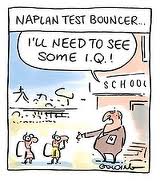
It sickens me to see the Government so smug about the upcoming round of National Testing.  In Australia it’s called the NAPLAN (I refer to it as “NAPALM”), and like other National tests around the world it compares student data against the average.  The Government uses the National tests as an easy way out of doing something constructive about Education.

Before I slam these pathetic tests, in the spirit of goodwill, I will acknowledge some advantages of National Testing:

  • It uses these tests as a vehicle for pressurising schools and teachers to lift their game and secure good results for their students.
  • It forces teachers not strictly following the curriculum to adhere to the syllabus
  • It gives parents some real data to consider, rather than the deliberately vague school reporting, which essentially tells parents nothing.
  • It gives parents an opportunity to become more involved in their child’s education.

Now for the disadvantages:

  • It forces teachers to stop what they are doing, and spend weeks if not months practicing for the test.  Everything gets put on hold while the sample test papers get wheeled out.
  • It fills students as young as 8 years-old with anxiety, pressure and insecurity.
  • It causes schools to “encourage” the parents of special needs students to keep their kids at home during the testing week.  This is to ensure that their child doesn’t affect the school’s results.  It also achieves in further marginalising these children who, in many cases, already feel disconnected from their peers.
  • It puts enormous stress on teachers.  This stress has an effect on their quality of teaching.
  • It turns education into an extreme negative at a time when kids still show an interest in learning.

I am currently teaching Grade 5 for the first time.  I am preparing my students for the rigours of NAPLAN (they sat for them 2 year ago).  It means that my emphasis has had to change.  Instead of teaching in an engaging and creative way, I’ve been forced to teach to the tests.  The result has been a succession of comparatively boring and turgid lessons on strategies for answering multiple choice questions, “debugging” sample tests and revising basic skills.  My students are not enjoying these lessons at all!  I fear that when they sit these tests they will sabotage the process by rushing through it as revenge for what its done to their enjoyment of school.

What makes these tests even worse is that they are testing the children at Grade 5 level even though they have just started Grade 5.  Because of that, my students haven’t covered some of the concepts being tested.  Surely, if they wanted to test a Grade 5 class against the Grade 5 benchmarks they should have done it at the end of the school year, not at the beginning!

When are Governments going to stop being so lazy and start taking on a fresh and innovative approach to learning?  Why must my students be subjected to sample tests and other turgid preparatorylessons, instead of conventional, authentic lessons?

Parents have the right to know how  their child is progressing.  At the same time though, their children deserve the right to have a pressure reduced primary education, where the teachers are able to harness their natural curiosities, instead of burden them with weeks of test prepa
ration!